I wrote a book about how to actually get real value out of AI.
It's for CEOs and solopreneurs and skeptics and enthusiasts alike.
It's the no-nonsense, bullshit-free guide that a lot of people need, but were afraid to ask for.
You can pre-order it now.
I wrote a book about how to actually get real value out of AI.
It's for CEOs and solopreneurs and skeptics and enthusiasts alike.
It's the no-nonsense, bullshit-free guide that a lot of people need, but were afraid to ask for.
You can pre-order it now.
A look at the research into using metal-organic frameworks as photoresists for cutting-edge silicon etching, as ASML aims to move from EUV to X-ray lithography (@mims / Wall Street Journal)
https://t.co/AES1f4mW20
https://t.co/HyTUz7P8kv
📥 Send tips! https://t.co/wlNZvXuhJs
Moore’s Law, the march of microchip progress that took us from mainframes to iPhones, will end in 2040. Here’s the tech that could get us across the finish line, writes Christopher @Mims https://t.co/NmzKgpkMJ3
Everyone told Corning to sell its unprofitable fiber-optic business. Now, because of the AI boom, that division is powering the company’s stock to all-time highs, writes Christopher @Mims. https://t.co/1plPjD4tuE
How do you Ai? I asked @mims about his new book, if his job is at risk, and how Ai removes what he calls "toil," which very well could make our work more human.
As the host of #BoldNames and columnist of @WSJ's "Keywords" column, practical Ai use cases are Christopher's bread and butter. For tech folks, you'll learn practical stories, for the uninitiated, you'll get caught up.
01:06 - Ai removes toil, not jobs
07:00 - Job disruption or new opportunities
09:23 - @Clorox uses Ai for previously impossible tasks
10:56 - Generative vs non-generative AI
12:49 - Is the construction industry at Ai risk?
14:57 - The urgency of adopting Ai
17:17 - Ai and law. A win for lawyers and consumers.
24:40 - Ai in Hollywood. Will it kill creativity?
28:40 - Tension of job loss and productivity gains
30:40 - Ai makes us more human
31:22 - Journalism in an AI World
@Propllrhead Not yet. But if you or your team wants me to show up and do one online or in person, they're free -- sign up by emailing me at the link near the top, here: https://t.co/bBS9jsDFvN
When I give talks for my forthcoming book I always say "these are the industries that will be disrupted by AI, and in this order: 1. coding 2. law ..."
90% of lawyering is:
(a) pattern recognition (calling it experience or intuition is cope)
(b) choosing the right template & filling it out
(c) reading & translating jargon
(d) writing
Guys - we are first up, and unlike the devs, most have no idea what's coming.
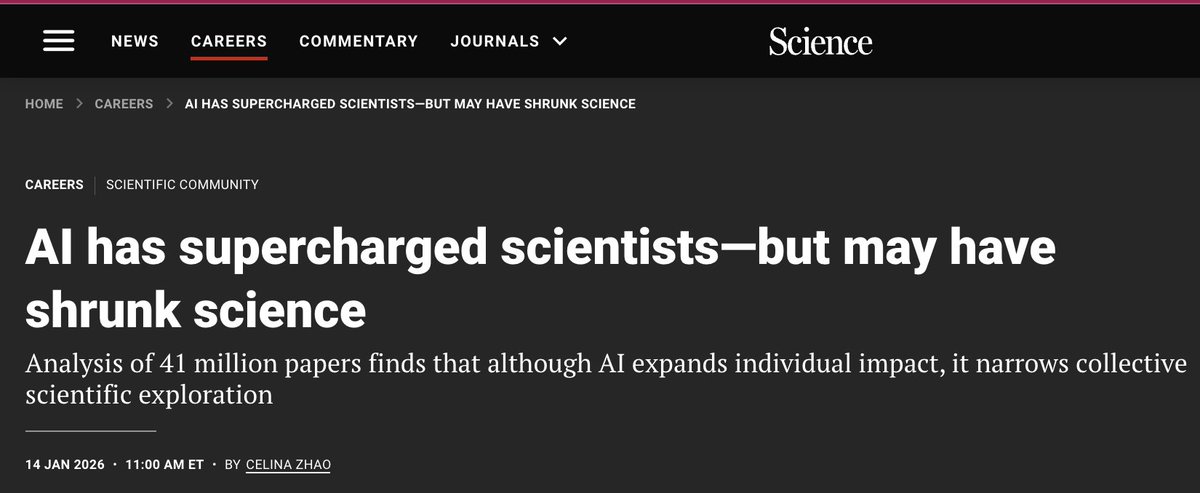
Scientists who use AI have published three times more papers, received five times more citations, and reach leadership roles faster than their AI-free peers.
But science as a whole is paying the price, the study suggests. Not only is AI-driven work prone to circling the same crowded problems, but it also leads to a less interconnected scientific literature, with fewer studies engaging with and building on one another.
It's a classic social dilemma: what's good for individuals is bad for the collective.
https://t.co/MUPrSIZypz
1000% this
It's the primary reason I wrote How to AI, the slim, accessible volume that has the potential to onboard the next million (ten million?) people who could meaningfully change their lives with just a little bit of AI.
Comes out TOMORROW
https://t.co/5AUKS1UZ3m
i follow AI adoption pretty closely, and i have never seen such a yawning inside/outside gap.
people in SF are putting multi-agent claudeswarms in charge of their lives, consulting chatbots before every decision, wireheading to a degree only sci-fi writers dared to imagine.
people elsewhere are still trying to get approval to use Copilot in Teams, if they're using AI at all.
it's possible the early adopter bubble i'm in has always been this intense, but there seems to be a cultural takeoff happening in addition to the technical one. not ideal!
Generative AI is making our gadgets radically better at both hearing and understanding us, writes Christopher @Mims. Here’s why people are getting “voice-pilled.” https://t.co/CFKo4mTXv4