I wrote a book about how to actually get real value out of AI.
It's for CEOs and solopreneurs and skeptics and enthusiasts alike.
It's the no-nonsense, bullshit-free guide that a lot of people need, but were afraid to ask for.
You can pre-order it now.
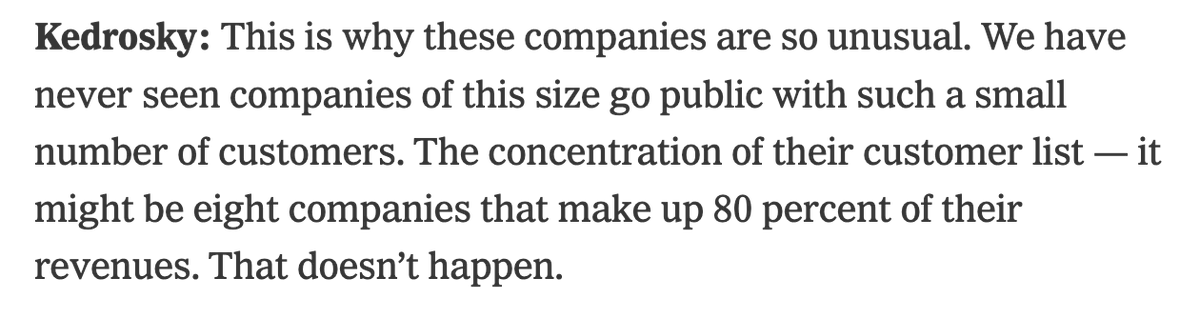
In a recent NYT debate, Paul Kedrosky claimed that 80% of Anthropic revenues come from 8 companies. He claimed Meta alone makes up 10%.
As Azeem Azhar pointed out, this concentration was declining over time and we'd have an answer in the S-1.
The S-1 tells us:
"No single customer represented more than 10% of our revenue for the nine months ended September 30, 2026. Approximately 79% of our revenue came from customers outside of our top five customers for the three months ended September 30, 2026, up from approximately 64% for the three months ended March 31, 2026."
So that resolves it. Concentration is below the levels Kedrosky warned of, and falling.
https://t.co/u7vgggB0M6
https://t.co/gdLy2DncoZ
My initial S-1 thoughts:
As I expected, Anthropic is still firmly unprofitable. But, to their credit, they've significantly reduced compute costs as a % of revenue, leading to much narrower losses. On first look, there is a plausible and imminent path to profitability. This is impressive.
However, the meat of the document begins at page 161, under "liquidity and capital resources." There, we learn where the true compute costs have been hiding: future compute purchase agreements.
As of June 30, Anthropic has signed roughly $587 billion in compute leases and minimum purchase commitments that haven't begun. It has since signed $245 billion more, resulting in more than $800B in future compute costs. None of these costs have made their way onto the income statement yet. But they will, and when they do, the profitability picture will look completely different.
Anthropic acknowledges how precarious these agreements are. They point out that their compute providers (on whom they also rely for financial support) also sell services that "compete with ours." As a result, these providers/competitors may eventually force them into onerous agreements. This is something I've expressed concerns about for a while, and it's nice to see Anthropic openly recognize it.
That's why Anthropic admitted their most significant strategic decision: They're about to initiate "substantial capital expenditures." So far, they've spent zero. Why the change? Because they know they can no longer rely on leasing compute, "the magnitude and timing" of which are "inherently uncertain." So, they're going to build their own compute, which will, in their words, "change the cash flow profile of our business." I.e. make it severely negative.
It's possible that this is why they want to go public now. Since these costs have not yet "come online," they can be left as footnotes at the bottom of the document. But very soon, that won't be possible.
In sum, Anthropic's income statement is not telling you the full picture. To the company's credit, they spared us the accounting gymnastics of stripping out training costs in their non-GAAP adjustments. That would have been offensive. Still, the most important numbers aren't getting the requisite attention.
I encourage you to start at page 161 for a more complete understanding of what's going on.
There is something really concerning (and disappointing) going on in the US right now.
A dangerous and preventable situation.
Let me explain.
https://t.co/zGjyCh9tKs
1/
"The Defector" - a 5,500-word espionage tale in today's WSJ that I can guarantee is worth your time.
I spent months speaking to one of the deadliest saboteurs in recent military history, a Russian officer who helped Kyiv kill hundreds of his fellow troops https://t.co/Ae8hskq22i
Moderna and Merck’s personalized mRNA cancer vaccine reduced melanoma recurrence by 42%. We already have a vaccine that prevents cancer (HPV). Now we’re going to have vaccines individually targeted to treat your cancer. This is the same technology that our government cut NIH support by $500 million. https://t.co/HqMouixQpR via @statnews
My deep dive on the "A.I.-driven" Alpha School, revealing their internal learning and enrollment data for the first time, just as the network expands into public education.
There is a big gap between the marketing and reality.
https://t.co/2U4aJrm04v
New: The three researchers OpenAI fired last month spent the summer fighting to keep AI's chain-of-thought process visible.
Then, OpenAI asked to see their Signal chats. A week later, they were let go.
More below from @keachhagey, @berber_jin1, and me.
https://t.co/7klEDa8R0M
Readers challenged Christopher @Mims to try an affordable EV on a route with less-than-ideal charging options, so he devised a nearly 1,000-mile torture test for a 2027 Chevy Bolt. Here’s what happened. 🔗 https://t.co/ItNRAyu4zm
I went to Phoenix to spend time with the Taiwanese community. TSMC will invest $265 billion and send thousands of engineers and their families, which marvel at their new lives in the Sunbelt
My first feature as a contributing writer to the New York Times:
https://t.co/n73RydKBiD
Readers challenged Christopher @Mims to try an affordable EV on a route with less-than-ideal charging options, so he devised a nearly 1,000-mile torture test for a 2027 Chevy Bolt. Here’s what happened. https://t.co/OG1IrQAkfz