Personal news! I'm joining @WSJ to cover AI.
I've had an amazing time at WIRED working with brilliant colleagues across the newsroom, but I'm very excited for this next chapter. I'll continue to cover OpenAI, Anthropic, and the bustling AI industry. I start next week!
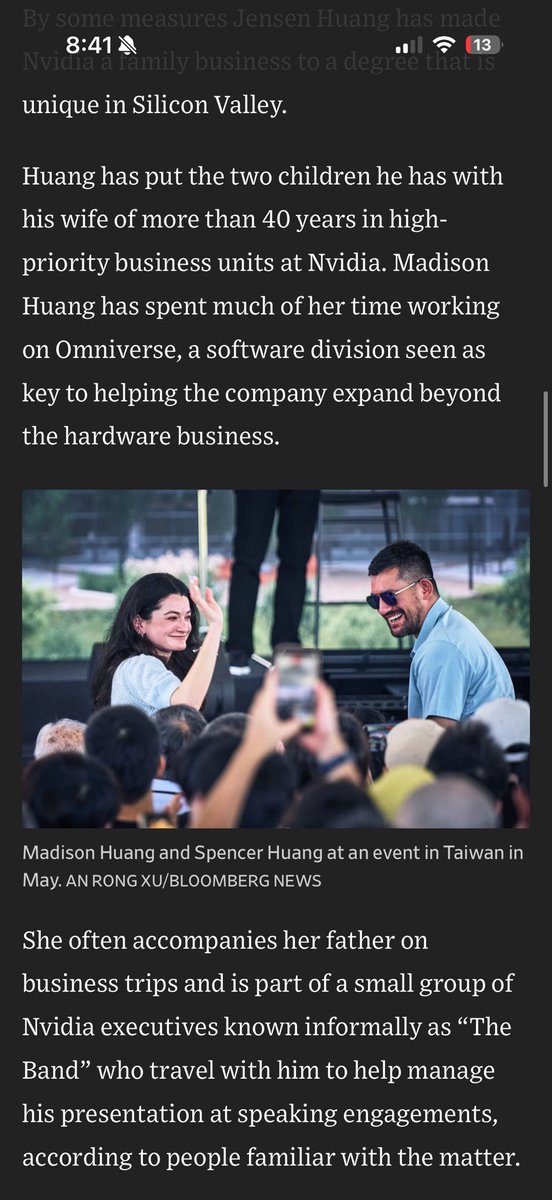
NEW: In a tense late-summer meeting, Jensen Huang called his Chief Financial Officer Colette Kress a “deer in the headlights.”
His concern: Nvidia’s plans to fund the AI boom with its balance sheet were running into problems. He needed to figure it out.
He called her a “reporting CFO,” not someone who could help him define a strategy or make decisions.
With @RWhelanWSJ for @WSJ
https://t.co/V0gmpNYD2z
I have a major result to share.
I’ve found conclusive forensic evidence that the top 4 Chinese AI labs—DeepSeek, Moonshot, MiniMax and Ant Group—have built their newest models on NVIDIA’s most advanced Blackwell chips, which are barred from export to China.
This sounds insane, but I discovered that almost every AI model carries a hidden signature of the GPU that trained it. When a model is first set up, the starting values of its weights are laid out in a pattern that depends on the exact GPU. Each combination of GPU and seed number produces a unique pattern—a sort of fingerprint of the hardware used to create the model. Traces of that pattern survive training into the published model.
Again, this evidence isn’t based on any insider information or leaking. It’s based on a forensic analysis of the model weights released by the companies themselves.
I searched more than six trillion combinations of chip layout and seed number and matched them to open-weights models. In doing so, I found conclusive evidence that six Chinese AI models—including DeepSeek-V4-Pro, Kimi K3, and MiniMax-M3—were initialized on NVIDIA Blackwell systems. Four of the models match Grace Blackwell, the GB200 and GB300 parts in NVIDIA’s flagship liquid-cooled rack-scale systems.
I then verified these results on real hardware. Running unmodified PyTorch with the seeds I’d recovered, a Blackwell B300 reproduced DeepSeek-V4-Flash’s untouched starting weights bit for bit, and a rented GB200 reproduced Kimi K3’s to a correlation of 0.999995. A Hopper H100 reproduced none of DeepSeek-V4-Flash’s, and changing the seed by one broke the match. (DeepSeek’s seed is 953049583 by the way.) The method also was verified to match 24 known open-weights models to the hardware that developers said they used.
It is exceedingly unlikely that these results are a coincidence. Across six trillion combinations, the best accidental match should reach only about 8 sigma (i.e., eight standard deviations above what random chance would produce). The real matches range from 49 to 1,385 sigma, and even the weakest single test hits 20.
These were data-center-scale training runs. With some analysis of release schedules and model details, I estimate that the largest, Kimi K3 and DeepSeek-V4-Pro, used 2,000 to 3,000 Blackwell GPUs each. Clusters of this size cost on the order of $150 to $200 million each to buy, and across these labs alone would add up to more than half a billion dollars of export-controlled GPUs, not counting experimental compute or otherwise. It’s quite likely that we see multi-billion dollar expenditure on export-controlled GPUs.
I am highly confident in this result, and it has been independently verified by senior researchers at OpenAI and Anthropic. You can read the full report at https://t.co/YOtzND0Jqk.
There is much more I’ve identified about these models through other forms of checkpoint forensics like this, and will have more to share soon.
interesting research from OpenAI on how AI models are getting more difficult to monitor through CoT, laying out a few reasons. One finding from the blog:
"... we expect further progress in pretraining to require new approaches to monitorability."
(1/10) Today, we’re sharing new research from @OpenAI: How does CoT monitorability (no-CoT capability and CoT controllability) evolve over the model training lifecycle?
We emerged with unsurprising but sobering findings: as we scale toward more intelligent systems, models are becoming harder to monitor through their CoT. 🧵
Meta said it's starting to look abroad for its DCs & Anthropic warned about moratorium risks in its S-1. It's the new reality for AI firms, which are all facing the same question: Will I be able to get enough compute?
More here in my story w/ @ZeffMax: https://t.co/O0Ul5AGBuy
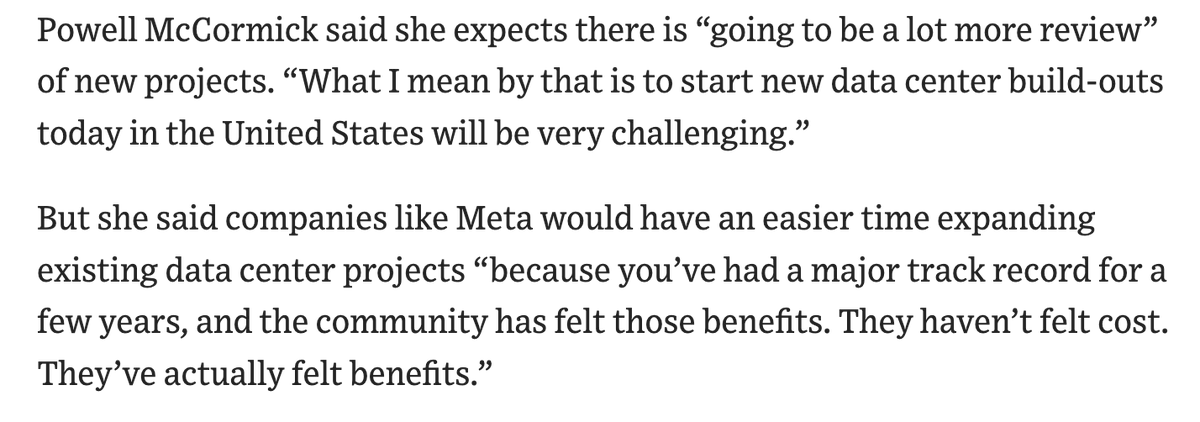
🚨 In Meta's first public comments since the election, President Dina Powell McCormick said the midterm results will make building data centers harder and that the company will have an easier time expanding existing data centers.
Oh yea, and he broke some news that OpenAI is expanding its work with JP Morgan, particularly on stuff like cyber. Anthropic also has a deal to work with JP Morgan on cyber
https://t.co/HrEdgPpZiA
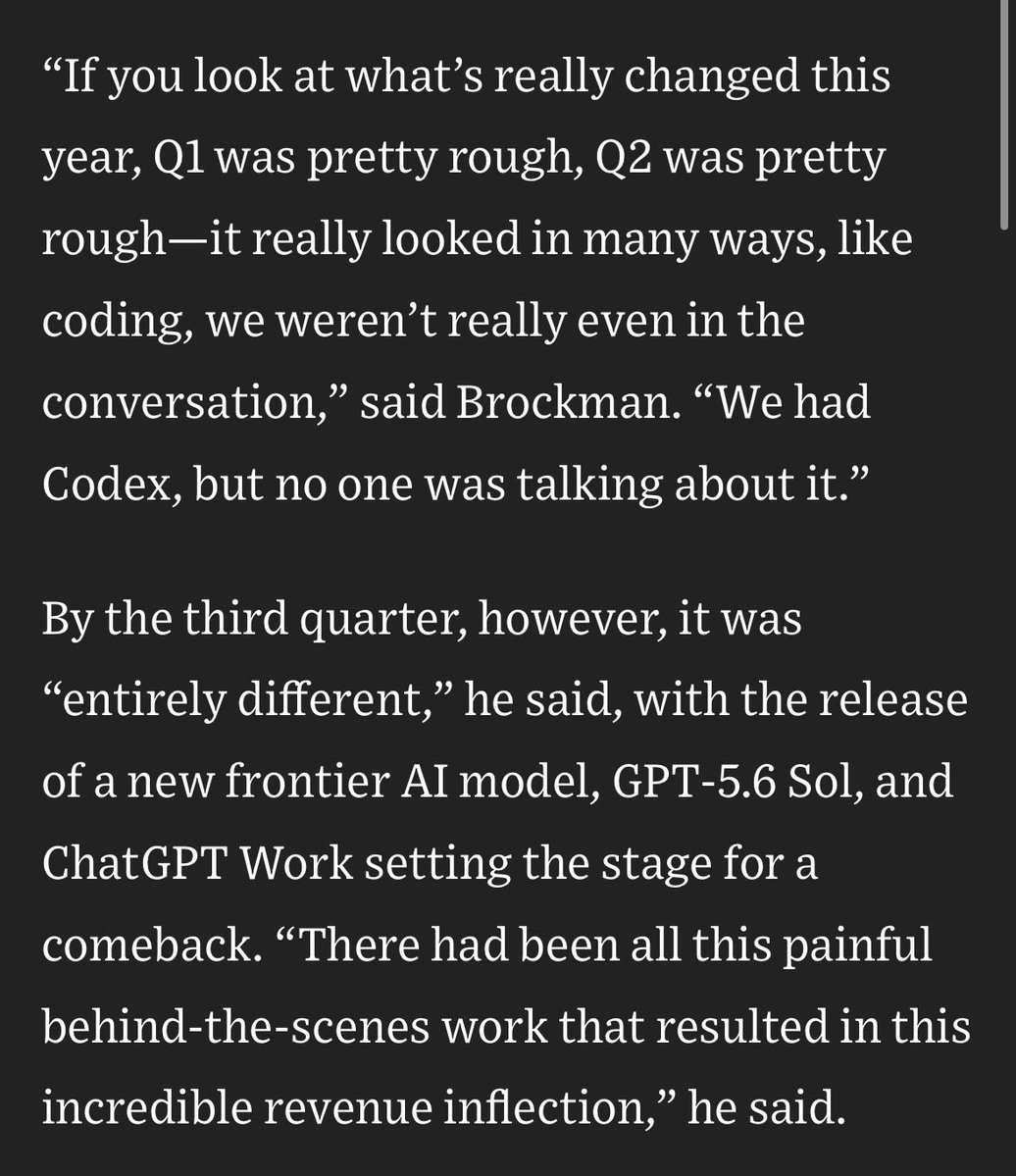
Pretty interesting to hear Greg Brockman’s candid comments on how OpenAI’s race with Anthropic has progressed over the course of 2026
He’s pretty blunt about how bad things were for OAI to start, but then Q3…
From his chat with @keachhagey at WSJ Tech tonight
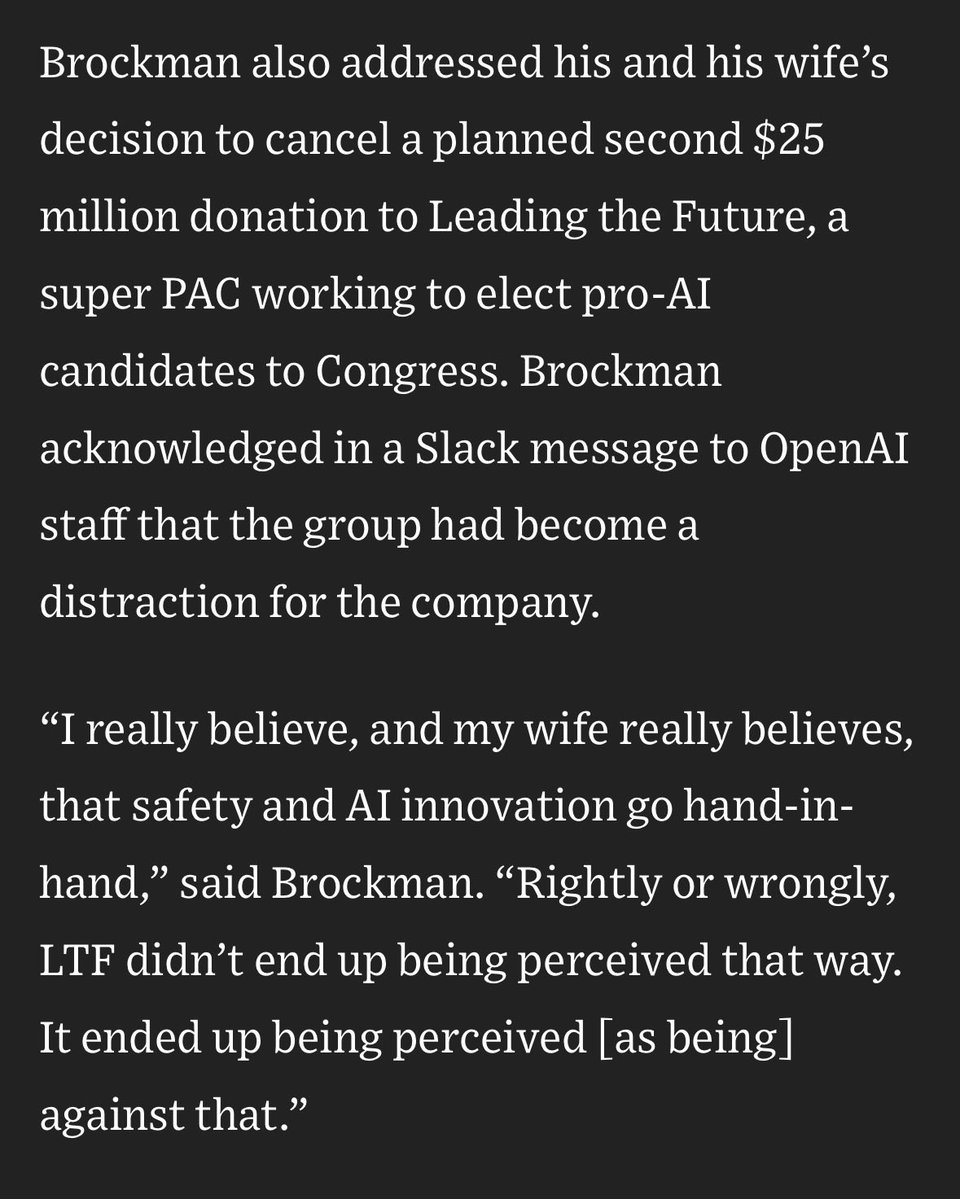
Later in the chat, Brockman also acknowledged his and his wife’s decision to cancel a planned second $25 million donation to Leading the Future.
He followed this by saying that LTF has actually put out some good, nuanced stuff more recently 👀
Some news: I’m joining OpenAI to lead product management for Core Products!
I have a lot of respect for OpenAI for showing the world that scaling works, for bringing AI to over a billion people, and for believing great products are core to the mission.
I’m excited to work with @thsottiaux, an incredible PM team, and everyone across OpenAI. Together, we’ll build agents that have your back and your team’s, and keep you in control, so you get more time for the people and work you love.
Lots to learn, and lots to build. Please keep your feedback coming!
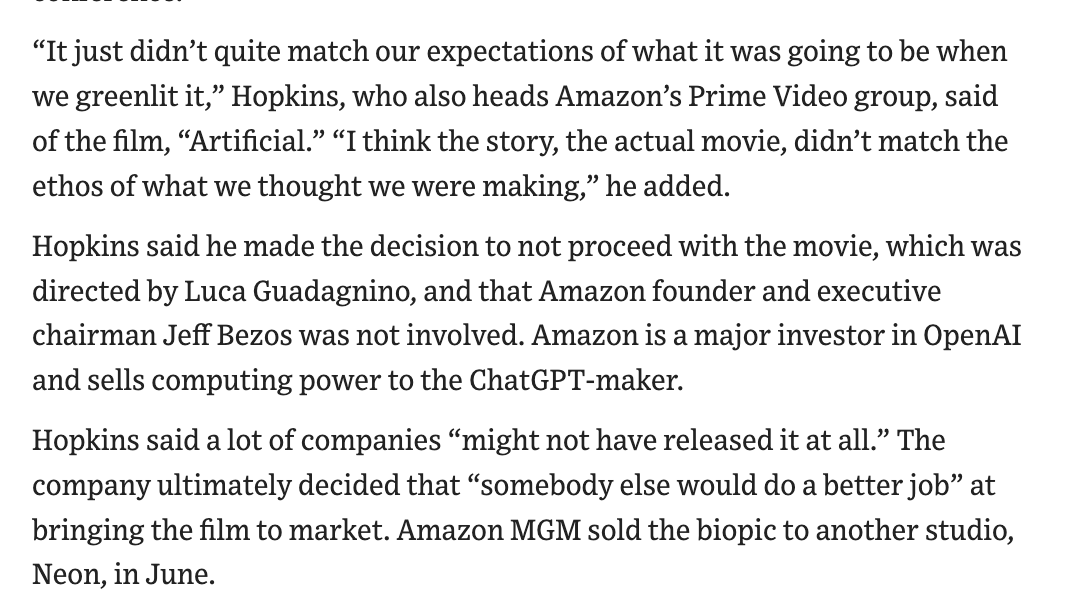
👀 The head of Amazon MGM studios said at WSJ's Tech event today that it walked from Luca Guadagnino's biopic of OpenAI CEO Sam Altman, "Artificial," because it "didn't match the ethos of what we thought we were making."
He also said Jeff Bezos was not involved in the decision
It’s pretty remarkable that AI is in the same ballpark as issues like the Iran War and immigration. IMO AI seems like it could well make the difference in the 2028 presidential election, given the margins of prior elections and how fast AI’s salience is rising
We’ve updated the Model Spec, our public description of how we want our models to behave. This revision makes clearer what we want from models as they take on more autonomous work in the world and become capable of helping us in new ways. 🧵
https://t.co/EdBbpGwyGS
@apples_jimmy Fair. In my defense, it’s a complicated story and we mention other reasons (and that quote, alongside several other responses from OpenAI) in the actual story.
Frankly, it’s hard to capture all the nuance of this particular case in one post.
Last month, OpenAI called in the three outspoken safety researchers and asked them to unlock their personal phones. It was conducting a leak investigation into a story in The Information about Astra’s use of opaque architectures, and the company’s plans to continue down that path. A week later, at 2 p.m., they were all fired.
Our story, w/ @ZeffMax and @berber_jin1 , looks at the battle over how much AI companies should share with third-party monitors like METR and Redwood to ensure AI safety https://t.co/6KJwKH6S6n via @WSJ