New from me at @theangle: HumanX this year captured a theme that I'm seeing in my own experience of AI, and that I think reframes how we should be thinking about its impact on jobs and enterprise organization design:
Some personal news: in two weeks I'm joining The @WSJ to cover @Tesla, one of the most incredible (and I mean that in just about every way possible) companies of our time.
It's a dream job, tbh, and I genuinely can't wait to get started.
I'll also be covering the actually-really-happening-now rise and spread of autonomous vehicles, which I expect will be one of the most fascinating technology, business, and labor stories that I'm likely to live through.
I can't wait to go deeper on companies like @Waymo and @Rivian, and see how this all shakes out in the coming years.
If you work/have worked at Tesla or one of these companies, or work in the industry more broadly, *or* just have a fun story to share, I want to talk to you! you can always reach me on Signal: okane.01 🫡
Genie 4 is quite an insane experience, generating game-like enviornments as you go. It isn't flawless but I can type "Neogothic brutalist city inhabited by robots and horses" & it creates one in a minute. Then I asked it to add dragons. Then a friendly otter NPC. All in realtime
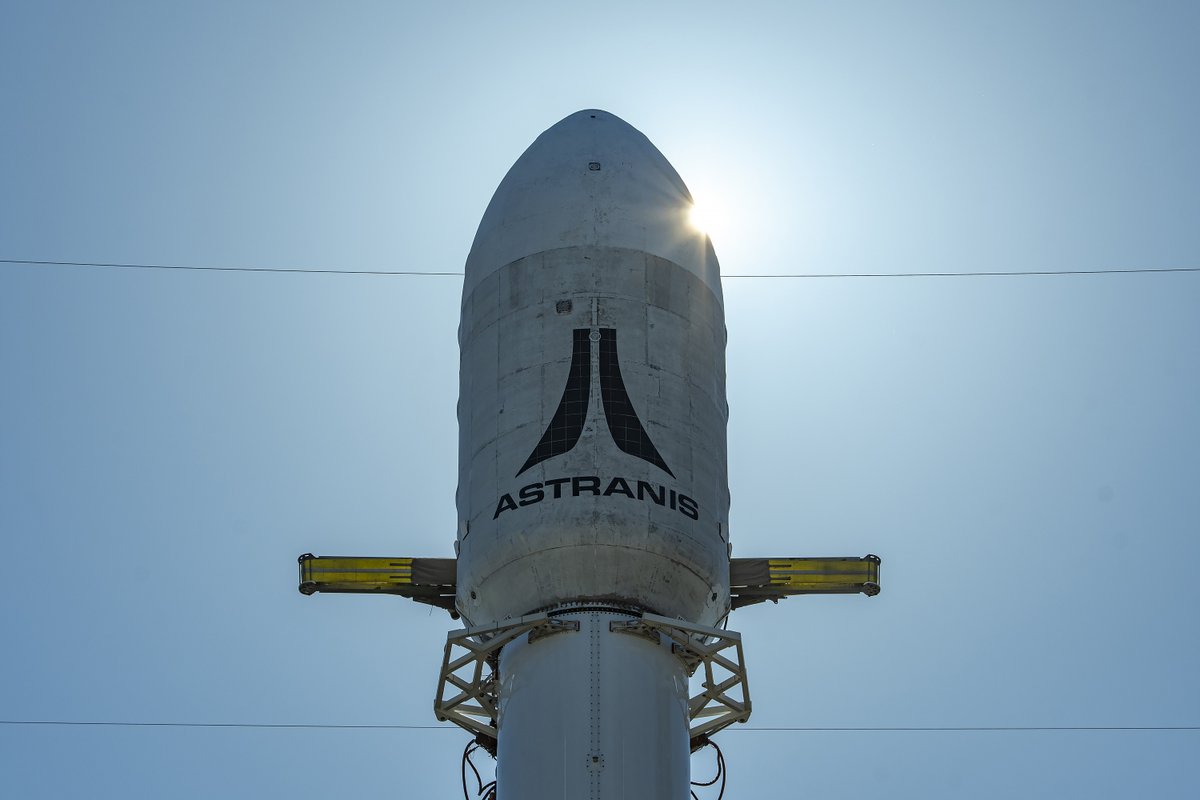
Today we're excited to announce we have upgraded our 4th launch with our partners at @SpaceX to a dedicated mission, launching in 2028.
Given increased customer demand --in particular from the sovereign and air-gapped network verticals-- we decided to increase the number of satellites we're launching to 6. This is the entire production run of our spacecraft Block 4.
Sovereign satellites, and specifically sovereign satellites in geosynchronous orbit, allow a country or enterprise to have their own dedicated comms satellite with a purpose built network deployed around it.
In this new world of cyber threats and super-intelligent agents in the hands of malicious actors, we're seeing more and more the desire to pull infrastructure off the public internet entirely with dedicated networks. It's the most effective way to shrink the attack surface. And it's where the world is headed.
As a result we've seen huge increase in demand for satellites that our customers can control and lock-down from a cybersecurity perspective. Something uniquely possible on a nation-state scale with a geosynchronous satellite.
We are pumped about this launch. And the best part? We’re going straight to 22,000 miles up, with a direct-inject to GEO using an Impulse Helios upper stage.
We are now seeing an insane amount of commercial and US government demand, and we’re only just getting started.
The cyber incidents of the last 48 hours have been pretty mind blowing. I’ve been trying to piece together the “why now” question, and I think what we’re seeing is the first of a new kind of super-agent driven vulnerability cascade-- first one vulnerability is found by a malicious actor, then other bad actors pop up to try and take advantage of it before companies patch their systems.
But because each bad actor is using swarms of thousands of super-agents, those agents are not only exploiting the existing vulnerability, but finding new zero days as well, all in a matter of hours. And the cycle repeats. As of the writing of this post there have been vulnerabilities found across at least half-dozen independent systems including LiteLLM, PHP, eMudhra Certificates, NGINX, Bind 9, and NodeJS. The list continues to grow hour by hour.
Basically everything connected to the internet is at risk. Not just company websites and the usual databases of sensitive personal information, but all our critical infrastructure-- banks, power grids, pipelines, government agencies, all of it.
The good news is that cybersecurity and ops teams had a chance to see this coming. This is why from when Mythos first dropped and had our first warning, these teams have been hard at work shoring up systems across the board.
This is also why at Astranis we’ve seen a massive uptick in demand for truly air-gapped, sovereign networks, deployed via dedicated satellite to span an entire country or connect a large enterprise.
It is in fact possible to take an entire category of critical infrastructure off the internet entirely. With a fully self-contained network where all the endpoints are off grid. This is not a new concept-- anyone could do this for your home today with equipment you can buy from Best Buy. But to stand up such a network covering a large geographic area or an entire country, without touching the existing fiber or other network infrastructure, you can only do that with a dedicated satellite. And specifically a satellite in a special orbit called geosynchronous orbit.
Over the past year we’ve begun working with some of our customers on what it will take to implement truly air-gapped, standalone networks in support of mission critical use cases like core government functions, emergency response, defense, core infrastructure, or all of the above.
That might sound extreme, but that is the kind of measure we expect will be required to shrink the attack surface of some of the world’s most critical infra. That’s just the position we are now in. It's a brave new world.
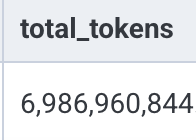
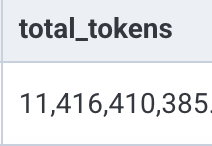
We hit 11.4B tokens in the last hour and nearly 7B in the last half hour, within the first three hours after launch!
You guys are cooking! Thanks for the engagement.
It is possible there may be some latency spikes. We are considering opening up some of our training clusters for inference. We will let you know if anything changes!
Introducing SubQ Snap, the first long-context decision model for real enterprise work.
Snap is the only decision model or LLM where compute per token stays constant as context grows.
• 384K tokens of multimodal context, 12x larger than Jev.
• 61.7 on Decision Index v0.2.1 vs Jev’s 57.9, outperforming on 13 of 16 enterprise benchmarks.
•Processes 100K tokens and returns a decision in under one second.
•$0.05/MM input tokens. Output is free.
Available today to anyone.
The first 10,000 sign-ups get 100M free input tokens.
We’ll likely hit capacity fast and will add users as we add compute. Compute offers welcome 🙂.
Latency will be variable as we tune the platform to this new model and category of users.
Model speeds are 80ms for minimal context, 250ms for 32k, 660ms for 100k, and 2.5 seconds for 384k.
Visit: https://t.co/Nc76iJF2a8
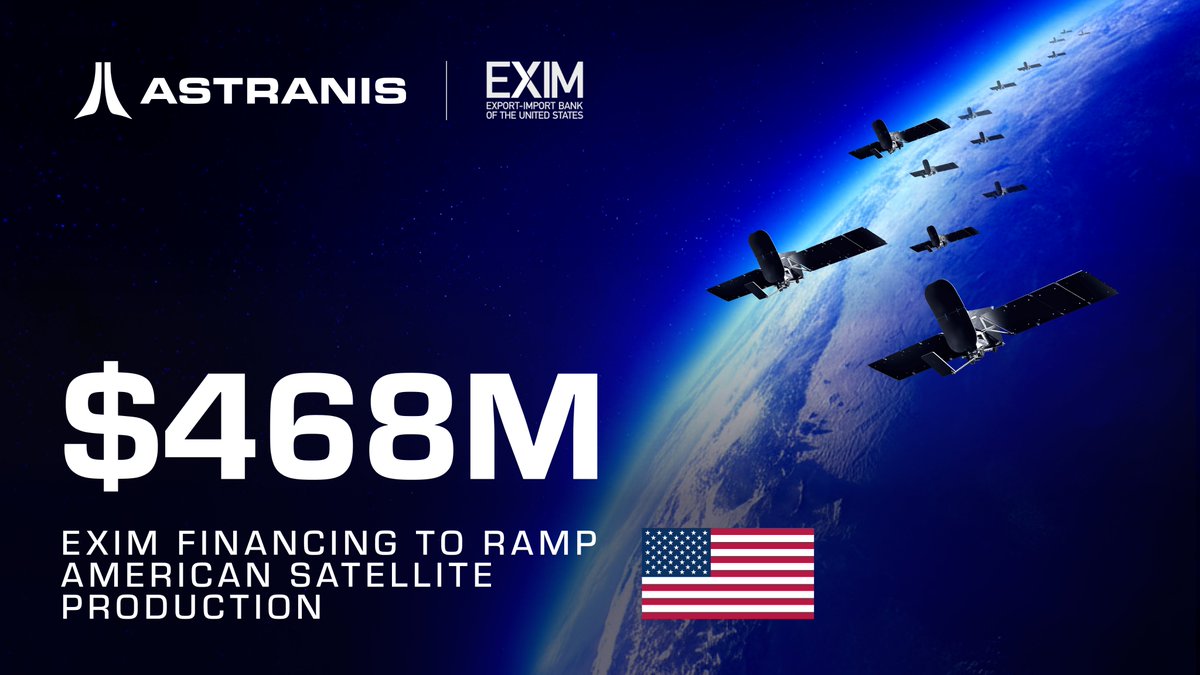
Today we are announcing a $468M credit facility from @EXIMBankUS to fund a massive ramp in satellite production here in America. For a New Prime like Astranis, it's a huge vote of confidence from the United States Government.
“Astranis is delivering mission-critical infrastructure to customers around the world at unprecedented speed and scale,” said EXIM Chairman John Jovanovic. “We are confident this is just the beginning. Under President Trump’s leadership, EXIM will continue to help the United States stay ahead of the curve in developing the industries of the future and boost American competitiveness around the globe.”
This means we have capital to build more satellites in the United States and get them into orbit faster. As we sign new customers, this helps us move from contract to satellites in orbit at the speed our customers need.
Astranis's satellites serve a huge unmet need. This year we've signed some of our biggest and most important deals yet. Earlier this month we announced earlier we announced a partnership with stc group for a dedicated satellite for Saudi Arabia.
We have more than $1B in contracts to deliver, and now we can ramp up production to meet this demand and do our part to help re-industrialize America.
Thank you to EXIM for backing us. Now, back to building for the Expansion Era.
Two new challengers to the Pareto frontier on accounting work.
First Sonnet 5.5, then GPT-6.1 Sol: each one scores more than any model at its price or lower. GPT-6.1 Sol then pushes both GPT-6 Sol and Sonnet 5.5 off the frontier.
We are 100% in a race with China right now.
We need to get to the Moon and secure the permanently shadowed craters that hold valuable Lunar ice, before they do. China is making a beeline there as we speak.
No time to waste. LFG.
Ramp is finally live in the UK!
Earlier this year, I wrote about wanting to make it easier to build a company in Europe. Very happy that more UK teams can now use what we've built.
Our full-page apology is in the Financial Times. Sorry we're late 🇬🇧
🇨🇦 We're BACK! 🇨🇦
May 31–June 4 - lock it in to your calendars!
Five days for the people building, funding, and shaping what comes next in Canadian tech.
Expect thoughtful programming, great events, and the conversations that turn into ideas, partnerships, hires, customers, and companies. More information to follow.
Some great ideas here from the cartel:
- you need to give us employee-level access to your entire operation
- if we don't think you're 'safe' enough, sorry we're shutting you down for 'safety'
- China won't comply, but everyone else has to! or no chips!
Brilliant stuff.
I’m very excited to announce a new Astranis partner in the Middle East and a new satellite-- a dedicated MicroGEO for the Kingdom of Saudi Arabia.
Astranis has signed a contract with @stc, the largest telco in Saudi Arabia, for a satellite that will launch next year to provide mission critical networking and telecoms services.
This is a great example of how Astranis is building out the infrastructure of high orbits, helping countries around the world build and deliver the essential services that they need.
Importantly, what we do is something that would be impossible on a shared network or LEO constellation.
GEO is the only orbit where you can park a satellite over one specific part of the world 24/7, which is why Astranis started there. Our MicroGEO satellites, built in America at a fraction of the cost and time of traditional large satellites, put dedicated satellite capacity within reach of any nation that wants it.
Our customers control coverage, payload configuration, and the networking stack end to end. While data stays in country, private and secure.
Saudi Arabia is making one of the world’s biggest investments in digital infrastructure, committing over $8 billion to future next-generation network build out, and now that backbone will extend 22,000 miles into space.
It is an honor to build for stc group and the Kingdom of Saudi Arabia. The Expansion Era is underway.