September 12, 1814. The British attacked Baltimore expecting another easy victory, but the city fought back so fiercely that the battle ended up giving America its national anthem. Here is the whole story.
The backdrop was grim. Just weeks earlier, British forces had marched into Washington and burned the White House and the Capitol, humiliating the young nation. Riding high, they turned toward Baltimore, one of the largest and richest cities in the country and a home base for American privateers who had been raiding British ships. The British sneered at it as a nest of pirates and meant to make an example of it.
But Baltimore was not Washington. The city had seen what happened to the capital and had spent weeks preparing. Under a determined general, thousands of soldiers, militia, and ordinary citizens dug trenches and threw up earthwork fortifications on the hills guarding the city. When the British came, they would not find an undefended town.
The British plan was to hit the city two ways at once, landing an army to attack by land while the navy blasted its way through the harbor. On this day, the land force came ashore and began marching toward Baltimore. American militia went out to meet them, not to win outright, but to slow them down and bleed them. In the fighting, American sharpshooters killed the British land commander, General Robert Ross, early in the battle. Losing their leader was a serious blow, and it threw the British advance off balance.
The Americans fell back in good order to their main fortified line, and when the British finally reached it, they found it bristling with cannon and packed with defenders. The new British commander looked at those defenses and realized he could not break through by land alone. He needed the navy to succeed first.
So it came down to Fort McHenry, the star shaped fort guarding the entrance to Baltimore's harbor. To reach the city, the British fleet had to get past it. Starting the next day, British bombardment ships opened fire on the fort, raining down mortar shells and screaming rockets. The barrage went on for about 25 hours, through the day and all through the night, one of the most intense bombardments the country had ever endured. The British ships stayed far enough out that the fort's guns mostly could not reach them, so the defenders largely had to just hunker down and take it.
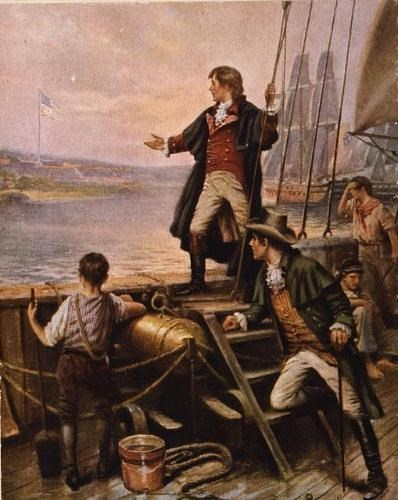
Watching all of this, from a ship out in the harbor, was a young American lawyer named Francis Scott Key. He had come under a flag of truce to arrange the release of a prisoner, but the British, not wanting him to warn the city, had detained him aboard their fleet until the attack was over. So Key was trapped, forced to watch the bombardment of his own countrymen, helpless to do anything but pray the fort would hold. Through the long night he strained to see, catching glimpses by the flash of the rockets and exploding shells.
When dawn finally broke on the second morning, the smoke slowly cleared, and Key looked toward the fort. There, still flying over Fort McHenry, was an enormous American flag. The fort had not surrendered. Baltimore had held. Overcome with emotion and relief, Key pulled out a letter and began scribbling a poem on the back of it, describing the flag he could still see waving by the dawn's early light, the bombs bursting in air, and the proof that the fort and the country still stood.
Unable to take the fort and having lost their commander, the British gave up and withdrew from Baltimore entirely. The defense had turned the disaster of the burned capital into a moment of triumph and pride.
Key's poem was published within days and set to the tune of a popular song of the era. People loved it, and it slowly grew into a patriotic standard, sung for over a century before Congress finally made The Star-Spangled Banner the official national anthem in 1931. The giant flag that Key saw that morning still survives, carefully preserved in a museum in Washington. And the battle that inspired the song America sings before every ballgame and ceremony began on this day.