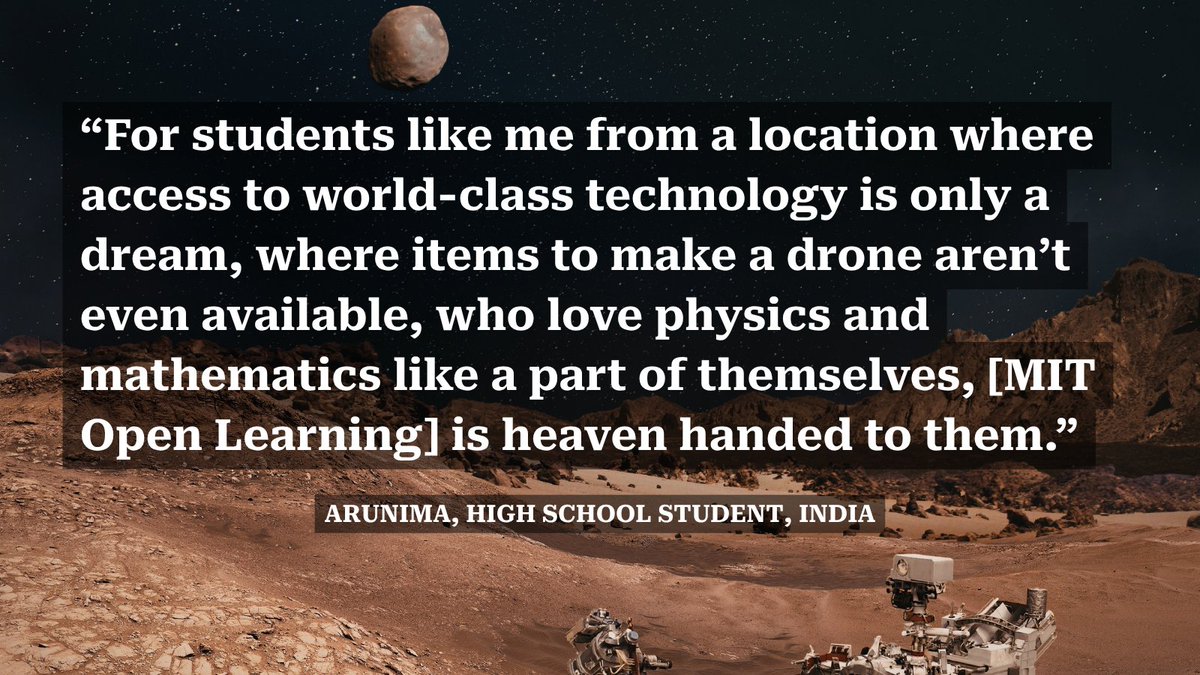
Meet Arunima, a high schooler from India who dreams of setting foot on Mars. 🚀
With @mitopenlearning's free physics & math resources, she now has the tools to start theorizing low-cost interplanetary exploration — bringing her one step closer to making that dream a reality.
Help us support the next generation of global scientists like Arunima. 🪐
Give now: https://t.co/BN7POOxIem
Image by Moisescu Florentina's Images via https://t.co/h9EeQ3IDdM.
MIT Open Learning has officially reached every continent — including Antarctica. 🇦🇶
John Della Costa, a researcher on the BICEP project at the South Pole, uses free open educational resources from @mitocw in a weekly “Fysics Fridays” series he started with his team.
Read more: https://t.co/HJTHlwJOCu
🥵 Summer heat got you cranking the AC?
@MITMechE Researcher Svetlana Boriskina is engineering a different solution: clothes made from polyethylene—the plastic in grocery bags—that let your body cool itself more efficiently.
🎧 Listen to the full episode on MIT Learn: https://t.co/Q43JT0evpo
These stunning images aren't from a museum—they're from inside a cancer research lab at @MIT.
Watch how the @kochinstitute turns scientific imagery into art that sparks real conversations about breakthroughs in treatment.
Keep exploring: https://t.co/OwmEsP1uSG
Have you registered for the Open Education Global Conference 2026 (#OEGlobal26)?
We're excited to co-host this year's conference with @OpenEdGlobal and the Massachusetts Open & Low-Cost Educational Resources Advisory Council (OLERAC). The conference will take place October 7-9 at the MIT Samberg Conference Center and online.
This year's theme is "Come Invent With Us! Innovating Open Practices to Uphold and Uplift Knowledge as a Public Good."
Register now: https://t.co/uR7RfJz0nE
How do you represent a molecule in a way that computers can understand?
@MIT researcher Sophia Yao breaks down SMILES—a text-based chemical notation that enables machine learning models to analyze molecular data faster and more cost-effectively.
Keep learning: https://t.co/kWA9bVmHYx
"After a very tiring year, it was just lovely to connect with like-minded people who keep contributing to open anyway. I feel reinvigorated," shared an OEGlobal 2024 attendee.
Find your people at #OEGlobal26. Early bird in-person rate until Aug 9.
Register: https://t.co/iB4NOBylVr
#OpenEducation
New courses. New possibilities.
The @MIT campus may be quieter this summer, but learning never slows down on MIT Learn.
Explore newly launched courses across 12+ subject areas, from AI and business to climate science and quantum computing.
Build your summer syllabus: https://t.co/JqSBmhH9Ms
50 years ago, scientists sparked a debate that would reshape medicine forever.
Watch to learn how the discovery of recombinant DNA paved the way for today's personalized medical treatments: https://t.co/OwmEsP1uSG
How do you detect a ripple in spacetime?
In a new Open Seminar episode, @MIT_Physics Professor Matt Evans explains gravitational waves: what they are, how they're created, and how scientists detect them. Discover how events like black hole collisions generate these cosmic signals and how new detectors could unlock even more cosmic mysteries.
🎥 Tune into the full episode on MIT Learn: https://t.co/GDnFhn6qza
Universal AI takes MIT's longstanding expertise in AI and completely reimagines how it is taught for a global learner.
You'll go from AI novice to authority, starting with core fundamentals and building to real-world, industry-specific applications.
Explore the program: https://t.co/sqHHAPeqwQ
How do @mit researchers design autonomous aquatic vehicles?
Meet the "Oystermaran," an autonomous aquatic vehicle designed to make oyster farming safer and more efficient.
Keep exploring on MIT Learn: https://t.co/rLYI6ueVtQ
What makes bird feathers certain colors? 🦜
The colors depend on the structure of feathers at the microscopic level, which can lead to amazing blues and iridescent effects. In an Open Seminar, Lorna J. Gibson, professor emerita of @MITMechE and @mit_dmse, shares how birds are able to display vibrant colors.
🔗 Watch the full seminar: https://t.co/IQYw7yGtET
Over three miles of tunnels run beneath MIT—connecting buildings, housing utilities, and keeping pedestrians moving in any weather. They're not just passageways. They're integrated infrastructure in action.
Wonder what else you can learn? Visit https://t.co/lBjk43sglH.
In 2001, @MIT became the first higher education institution to make its educational resources freely available through @MITOCW.
Our new short film explores the vision behind that decision and its lasting impact on learners around the world.
🎬 Watch "The Courage to Be Open: MIT OpenCourseWare and the Democratization of Knowledge:" https://t.co/DblfbQLnnS
What do bananas and iPhones have in common?
Perishability.
Bananas spoil. iPhones lose value as newer models are released. Different timelines, same supply chain challenge: How much inventory should you have, and when?
In our latest podcast, @mitsupplychain Executive Director Chris Caplice explains how supply chains work, where they break down, and why understanding them has become more important than ever.
🎧: https://t.co/BQxsJhWW4a
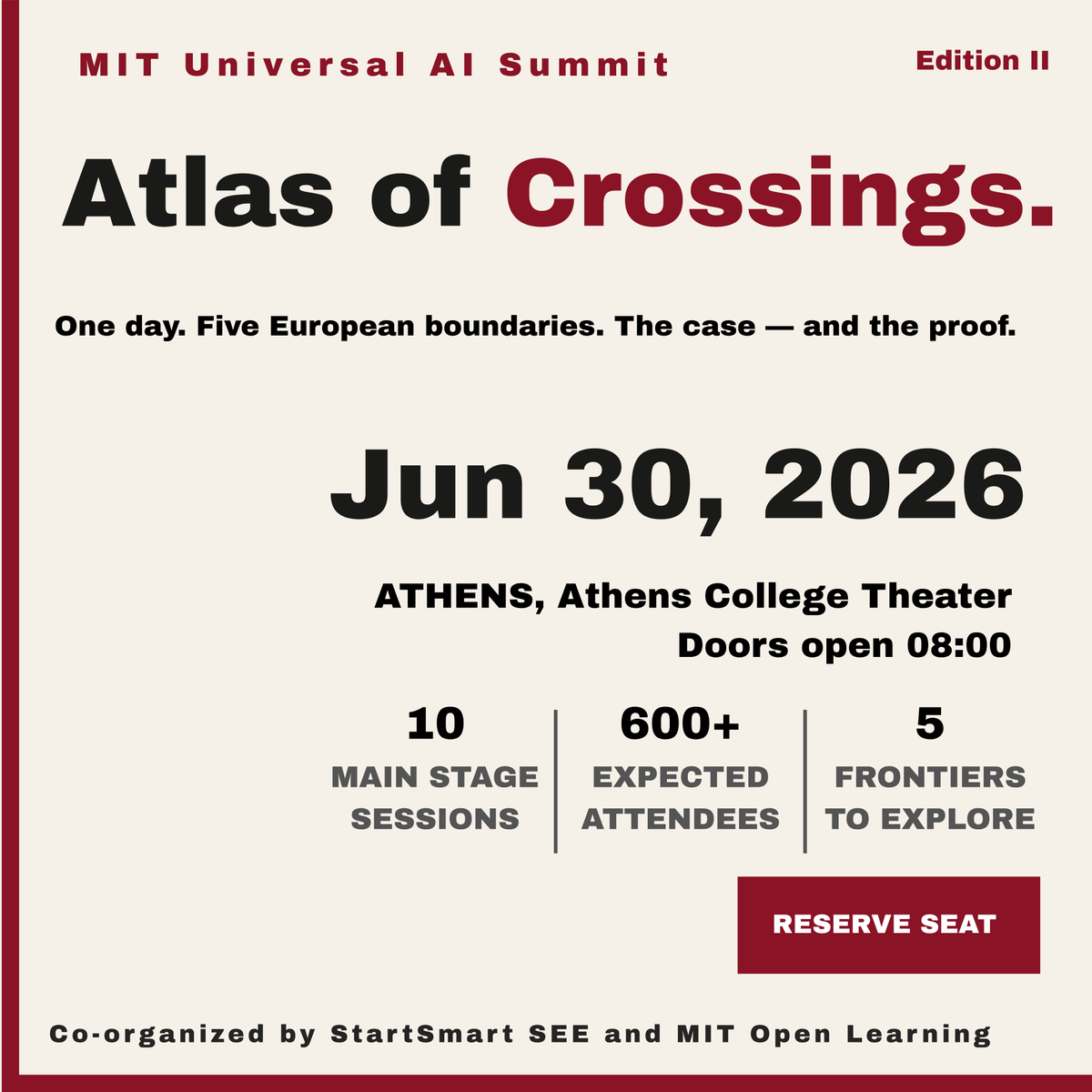
The MIT Universal AI Summit is returning to Athens on June 30!
The thesis: Europe doesn't have an innovation problem. It has a scaling problem. For the first time, AI gives European founders, researchers, and industries the tools to fix it — without waiting for policy.
Reserve your seat today: https://t.co/XMFXXFI5V0
What are you getting wrong about robots?
Three PhD students @MIT_CSAIL share three facts about robots that you should know.
Keep learning: https://t.co/lBjk43sglH.