How can open educational resources strengthen trusted public knowledge?
Join MIT Open Learning's open conversation with Andrew Lih, Peter B. Kaufman & Curt Newton on a new collaboration with #Wikipedia.
�� Oct. 6, 2026 🕠 5:30 PM ET 💻 Online
Register now: https://t.co/KSm9nzkl6F
#OpenEducation #Wikipedia #OpenKnowledge #MITOpenLearning #HigherEd
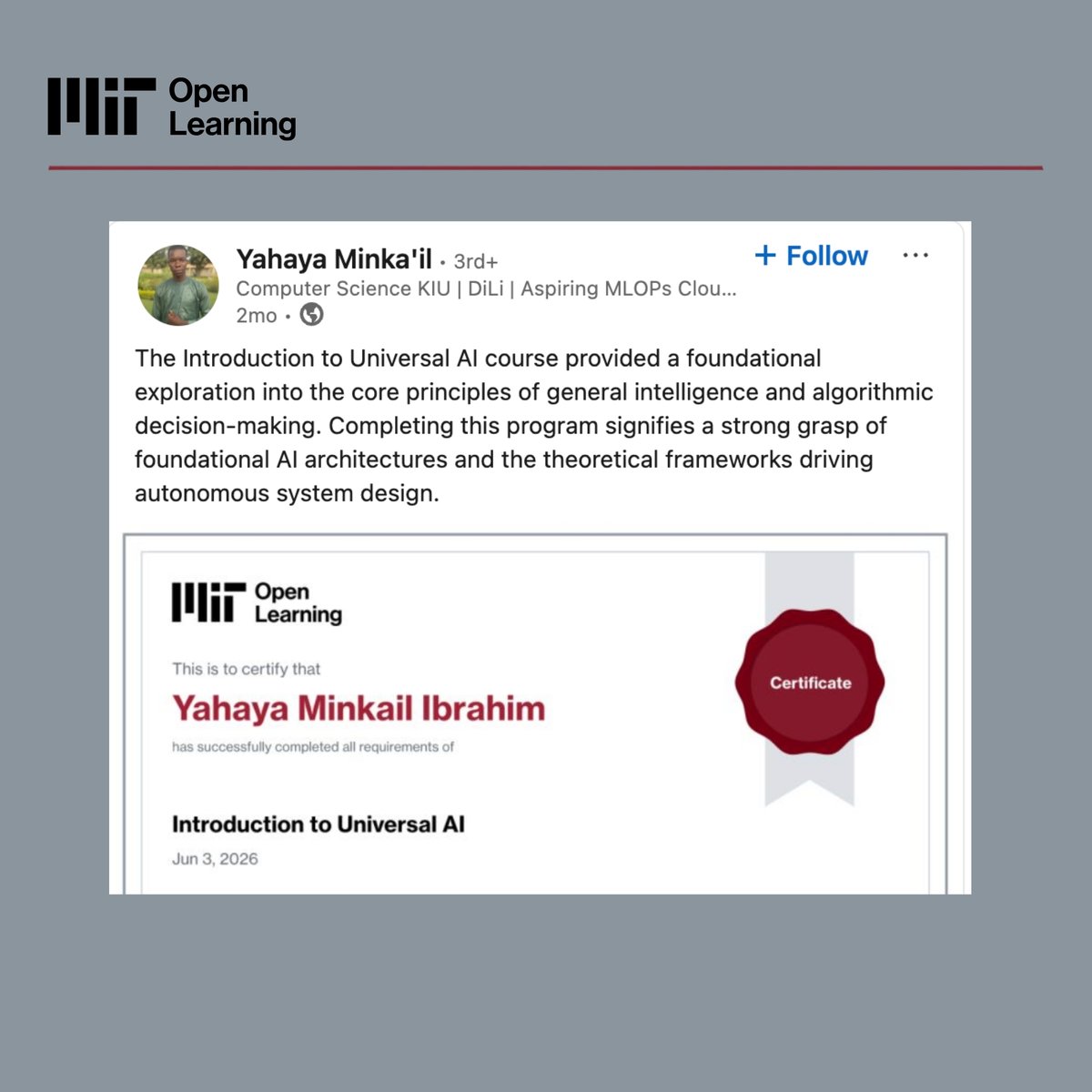
Congratulations to the 3MTT Nigeria learners who recently completed Universal AI with MIT Open Learning!
Through Nigeria's 3MTT initiative, these learners gained access to Universal AI and put in the work to build practical skills they can use right away.
We're proud to see so many of you sharing your achievement here on LinkedIn.
This is just the beginning!
Explore Universal AI and more at https://t.co/Ra69l1UzIP
Safety doesn't have to mean surveillance. Meet Dominique, an MIT researcher using radar instead of cameras to help seniors stay safe at home. Radar picks up falls and unusual activity, but here's the thing: it can't see you. Your privacy stays protected while someone looks out for your wellbeing.
Continue learning on MIT Learn. https://t.co/dg4dGgZEWa
Meet Gevorg Minasyan: He's sparking meaningful change across Armenia using lessons from our MITx Courses MicroMasters Program and MIT Department of Economics master's in Data, Economics, and Design of Policy.
When Gevorg saw well-intentioned public policies fail to address pressing issues, he was inspired to understand what works, what doesn’t, and why.
Get to know Gevorg: https://t.co/O3z2tuYeFM
AI won't deliver value on its own. Strategic decisions will. Learn where AI deserves your investment.
Join MIT xPRO’s AI for Senior Executives program to elevate your leadership for the AI era. Gain exclusive access to MIT CSAIL faculty during a 5-day on-campus immersion in Cambridge.
Learn more about the program: https://t.co/gif4AymDLT
What happens when 800 joules unleash in microseconds?
Capacitors store massive charge and release it almost instantly. When 4,000 volts and 800 joules force through a tiny wire in microseconds, resistance creates intense heat. That heat vaporizes the wire. It's dangerous. It's loud. It's why you never touch a charged capacitor or try to repair a microwave yourself.
Continue learning on MIT Learn: https://t.co/MxWv03qA27
What happens when passion becomes purpose? ✨
Gustavo Barboza traded a college classroom in Colombia for a life of adventure, serving in the French military before finding his way back to learning.
Today, he's working toward an electrical engineering degree — and @mitocw has been there every step of the way with free courses in calculus, classical mechanics, electrical engineering, and more.
🔗 Click on the link in our bio to start learning!
#OnlineLearning #OpenEducation #LifelongLearner #OpenAccess
Thinking about adding machine learning to your engineering toolkit? Start by hearing from the person who teaches it.
On Wednesday, September 9 at 12pm ET, MIT professor Youssef Marzouk will walk through MIT xPRO's machine learning, modeling, and simulation: engineering problem-solving in the age of Ai. You'll learn what to expect from the program and get to ask the course team directly.
Register now: https://t.co/XVMVTW3yKS
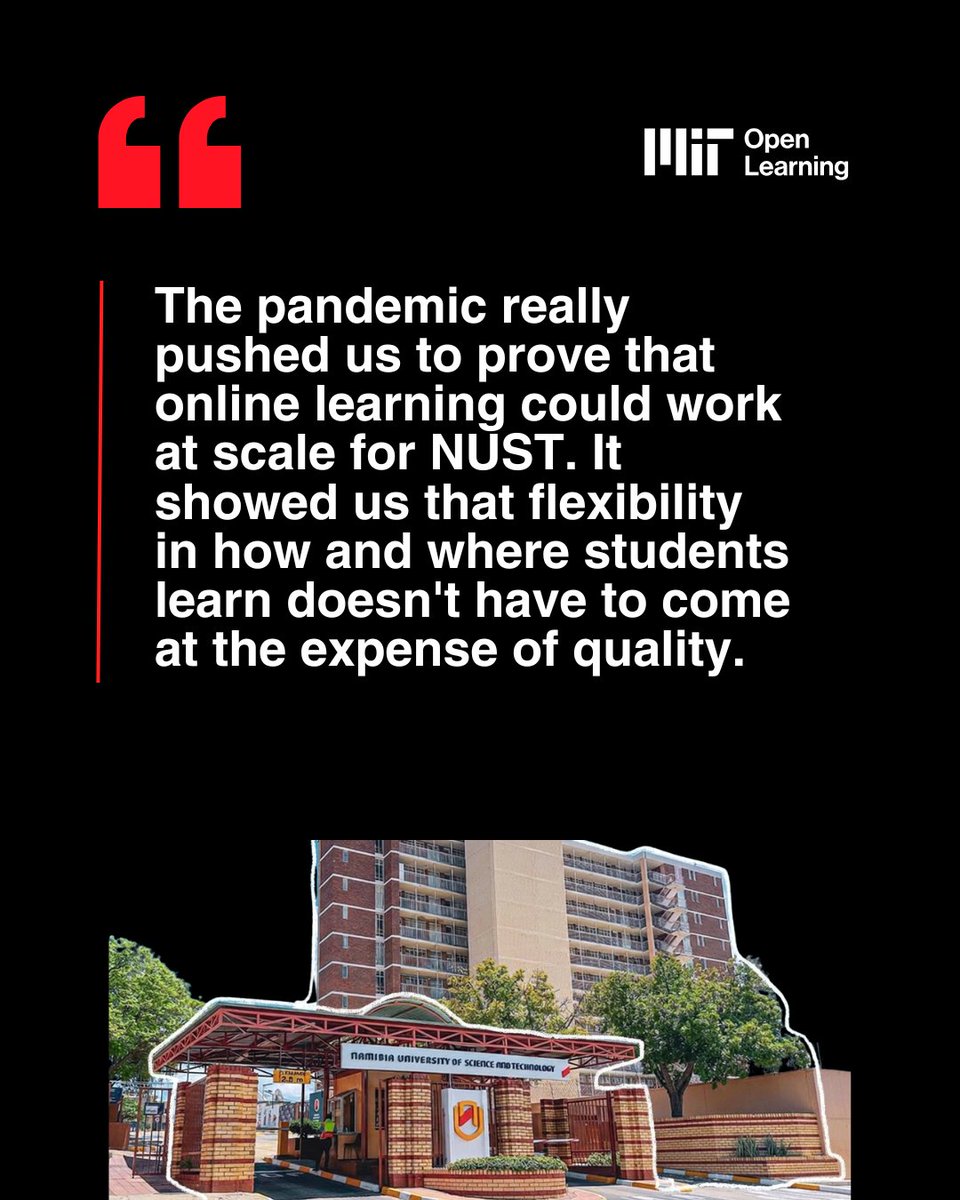
When a university needs to train 15,000 students in AI fast, you adapt. Namibia University of Science and Technology did.
Over 1,100 people moved from zero AI skills to confident practitioners in six months. Free resources. Strategic focus. Institutional change.
Read the full story on MIT Learn: https://t.co/4K2WjvllOo
Camera lenses are doing something far cooler than most people realize.
Half the lens covered. Half the image gone? Actually, no. Jim Bales, associate director at @MITEdgerton, breaks down the physics of how lenses focus light, bend rays, and form complete images. Two minutes to understand what's really happening behind the camera.
Want to learn more? Head to MIT Learn: https://t.co/MxWv03qA27
Recognize. Relate. Integrate.
MIT senior lecturer Laura Frawley's students use concept maps to show how they organize ideas, and the mapping itself is a way to study.
Full episode of Open Seminar on MIT Learn: https://t.co/PjAn8YvQAS
When a university with 15,000+ students faces an enrollment surge and an urgent need for AI-skilled graduates, quick action is essential.
@nust.na turned to MIT Open Learning's Universal AI.
In six months, over 1,100 participants moved from AI novice to confident practitioner—and the university's instructional design department began benchmarking its own courses against Universal AI's principles.
The result: institutional transformation, not just individual certificates. What's possible when you align free world-class resources with strategic institutional goals?
Read the full story on MIT Learn >> https://t.co/bcqMpCBxwM
Meet Gevorg Minasyan: He's sparking meaningful change across Armenia using lessons from our MITx Courses MicroMasters Program and MIT Department of Economics master's in Data, Economics, and Design of Policy.
When Gevorg saw well-intentioned public policies fail to address pressing issues, he was inspired to understand what works, what doesn’t, and why.
Get to know Gevorg: https://t.co/O3z2tuYeFM
You know light years. But have you heard of light hours? Light seconds? @MIT Professor Brett McGuire breaks down the units that measure the universe, from the sun to the Andromeda galaxy.
The answer might surprise you.
Learn more on MIT Learn: https://t.co/orrTAFZ0z7
Meet Freesia: She built a VR prototype at 19 years old thanks to our free @mitocw courses.
“I couldn’t find anything else quite like it online,” she says. “It really helped me in terms of understanding how electrical engineering worked in a practical sense, and I just started modding things.”
Start your own learning journey on https://t.co/LUfK7S6F3x
#VR #VirtualReality #ElectricalEngineering #Circuits #FreeCourses #FreeEducation
Pop quiz: Is an exam really the only way to assess learning?
@MIT Lecturers say no. Peer-to-peer learning lets you learn from others. You get choice in how you demonstrate mastery. Short personalized assessments work just as well as long exams. You learn more, feel less stressed.
Continue learning on MIT Learn: https://t.co/MxWv03qA27
Nearly 20 years into a career in real estate and property management, Joshua Gayman signed up for MIT-level finance coursework.
He didn't expect what it did to how he thinks.
Read his story on MIT Learn: https://t.co/BN6KgrXGt5
#Finance#OnlineLearning#LifelongLearning #CareerGrowth #ProfessionalDevelopment
What's it like to study the parasite that once infected you? @MIT's Sebastian Lourido shares his take on Toxoplasma gondii, Cyclospora, and the tools scientists use to understand parasites, on the Beyond Biology podcast. Listen on MIT Learn: https://t.co/crqqKSL738
You might be able to pronounce LIP-id NAN-oh-par-ti-kulz, but do you know what they actually do? Not only is it a thousand times smaller than a human hair, but it's powerful enough to carry life-saving medicine.
Here's what a lipid nanoparticle is and how it works. Want to keep learning with us? Head to https://t.co/MxWv03qA27