“The economy of the future is not an economy where we say, ‘Let’s create agents for X.’ It’s an economy where we instead say, ‘Let’s create X for agents.’” — @raskarmit https://t.co/No9fbTBnFQ
Organizations that deploy AI across every functional area from the start are able to develop products and acquire customers at lightning speed — with few employees and little capital outlay. https://t.co/XKRhGRbFNk
Unlike AI assistants that primarily support individual tasks such as drafting, summarizing, searching, or analyzing information when prompted, digital colleagues become part of the work itself.
https://t.co/yW3MGwRKaX
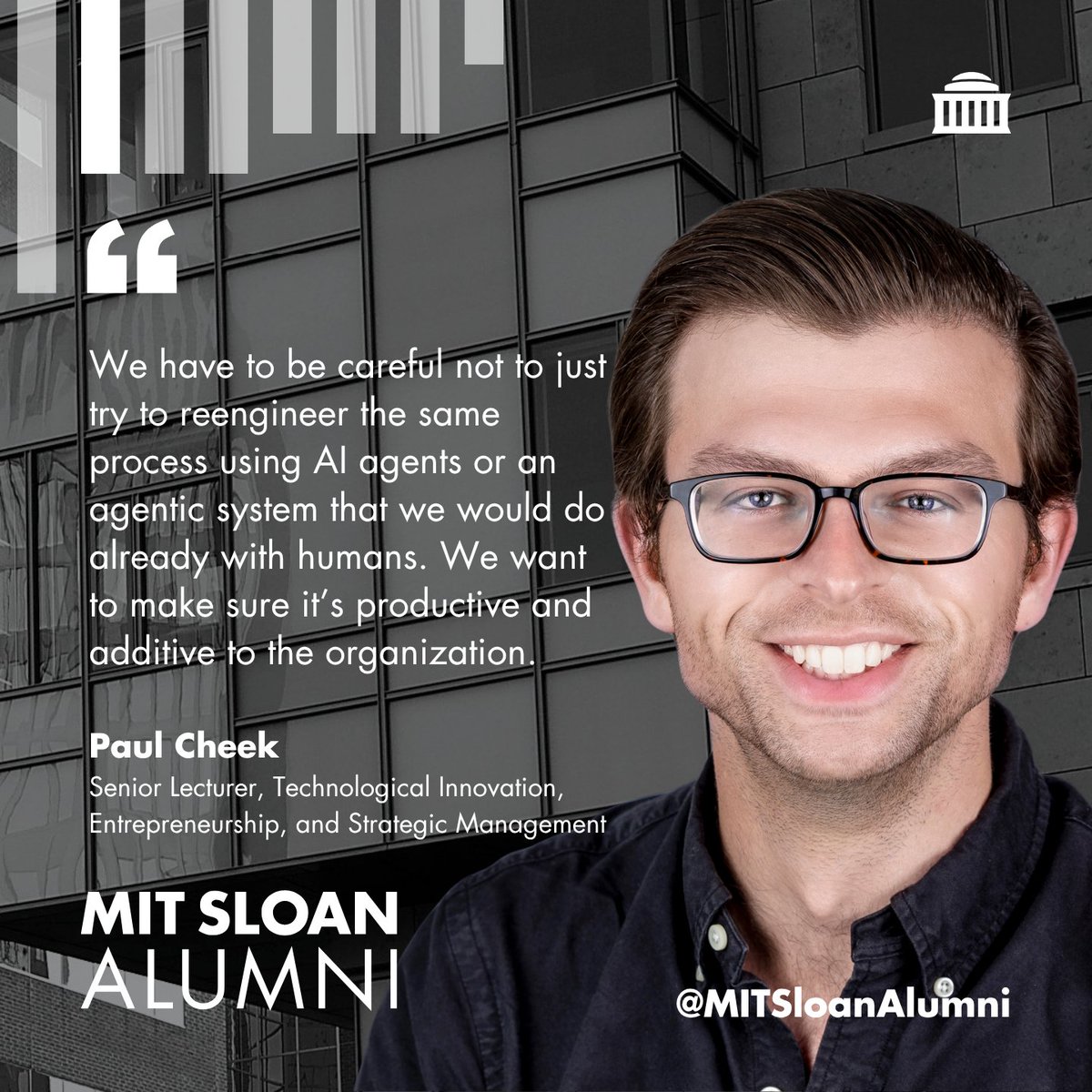
“AI-driven enterprises achieve phenomenal impact with far fewer resources in far less time. Companies are becoming more efficient, and they are emerging into the marketplace and stealing market share from incumbent organizations faster than ever before.” — @pcheek https://t.co/6ubhg1c1dN
MIT Sloan’s Taha Choukhmane co-authored a new paper, “AI Financial Advice: Supply, Demand, and Life Cycle Implications,” that measures and analyzes the quality of financial advice given by large language models.
Learn more at the link below.
https://t.co/QuMxZvbGLw
Leaders who foster collaboration, learning, and adaptability will be best equipped to help their organization navigate a rapidly evolving business ecosystem.
Learn more: https://t.co/gUXEa35Ffo
Instead of trying to anticipate every possible scenario up front, minimum viable governance creates a flexible foundation that can evolve alongside AI adoption. https://t.co/WdC90cuPsi
For a while, the conversation about generative AI was largely speculative. What might it do to our day-to-day work, our workplaces, our careers, and the economy? Now our AI coworkers have arrived in most workplaces and sectors. https://t.co/EwvJEYF2G9
At MIT Sloan Reunion 2026, Professor of the Practice Gary Gensler explained why he believes it will take time for AI to truly transform business.
Learn more at the link below.
https://t.co/tPb5JXUejR
Digital colleagues are AI-enabled systems that collaborate with people to perform complex work by combining multiple AI tools with enterprise rules and data. https://t.co/yW3MGwRKaX
These new MIT Sloan faculty members are experts in workplace instability, microfinance, human-AI interaction, digital economics, and more. https://t.co/C6buCMOaCQ
As artificial intelligence systems become more capable, companies will need to think beyond individual tools and begin managing AI as a “digital colleague” — part of how teams, workflows, and business processes operate. @MIT_CISR https://t.co/yW3MGwRKaX
Curious how your region could be affected? Explore prolonged drought projections by 2100, and how action changes impacts, using En-ROADS from @climateinteract + @MITSloan:
https://t.co/qxGEUi99Be
Amid the transformative promise of artificial intelligence, one significant question is “Will AI enhance welfare for all or generate wealth for just a few?” Learn about five investments that can close the gap between AI wealth and welfare: https://t.co/mNAknIqFO2
People are increasingly turning to artificial intelligence for financial advice, but will following it improve their financial standing? https://t.co/Lsqb1dY5Yx
McKersie's 1965 framework for labor bargaining became one of negotiation theory’s most enduring ideas — and helped guide a life of activism, mentorship, and academic leadership. https://t.co/Q8fa7f7xGK
Artificial intelligence presents business leaders with a difficult management problem: The risks are numerous and fast-moving and fall unevenly across organizations, sectors, and stakeholders. https://t.co/NESQAI84FN
Flexibility is a defining feature of the modern workforce. But, according to MIT Sloan’s Paul Osterman, that flexibility can come at a cost. https://t.co/poWEIVz7J8
Enterprises looking to make the most of agentic AI must rethink how work gets done and how teams are organized, without forgetting the human workers who set their companies apart.
Learn more at the link below.
https://t.co/JBFImJL0sU