A new report from the Global Climate Policy Project at Harvard and MIT offers a practical framework for comparing different carbon-pricing systems without forcing them into a single model | @HarvardSalata@MITSloan
Read the report here: https://t.co/McEIQgdjQW
Manny Barragan Alcaraz, VP at @BeneficialState, shares how #EnROADS helped bring climate insights to parts of his team.
#EnROADS, co-dev'd by @climateinteract + @MITSloan, helps organizations explore future climate pathways.
80+ endorsements: https://t.co/vdp5yaoGvX
“The impact that MIT can have by ‘cooling people, not spaces’ is enormous,” says Professor Christoph Reinhart, faculty lead for The MIT Climate Project’s Critical Cooling initiative.
Learn more: https://t.co/xDSWRyZ180
Curious how your region could be affected? Explore prolonged drought projections by 2100, and how action changes impacts, using En-ROADS from @climateinteract + @MITSloan:
https://t.co/qxGEUi99Be
New from Ask MIT Climate: Which parts of the planet are getting drier? Prof. @MathewABarlow of @UMassLowell explains why warming air can make droughts and downpours more intense–and why places like the American Southwest, Middle East, and southwest Asia are becoming more arid.
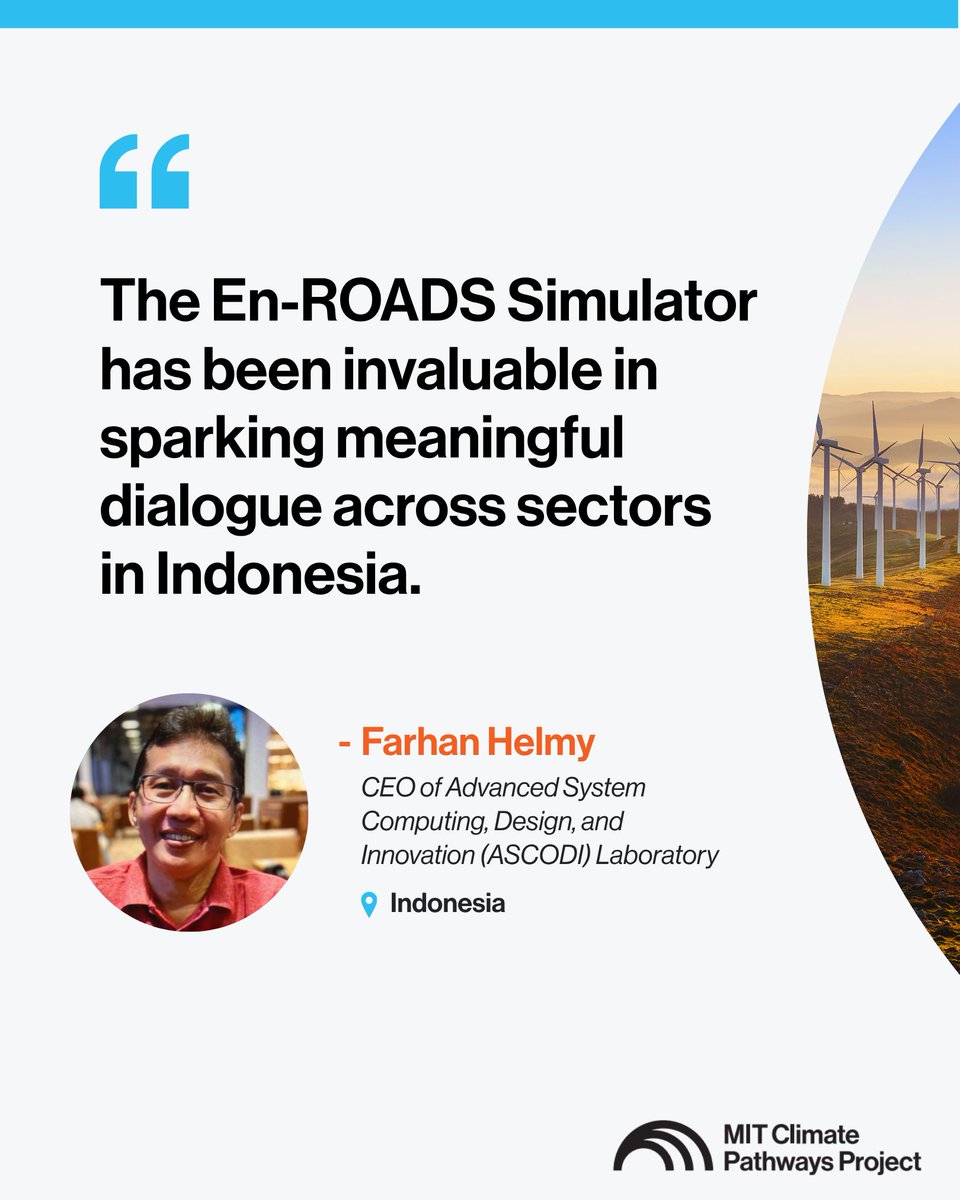
Farhan Helmy, CEO of ASCODI Lab in Indonesia, shares how #EnROADS helps spark important climate conversations across sectors.
#EnROADS, co-developed by @climateinteract + @MITSloan, helps leaders explore future climate pathways.
80+ endorsements: https://t.co/vdp5yaoGvX
Green energy and affordable utilities are not at odds, but our policies need to catch up to new technology. Research from @knittelmit suggests three key steps forward to reduce energy costs and make them more equitable. Learn more: https://t.co/gW83VamcKW
MIT researchers have developed a framework that combines fine-scale meteorology with energy infrastructure simulations, showing how climate-informed siting of wind, solar, and transmission projects can help reduce future energy shortfalls.
https://t.co/zFyNBH4Bp5
“The war has really highlighted the focus on energy security, and that’s good for climate-tech and for the clean energy transition,” says Catherine Wolfram. However, we still need climate policy, she warns. Learn more: https://t.co/MORTYKKUHR
Research co-authored by @MITSloan's @knittelmit estimates that American households are spending an additional $400 to $900 per year on average, with costs appearing across utilities, groceries, vehicle expenses, home insurance, and more. https://t.co/80g2TBAQiv
A new study co-authored by MIT Professor/CS3 faculty affiliate Christopher Knittel suggests flexibility in the timing of #electricity consumption could lower #energy costs associated with data centers. #datacenter
https://t.co/KqbRzq1vKv
“The end result is really up to us, and up to policy.” A new study from our Faculty Director Chris Knittel and researchers @mitsloan suggests flexibility in the timing of electricity consumption could lower consumer costs–but what about emissions?
https://t.co/FvyfER5Toe
How do geopolitical events shape energy prices? @knittelmit explains how geopolitical risk, from destruction of energy infrastructure to the perception of risky travel through Strait of Hormuz, affects oil and gasoline markets. #EnergyPolicy#EnergyMarkets
https://t.co/UFD7Q5aeSU
Dr. Frederik Zohm, R&D Executive Board Member at @MANtruckandbus, shows how #EnROADS links transport decisions to climate outcomes.
#EnROADS, co-dev'd by @climateinteract + @MITSloan, helps leaders explore system-wide impacts.
80+ endorsements: https://t.co/vdp5yaoGvX
Christy Loper from Robertson Foundation shares how #EnROADS helps funders focus on climate opportunities that matter most.
The simulator, co-dev'd by @climateinteract + @MITSloan, helps users compare pathways and prioritize actions.
80+ endorsements: https://t.co/vdp5yaoGvX
Our latest newsletter is out, with updates on how our research informed transmission policy + new policy insights on reducing barriers to energy-efficient buildings. It also debuts our refreshed visual identity. Feedback welcome!
https://t.co/zGLnVeLZ6w
When energy prices ⬆️, fuel use falls—but only up to a point.
In a @nytimes article, Catherine Wolfram notes that people + businesses need gasoline, diesel, and jet fuel despite ⬆️ prices.
Knowing which demand is flexible, and which isn't, matters.
https://t.co/Fu5ZJjZFBq
As AI drives data center growth, leaders face❓️s on power demand, reliability, costs, clean energy.
Chris Knittel discusses the challenges below. MIT research explores how flexible data centers could help💲⬇️, inc. reliability, ➕️ more clean energy.
https://t.co/ISsyulU9iA
@pablolucangeli, Professor and @Climatebase Founding Fellow, shares how #EnROADS empowered him to learn and act on climate change.
#EnROADS, co-dev'd by @climateinteract + @MITSloan, helps people turn climate learning into action.
80+ endorsements: https://t.co/vdp5yaoGvX