HOW EFFECTIVE ASSET OVERSIGHT IMPROVES LONG-TERM FIELD VALUE
Asset oversight isn’t just about daily operations it protects performance, revenue, and field longevity.
Proactive maintenance, monitoring, and production optimization extend asset life, reduce downtime, and prevent costly failures.
Well-managed fields generate predictable returns and support broader development goals.
Strategic oversight may cost more upfront, but the long-term value preserved often far exceeds short-term savings.
What strategies have you seen that maximize long-term value through asset oversight?
WHY ASSET OVERSIGHT IS ABOUT JUDGMENT, NOT JUST DATA
Data alone doesn’t guarantee safe or efficient operations judgment turns information into action.
Sensors, inspections, and real-time metrics provide insights, but operators must interpret them, balancing safety, production, cost, and environmental compliance.
Operational judgment anticipates failures, prioritizes interventions, and acts before small problems escalate.
Experience and decision-making are as critical as technology in protecting assets and ensuring reliability.
How do you ensure operational judgment complements data-driven insights in asset management?
HOW RENEWABLES FIT INTO AFRICA’S CURRENT GRID REALITIES
Renewables are essential, but Africa’s grids are fragile.
Limited storage and intermittent solar and wind mean large-scale deployment without support risks blackouts.
Phased integration is key: strengthen transmission, invest in grid management, ensure flexible backup, and deploy storage solutions.
Renewables aren’t a silver bullet.
Thoughtful sequencing of infrastructure, operations, and clean energy builds a reliable, resilient system that powers households, industries, and development.
How can renewables be integrated safely into emerging power grids without compromising reliability?
WHY OIL & GAS STILL MATTER FOR DEVELOPMENT FINANCING
Oil and gas often get criticized, but in Africa, they remain engines of development funding.
Hydrocarbon revenues support public services, infrastructure, industrial growth, and even renewable projects.
Phasing them out too quickly risks energy access, industrialization, and economic stability,with strategic governance, fossil fuel revenue becomes a bridge funding rural energy access, renewable integration, and local industry.
Balancing climate goals with immediate economic needs is not optional it’s essential.
How can oil and gas revenues be managed to support both development and a cleaner energy future?
WHY DEVELOPMENT OUTCOMES SHOULD ANCHOR TRANSITION CONVERSATIONS
Energy transition isn’t just about installing renewables or cutting emissions it’s about real, tangible development outcomes.
In Africa, energy systems must expand access, improve affordability, ensure reliability, and reduce emissions. Focusing on one goal without the others risks leaving millions behind.
Solar farms or wind projects are valuable, but if they don’t reach hospitals, schools, or small businesses, their impact is limited. Decarbonization should complement development, not replace it.
Anchoring transition discussions in development outcomes ensures policies are practical, inclusive, and impactful.
What development outcomes should guide energy transition policies in Africa, in your view?
THE LINK BETWEEN POWER RELIABILITY AND ECONOMIC DEVELOPMENT
Power supply matters. But power reliability is what drives real economic growth.
Every outage reduces productivity, cuts revenue, and forces businesses to operate below capacity. Over time, this discourages investment and slows job creation.
Reliable electricity changes the equation. It supports consistent production, strengthens critical services, and enables long-term economic stability.
More generation without reliability doesn’t solve the problem. System stability is what turns energy into growth.
What’s one strategy you’ve seen actually improve power reliability?
ENERGY TRANSITION AS A PROCESS, NOT A DESTINATION
Energy transition is often described as a destination. In reality, it is an ongoing process.
Energy systems evolve gradually. Infrastructure takes decades to build, operate, and replace. New technologies integrate step by step into systems that already exist.
For many regions, especially across developing economies, the transition is not simply about replacing one energy source with another,It involves expanding energy access, strengthening grid infrastructure, improving operational reliability, and gradually integrating cleaner technologies.
Each of these stages builds on the previous one.
A successful transition therefore requires sequencing. Systems must remain reliable while they evolve. Infrastructure must adapt while demand continues to grow.
Thinking of energy transition as a process encourages long-term planning and realistic expectations. It recognizes that sustainable systems are built over time, not achieved overnight.
How should policymakers and industry leaders balance speed and system stability in the energy transition?
Why “Just Leapfrogging to Renewables” Isn’t a Serious Plan
“Leapfrogging to renewables” sounds simple but energy systems aren’t.
Solar and wind are essential, but they’re variable. Without strong grids, storage, and backup generation, reliability becomes a challenge.
Many developing systems are still building core infrastructure, which limits how fast renewables can scale.
The goal isn’t to slow renewables, but to integrate them properly.
Energy transitions work when technology, infrastructure, and operations grow together.
What do you think is the biggest barrier to scaling renewables?
Follow for more insights on energy systems ⚡
The Difference Between Reported Production and Operational Reality
Production numbers tell a story but not the full story.
Reported figures show output over time, but they often hide what’s really happening behind the scenes. Equipment strain, deferred maintenance, and operational constraints can exist even when targets are met.
A system can look stable on paper while operating under pressure in reality.
True insight comes from looking beyond the numbers to understand the conditions sustaining them.
How often do you think production reports reflect the full picture?
Follow for more insights on upstream operations 🔧
How Small Operational Decisions Lead to Big Production Losses
Production losses rarely come from one major failure. They usually build over time through small, everyday decisions like delayed inspections, postponed maintenance, or minor issues left unresolved.
Each of these may seem insignificant, but when they accumulate, they lead to reduced output, increased downtime, and declining performance.
In upstream operations, consistency in handling small tasks is what protects long-term production.
What small operational habits do you think have the biggest impact?
Eid Mubarak to our Muslim community 🤍
As this beautiful season of reflection and celebration unfolds, we wish you peace in your hearts, joy in your homes, and blessings in all you do.
May the values of sacrifice, faith, and gratitude continue to guide and strengthen you.
From all of us, have a fulfilling and joyful Eid.
Why Efficiency in Upstream Operations Isn’t Just About Cost Cutting
Most people think efficiency = spending less. That’s not the full picture.
In upstream operations, efficiency means keeping wells running smoothly, avoiding downtime, and preventing costly failures. When systems are reliable and data is accurate, operators can make faster, better decisions even when conditions change.
Cutting costs the wrong way can lead to equipment breakdowns, safety issues, and production losses that end up costing more.
Real efficiency = safe operations, steady output, and smart decision-making.
Follow for more insights on upstream operations 🔧
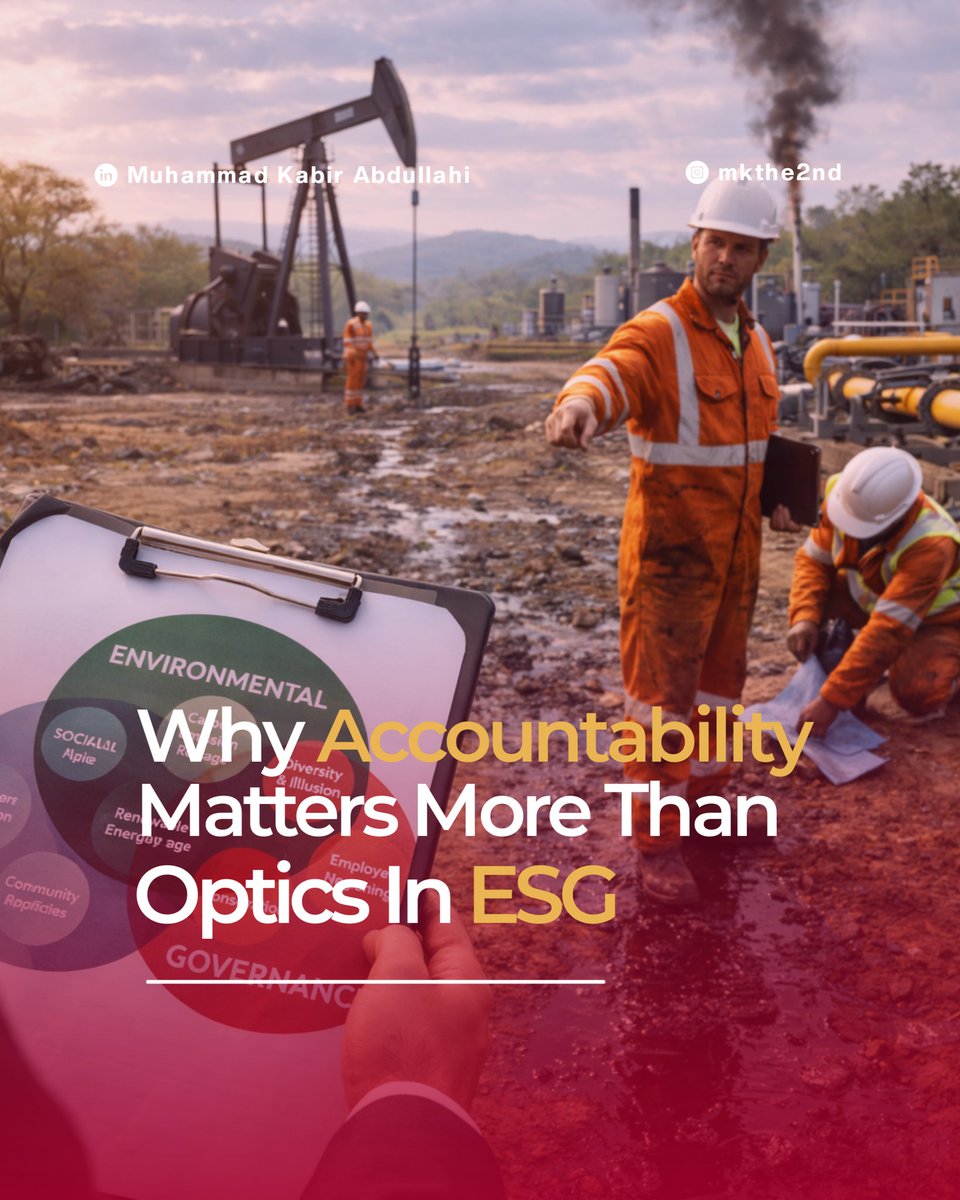
WHY ACCOUNTABILITY MATTERS MORE THAN OPTICS IN ESG
ESG rarely fails because ambition is weak. It fails when accountability is optional.
Targets are announced and reports are published. But when performance falls short, what actually happens?
Without consequence, ESG becomes theater. With accountability, it becomes governance.
Real credibility comes from three things: measurement, transparency, and consequence. Remove one, and the system weakens.
The real question: where does ESG failure carry real consequences — and where is it hidden by optics?
ENVIRONMENTAL, SOCIAL, AND GOVERNANCE (ESG): WHAT IT REALLY MEANS BEYOND INVESTOR SLIDES
Environmental, Social, and Governance (ESG) often looks impressive in presentations. But operational resilience is not built on slides.
Across the energy sector, ESG is frequently reduced to disclosures, scorecards, and reporting language. In reality, ESG is not just a communications framework it is a risk management architecture.
At its core, ESG measures governance discipline, social license to operate, environmental exposure, and long-term operational resilience.
When ESG is treated as branding, it becomes cosmetic. When it is embedded into decisions, it becomes strategic.
Real ESG shows up in maintenance culture, safety enforcement, procurement transparency, regulatory compliance, and leadership accountability.
If ESG does not influence operations, capital allocation, and project execution, it is not ESG it is marketing.
So the real question is: Where does ESG show up in daily operations beyond the annual report?
HOW INFRASTRUCTURE CONSTRAINTS SHAPE PRODUCTION PERFORMANCE
Where does production really get limited? In many cases, it is rarely at the wellhead.
Across many African markets, the real constraint is not resource potential, it is system capacity.
Wells can perform and generation capacity can increase, but if pipelines are constrained, output slows.
When transmission lines are weak, power generation cannot scale. When export terminals are limited, production eventually stalls.
Infrastructure quietly sets the ceiling on energy performance.
It rarely trends on social media and it rarely dominates headlines, yet it determines how much energy can move, how quickly output can grow, and how reliably supply can reach markets.
The real question is this: Are energy strategies investing enough in the systems that carry energy, or only in the assets that produce it?
Disruptors ship. They deliver new value, not just new vocabulary. If you want to “change the game,” show the product, show the service, show the results.
#MonumentalLeadershipMorning
Fortify your home base. Your leadership capacity depends on emotional stability. When home is stable, you think better, decide faster, and recover quicker.
#MonumentalLeadershipMorning
ENERGY ACCESS VS CLIMATE AMBITION: UNDERSTANDING THE TRADE-OFF
What happens when climate ambition moves faster than energy access?
Across many African countries, millions still lack reliable electricity. Industries operate below capacity and businesses rely on diesel generators to survive. At the same time, global decarbonization pressure is accelerating.
The tension is clear: expanding generation improves access, but restrictive emissions targets constrain choices. The issue is not whether Africa should transition it should,the issue is sequencing.
Climate ambition must align with system readiness. When ambition ignores development gaps, resistance grows. When development ignores climate risk, vulnerability compounds.
Energy transition in Africa will succeed only when ambition meets operational reality.
Are climate targets realistic if system readiness is ignored?
If the mission is not your obsession, it will not become a movement. Attention is your main asset. Split attention creates half-built systems, half-finished products, and weak momentum.
#MonumentalLeadershipMorning
Be unconquerably strong. Strength is calm under pressure, not loudness. The team watches how you react to setbacks, that becomes the culture.
#MonumentalLeadershipMorning