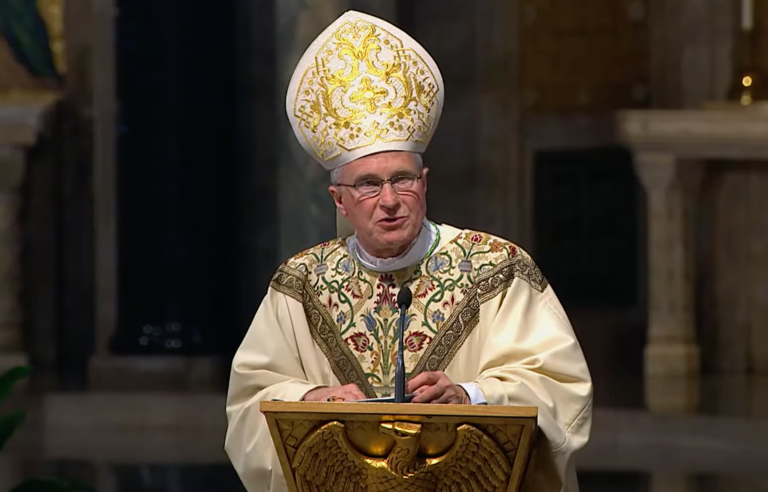
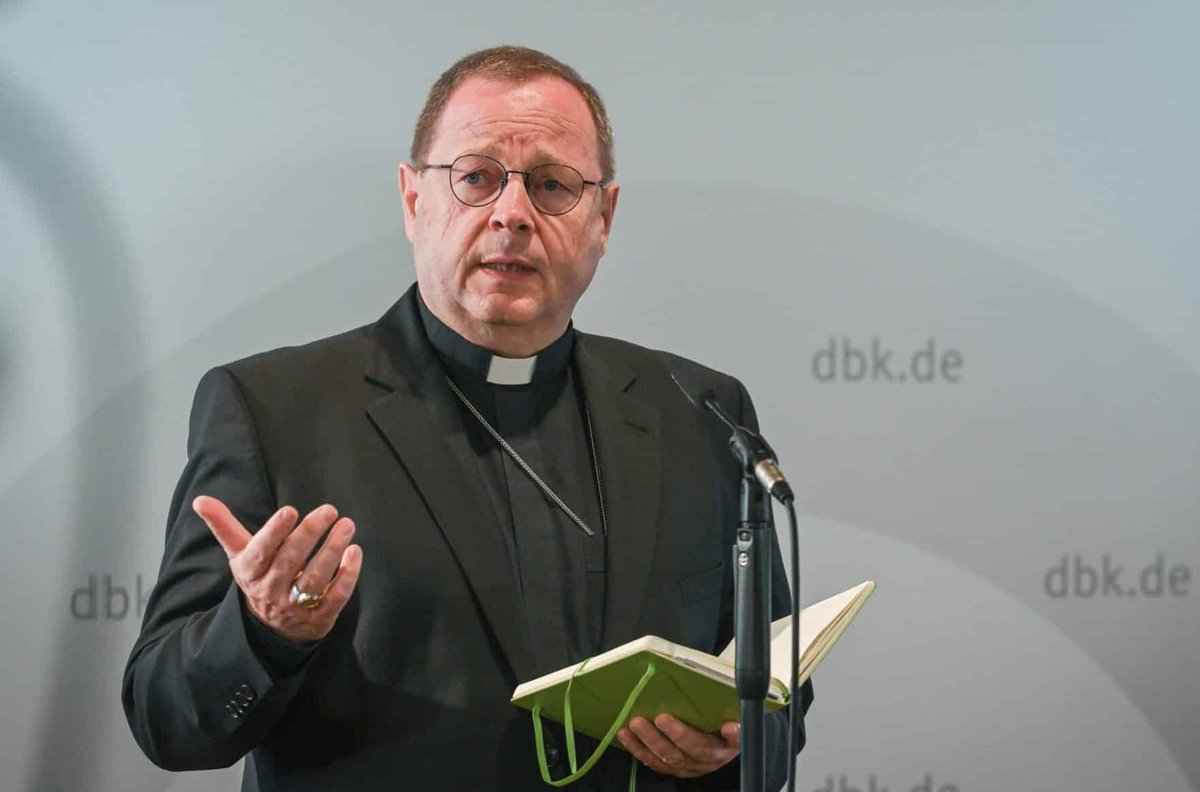
Archbishop Broglio on the Latin Mass – “someone told me that Traditionis Custodes was a solution in search of a problem”
The former @USCCB president & current ordinary of @MilArchUSA called for wider availability of the old rite:
“I believe it’s not necessary to stifle this desire to worship God in this way.”
Details on @CatholicHerald via @tribuchretienne
Today Pope Leo told clergy in Argentina not to justify certain actions by citing “pastoral” concerns, commenting ––
“Something even more serious can happen: that we learn to justify everything, finding ‘pastoral reasons’ or communal or personal motives for doing what we know is wrong.”
Pope Francis famously & controversially approved the interpretation of Amoris Laetitia offered by the Buenos Aires bishops – namely that the divorced and 're-married' could receive Holy Communion out of pastoral concern.
Analysis of last 48hrs of papal trip in Argentina below @CatholicHerald
‘The Church in Argentina needs you,’ Pope Leo said during a homily at Mass in Buenos Aires.
“We are all called to holiness,” he added in Córdoba. “Our task on earth consists precisely in this: to achieve perfect union with God. This call, moreover, is always of a missionary nature.”
✍️ Michael Haynes
https://t.co/nuAsqprrLk
JUST IN: Archbishop Hector Aguer has died aged 83.
He was formerly Archbishop of La Plata in Argentina & succeeded in the see by now-Cardinal Fernández
An outspoken critic of much of Pope Francis' pontificate, including restrictions on the Latin Mass, promotion of Synod on Synodality
The Archdiocese announced that he died today, saying funeral arrangements will come later
His death occurs on Pope Leo's last full day in Argentina
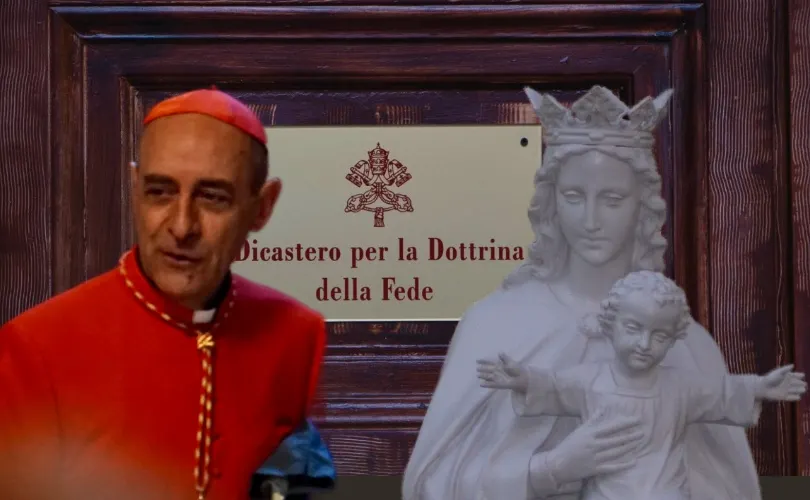
As Pope Leo arrived in Argentina's capital of Buenos Aires on Sunday, a series of posters lined the main street, calling for him to remove Cardinal Victor Manual Fernández from office.
✍️ Michael Haynes
https://t.co/8gkKOFiJaG
Posters line one of the main streets in Buenos Aires as Pope Leo arrives
They are calling for the removal of Cardinal Fernández as prefect of the Dicastery for the Doctrine of the Faith.
Leo arrived in the city today & will be in Argentina until Wednesday
An entire wall in Buenos Aires’s Avenida de Mayo plastered with anti-Tucho posters. The message asks for the removal of Tucho for “the good of the Church” with a QR code link to a heretical homily. @Pontifex_es@Pontifex#LeoXIV#Argentina#CatholicChurch
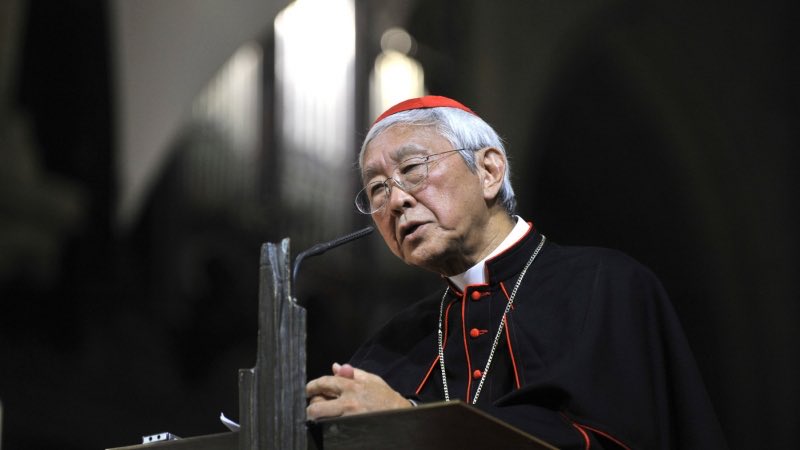
JUST IN: Cardinal Zen calls for Pope Leo to remove Cardinal Grech, Cardinal Hollerich & Cardinal Fernández from their roles
He also urges Pope Leo to put an end to the Synod in Synodality & its follow up stages
“If we now seek to accommodate the world, we betray our own mission,” he says re the Synod
While Remembering St. Charles Borromeo
(A) Today is the feast day of St. Charles Borromeo. He was a great Archbishop of Milan, the largest diocese in Italy.
The Council of Trent, which had to resolve many problems, had taken place at that time. The Protestant Reformation contained heresies and denied the sacraments—rejecting the Eucharist and the true priesthood, and the council served as a Counter-Reformation.
However, there were also internal issues within the Church that required a thorough reform. The powers of the nobility had weakened the Church, and the formation of the clergy had been greatly neglected.
The Council lasted 18 years, under the leadership of three popes (Our Second Vatican Council lasted four years under two popes: John XXIII, who began it, and Paul VI, who continued and concluded it). A great deal of work followed the Council of Trent: many diocesan synods in Milan and in many other dioceses, partly under the influence of St Charles Borromeo, truly brought forth the fruits envisioned by the Council of Trent.
(B) Many years after the Second Vatican Council, we must regrettably acknowledge today that it has not been sufficiently fruitful. It has been under constant attack by those who claim to be “continuing” the Council—arguing that its “reform” was not completed—while, on the other hand, there are those who suspect that the Council contains assertions contrary to the Tradition of the Church.
Following the example of St. Charles Borromeo was the Archbishop of Kraków, who later became Pope John Paul II. He worked strenuously with his diocesan community to ensure that the Council’s documents were thoroughly understood and their teachings put into practice. Obviously, this did not happen in all the dioceses of the Church.
Popes Paul VI, John Paul II and Benedict XVI did a great deal to ensure that the Council achieved its desired purpose, and they succeeded to a certain extent.
Many bishops found themselves in difficulty after the Council, because they did not know how to explain to the faithful precisely what the Council had changed in the life of the Church and what it had not changed. The Holy See, under the leadership of Cardinal Ratzinger, following extensive consultations throughout the Church, drew up a “Catechism” containing the entire dogmatic, moral and liturgical doctrine of the Church, set out in a systematic order. However, the sheer volume of the “Catechism” may have put people off, and not many have actually studied it.
(C) Forces opposed to the Council have been troubling the Church throughout these years.
Regrettably, in these recent years we have had the supreme head of our Church who, whilst proclaiming the great validity of the Second Vatican Council, was in fact not faithful to its decrees.
Pope Francis was certainly admirable for his kindness and his special concern for the poor and the weak. However, this kindness and predilection have lacked balance; he seemed to believe that, out of compassion for these people, one can even compromise on the truth.
He believed that the primary danger within the Church is clericalism, and thought that through a general consultation of the People of God he could succeed in having his line of thinking approved. He was certainly a reformist. He destroyed many good things built up by his predecessors.
He did not appreciate the entire struggle in defence of Orthodoxy waged by John Paul II and Pope Benedict XVI.
He abolished the Synod of Bishops which had been established by Paul VI towards the end of the Second Vatican Council as a sort of continuation, miniature version, of the Council, intended to provide the Pope with counsel from the episcopate of the entire Church through their elected representatives.
This Synod has been done away with, and in its place, something else has been created: what might be termed “a democratic consultation of the entire People of God” (See my address to the General Congregation of Cardinals prior to the conclave).
(D) How can the Pope directly consult the entire People of God? Pope Francis said that a shepherd must have a “feel” for the scent of his sheep, but how can a Pope in Rome possess this sense? It is the bishops who can truly sense the scent of their own sheep, and they, in turn, bring this insight to the Pope so that he may see what today’s problems are and how to tackle them.
By emphasizing the etymological meaning of the word “synod,” this Synod on Synodality has overlooked the historical reality of what synods actually are. A synod is, by definition, a matter for the bishops.
The fact is that behind all this lay “hidden agendas”.
After all these years of the synodal process, they have failed to get their “hidden agendas” (in fact, not so “hidden”) fulfilled. There was relentless manipulation and strict control of the process, yet it was a failure. Despite every effort to stifle genuine discussion, the objectives that the Pope evidently entrusted to the Synod Secretariat were not achieved.
Even within the limited time for free speech in the assembly, it was evident: that Synod members rejected those objectives: changing the hierarchical constitution of the Church, ordaining women to the priesthood starting with the diaconate, the free choice of celibacy for the Roman clergy, and the sexual morality radically “updated” (?) under the L.G.B.T.Q. banner.
As this attempt failed, the Pope then removed these “controversial” topics from the Synod and handed them over to “study groups”, the formation criteria of which were unknown. And these groups were expected to report their conclusions directly to the Pope.
(E) That the cause of homosexuals had been one of the “hidden agendas” was highlighted by the publication of the document “Fiducia Supplicans”, which approved the blessing of same-sex couples (issued between two sessions of the ongoing Synod, without consulting the Synod participants).
The document threatened to cause a terrible breaking up of the Church; Pope Francis and the Cardinal had to appease the public outcry with an attitude of “condescending understanding”, yet without any genuine retraction.
That the cause of homosexuals is particularly close to Pope Francis’ heart is evident in his special favor toward Father James Martin, S.J., of “Outreach,” as well as his famous quote: “Who am I to judge?”
And recently, something has happened which made us realize, to our horror, that the whole lengthy discourse on the synodal process is intended to provide a tool for justifying anything.
At the end of Section D, we mentioned “study groups”. Now, the final report of Group 9 has been published, in which assuming (arbitrarily) that the synodal method is sacrosanct when it comes to the study of homosexuality, they reached the conclusion that the sexual act between a homosexual couple is a gift from God!? Is this not blasphemy? It is incredible that such a thing could appear in a publication issued by the Holy See!
Confusion has reigned for years, but now it has reached the bottom.
The groups are supposed to submit the results of their study to the Pope; now the Pope is Pope Leo, did he see the report before its publication? And did he give his consent?
Everything that happens in the Church falls under the jurisdiction of the reigning Pope (he could even cut short an ongoing Ecumenical Council. There is a saying: “no Pope rules from the grave”.)
[By the way, during the Jubilee Year, there was that “triumphal entry” into St Peter’s, which was obviously a “Pride Parade”– a true desecration of the Basilica – and yet no protest from the Holy See!?]
(F) It is said that the doctrine of the faith does not consist solely of sexual morality. This is true; the most important thing is the love of God. Yet, no one rejects God for no reason; rather, it is always because one is drawn towards some other values—one ends up worshipping another (false) divinity.
St Paul, in his Letter to the Romans, says that the most obvious sign of the rejection of God is precisely this sin of homosexuality.
The enemies of God, the three enemies of our salvation are: our passions, the world and the devil. But where does the destruction of God in souls begin? Precisely with this deviation from sexual morality! For concupiscence lies within our flesh, and when indulged, it becomes an addiction, causing us to lose the power of the will. That is why even the devil says that the most important thing is to destroy the family.
Moreover, it is not true that we insist solely on sexual morality; the question of the Church’s hierarchical structure is far more fundamental today. Jesus founded the Church upon the apostles, with Peter as their head. Now the Church must be guided by the bishops, with the Pope at their head. But the entire course of the recent synod on synodality ignores the importance of the bishops; it is no longer a true synod. By emphasising the etymological meaning of the word “synodality” as “traveling together” or “participation”, the significance of the historical reality of synods has been sidelined: synods and councils of bishops within the Church, and the synod presided over by the bishop within the diocese.
With the conclusion of the second session of the Synod, a final document was approved, which Pope Francis has incorporated into his own magisterium. He stated that it is not strictly normative; rather, each episcopal conference is to implement it experimentally, in the manner deemed most appropriate for its own local culture. But in this way, we will end up resembling the Anglicans (no offense intended toward the Anglicans, but we are different).
(G) The world is in a state of great confusion.
I was not present at the recent Consistory in June, but I noted from the press that during the discussion on the question “In what kind of world are we to carry out our mission today?”, many cardinals remarked that the fundamental problem is the loss of meaning, which is why an ever-increasing number of young people are taking their own lives.
We possess the solid doctrine that gives meaning to life, for we know that God created us for eternal life. This truth resides within the Catholic Church, but only if the Catholic Church remains faithful to the entirety of the doctrine handed down from the Apostles.
If we now seek to accommodate the world, we betray our own mission.
So let us put a stop to this so-called “Synod on Synodality”!
May the Holy Father grant Cardinal Grech and Cardinal Hollerich a long vacation; he cannot entrust the governance of the Church to the Secretariat for the Synods; on the other hand, closer communion between the bishops and the Pope, between the cardinals and the Pope, is most welcome.
People are longing for something solid. Sadly, the world is dominated by modern atheistic philosophy and nihilism, and an attitude of relativism is now permeating the Church. Let us strive to testify to the intact treasure of our faith, so as to offer hope to all of humanity.
The Holy Father should also replace the head of the Dicastery for the Doctrine of the Faith.
It is well known that this cardinal has written things in the past that he would not write today.
But most disconcerting of all is the letter Pope Francis wrote to him upon his appointment as head of the Dicastery; in that letter, the Pope assigned him a task quite different from the one traditionally entrusted to that office—no longer the defense of doctrine, but rather to encourage the theologians.
I am old, but I believe my mind is still clear. I thank those who have formed me with the doctrine of the Church, which is a great gift that the Lord has bestowed upon so many of us. Let those who are keenly aware of the urgent need for the Church to return to the unity of the true faith, raise their voices to encourage and support the Holy Father as he undertakes this arduous task.
Of course, we must pray intensely for the Holy Father; only Almighty God can grant him the steadfastness and prudence he needs.
“May the Lord preserve him,
and give him life,
and make him blessed upon the earth.”
Translated 6/11/2026 #synodality #synodofbishops #PopeFrancis #Jesuits #Grech #Hollerich #DicasteryfortheDoctrineoftheFaith #Jamesmartin https://t.co/g9ABYTvwzn
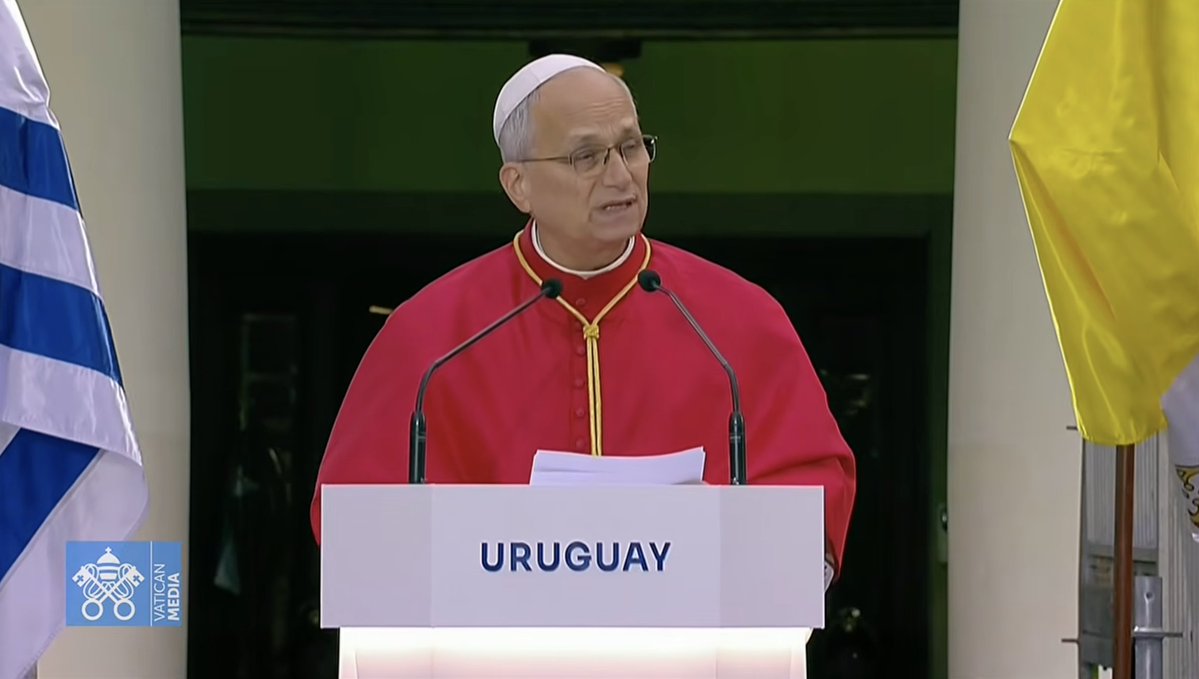
Pope Leo has urged Uruguayan clergy to pray & fast for more vocations in the nation
Offering Mass today, he added “I encourage you to continue the evangelising mission with enthusiasm”
“Be bridges, so that many may meet Jesus”
Full @CatholicHerald analysis on the 1st day of the trip ––
https://t.co/1Ufbu879ez
NEW: Leo XIV made a firm defence of the unborn, during his 1st speech in Uruguay today
“The unborn already belong to the human family and to the future of their people. Their absolute dependence on their mother does not diminish the dignity to which they are entitled or the protection they deserve.
Welcoming a new life requires that fathers assume their responsibility alongside mothers, that the family offer its support, and that social conditions exist that allow both parents to raise and care for their children.
The protection of the unborn and the support of those who welcome them are inseparable.”
Some politicians are currently seeking to widen abortion access in Uruguay, but are reportedly waiting until after the papal visit
Abortion is currently legal on demand up to 12 wks.
After that, it is legal to 14wks for “fatal fetal abnormalities,” & after that only for “health risks” to mother
Pope Leo has arrived in Uruguay, where he will stay until departing for Argentina on Nov 8.
On the plane he fielded questions & spoke about the trip ——
Re voting in the US Midterms, he said: “I have already made a statement about this. I am proud to be American and to exercise the right to vote.”
Re his cancer: said he “had no doubt and was convinced that this trip had to go forward.”
Added his health comes from “faith. The Lord is very generous to me.”
Re visiting Peru, he said: it is “one of my many homes…I’m very happy to be going back there.”
Re visiting Argentina, he said it would be “a tribute” to Pope Francis, “in the sense that I am visiting his country, which he was unable to visit.”
Pope Leo XIV left Rome this morning to begin his voyage to Uruguay, Argentina & Peru
He will return to Rome on Nov 17, after taking 14 plane & helicopter flights, travelling over 19,000 miles during the course of the 12 days
Full coverage as the trip happens on @CatholicHerald
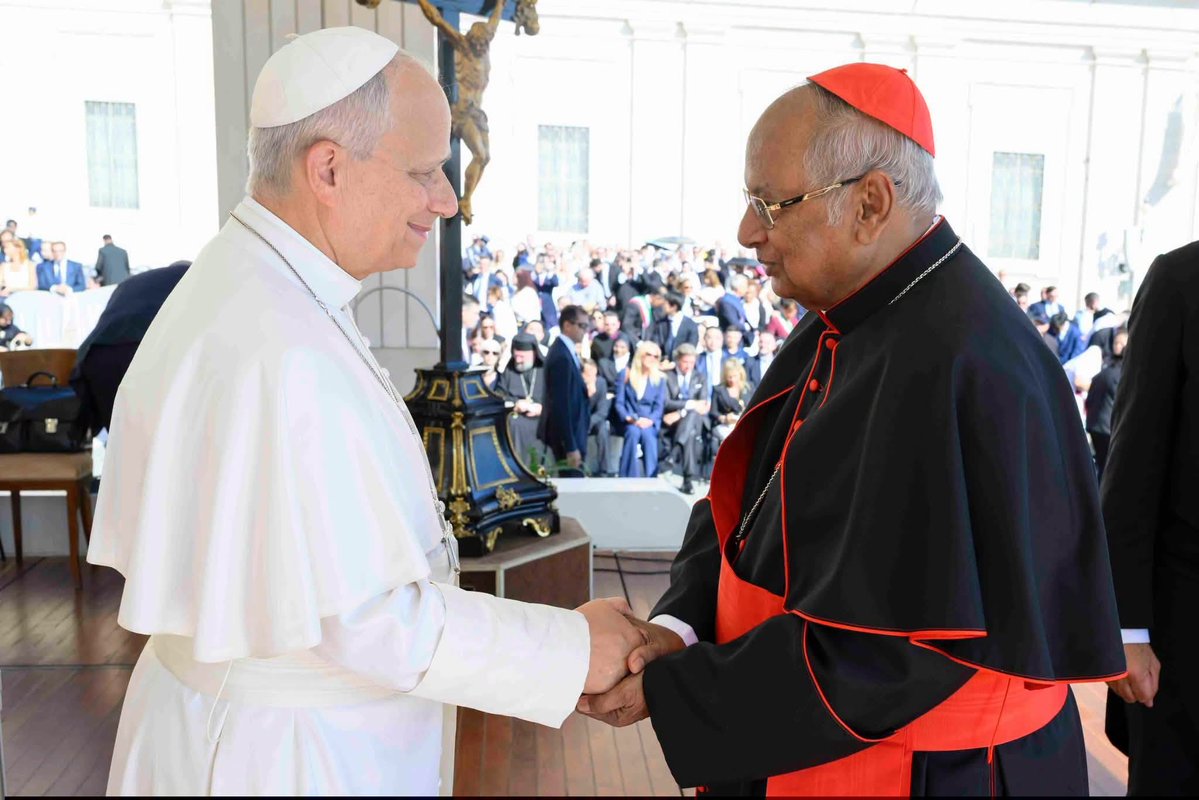
Cardinal Ranjith –– the Church in West has abandoned its “own spiritual & liturgical heritage”
Re the growth of the Latin Mass – it is a “natural consequence of a conviction” about the deeper meaning of life.
“Unfortunately, the Western Church has succumbed to the temptation of despair & lack of faith, abandoning its own spiritual & liturgical heritage thinking that it was enough to go with the flow.”
Cardinal Malcolm Ranjith states that the loss of Catholicism in the West is in part due a “a theological revolution that swept away the strong pillars of Catholic theology.”
✍️ Michael Haynes
https://t.co/E3BAf0uJOm
NEW: Cardinal Ranjith on the loss of Faith in the West
Process of securalism was “accelerated by a theological revolution that swept away the strong pillars of Catholic theology.”
“The forms of worship, moral principles and hierarchical structure that characterized the Church before the war were considerably weakened.”
Via @tribuchretienne details soon @CatholicHerald
Pope Leo XIV left Rome this morning to begin his voyage to Uruguay, Argentina & Peru
He will return to Rome on Nov 17, after taking 14 plane & helicopter flights, travelling over 19,000 miles during the course of the 12 days
Full coverage as the trip happens on @CatholicHerald
Marian Theologians Renew Appeal to Cardinal Fernández Over Vatican Doctrinal Note
A year after the publication of Mater Populi Fidelis, the International Marian Association says its detailed criticisms remain unanswered.
https://t.co/oRwQnRzRNI
Cardinal Parolin defended the Sino-Vatican deal today as he took the stage with Beijing's Archbishop Li Shan
Abp Li is president of the state-approved church in China
He joined Parolin at a high-profile Vatican conference bringing Chinese & Vatican prelates together
Li committed the Chinese church ever more to the government's policy of Sinicization, saying that this was in line with Vatican II
Full analysis below
Communion, inculturation, “Sinicization” and dialogue were the watchwords at a high-profile conference in Rome today, marking the 100th anniversary of the consecration of the first Chinese bishops.
✍️ @MLJHaynes
https://t.co/b9ELeGigUW
Pope Leo hosted Bob Dylan at the Vatican today.
The meeting was private and not included on the Pope’s calendar or scheduled events.
Leo gave the singer a rosary, whilst Dylan gave the Pope a copy of his autobiography.
1yr ago today, Cardinal Fernández published Mater Populi Fidelis which argued ––
“Given the necessity of explaining Mary’s subordinate role to Christ in the work of Redemption, it is always appropriate to use the title Co-redemptrix to define Mary’s cooperation.”
Since then, numerous Mariologists and leading prelates have defended the ancient title.
Most recently, Fernández's predecessor at the CDF, Cardinal Müller, did so at a high-profile conference by the Vatican, saying ––
“Therefore, when Mary is called Co-Redemptrix in Catholic piety and theology, this is neither a misleading attribution nor an enthusiastic exaggeration, but a truth objectively contained in revelation.” {Full conference details & texts on @PerMariam}
Contrary to the aims of MPF, the past year has seen discussion & defence of the title “Co-Redemptrix” reach new heights, with the document arguably undermining itself.
Indeed, referencing the text's preparation, CDF official Fr Gronchi told EWTN last yr that “no collaborating Mariologists could be found” – an unprecedented move which he said “can be understood as dissent” with MPF.
Pope Benedict XVI & the Vatican repeatedly requested the German bishops use “for many” in the Consecration formula, rather than “for all”
He re-issued the request in 2012, via a detailed theological letter
Benedict also called the German bishops to catechise the faithful about the meaning of the term.
14yrs later & the German bishops are still rejecting that request, while now adding “inclusive” language to the Missal & warning about “strongly masculine images of God”
A revision of the German translation of the Missal will feature “inclusive” language, as the bishops of the German-speaking nations warned about using “strongly masculine images of God”.
✍️ Michael Haynes
https://t.co/gHnVXrr1eJ
NEW: Bishop Bätzing has argued that homosexuality is not a factor in clerical abuse ––
“It is not the homosexual orientation of priests that constitutes a risk factor, but rather the taboo surrounding it, which can foster dependencies and a culture of silence”
He cited a survey in which 63% of the 3,600 victims were male.
Bätzing blamed the “taboo-ridden approach to sexuality and sexual orientation” as partly responsible for the levels of abuse
Details @CatholicHerald