The World Lives Here.
Canada is all together different. Truly unique. And so is our relationship to the beautiful game. This is our opening to the 2026 World Cup. Narrated by Kiefer Sutherland. #FIFAWorldCup
🏡 Vieillir au bon endroit : la plupart des personnes âgées souhaitent vieillir chez elles
Les résultats de l'Enquête 2025 de l’INV sur le vieillissement au Canada montrent que la grande majorité des personnes âgées canadiennes souhaitent rester chez elles à mesure qu'elles vieillissent — mais beaucoup ne sont pas encore prêtes à le faire.
• 81 % des personnes âgées souhaitent rester chez elles ou emménager dans un logement plus petit à mesure qu'elles vieillissent
• 90 % des âgées propriétaires souhaitent vieillir chez elles, contre 65 % des locataires
⚠️ Des lacunes persistent en matière de préparation :
• Seuls 49 % estiment que leur logement est parfaitement adapté au vieillissement
• 62 % des âgées n’ont apporté aucune modification ni prévu de travaux pour préparer leur logement à les aider à vieillir chez elles
• Seuls 18 % ont mis de l’argent de côté pour des soins à domicile ou des rénovations et 18 % ont installé des dispositifs de sécurité.
Favoriser le vieillissement chez soi implique d’investir dans des logements accessibles, des aménagements du domicile et des aides communautaires qui permettent aux personnes âgées de rester en sécurité et autonomes.
🔗 Lire le rapport complet de l’INV https://t.co/aVQrhi0nwo
L’Enquête 2025 de l’INV sur le vieillissement au Canada a été réalisée avec le soutien de Manuvie.
#VieillirChezSoi #LogementEtVieillissement #VieillissementEnSanté #INV
Attenborough at 100 — A Sting Cut
We know what humans think of David Attenborough: the greatest broadcaster in TV history. But what do the animals think?
More than 1 in 3 older inpatients in this study were dehydrated.
Dehydrated patients: 13% higher odds of falling (OR 1.13, P=.002).
↳ Dehydration is cheap to fix - but easy to miss.
💧💧💧💧💧💧💧💧
⇉ Do you check fluid status on every ward round?
Reorientation tip in #delirium: Instead of repeatedly asking "Do you know where you are?" (which can increase frustration), provide orientation information naturally in conversation.
Today is World Delirium Awareness Day.
Delirium is a sudden change in thinking or behaviour and is often a sign of a serious underlying medical problem.
Early recognition can make a critical difference.
Learn more and explore our #delirium resources.
#WDAD2026
Today, on World Delirium Awareness Day, we seek to raise awareness about #delirium.
At the heart, @NIDUS_Delirium exists to support a collaborative, worldwide network that advances scientific research on delirium in older adults.
Learn more our ongoing work: https://t.co/JWAG0Ew1h7
#WDAD26
In hospitalized older adults, language barriers are linked to higher delirium rates, and among those with delirium, greater use of restraints and antipsychotics. Communication is care. Learn more, and find multi-lingual resources➡️https://t.co/xSKBf982nZ #WDAD2026#sfCare
What is World Delirium Awareness Day? This annual event raises awareness about #delirium and its impact on patients, families, and healthcare systems.
Learn more and find out how to get involved with #WDAD2026: https://t.co/mC1UekciOo
As I just told reporters, this is the single largest mass sexual assault allegation in our Canadian LTC history.
It should be national news yet barely anyone is talking about it.
What if this happened in a daycare?
Haloperidol is a very poor treatment for urinary retention.
When a person looks agitated, systematically check for direct causes of distress.
#delirium
Information on #delirium for carers from the Regional Geriatric Program of Toronto. We need to make providing this kind of information the norm, not a rarity.
Let's look at delirium and dementia:
Episodes of delirium: more rapid progression of dementia.
Delirium survivors: x3-fold higher risk of future dementia.
➡️ We really need the support of dementia charities in helping improve delirium care.
#delirium#dementia#medtwitter
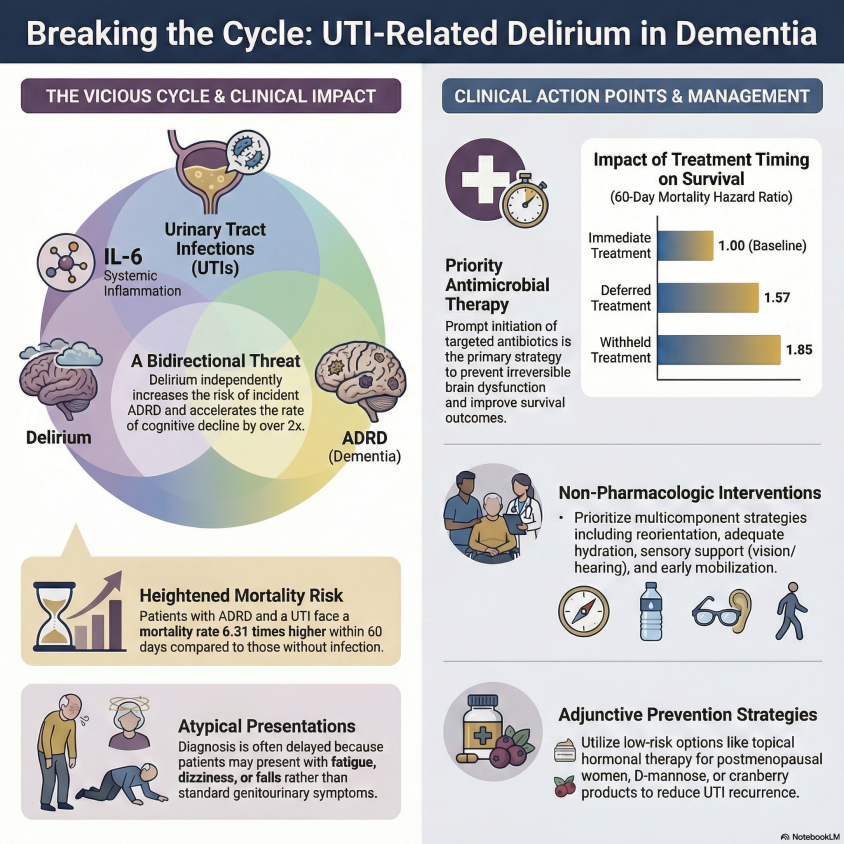
New review in Alzheimer's & Dementia on UTI-related delirium in dementia.
Key tension: UTIs are overdiagnosed as causing delirium.
But they're also a genuine and common trigger, especially when the patient can't report symptoms.
60-day mortality 6.31x higher. Delayed Abx treatment: HR 1.57. Abx withheld: 1.85.
We need to hold two ideas at once: stop reflexive urine-dipping AND take UTI seriously when delirium is the presenting feature.
Kim S et al. Alzheimer's Dement. 2026;22:e71184
#Dementia #MedTwitter
💡 One of the most important findings in delirium research in recent years, and I think it's still not widely enough known.
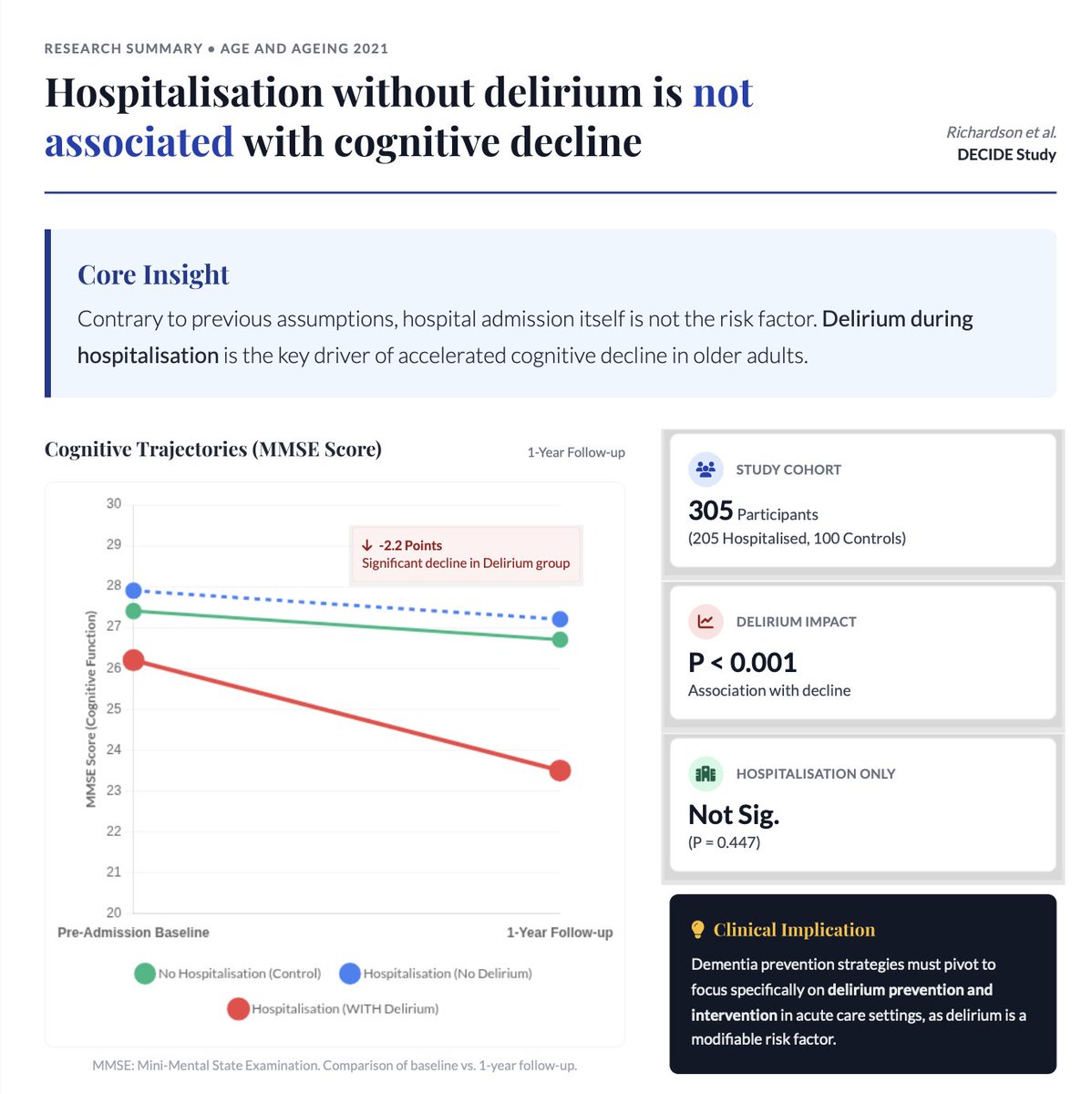
The DECIDE study (Richardson et al, Age and Ageing 2021) followed 305 older adults from the population-based CFAS II-Newcastle cohort.
They compared cognitive trajectories in three groups: hospitalised with delirium, hospitalised without delirium, and a matched group who weren't admitted to hospital at all.
The hospitalised patients who didn't develop delirium had essentially the same cognitive trajectory as those who were never admitted. No significant difference.
But those who developed delirium during their admission showed a 2.2-point MMSE decline at one year compared to the no-delirium group (P<0.001). Neither the number of admissions nor total length of stay were significant predictors.
For years we've assumed that hospital admission itself is bad for the brain. This study suggests the real culprit is delirium. And delirium is something we can detect and, at least partly, prevent.
That makes it potentially a modifiable risk factor for dementia - at least it means that we need to look into this more and explore the potential benefits of early detection and aggressive treatment aimed at protecting the brain.
#medtwitter #dementia
❓ "But they're too drowsy to assess."
I hear this regularly. A patient is lying quietly, eyes closed, not responding to questions. How can we screen for delirium if they won't engage?
✅ 𝐇𝐞𝐫𝐞'𝐬 𝐭𝐡𝐞 𝐜𝐥𝐢𝐧𝐢𝐜𝐚𝐥 𝐩𝐞𝐚𝐫𝐥: 𝐝𝐫𝐨𝐰𝐬𝐢𝐧𝐞𝐬𝐬 𝐈𝐒 𝐭𝐡𝐞 𝐚𝐬𝐬𝐞𝐬𝐬𝐦𝐞𝐧𝐭.
A patient who is drowsy or unrousable has altered consciousness - which is itself a key feature of delirium. You don't need them to answer orientation questions to recognise something is wrong.
The 4AT was designed with this in mind. Item 1 assesses alertness first. A patient who is clearly abnormally sleepy, or agitated, scores 4 points immediately - meeting the threshold for possible delirium before you even ask about the year or the months backwards.
𝑾𝒉𝒂𝒕 𝒕𝒐 𝒅𝒐 𝒘𝒊𝒕𝒉 𝒕𝒉𝒆 𝒅𝒓𝒐𝒘𝒔𝒚 𝒑𝒂𝒕𝒊𝒆𝒏𝒕:
Check their level of arousal. Are they sleepy but rousable? Only rousable to physical stimulus? Unrousable?
Consider this altered consciousness as clinical information. In most cases, the patient will fulfil criteria for delirium when assessed.
➡️ The sleepy patient isn't unsuitable for assessment. The sleepiness is a critical clinical sign.
What's your approach when the patient is too drowsy to complete cognitive testing?
McMaster University has posted the email written by the professor to Canadian figure skater Maddie Schizas, granting her an extension on her assignment.
“I’d say focus on the competition right now, and submit it directly to me when it is done”
This is a really lovely note.