@ryancbriggs@carlislerainey@RohanAlexander Very interested to read this! I’m also writing on attention as a bottle neck, but under the assumption that adjudication stops being one.
Thoughts from today’s lunch w/ friends & colleagues.
Anyone who suggests that knowledge work is safe because AIs are not yet good enough misses the fundamental point.
They do not write like skilled human writers; they cannot conduct strong unguided literature reviews; they cannot produce slides exactly as desired on the first try; they often fail at advanced statistics; they are not intutitive, and so on.
All of these will change quickly.
Where do humans retain an edge in a few years? I think it rests on two areas:
- Very complex and open-ended environments where AI lacks sufficient training data (such as robotics in residential settings), though this will improve over time.
- Tasks that involve human frictions in society and require direct human interaction.
This is a pessimistic view, and I cannot offer a more optimistic one at the moment.
I also feel that human societies, especially political systems, are not at least prepared for extremely powerful AIs controlled by a small number of entities.
And even if access is uniform, the efficiency gain will be highly heterogeneous.
I'm both extremely thrilled and extremely worried.
I used Claude Code to build an website that implements the simulations presented in "Making in the Supreme Court: The Politics of Appointments, 1930-2020" (with Chuck Cameron) that predict the composition of the Supreme Court under different scenarios.
https://t.co/Mh4d3P5ndm
Super happy to see this paper finally formatted.
While this paper might seem about political fundraising, it's really about the theory of *parties*: is it a broader network (UCLA school, i.e., Bawn et al. 2012) or elite/institutions-driven (re: Aldrich)?
https://t.co/CLMf8EBL8D
This is the correct take. Econ has historically been the standard bearer for rigor in social science, they get credit for that… even if there are other deserved criticisms.
This is where I need to say that needling economics is fun because it has a few arrogant, loud people & everyone else is a good sport. Social science is hard, econ has contributed **so much** & this is all a team sport. But also there is no defensible disciplinary supremacy here
@MichaelGiberso3@PradyuPrasad Yes that’s right. I am citing economists to criticize the notion that Econ is free of any type of ideological capture. Obviously I’m not categorically dismissing Econ. That wouldn’t be a serious thing to do.
Economists: We are a pure science that is above ideology.
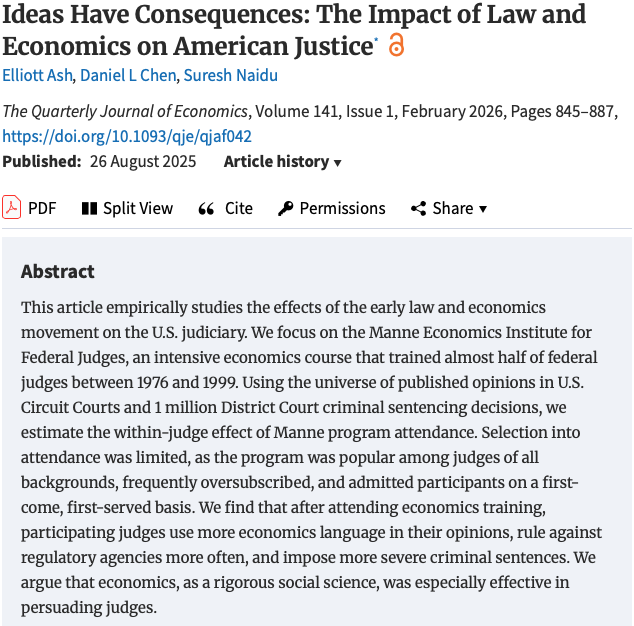
Also economists: Let's give federal judges an all expenses paid vacation to push a conservative agenda.
let's use these new Nature papers (https://t.co/BuAFqwKF80) to see if economics is doing better than other social science on reproducibility. Many economists thought they were—and I was assured that they're smarter than most social scientists—so let's see if they were right.
@VincentGeloso Yes! I'm citing not accusing the authors. I'm a fan of Elliot Ash's work in particular. Many economists do great work obviously. I actually think they've *mostly* been the standard bearers for rigor in social science.
Just pouring some cold water on all the chest thumping lately.
@audowla Granted "economists" as a collective did not, I certainly don't mean to imply all economists have an ideological axe to grind. But seems like academic economists were instrumental in founding and running the program? Or is paper's characterization of the program not correct?
@PradyuPrasad Unfortunately all of claude's points are wrong here. I'm not accusing the authors of pushing an agenda, that should be obvious. I'm citing them for revealing one! Nor did I say the program was simply ideological talking points or that attendance was targeted.
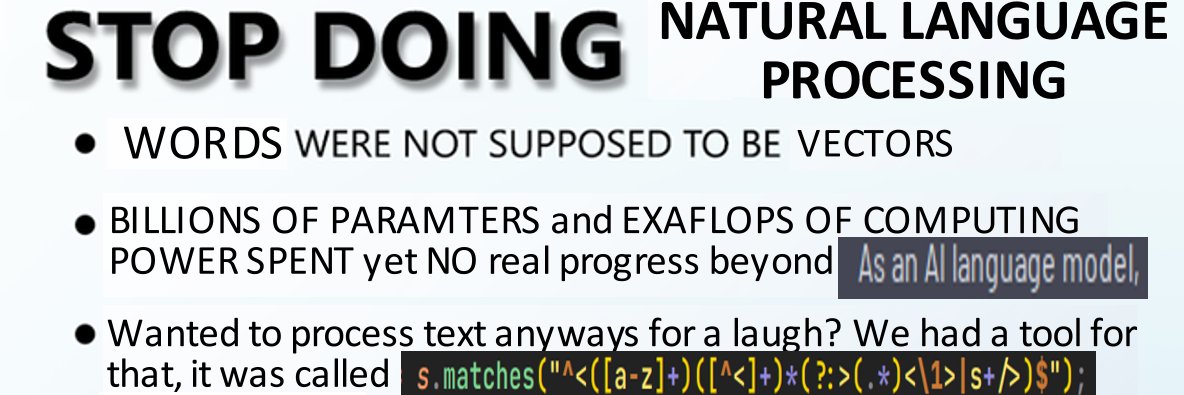
@antoine_chaffin Flash attention is the biggest barrier for widespread adoption! Lot's of BERT users are on OSX/Windows and won't set up a Linux environment. Think researchers outside of computer science.
Amazing stuff!
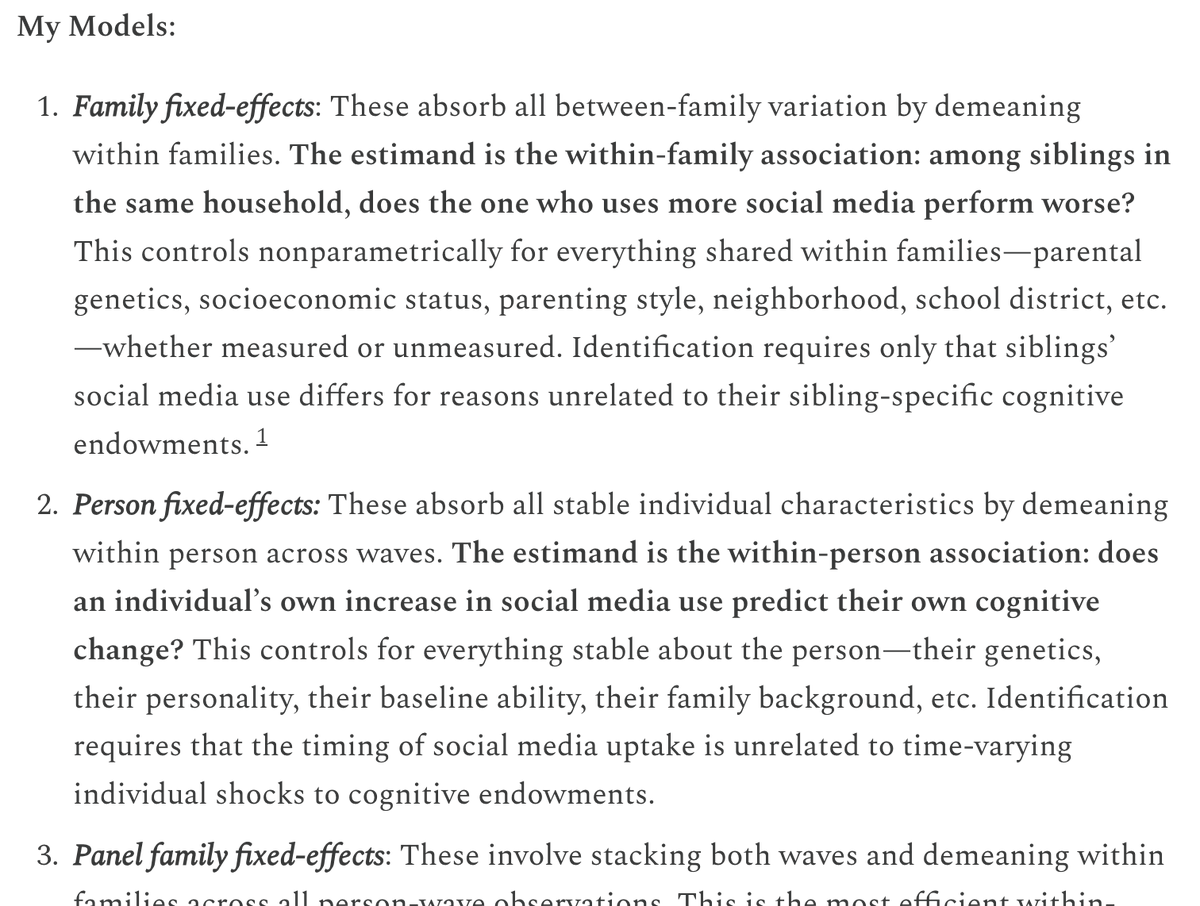
1. Blasts social scientists by critiquing a paper not written by social scientists
2. Apparently doesn't read much social science as he thinks FEs are a foreign concept to them
3. Makes the same mistake as social scientists by having too much faith in FEs
I did ask some social scientists if they understood these models, and most said they would not have thought to do them.
But they're simple: compare siblings, compare the same person over time.
Maybe it's ignorance holding social scientists back from testing theories properly.