I am delighted to share that my first PhD paper has been published in iScience.
It examines how drought severity affects surface water bodies of different sizes across India's climate zones.
Grateful to my supervisor, @vmishraiit, for his guidance.
https://t.co/lZ6CcdHHjG
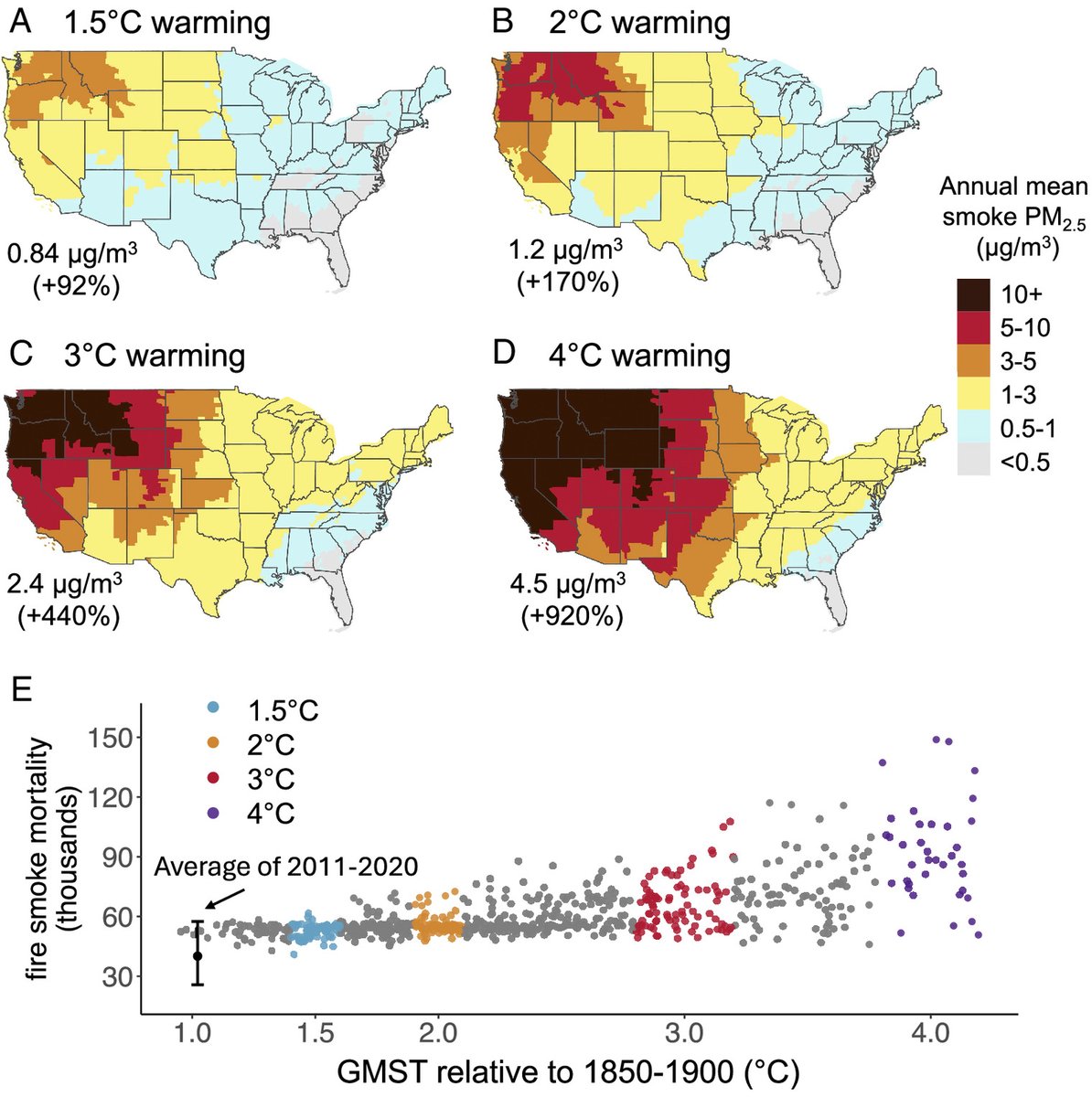
At 3 °C of warming, climate-driven wildfire smoke could kill 64,000 Americans annually—a 60% increase over current levels. Incorporating that mortality into carbon cost estimates raises the domestic monetary value of CO2 mitigation by 74%. In PNAS: https://t.co/qFBOvTWoVI
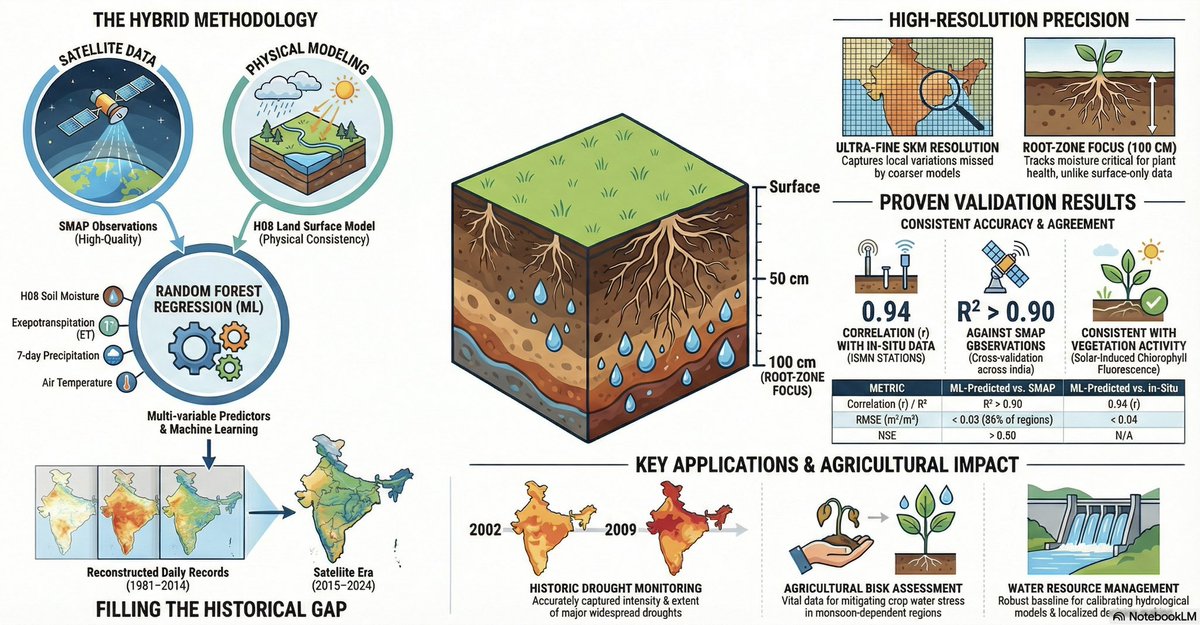
New Dataset Released! – Gridded Root-Zone Soil Moisture for India (1981–2024).
Excited to share our recent work on “Development of Gridded Root-Zone Soil Moisture Product for India, 1981–2024” using Machine Learning.
Read full paper here: https://t.co/ZKadx2krtg
@vmishraiit
Deadlines approaching!
🤖 AI for Science (Google DeepMind Scholarships)
Deadline (Round 1): 6 March 2026
Apply: https://t.co/HcRdHGr3Wt
Take the next step in your scientific journey!
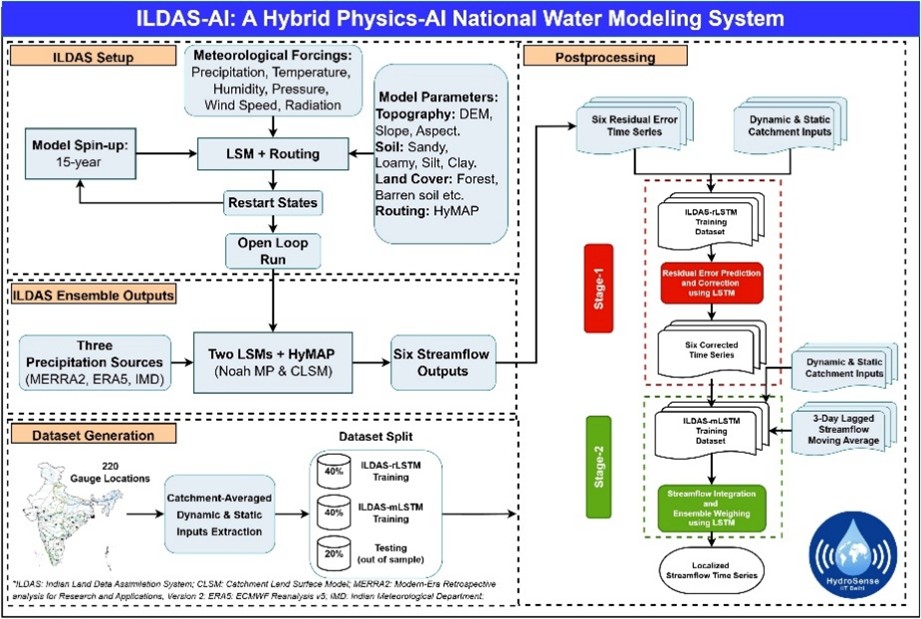
An AI-enhanced river flow modeling system that significantly improves the accuracy of river streamflow predictions across the country, a critical advancement for flood forecasting and water resource management, has been developed by researchers at #IITDelhi.
The study led by PhD Scholar Bhanu Magotra and Prof. Manabendra Saharia from the Department of Civil and Environmental Engineering and Yardi School of Artificial Intelligence demonstrates how integrating artificial intelligence with traditional hydrological models can overcome longstanding challenges in water cycle prediction.
Read more at: https://t.co/SQ4ysYQ3EC
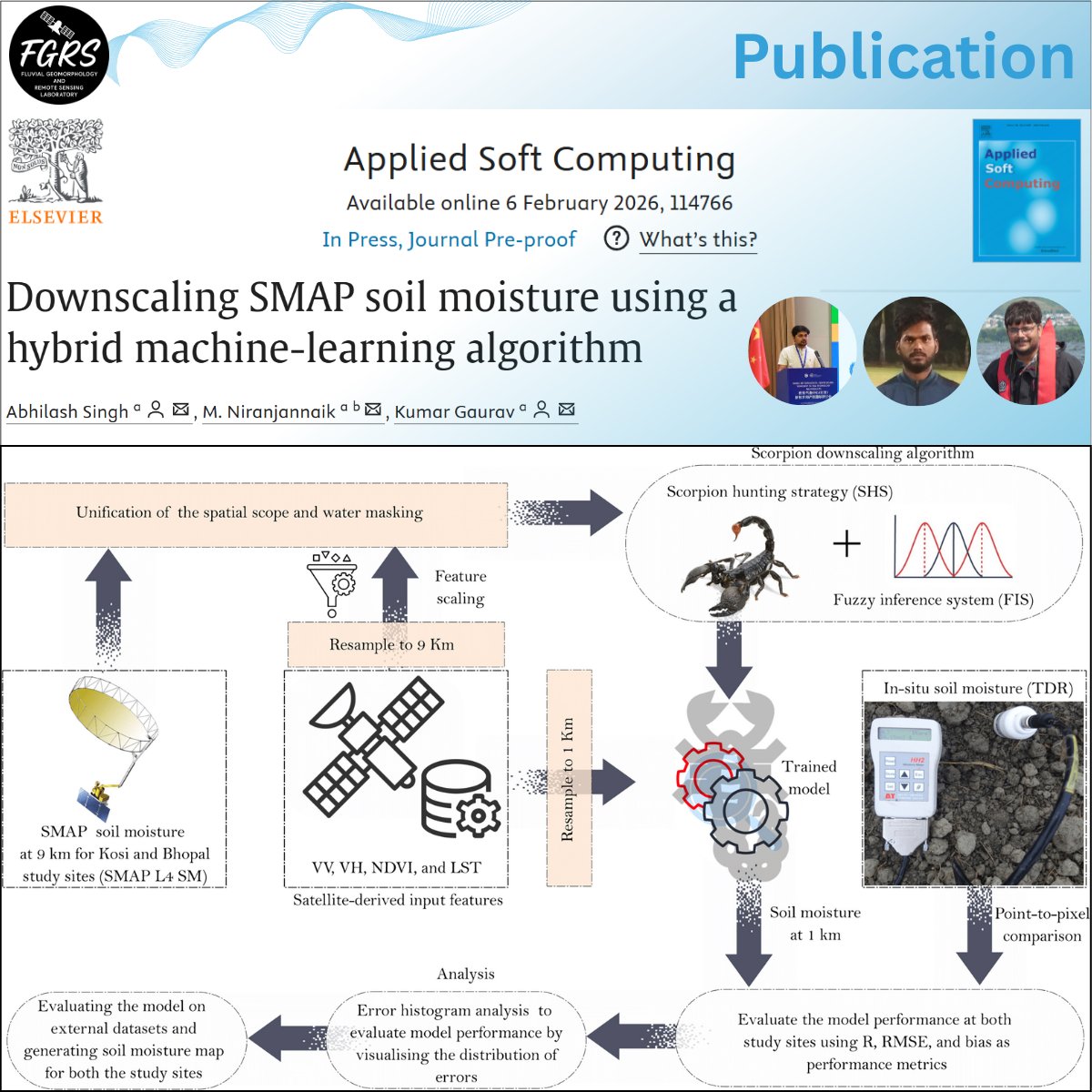
New publication from our Lab!
Congratulations to the team for their dedicated efforts.
Check out at https://t.co/yyVlMP9K7i
#ML#SoilMoisture#IISER#AGU#JGR
📢Join us for upcoming exciting online seminar in the AI for Good Webinar Series: “𝗭𝗲𝗿𝗼-𝘄𝗮𝘀𝘁𝗲 𝗺𝗮𝗰𝗵𝗶𝗻𝗲 𝗹𝗲𝗮𝗿𝗻𝗶𝗻𝗴” 📅9 Feb 26,⏰16:00 - 17:00 CET
🧑🏫 Speaker: @tomasztrzcinsk1 (@IDEAS_NCBR)
👨🏻💻 Moderator: @Conrad__Philipp (@UniJena)
https://t.co/iV0u8eKBb1
📢 The @ELLISforEurope Winter School 2026 — co-organized with @ntua, MeDiTwin, @AI4PEX
📅 16–20 March 2026 | Athens 🇬🇷
A 5-day hands-on program with keynotes, workshops, tutorials & social activities.
⏳ Countdown to apply: Dec 15, 2025
🔗 https://t.co/1Seua1hvL7
Look out for our online poster presentation from the SWIM Lab @ IIT Ropar at #AGU25 "Examining the impact of COVID-19 on groundwater resources in South-Indian river basins by integrating machine learning techniques with GRACE satellite datasets" #hydrology
https://t.co/x5Gn1kjfBL
The ADIA Lab Symposium in Abu Dhabi starts tomorrow!
https://t.co/X1ObQPE54S
This year’s program will feature thought-provoking discussions, cutting-edge research, and insights from world-renowned experts, including 4 Nobel Laureates
My talk tomorrow, free online participation
We present a physics-aware denoising diffusion model for soil moisture estimation using surface data.
Trained on 20 global sites, it achieves accurate, uncertainty-aware predictions without site-specific inputs—scalable for data-sparse regions.
#GRL#Soilmoisture
Can weak physics improve machine-learning generalization to new (or any) sites compared to hard-constraint physics-informed machine learning that requires site-specific details?
We address this question in our new paper in Geophysical Research Letters "Physics-Aware Probabilistic Modeling of Subsurface Soil Moisture Using Diffusion Processes Across Different Climate Settings."
What’s new:
1. We replace hard, parameter-heavy constraints with weak, domain-agnostic physics (smoothness + Fickian diffusion cues) inside a denoising diffusion model.
2. No site-specific soil parameters needed; works across diverse climates and temporal resolutions with built-in uncertainty quantification.
Best promotion line (straight from a reviewer):
"I really like the core idea of this manuscript. Physics-informed ML has begun to outperform purely data-driven models in many geoscience problems, but a recurring barrier is that the governing-equation terms typically require site-specific variables (e.g., material parameters, boundary conditions) that are hard to measure consistently across networks. This work neatly sidesteps that bottleneck by enforcing fundamental, domain-agnostic physical principles rather than relying on fully parameterized, subject-specific equations. In doing so, it avoids the need for hard-to-obtain variables while still injecting meaningful physics, which substantially improves practicality and portability across sites and climates. ..."
Congratulations to my co-authors @vidhi_iiserb and @gauraviirs for the thoughtful discussions that made this possible and thanks to the anonymous reviewers for the insightful feedback that sharpened the paper.
Looking forward to its application with data from the NASA–ISRO NISAR mission.
#Newpublication #soilmoisture #subsurface #diffusionmodel #physcisinformed #weakphysics #iiserb #GRL #AGU #InternationalSoilMoistureNetwork #ISMN @tu_wien #ICWRGC
@iiserbhopal@EES_IISERB@DoWRRDGR_MoJS@IFCPAR@moesgoi@fgrs_iiserb@theAGU
https://t.co/DZsT0PgyOd
Data gaps in soil moisture remain a major challenge for hydrology 🌱
Our new study shows how an FNO-based framework can help bridge this gap — with strong results across sites in India & Africa
Read here 👉 https://t.co/mCbRrgLSnb
A novel imputation framework based on Fourier neural operators (FNO) for soil moisture data (10-40 cm). The FNO model outperforms traditional approaches, and incorporating temporal lag reduces error by up to 15% in the diverse climates in India and Zambia. https://t.co/CxnXfUszGz
New article alert. Published today in Nature Plants
@NaturePlants! I provide some context and my own thoughts on the interesting work by @ManuDelBaq, @DJ_Eldridge, and others on global dryland protections and the consequences (https://t.co/GAOY8k38iU).
https://t.co/Hpl36uppSR