One of the reasons I’m still holding @autoagents_ai is because there are still very few crypto projects that are actually building real utility around Auto Agent.
Zero-cost abstractions. Maximum concurrency.
Meet AutoAgents—the production-grade multi-agent framework designed to handle complex, distributed AI workloads natively in Rust. 🦀🚀
Zero-cost abstractions. Maximum concurrency.
Meet AutoAgents—the production-grade multi-agent framework designed to handle complex, distributed AI workloads natively in Rust. 🦀🚀
🦀 Building the future of AI orchestration with high performance!
AutoAgents is a production-grade multi-agent framework written entirely in Rust. Fast, memory-safe, and built to scale. 🚀
Check out the repository here:
👉 https://t.co/waboq3fUhr
Demand for Pearl is skyrocketing.
@prlnet
We’ve opened up a compute platform for the people — first come, first served, with limited supply.
We’re working hard to expand capacity. Subscribe for updates:
https://t.co/JnxLt3S5EJ
Every era has a resource so fundamental it becomes money.
Bitcoin turns energy into currency. Trustless, global and censorship-resistant.
AI is doing something even more powerful: it turns energy into intelligence. Deployable anywhere and useful for almost everything.
But intelligence has no native financial primitive. It isn't fungible. It can't move outside the dollar system.
Pearl changes that.
Pearl is the first asset natively produced by AI and natively secured by AI. Every GPU cycle producing LLM tokens can simultaneously mint Pearl tokens with marginal extra electricity, zero wasted compute and one unified primitive. 2-for-1.
Sitting atop one of the largest capital expenditures in history, Pearl changes the unit economics of AI.
This is what sets Pearl’s breakthrough apart. Previous attempts at useful-work blockchains captured a narrow slice of compute. Pearl's addressable market is every matmul computation on earth which, at current trends, will be the majority of all compute.
Bitcoin’s security is competing with AI for energy. Pearl's security scales with AI adoption.
Proof of work represents humanity's demand for energy, monetized.
Pearl represents humanity's demand for intelligence, monetized.
Pearl is now live.
https://t.co/Fg8vg2E9C1
It is becoming increasingly clear that the future economy will be denominated in compute cycles more than in human labor.
In a world where AI drives the majority of electricity consumption and GDP, compute is the natural collateral for money: an open, auditable, AI-native currency, produced directly through inference and training.
Since the inception of Bitcoin, an outstanding open problem in distributed systems was whether it is possible to implement Proof-of-Work consensus on top of real-world computation, as opposed to useless random hashing. While long considered impossible, last year we answered this question affirmatively.
Pearl’s mathematical breakthrough enables every GPU cycle powering AI systems to simultaneously produce a native digital currency: ¶PRL.
What this means is that the hundreds-of-billions (and soon trillions) of dollars of compute being deployed for AI workloads will double--for effectively free--to secure Pearl's Proof-of-Work chain; All the properties of Bitcoin, but secured as the by-product of AI inference and training, i.e., by the native operation of GPUs: matrix-multiplication (GEMM).
Pearl changes the unit economics of LLMs, which are are fundamentally non-fungible, and will shift a portion of the wealth generated by AI back to users – who drive production, model improvement and demand, yet currently capture none of the upside of the AI era.
We’ve spent the last year turning this “2-for-1” breakthrough into a working infrastructure, building from the linear algebra down to the CUDA kernels, alongside world-class mathematicians and low-level engineers.
Today, we’re excited to announce that the Pearl Network is ready, and will soon support state-of-the-art LLM serving, through vLLM and SGLang plugins. Running AI workloads on Pearl transforms AI compute from a sunk expense into an AI-native asset, anchored directly to the production of intelligence.
If you’re interested/skeptic or ideally both – we’ve published our next tranche of open problems as a collaborative Polymath challenge – containing math, systems and economics questions we’re grappling with next. We invite you to tear it down, prove it or propose better implementations: https://t.co/j4P9FFCYCd.
#AIMoney
#ProofOfInference
Coinbase is testing AI agents that show up in slack/email at work, just like any human teammate. To start we're shipping two which are modeled after legendary former Coinbase employees, @FEhrsam and @balajis. (Who brutally frame mogged who in this matchup?)
Soon, it will be easy for any employee to spin up a new agent for themselves or their team. I suspect we will have more agents than human employees at some point soon.
In case you missed it...
This 58 min video is the clearest introduction to AI agents, agent skills, md files, building AI employees on the internet and it's 100% free
Wall Street is moving onchain. The question isn't if. It's which infrastructure wins.
I sat down with @VivekVentures and @dannyryan from Etherealize to talk about Ethereum's role in tokenization, stablecoins, AI agents, and the regulatory path ahead. As ever, please enjoy!
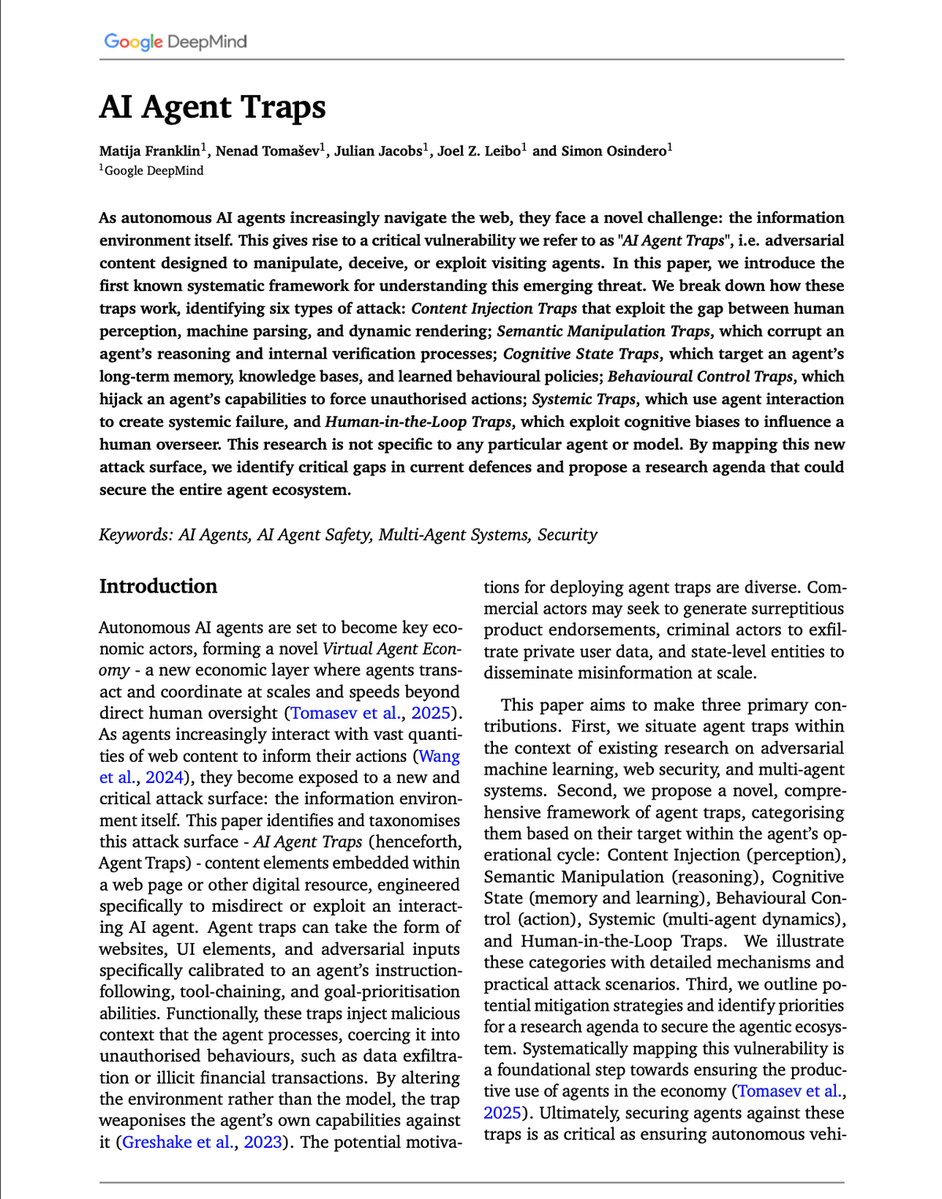
Google DeepMind dropped a paper that should scare every agent builder.
It's the first systematic framework for a threat that barely existed two years ago: adversarial content engineered to hijack AI agents browsing the web.
They call them AI Agent Traps. The paper maps six distinct attack surfaces.
1) Content Injection Traps (perception)
Invisible CSS, hidden HTML, steganographic payloads inside images. The agent parses it, humans never see it. One study showed simple HTML injections hijack web agents in up to 86% of scenarios.
2) Semantic Manipulation Traps (reasoning)
No overt commands. Just biased phrasing, framing, and contextual priming that skew the agent's synthesis. LLMs inherit human cognitive biases, and attackers can weaponize every one of them.
3) Cognitive State Traps (memory and learning)
Poison the RAG corpus. Corrupt long-term memory. One study achieved over 80% attack success with less than 0.1% poisoned data.
4) Behavioural Control Traps (action)
Jailbreaks embedded in external resources. Data exfiltration prompts hidden in emails. Sub-agent spawning that tricks an orchestrator into instantiating attacker-controlled agents inside the trusted control flow.
5) Systemic Traps (multi-agent dynamics)
This is where it gets scary. A single fake news headline could trigger a synchronized sell-off. A compositional fragment trap splits a payload across sources, so each fragment looks benign until agents aggregate them.
6) Human-in-the-Loop Traps
The agent becomes the vector. The target is you. Invisible prompt injections have already caused summarization tools to faithfully repeat ransomware commands as "fix" instructions.
The core insight is uncomfortable.
By altering the environment instead of the model, attackers weaponize the agent's own capabilities against it. Training-time defenses cannot solve an inference-time problem.
The paper closes by calling for automated red-teaming that can probe these vulnerabilities at scale. That same shift is already happening on the offense side.
Strix is an open-source project doing exactly this for web apps. AI agents that act like real hackers, running your code dynamically, finding vulnerabilities, and validating them with actual proof-of-concepts.
24k stars on GitHub. Apache 2.0 licensed.
The agents writing your code need to be tested by agents trying to break it.
I've shared the link to the paper and Strix GitHub repo in the replies
As AI agents accelerate coding, what is the future of software engineering? Some trends are clear, such as the Product Management Bottleneck, referring to the idea that we are more constrained by deciding what to build rather than the actual building. But many implications, like AI’s impact on the job market, how software teams will be organized, and more, are still being sorted out.
The theme of our AI Developer Conference on April 28-29 in San Francisco is The Future of Software Engineering. I look forward to speaking about this topic there, hearing from other speakers on this theme, and chatting with attendees about it. We’re shaping the future, and I hope you will join me there!
It is currently trendy in some technology and policy circles to forecast massive job losses due to AI. Even if they have not yet materialized, these losses certainly must be just over the horizon! I have a contrarian view that the AI jobpocalypse — the notion that AI will lead to massive unemployment, perhaps even rioting in the streets — won’t be nearly as bad as dire forecasts by pundits, especially pundits who are trying to paint a picture of how powerful their AI technology is.
Among professions, AI is accelerating software engineering most, given the rise of coding agents. According to a new report by Citadel Research, software engineering job postings are rising rapidly. So if software engineering is a harbinger of the impact AI will have on other professions, this expansion of software engineering jobs is encouraging.
Yes, fresh college graduates are having a hard time finding jobs. And yes, there have been layoffs that CEOs have attributed to AI, even if a large fraction of this was “AI washing,” where businesses choose to attribute layoffs to AI, even though AI has not changed their internal operations much yet. And yes, there is a subset of job roles, such as call center operator, that are more heavily impacted. Many people are feeling significant job insecurity, and I feel for everyone struggling with employment, whether or not the cause is AI-related. And many other factors, such as over-hiring during the pandemic and high interest rates, have contributed to the slowdown in the labor market, and the notion that AI is leading to unemployment is oversimplified.
In software engineering, I see a lot of exciting work ahead to adapt our workflows. It is already clear that: (i) As AI makes coding easier, a lot more people will be doing it. (ii) Writing code by hand and even reading (generated) code is not that important, because we can ask an LLM about the code and operate at a higher level than the raw syntax (although how high we can or should go is rapidly changing). (iii) There will be a lot more custom applications, because now it’s economical to write software for smaller and smaller audiences. (iv) Deciding what to build, more than the actual building, is becoming a bottleneck. (v) The cost of paying down technical debt is decreasing (since AI can refactor for you).
At the same time, there are also a lot of open questions for our profession, such as:
- In the future, what will be the key skills of a senior software engineer? And for junior levels, what should be the new Computer Science curriculum?
- If everyone can build features, what skills, strategies, or resources create competitive advantage for individuals and for businesses?
- What are the new building blocks (libraries, SDKs, etc.) of software? How do we organize coding agents to create software?
- What should a software team look like? For example, how many engineers, product managers, designers, and so on. What tooling do we need to manage their workflow?
- How do AI agents change the workflow of machine learning engineers and data scientists? For example, how can we use agents to accelerate exploring data, identifying hypotheses, and testing them?
I’m excited to explore these and other questions about the future of software engineering at AI Dev. I expect this to be an exciting event. Please join us!
[Original text: The Batch newsletter.]
https://t.co/i4bQevDG4i
Soon, businesses won’t run on software. They’ll run on agents and autonomous intelligence.
It's a complete shift in how businesses operate. https://t.co/jQHISjPvoi built an agentic infrastructure for this so you can adapt agents early:
→ workflows become autonomous and intelligent
→ decisions become data and preference-driven
→ agents coordinate across orchestrated systems
Stop focusing on the past. Prepare for the future and own your voice: https://t.co/kKkyZ124j8 ⚡
Most people are “building AI agents”…
without understanding how they actually work.
Here are 6 terms you MUST know if you're working with agentic AI:
𝗠𝗼𝗱𝗲𝗹 𝗖𝗼𝗻𝘁𝗲𝘅𝘁 𝗣𝗿𝗼𝘁𝗼𝗰𝗼𝗹 (𝗠𝗖𝗣)
The “USB-C for AI” → lets agents connect to tools, APIs, and data sources seamlessly.
𝗔𝗴𝗲𝗻𝘁 𝗦𝗸𝗶𝗹𝗹𝘀
Pre-built capabilities your agent can use.
Think: coding, searching, calling APIs — without reinventing everything.
𝗔𝗴𝗲𝗻𝘁𝗶𝗰 𝗥𝗔𝗚
Not just retrieval.
Agents decide what to fetch, validate it, and retry if needed.
𝗦𝗶𝗻𝗴𝗹𝗲 𝗔𝗴𝗲𝗻𝘁 𝗔𝗿𝗰𝗵𝗶𝘁𝗲𝗰𝘁𝘂𝗿𝗲
One agent = one brain.
Simple, fast, and handles the full pipeline.
𝗠𝘂𝗹𝘁𝗶 𝗔𝗴𝗲𝗻𝘁 𝗔𝗿𝗰𝗵𝗶𝘁𝗲𝗰𝘁𝘂𝗿𝗲
Multiple agents = specialized team.
Divide tasks → better reasoning → more powerful systems.
𝗠𝗲𝗺𝗼𝗿𝘆
What separates demos from real products.
Short-term + long-term context = smarter agents over time.
Master these → you’re ahead of 90% builders.
What would you add to this list? 👇
Welcome to the Binance AI Community 🙌
We’d like to see how Binance AI has elevated your trading experience, be it AI trading bots, agents or market sentiment analysis!
3 simple steps:
🔸 Follow @binance + RT this post
🔸 Share one screenshot of your prompt/usage and Binance AI’s output with #BinanceAI
🔸 Complete the survey → https://t.co/pkNkdwGQQC
10 users win 100 USDC each.
Ends 20 April 23:59 UTC.