Our people must not return home in silence.They must join the struggle to hold the current government accountable for the collapse of industries, the loss of jobs, and the hardships we continue to endure.We will reclaim our future through People-Powered Change #YouthDzorera
Dear @nickmangwana,
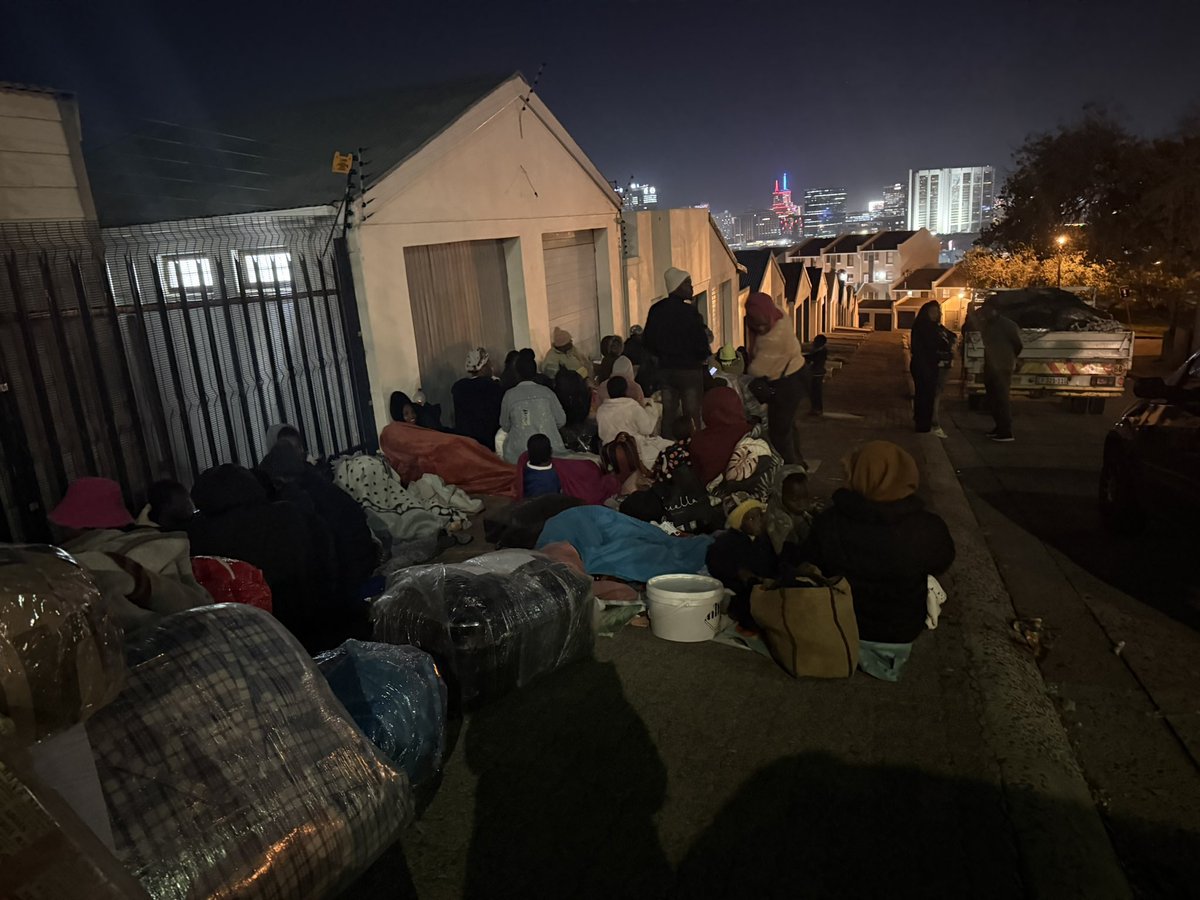
I hope you have seen the pictures that have gone viral on social media showing Zimbabweans sleeping outside the Zimbabwean Consulate in Cape Town in winter temperatures running away from xenophobic harassment, hate and violence.
Surely, as a government, you can do something to assist your own people in such circumstances. Imagine, Nick, if it were your wife and children sleeping outside in the Southern African winter, exposed to temperatures close to zero degrees. No reasonable person would find that acceptable.
The government has the resources and the responsibility to intervene. At the very least, these Zimbabweans should not be left to sleep on the pavement in the cold.
Why do we have to be so cruel to our own people? What is the purpose of having a government if it cannot step in when its citizens are in obvious distress? These are the same Zimbabweans who, in better times, send remittances back home that sustain families and contribute significantly to the country’s economy.
I hope you will not simply look at these images and move on. I hope you will bring this matter to the attention of your principals and urge them to act. Sometimes I wonder whether President Emmerson Mnangagwa is fully aware of situations such as this, because I struggle to believe that any sane and compassionate leader could see fellow citizens enduring these conditions and simply carry on as if nothing is wrong.
These people are not mere statistics. They are Zimbabweans. They deserve dignity, compassion, and assistance from the government that claims to represent them.
CCC MP, Marondera Central, Caston Matewu, was kicked out of parliament today. He fiercely protested when he was cut off from finishing his speech only after 2 mins. Each MP was allocated 10 mins, but Tsitsi Gezi decided to give him 2 mins because he was strongly opposed to CAB3!
I received a call from MadziBaba VeShanduko. He is facing serious financial difficulties and is struggling to pay his children’s school fees and provide for their basic upkeep.
His home was burnt down, and he spent eight months in prison for a political crime he did not commit before later being acquitted by the courts.
We have set up a GoFundMe campaign to help him rebuild his life and support his family during this difficult period.
Please donate whatever you can and help spread the word.
RETWEET.
https://t.co/hsLy1LNsmw
🔸Hard to believe that this is the Party of Herbert Chitepo, Bernard Chidzero and Jason Moyo. Imagine losing your life in an armed struggle only for a violent, shameless, incompetent looting mafia to take power. It’s a mess.
We need new leaders.🇿🇼
Professor Patrick Loch Otieno Lumumba adds his voice against #CAB3. He laughs at how a government that professes to be serving the people runs away from the same people by refusing elections. He says "you cannot cure the difficulties of democracy by amputating the will of the people." He pours scorn over claims by 2030ists that "elections are toxic" and hamper development. He argues that the only "toxic thing in Zimbabwe" that hampers development "is a ruling elite that uses violence to silence the people".
🔸Your Excellency, the uncomfortable truth we cannot shy away from is that, for as long as the political crisis in Zimbabwe remains unresolved, people will continue to run away. Very little will be able to stop them. This must be top most in your minds when you prop up the regime that is causing mass suffering. These are the side effects of mollycoddling and making friends with corrupt dictatorships.
We need new leaders.🇿🇼
I want to thank Zimbabwean dancehall star Winky D for the very insightful message in his new song, Chivanhu.
He touches on a serious topic that I have advanced on this page for years, respecting our past, respecting our ancestors, and refusing to be held hostage by foreign religions brought to us through colonial rule and missionary indoctrination.
A people who do not understand their past, who embrace other people’s ancestors while disowning their own, and who disparage their history are bound to struggle. Africa continues to face challenges because many of the things we consider important are not rooted in our own history, culture, and experiences.
You cannot be more Muslim than Muhammad, and you cannot be more Christian than the people among whom Christianity first emerged. Part of the success of the Chinese, whom Winky D references in his song, has been their authenticity, confidence in their own civilisation, and belief in themselves.
I am not a Christian because I hate Christianity. I am not a Christian because I do not believe my identity can be rooted in a foreign religion whose foundations were built by other people’s ancestors while requiring me to disconnect from my own.
Every people who have risen and prospered have done so by understanding who they are, where they come from, and what values define them. Self-respect begins with knowing your own story before seeking validation in someone else’s.
Winky D has truly matured into an artist who does not follow the wind, but has become the wind itself, the one that others follow.
Consummate artists do not chase narratives, they shape them. They do not merely reflect society, they challenge it, provoke thought, and help direct the national conversation towards issues that matter.
That is what separates entertainers from cultural icons. The greatest artists leave a lasting imprint on the conscience of a nation.
Well done to Winky D and his team for producing work that stimulates thought and encourages introspection. More life to Gaffa Nation.
https://t.co/gmcPGJRtNM
How do Jacob Zuma and all these other thug leaders feel when they see their supporters harassing legitimate business people who are South African and are actually Zulu in KwaZulu-Natal under the pretext of dealing with the problem of illegal foreign nationals?
This is exactly what has always been said would happen. After harassing foreign nationals, they would eventually turn on each other. When you encourage people to target others based on suspicion, rumours, and prejudice, it becomes impossible to control where it ends.
What is happening is embarrassing, especially for the MK Party, which has a hand in all this. Instead of addressing real issues through lawful means, this dangerous culture of intimidation is now affecting the very people it claimed to protect.
The events unfolding in KwaZulu-Natal should serve as a warning that mob behaviour never remains confined to its original target. Once it is unleashed, it grows, spreads, and eventually turns on everyone.
This happened yesterday in South Africa’s KwaZulu-Natal province. These are just criminals, nothing more, nothing less. This has nothing to do with illegal immigration, but simply with criminality. They use immigration to sanitise their criminality.
South Africa is being bashed by Donald Trump and falsely accused of committing genocide, and now some of its own citizens are giving him reasons to criticise the country, as we saw yesterday when incidents such as these were cited by the American government while criticising South Africa’s foreign minister.
This is the last thing the country needs for its reputation. At a time when South Africa is already facing intense international scrutiny, scenes like this only damage its image further and provide ammunition to those who seek to portray it negatively.
What is particularly disturbing is that many of these businesses employ South Africans and serve South African communities. When shops are looted and destroyed, jobs are lost, investment is discouraged, and entire neighbourhoods are left worse off.
There is no victory in burning down the very economy that people depend on for employment, goods, and services.
One of the great ironies is that the very businesses being looted are among the contributors to the tax base that funds public services.
Every day they pay VAT, company taxes, municipal rates, licence fees, and other statutory obligations.
When a shop is destroyed, the state loses tax revenue, workers lose income, suppliers lose business, and communities lose access to goods and services.
In the end, it is not just the business owner who suffers, but society as a whole, because the revenue that helps fund government programmes and public services like social grants is diminished.
Ignorance is very expensive, and the cost is ultimately borne by everyone. This is mindless ignorance. It is at times like these that one realises the importance of a truly good education, one that equips citizens to be thoughtful and to apply critical thinking to their daily lives.
How will this looting help in dealing with illegal immigration? How will this wanton violence help in creating employment? How does closing down businesses run by people who are legally in South Africa, many of whom are actually South Africans operating lawfully, help to create jobs?
Looting shops will not stop illegal immigration, it will only destroy jobs, shrink the tax base, and make South Africa poorer.
A wave of xenophobic violence has spread across South Africa, fuelled by a toxic mix of anger, disinformation and inflammatory mobilisation online.
At the centre of the movement is Jacinta Ngobese-Zuma - radio personality turned political agitator - who has emerged as the face of the new anti-immigration group March and March.
@nic_muirhead reports.
What is true is that Ghana did refuse to renew the mining lease for Gold Fields’ Damang mine and later moved the asset into Ghanaian hands through a local company, Engineers & Planners. Ghana also restricted the bidding process to companies that are 100% Ghanaian-owned.
It is not true that Ghana has rejected all Gold Fields operations or that South African Gold Fields has been completely pushed out of Ghana.
However, the rejection by Ghana of the renewal of South Africa’s Gold Fields licence for the Damang mine will indeed be a tragic and massive own goal by the xenophobes and Afrophobes to the South African economy, and a profit disaster for South Africa’s Gold Fields.
With its underlying profits estimated at more than half a billion US dollars, about R9 billion, a year in a strong gold price environment, Gold Fields was making enormous profits from its operations in Ghana, particularly from its Tarkwa and Damang mines.
The company’s Ghanaian assets have consistently ranked among its most productive operations, with Tarkwa alone contributing nearly a fifth of the group’s total gold output in 2025. Record gold prices helped drive a sharp increase in profitability across the company, with Gold Fields reporting that annual profit more than doubled during the period.
Losing such assets would not only affect the company, but could also have broader implications for South Africa’s mining sector, investment footprint, and economic influence across the African continent.
These profits generate taxes for the South African government, and part of that money is used to pay grants to the very people tarnishing the name of their country, resulting in companies not having their licences renewed as a tit-for-tat response.
Many South African companies make more money elsewhere on the African continent than they make in South Africa itself. South African banks, retailers, telecommunications companies, insurers, mining houses, and other businesses have expanded across Africa because that is where much of their growth and profitability comes from.
Put differently, South Africa benefits enormously from the rest of Africa. In many sectors, South Africa makes more out of Africa than all African countries receive from South Africa through investment, and other forms of economic activity combined.
That is why damaging relations with the rest of the continent through xenophobia and Afrophobia is not just morally wrong, it is economically self-defeating.
Ghana did warn that it would retaliate. If this is part of that retaliatory toolkit, and if other African countries follow suit, it could significantly damage the profit base of South African companies operating across the continent and deprive the South African government of taxes that come with those profits.
Hopefully, an adult in the room will put their hand up and bring this to an end before more damage is done, because the Afrophobe groups will not stop it on their own.
What started as rhetoric has already begun damaging South Africa’s reputation, investor confidence, and relations with other African countries. The longer it is allowed to continue, the greater the risk of unintended economic and diplomatic consequences that will ultimately be borne by ordinary South Africans.
America is already publicly cheering on Ghana and Nigeria for taking a tougher stance towards South Africa over Afrophobia, and will no doubt be encouraging more ruptures in relations across the continent.
Put simply, South Africa does not need this damaging episode at a time when unemployment stands at between 30% and 35% and the tax base is shrinking.
Illegal immigration should be dealt with by the state through the proper application of the law. Africans living legally in South Africa should not be harassed, abused, intimidated, or have their businesses attacked while the state watches and does nothing.