What Makes Some Relationships Feel Spiritual Rather Than Just Romantic?
Divorce is no simple matter. Nerves, time, money, health, not to mention the children. No one promises that the next relationship will be any better, so it is no wonder that more and more people are giving up on the idea of marriage altogether. Why head into failure again if you can avoid the whole mess from the outset? It turns out that the breakdown of the family unit in our time is not accidental at all, and its role is to move us toward a new era in relationships among human beings in general.
When examining matters in depth, it becomes clear that this is not a problem in the relationship between partners, but a general problem in human communication. We have developed to a state in which we want to be free from others, that no one will limit us, to the point where it is very difficult for us to maintain social relationships. The family relationship is the most intimate and has always been the foundation of society. If in our time it too is collapsing, then this is the main sign that we have reached a new stage in our evolution as a human species. Until now we developed the environment, tried to build a proper society, constructed various systems, developed science and technology, but today we have reached a point where all these external things do not help us feel happiness, and we must approach the heart of the matter: the correction of the human being.
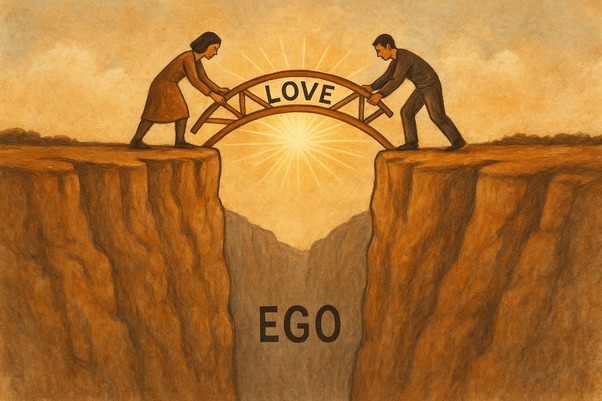
Nature developed the still, vegetative, animate, and human, and then developed in us humans specifically a large ego, in order to now bring us to the next stage of the process. At this stage, we must learn how to rise above our ego, to build above it a new quality through which we develop a new attitude, vision, outlook, and world. Nature aspires to bring all its parts into perfect balance. For us as humans, this means that at the peak of our evolution we will need to be connected to each other harmoniously, like organs in a single body.
Developing the ability to relate to others in a new way, above the ego, requires a research laboratory. It waits for us constantly at home in our closest relationship. The romantic relationship can be a wonderful place for carrying out all kinds of experiments, to slightly change ourselves and see what new world opens up to us as a result. Just like an experiment in physics or chemistry, we change various parameters and observe phenomena. Then, we change the parameters again, and again we check the resulting phenomena. The variables we change in the relationship lab are within our relationship with one another. If we train within the relationship on developing various new forms of attitudes toward the other, it will help us succeed in every area of life. We will know how to work with people to receive a desired response from them. Relationships always stand at the heart of things, and everything else is just a result.
The optimal approach to building good relationships is founded on the principle: “Love covers all transgressions” (Proverbs 10:12). This does not mean that we try to hide all the “transgressions,” i.e., the bad things between us like a lack of care, pride, disrespect, and even hatred, but rather that if we want to start building something new and corrected, there is no point in digging into existing flaws. There is no need to study deeply how egoistic and bad we each are, unwilling to see our own flaws but always able to list in detail what is wrong with the other.
Therefore we are given the rule, “Love covers all transgressions.” That is, despite everything that seems flawed in our partner, we must build a positive attitude toward them, beauty, love, concession, and care. Through such exercises of developing a more advanced attitude, precisely over the problems that arise, we begin to discover within ourselves good qualities that were dormant, increasingly highlighting them. Everything that appears as bad in the other is only an opportunity for us to rise to a state of love.
After learning to neutralize the egoistic view and to develop love, we begin to see all the beauty in our partners. We realize that until now we did not see them objectively, without ego dependence. Suddenly now, when we seemingly exit ourselves, outside of ourselves, outside our skin, our body, rising above our ego, we begin to see them differently. Also, it is not only them, but reality in general appears to us anew. We discover that it is not bad at all. There are no transgressions, no flaws, if we cover everything with love. A new and good world opens up before us, and we begin to grasp that all the evil is within us and all the good is actually outside us. Reality becomes clarified to us as divided into two parts. One part is what we have seen until today, a world that our ego made us picture, about which it is said, “The inclination of man’s heart is evil from his youth” (Genesis 8:21). The second part is what now begins to reveal itself before us as we develop love. The latter is found outside of us, and it is a world that is entirely good.
Thus, we have acquired in our home laboratory the method for an optimal attitude toward everything outside us, a new worldview. After we have done this with our partners, we see that toward the rest of humanity there is not much more to add, because our work was in fact not with our partners, but with ourselves. With the help of the mirror of partnership that nature arranged for us, we saw what needs to be corrected within us and worked on it. As a result, we became ready to absorb the connected world that is supposed to be revealed in our time to humanity. Then, we understand that the romantic relationship is a natural framework to prepare ourselves for a new and upgraded social life.
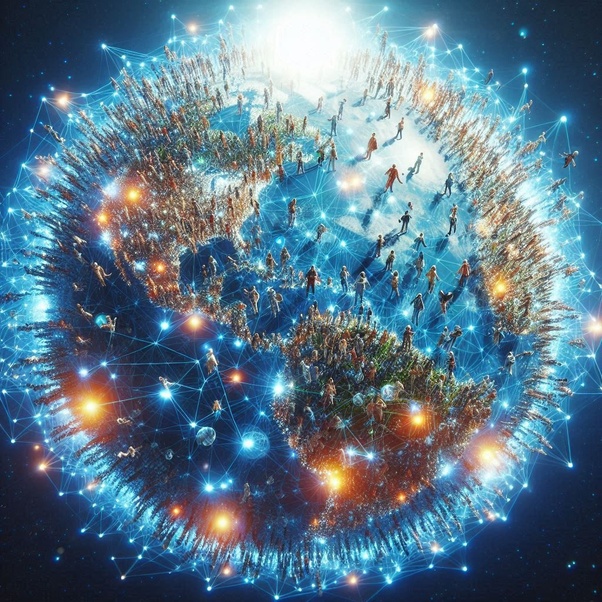
The former form of the family unit had to collapse in order to advance us to a more evolved form, which will bring us to the peak of human evolution. At this level, all people will be like one family. If until today we dealt with developing technologies and devices, as we head into the future, we can advance only through developing new people.
#RelationshipGoals #love #EGO #sustainable #Future
Based on episode 31 of "New Life" with Kabbalist Dr. Michael Laitman. Written/edited by students of Kabbalist Dr. Michael Laitman.
New Life series - episode No. 31
- Love Above Egoism
Full episode available here >> https://t.co/f4aw2RKiRq
Translation available in English, Hebrew, Russian, Italian & Spanish
Can We Live With No Disappointment at All?
When we move toward life's ultimate goal, we can never be disappointed, neither today, nor tomorrow, nor ever, because it is the only genuine, eternal, and perfect goal we have in life. With that clarity, we can move ahead in life steadily and confidently.
Of course, along the way, questions arise from within and from the environment, but they serve a purpose: they constantly direct us back to the goal. If we keep adjusting our course, then everything will turn out fine.
I speak about this as a Kabbalist, i.e., one who understands and attains that the purpose of life is to attain adhesion with the source force of our lives that created and sustain us. However, even an ordinary person today needs to start understanding that such is the goal of life.
The goal is the same for everyone. It does not change from one person to the next. But who among us truly knows this goal? If we knew it, if we recognized that we all shared the same purpose, we would naturally reach a grand mutual agreement. We would search together and unite our efforts in order to achieve it.
Instead, our egoistic nature with its divisive drives tears us apart. It blinds us, making us each feel that we need to chase after our own individual path with personal goals, which differ from one person to the next. This separation is what prevents us from feeling the unity that would otherwise guide us forward together.
We need to reach the understanding that the goal of life is to attain the meaning of life, which means to know, feel, and live its meaning.
When we achieve the meaning of life, we feel absolutely fulfilled. We know why we exist. who guides us, to whom we turn, what we fulfill at every moment of our existence, and where we are headed. New horizons open before us. We feel like children entering Disneyland for the first time. Everything becomes dazzling and vibrant, like a wondrous fairy tale. This is the feeling we experience when we discover nature's plan and program.
On the other hand, however, each person does experience the meaning and goal of life individually because every soul is unique. Yet, when we embark on the path to the meaning of life and discover it, we find how our ultimate happiness and fulfillment comes from our connection with others. It comes from increasingly discovering the integral links between us.
The "Disneyland" of the new world we discover is revealed precisely through these #connections. It is through them that we attain the true reality that has been waiting for us all along.
#purpose #life #meaning
What Should a Person Receive from Their Community?
First of all, a person should receive mental and personal security. People should know that they have food on the table today and the next day, a roof over their head, a place for their family, and that they can deal with any health or physical problem that arises. Only a community can provide such security to a person.
This awakens the question: Why do we need a community specifically, and not money, through which we can buy several material goods to give us security?
We can partially buy such security for money, but we will reach such states where we will see how weak we are and how we will be unable to solve our problems with money. Also, we will be unable to protect ourselves from various phenomena that exceed the boundaries of what money can solve.
Precisely as we evolve to become an increasingly interconnected and interdependent society around the world, only a community will be able to protect us with the integral force that it generates, a force that is in balance with nature's integral, interconnected, and interdependent form.
#sustainabledevelopment
Taken from New Life series - episode No. 1241
- Global Community
Full episode available here >> https://t.co/5Av4gIoilA
Translation available in English, Hebrew, Italian, Russian,German, Spanish, Norsk & Turkish
What Do You Wish Upon Everyone?
Absolute mutual love. We need nothing but pure unconditional love, to love each other not because of what someone did or did not do, and not because of shared values or common goals, but simply because we are all human beings.
Is such a life possible? Yes, it is. Absolutely.
In order to love one another and to feel genuine love for people, we need to understand that there is nothing greater in existence than this feeling.
Love is the very foundation of nature. Everything we see, and even more so, everything even beyond our vision that is hidden in the upper reality is built entirely on love. The higher nature above the one we can perceive is love itself. Every law, force, and movement at its root is an expression of this single power.
Moreover, nature awaits us to attract this force. The moment we turn toward it with this desire—not for personal gain, but to love one another—it responds. Love is not just the most exalted feeling that exists; it is the most central and most powerful force in all of nature.
However, what if we are filled with hatred right now? What if we cannot stand another person, a whole group of people, or maybe even humanity as a whole? Is it still possible to make the switch? Could we shift from hatred to love over a certain period of time, for instance, over a year?
Yes, we can. In fact, it is precisely because we are in such extreme opposite states that we can undergo this transformation. It is because we stand at the edge, facing the full bankruptcy of our egoistic path, of living to serve our narrow self-interest, and this is what opens the gate to something higher.
Why? It is because when we finally see that trying to fulfill ourselves egoistically, i.e., wishing to enjoy ourselves at the expense of others, leads to conflict, emptiness, helplessness, disconnection, hatred, and suffering of all kinds, then we feel like blind, foolish puppies, chasing after illusions and collapsing in exhaustion. It is as if we have achieved so much, and yet we hold nothing in our hands. We have advanced in every field of human activity, and yet we fail to truly connect and feel truly alive. It is painful and humiliating. I have no other words for it.
But there is a way out. If, from the depths of our hearts, we ask nature to change us, we will change. We will be given a #transformation of our perception, sensation, and attitudes. It is a transformation so deep that we cannot even imagine it. It is because the force that governs all of reality is a force of love. And if we ask for love, we ask for that very positive force that dwells in nature, and it responds.
#love
To Whom Does the Land of Israel Belong?
The Land of Israel belongs to whoever adapts themselves to it.
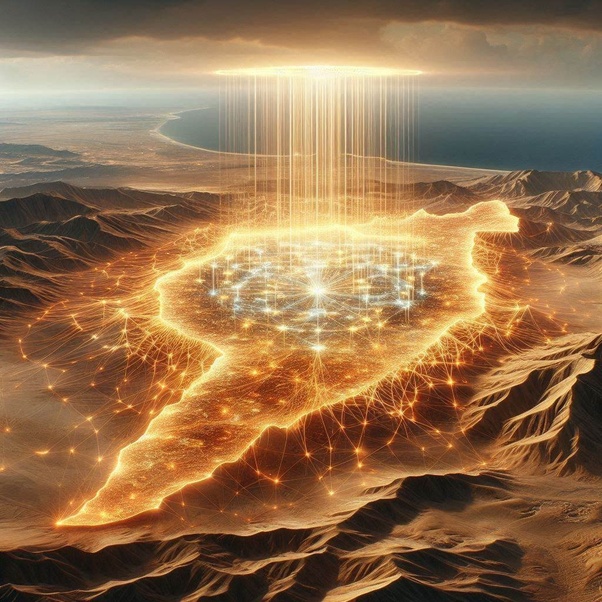
What does this mean and how does it work? According to the wisdom of Kabbalah, "land" (Eretz in Hebrew) means desire (Ratzon), the very matter or substance of creation. The Land of Israel thus refers to a desire aimed directly at the upper force of love, bestowal, and connection, called “the Creator,” since the word "Israel" comes from a connection of two words "Yashar-El" ("straight to God"). It is a desire that we can develop that longs to love, give, and positively connect as is the Creator's quality of love, bestowal, and connection.
We do not sense this desire through our inborn corporeal senses of sight, smell, touch, hearing, and taste. It is rather a spiritual quality of love, bestowal, and connection that exists above our corporeal sensation, i.e., above wishing to receive solely for self-benefit. This spiritual state casts a shadow into our world, a reflection that materializes as physical land with borders, terrain, climate, and a history. Kabbalah explains that every spiritual force has a physical imprint as people, places, and events in our world, because everything exists in a single system.
Therefore, if we live according to spiritual laws of love, bestowal, and connection, then we will feel blessings, abundance, and peace, even here in the physical Land of Israel. But if we reject these laws and live in hatred and division, primarily serving our egoistic and divisive drives, then this same land rejects us. As it is written, “the land will vomit you out” (Leviticus 18:28).
Is this not exactly what we have seen? 70 years ago, we returned to the land physically but we did not adapt to it spiritually. We did not match the land’s inner quality, arranging ourselves to live according to laws of mutual love and bestowal.
Why does this coarse land respond to something as intangible as love or hatred? It is because spiritual forces work on every level of reality, the still, vegetative, animate, and human. Nature absorbs our inner state. It reacts to our intentions. The land itself "feels" whether we relate to each other with either unifying or rejecting attitudes.
While we know of the Earth as being physically constructed of atoms and molecules, beneath it lies a spiritual infrastructure, a matrix of desire and intention. Every desire has a structure: five levels, each with its own corresponding intention. When we aim our desires outwardly at the benefit of others, then we awaken #nature to respond to such an intention positively, as a force that brings harmony and peace.
However, #Humanity has yet to mature spiritually. Our desire to bestow has not fully formed, and as a result, conflict and suffering persist, especially in the Land of Israel. Why? It is because the human being, "Adam" in Hebrew, has not yet reached a state of being "Domeh le Elyon," i.e., "similar to the Most High." Until we reach similarity with the upper force, with the Creator, with the altruistic and integral laws of nature—all of which Kabbalah describes interchangeably—we influence nature with our corrupted egoism and nature reflects that imbalance back at us.
Kabbalist Yehuda Ashlag (Baal HaSulam) wrote in the 1940s that just as Earth formed through a struggle between opposing forces, so too humanity is in constant conflict. However, while the still, vegetative, and animate levels of nature exist in balance, human beings project their egoistic imbalance onto the whole system, which is the reason for the myriad forms of suffering in the world.
What must we do as humans? We must become human in the fullest sense of the word, "Adam," a being that resembles the Creator. How? It is by developing love for others, by rising above egoistic reception and shifting to an altruistic modus operandi, one where mutual responsibility, concern, support, and encouragement thrive in our connections. Then we will feel a new reality. We will see the world differently as harmonious and peaceful, not because the world changes, but because we do.
In our world, we feel mostly negative forces. Positive forces of love, bestowal, and connection are rare, usually limited to family and instinctual relationships. But if we learn how to awaken the positive force through unity, we can enable balance in the entire system. When that happens, all levels of nature—still, vegetative, animate, and human—will harmonize.
So why were we given this land again after 2,000 years of exile? It was not for the sake of simply possessing it. It was for the purpose of correcting ourselves within it. "Correcting ourselves" means undergoing a process of changing our inborn egoistic intention to an altruistic one that elevates us to the human level, the level of Adam where we enter into balance with nature, or in other words, similarity to the Creator. The return is thus an opportunity. But time is limited. If we fail to correspond to the Land of Israel's inner quality, it will again reject us.
Based on the video “The Land of Israel - Spiritual States” with Kabbalist Dr. Michael Laitman.
https://t.co/1oLpFqKxuj
The Allegory of the Big Dog and the Puppy Chasing Its Tail
A big dog saw a puppy chasing its tail and asked, “Why are you running in circles?” The puppy replied, “I have studied philosophy, solved the mysteries of the universe, and learned that the best thing for a dog is happiness. And my happiness is in the tail. When I catch it, it will be mine.”
The dog smiled and said, “Son, I also thought about the world’s problems and came to the same conclusion that happiness is in the tail. But then I noticed that wherever I go, whatever I do, my tail follows me.”
This allegory illustrates that we chase happiness, thinking it is somewhere ahead, yet it is always near, always following us. There is no need to run after it.
It raises questions about happiness: What is happiness? Can we recognize it? Happiness is not something to chase. It exists close to us, within us, behind us, always present.
However, we live in a world that values chasing materialistic goals, and striving for advancements in knowledge, science, and technology. Should we not enter this pursuit to advance in these fields? Does that pursuit not bring us pleasure and happiness?
There is really no need to run anywhere. We have yet to learn that happiness comes from living quietly, from being at peace with life itself. "Living quietly" means living without unnecessary ambitions and unattainable goals, simply living life as it is, in peace. Life itself shows us the way. It teaches us not to demand too much from it. Instead, take what you have, be satisfied, and set an example for others.
This is how I live. Happiness is not about chasing, acquiring, or achieving. It is about learning to exist in peace and to accept life as it comes.
#LifeLessons #Happiness
What Are the Most Significant Challenges Humanity Will Face in the Next 50 Years?
Scientists predict that in the coming 50 to 100 years, humanity will face major challenges, such as:
•Genetic modification: By 2050, advances in genetic engineering may allow people to enhance themselves and their children in ways previously only imagined in science fiction.
(Source https://t.co/0vegKmxJ2A )
•Aging population: The number of centenarians is expected to increase more than 50 times by 2100, from 500,000 today to over 26 million. This will create challenges in elderly care and potentially influence immigration policies.
(Source https://t.co/jZ4PPYx2gV )
•Disappearing cities: Rising sea levels due to climate change may lead to the loss of parts of coastal cities. By 2050, US coastlines could see sea levels rise by up to 30 centimeters (12 inches).
(Source https://t.co/fzCMNpaFc3 )
•Natural resource depletion: By 2050, there will be increased pressure on natural resources due to population growth, with a projected 54% increase in global food demand and 56% increase in energy demand.
(Source https://t.co/JRWxyXnOju )
•Climate change: Under a business-as-usual scenario, global temperature could increase by 3.2°C by 2050, leading to worsened air pollution affecting 4.9 billion more people and greater water stress affecting 2.75 billion people.
(Source https://t.co/JRWxyXnOju )
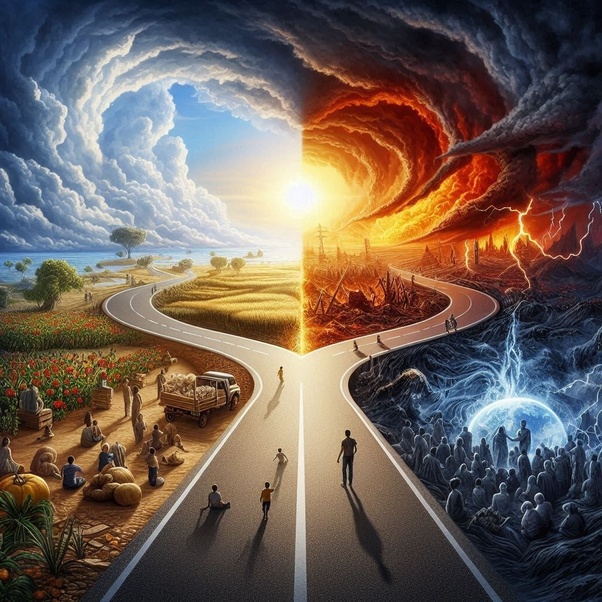
However, none of this will happen the way people imagine. Our current development leads us straight into a dead end. It might seem like we can tackle these problems by populating planets and transforming deserts, among other apparent solutions. We can build, destroy, or revolutionize the world, but the human ego will not let us do any of it in a way that will ultimately benefit humanity.
Instead, our egoism—the desire to enjoy at others' expense—will make life unbearable. It will lead to endless conflict, between family members, parents and children, neighbors, cities, and nations. It does not matter where or over what, we will be unable to get along. Eventually, it will become so extreme that we will be running through deserted streets just to buy bread, armed and desperate. This is where egoism will lead us.
No invention will save us. We will use every technological breakthrough to dominate, exploit, and suppress others. We can see this today with our technological advancements. What do we really use them for? To manipulate, profit, and control.
So instead of chasing empty dreams, we would be wiser to ask the real question: What is preventing us from being genuinely happy?
Happiness is not about colonizing lifeless planets, building driverless cars, or extending life to 200 years. 70 or 80 years is enough if they are lived meaningfully. It is not about how long we live but how we live. Death is inevitable and trying to push it further away is a meaningless pursuit.
What we really need is to achieve a sense of eternity and perfection while still alive in this world. That is the real solution, and not to get lost in egoistic distractions that will ultimately drive everything into ruin.
Can we say that we are happier today than people were 50 years ago? They did not have the electronic gadgets we do now, yet that did not make them any less happy. In fact, many studies show that people are more depressed, lonely, anxious, and stressed today, struggling more than ever before.
Today, people seek ways to escape reality, whether through substances, distractions, or an endless stream of entertainment. If someone lived for 200 years under these conditions, what would they do with their extra time? Spend 100 of those years in a narcotic dream?
We need to create a good life here and now, and the solution is simple: to develop positive and kind relationships. If we fail to establish this upgrade of human relations, we are headed straight for disaster.
People talk about #Armageddon, but do they even know what it means? It comes from the name of a small mountain in Israel, Har Megiddo, where battles took place thousands of years ago. Since then, the term has become a symbol for the end of the world. We do not, however, have to wait for such a catastrophe. We can choose not to push ourselves to extreme suffering. We can make life peaceful, good, and fulfilling, not in 50 years, but today.
Most importantly, through the #Wisdom of Kabbalah, we can begin to feel the next stage of existence, the upper world, the transition from one state to another, from one cycle of #life to the next. This is within our reach. I truly wish for everyone to discover this eternal state of growth and fulfillment, and to do so sooner rather than later, sparing ourselves much suffering in the process.
#sustainable #future
Can Conflicts and Disagreements Actually Strengthen a Relationship or Are They Detrimental?
The formula for human progress is very simple: negative experiences push us toward positive transformation. If we feel something is truly obstructing us, then we make a shift toward something better. It is the law of negation: we move forward when we encounter resistance that forces us to seek a better state.
Can this process happen the other way around? No. It is a law of nature. If we want to #develop, we need friction. We must provoke discussions, arguments, and conflicts, but in a friendly way. “Let’s argue!” You cannot imagine how much energy this releases and how much clarity it brings. When people argue without hostility, they begin to say truthful things to one another and perceive them differently. They stop seeing each other as adversaries. In such an environment, objections and remarks are no longer attacks but pathways to understanding. When friendliness is present, defensiveness disappears, and much more fruitful communication begins.
People think they argue over trivial matters, but it is untrue. Nothing is trivial. Every argument is a spark that ignites deeper tensions. Just like wars often begin over small disputes, yet the real cause is years of unresolved tension. Sports serve a similar function. They help release built-up aggression. Without moments of conflict, we cannot progress to better #relationships . It is a natural law: without experiencing hatred at some point, we cannot move toward a higher level of cooperation. Good cannot exist without evil. They need to be managed together.
How do we learn to appreciate evil as the starting point for good? It is by treating both equally. We can then maintain balance and use both positive and negative experiences for advancement. And how can we achieve this?
It is by rising above both the good and the bad. This is possible in an environment that supports such an ascent. The wisdom of Kabbalah teaches us how to rise above our natural inclinations. With its help, we can learn how to manage our nature and progress toward a harmonious, peaceful, and unified world.
https://t.co/iA3P7lLySw
#conflict #management
What Do People Need the Most?
People need happiness. At our core, we all seek to feel happy. But real happiness is not found in fleeting pleasures. It comes when we understand why we exist, for what purpose, and how our lives and the world around us constantly evolve. When we see our role in this process, when we realize how we can improve ourselves and contribute to the world, we experience a sense of deep and lasting happiness.
Happiness is also no solitary pursuit. It arises through the exchange of positive influences between people, i.e., when we do good for others and when others do good for us. This mutual flow of giving and receiving, directed in a mutually beneficial way, creates a wondrous sense of fulfillment.
Nature provides a key example of how happiness works: a baby in its mother’s arms. The baby feels a perfect sense of security, warmth, and love. To feel truly happy, we should feel similar to how the baby feels in its mother’s arms relative to human #society , humanity, and life itself. We should not feel burdened by worries and fears but the support of a society that nurtures and uplifts us.
In such a state, life and death become irrelevant because all that really matters is the experience of mutual happiness. I bring joy to my "mother"—the society that cares for me��and in return, my "mother" delights in me. Happiness thus depends on us developing to a #life of mutual bestowal, where we each support, encourage, care for, and uplift one another, and by doing so, rise above all limitations.
What Is the Difference Between Healing Our Souls and Treating Physical Illness?
An illness of the soul is far more challenging than a physical illness because it is the root of all illnesses, every single one of them. If we attain the correct attitude toward the world, i.e., one of absolute love, care, and bestowal, which enters us into balance with the laws of nature, then we could be immersed in icy water for an hour and remain completely unharmed.
Achieving this state, however, is not a matter of practicing Eastern techniques. While such methods once helped people connect to nature and find a certain unity between their inner world and the environment, they no longer suit the person living in today’s modern world with its overblown egoism—the giant desire to enjoy at others’ expense. Those approaches were effective at a time when humanity functioned on a more primitive level, closely tied to nature’s inanimate, vegetative, and animate levels. But we have evolved at an extraordinary pace, breaking away from being able to calm ourselves into a state of balance at those levels.
Over time, we have become increasingly detached, rising above nature and constructing artificial systems of existence. This separation began thousands of years ago, but it accelerated significantly during the Middle Ages and especially in the last 300 to 400 years. The result has been a host of psychological, physical, and social problems.
On one hand, we attempt to compensate for this detachment through #Science and #technology, trying to solve problems mechanically. But on the other hand, we can no longer live in harmony with nature like animals do. We have stepped outside of nature’s boundaries, and we are no longer a seamless part of it. Instead, we try to dominate, suppress, and control it, and such an approach leads to more and more suffering.
While, out of necessity, we need to continue treating physical illnesses that continually surface, we should couple this with learning how to enter into a state of mutual complementarity with #nature healing of the soul. That is the ultimate key to entering into balance with nature and overcoming the inner illness that plagues humanity, which leads to every illness we perceive on the physical level.
Why Do People Want to Climb Mount Everest, Risking Their Lives?
Many strive to climb Mount Everest, as it is one of the Earth’s highest peaks, reaching 8,848 meters above sea level. Climbers and scientists have even called this extreme altitude the "death zone." Indeed, why do so many people seek to climb such heights, putting their lives at risk?
It is a sport, a game—a way to prove to oneself that it can be done, just as others have done. Deep down, we possess a desire to establish ourselves above nature, to show that we can rise beyond its limits. This inclination to climb higher, to achieve more, and to prove ourselves extends even beyond physical limits.
The same inner drive exists in our #spiritual ascent, i.e., in rising above our individual selves to a complete positive connection with others and nature. In general, we wish to conquer peaks, to be above nature, to rise above ourselves, and to realize ourselves at the most extreme point. It is a fundamental human quality.
Unlike animals, which instinctively seek maximum comfort and security, we humans find no satisfaction in comfort alone. If there remains an opportunity to assert ourselves, we will pursue it. This is because within us, in addition to the inanimate, vegetative, and animate levels of nature, exists something even higher—the human level.
What is this human level that makes us risk and endanger our lives? It is the desire to be above nature. Within us, there exists an additional point called "human," but it resides inside the animalistic nature. This creates an internal conflict: as we develop this higher human quality, the animalistic part begins to suffer. It protests, wondering, “Why do you neglect me? Why are you striving for something beyond me?” Here, we encounter a struggle—the human part aspires upward, while the animalistic part resists, fearing its own diminishment.
If we focused on rising above the animal level within us, we would feel no need to cross oceans, climb the highest mountains, or dive to the depths of the sea. That is, the biggest ascent we can do as humans—the attainment of life’s meaning and purpose—is not found in these physical conquests but in overcoming our inner nature. Our most meaningful ascent is not in challenging our physical limits but in rising above the ego that resides within us.
To rise above nature means to rise above human egoistic nature, i.e., the desire to benefit ourselves at the expense of others. The human ego manifests on three levels: inanimate, vegetative, and animate. To rise above it means to shift from a state of hatred toward one’s neighbor to a state of love. This is the most significant elevation we can conduct in our lives—one that does not require scaling mountains or plunging into deep waters, but rather, reaching the highest peak within: the transformation from egoistic self-love to the love of others.
#life #love #development
Should Existential Questions Be Aroused in People?
Existential questions should not be aroused in people. Instead, people need to have their own preparation, where existential questions should awaken seemingly by themselves. There is a saying that if you place an obstacle in front of a blind person, then you commit a terrible crime, or if you put a stone or a tree in front a blind person, he will stumble and fall.
Regarding life's most fundamental questions about its ultimate meaning and purpose, all people are blind. How can we then try to arouse existential questioning in them if they themselves have not awakened to it?
They have no answer to such questions, and thus raising them will only make them depressed. We should thus gradually reveal existential questions, i.e., questions about the meaning and purpose of #life, when we know in advance how to simultaneously provide accurate and time-tested answers to such questions, which the people will find acceptable and desirable. Then such people will see joyful horizons opening up to them, and not dark ones.
#hope #Future
Are People Losing Trust in One Another These Days?
Yes, indeed. I heard one of my students recently even label our era as characterized by a growing “trust crisis” in the media, the government, and among people. We see a lack of understanding of what trust is and how to nurture it.
Why are people losing trust in one another these days? The first reason for people losing trust in one another is because our egoism, i.e., our desire to enjoy at others’ expense, has grown and demands new relationships: clearer, more connected, rougher, and tied to each other. Each of us has significant egoism, and everyone desires greater independence from others.
The second reason for people losing trust in one another is due to social, technological, and lifestyle developments. As opposed to past generations, today we can live and provide for ourselves independently, with much less person-to-person contact. Binding ourselves through family, friend, and workplace connections, requires effort, sometimes considerable effort.
Therefore, today it has become more challenging to compel people to enter into various connections, and they do so either when it is for very tangible rewards or when absolutely necessary.
#trust #crisis #global
Do You Feel That Humanity Is Benefiting More or Hurting More Because of Technological Advancements?
We strive for better, more comfortable lives, which is natural. But do we attach the right intention to it? Do we correct the “human being” in us while doing so, i.e., elevating us above our animal level to the level where we relate to each other through the most exalted human-specific qualities of love, care, support, and encouragement?
If we act with an aim to correct ourselves for the world’s benefit, i.e., to change our inborn egoistic intention for self-benefit at others’ expense to an altruistic intention to benefit others and nature, then we can act freely. Otherwise, our actions bring troubles, wars, and disasters.
Humanity progresses by fleeing suffering. Each generation pushes forward, pressed by the relentless force of evolution, what we call “the steamroller of evolution” in the wisdom of Kabbalah. We rush ahead without knowing why, compelled by unseen pressures.
For millennia, this pattern drove us through the first three levels of nature: still, vegetative, and animate. Now, we face our evolutionary limit. Though technological opportunities abound more and more, we find ourselves increasingly dissatisfied, and we thus question their purpose. Nanotechnology and the Internet offer much, but why do we need them?
The Internet mostly reveals our emptiness. Much of its content is trivial, empty of messages that truly benefit us. Even science, instead of elevating humanity to new levels of fulfillment and happiness, adds to this void. These tools highlight the fact that our problem is not solvable with technological means.
Although technology continues progressing, we fail to progress in our attitudes to each other, the place where we can truly progress to another level of existence. Deep down, we no longer feel the need for endless technological progress. Decades ago, during the hippie era, similar doubts emerged. Progress seemed to strip #life of meaning, reducing us to machines. Birth, work, and death became the formula, leaving many disillusioned.
Without developing the human level within us, i.e., the next level of existence where we discover positive connections to each other through discovering the positive force that dwells in nature, technological progress stalls. Culture and upbringing might help, but we need deeper, more essential results. The unfulfilled desire, or Reshimot (spiritual data or records), stirs in us, exposing emptiness that technology cannot fill.
Why can we not solve this? Technology creates the illusion we can easily improve ourselves. But true inner change requires a higher, spiritual force. Earthly means fail to correct human nature. Until humanity realizes this, the situation will remain unchanged.
#technology #development #solution
Could Being in Debt be Considered a Modern-Day Slavery?
Modern-day systems deliberately hold us in #debt as a form of modern slavery. This system binds people, confuses them, and enslaves them. We think we are free, but if we cannot provide for our families today, we are bound by iron chains. A minus in our bank account completes the enslavement.
Taxes, debts, and payments are tools of control. It might seem manageable—you borrow more money, and life goes on. But this debt-driven system is relatively new. Entire nations now live in a minus, with debts reaching hundreds of billions. When a country’s accounts are frozen, it begs for survival: “I’ll do anything—just give me food!” This is how people and nations are enslaved, trapped in a system with no escape.
Such a situation is yet another outcome of our egoistic development, where we evolve through our growing desires to enjoy at the expense of one another. This #development is leading us to a state where we will realize the shortcomings of our egoistic nature and start awakening to the need for a shift in our attitudes to each other: from egoistic to altruistic, exploitative to supportive, and divisive to positively connected.
It will be the sole way we will find pleasure and meaning in our lives as we move ahead in our #evolution, while the failure to make such an adjustment, trying to continue “business as usual” will lead us to increasing despair and helplessness.
Does Money Help in Getting Powerful Connections?
The impact of money depends entirely on how it is used. If I aim to fulfill my egoistic desires, i.e., desires for self-benefit at the expense of others, money becomes a necessity. However, if I seek to channel my egoism toward fulfilling others, I need an anti-egoistic screen—a "covering" for egoism, which is represented by money.
Money is an indicator of one’s strength, the force of the screen. Wars, for instance, are not truly fought over money itself but rather because of the egoism that money amplifies.
However, #money has its limitations. While it can buy many things, it cannot purchase everything. The qualities that are rooted in our soul, such as the connection between people or innate talents in music, art, or literature, are beyond monetary value.
The qualities we receive from nature, like our talents and spiritual potential, cannot be bought with money. Similarly, positive connections that we build in love and bestowal upon others cannot be bought with financial means.
We often confuse money with effort, assuming we can simply pay to achieve a desired outcome. Yet attitudes, deep connections, and gifts originating from the positive force of #love , bestowal, and connection that dwells in nature cannot be acquired through egoistic means. These intangible aspects, which we need to nurture and bring into balance with their source—the very positive force dwelling in nature—remain untouched by paper money or material wealth.
#money #power #Control #Connections
How Do Your Work Relationships Impact Your Life?
In today’s fast-paced, competitive world, the idea of developing balanced relationships—especially in the workplace—might seem idealistic. However, such relationships are essential for creating a harmonious and fulfilling life.
Imagine a work environment where the focus shifts from outshining others to ensuring everyone feels valued. By caring about the well-being of those around us, we create a space where collaboration thrives, and the stress of constant competition fades.
When people feel good and supported, they are more likely to reciprocate, leading to a healthier and more productive workplace. This change extends beyond the office, influencing how we treat others in everyday interactions and even how countries relate to one another. When we exercise mutual respect and balance throughout society, we can replace conflict with cooperation, and promote harmonious and peaceful relations on a broader scale.
What is the main barrier to this vision? It is our ego, which urges us to prioritize personal success over the common good. The ego is our true enemy as it traps us in dissatisfaction and competition. True success comes from rising above our egoistic nature to prioritize the benefit of others over personal benefit.
When we cultivate balanced relationships, we open ourselves to a more meaningful life. We broaden our perspective and experience a deeper connection to the world and to nature. The key is to realize that fulfillment lies not in competing with others but in building connections that uplift everyone. In doing so, we discover a sense of harmony, peace, and wholeness that is far beyond the fulfillment we can acquire through an egoistic approach to life. The more that such awareness spreads throughout society, the more we have a chance to truly shift to a harmonious and peaceful world.
#life #relationshipgoals #SustainableFuture
Taken from New Life series - episode No. 1237 -
From New Thinking To New Relations
Full episode available here >> https://t.co/sLKRleLdbT
Translation available in English, Hebrew, Italian, Russian, French, German, Spanish, Turkish, Magyar & Norsk
How Can We Change Our Thoughts to Create Different Results in Life?
First, we need to understand that our thoughts shape our life and what this means. Our attitude toward who and what we are, to what surrounds us, and to our purpose, are all considered “our thoughts.” We would thus be wise to actively seek answers to existential questions that dwell in us, such as why we are here, what is this process we are evolving through in our lives, how will our lives end, and what will we be left with.
Such questions might surface in a purely egoistic manner, i.e., in ways where we are solely concerned with what we envision as our own individual bubble of life that includes mostly us and a few people around us, but in any case, we should seek their answers. Eventually, we need to reach a realization that if we focus solely on satisfying our egoistic desires for self-benefit alone, we will end up eventually finishing the same way.
If I wish to rise to a higher level of existence, above our inborn egoistic modus operandi and into a spiritual form, then we need to start living according to entirely different values: not to merely envision the purpose of life in filling our physical bodies as much as possible, but to fill ourselves with the supreme qualities that exist in nature, those of love, bestowal, and positive connection. The latter is a completely different value system that leads us to a completely different life, one that is eternal and perfect, with a whole inner #connection among all of us, as opposed to our transient and incomplete lives here in our current world, where we are internally detached from each other.
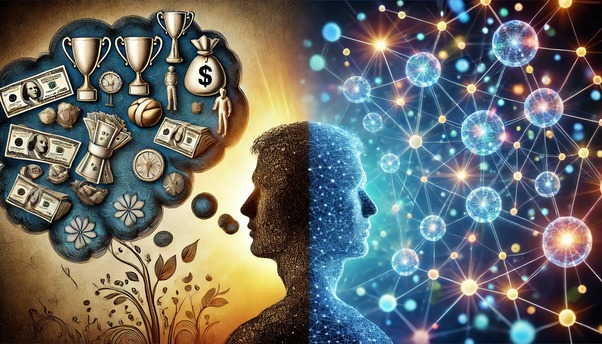
At such a juncture, we face a significant challenge. We then start seeing ourselves on a seemingly vast plane that has the egoistic-materialistic values of wealth, respect, and power on one side, i.e., values that the society we were born and raised into sees as worth living for, and a vague and unknown ��something” on the other side, where questions regarding our greater meaning and purpose in life prod at us. Accordingly, we start repositioning ourselves in a completely different way in terms of what we value in life, and look into how we can discover a purpose much greater than the egoistic-materialistic goals that we then view as lesser and lesser in value.
This plane is an inner plane of our desires and thoughts. More and more people are encountering this existential questioning today. It is the form of scrutiny that can bring about a true change in our lives. By seeking an optimal environment, i.e., texts, teachers, and friends that do not simply fall into the egoistic-materialistic flows of life that lead to a dead end, but those who regularly direct themselves at much higher values, meaning, and purpose, then we can optimally influence our thoughts to develop ourselves toward life’s greater meaning and purpose.
Kabbalist Yehuda Ashlag (Baal HaSulam) describes this principle at length in his article, “The Freedom,” https://t.co/mhDhj4a1zX and in my organization, the Bnei Baruch Kabbalah Education & Research Institute, we work on growing this environment for the optimal #spiritual #development for whoever so desires.
#life
What Is Money?
The Hebrew word for money, “Kesef,” comes from the word for “covering,” “Kisuf.” It stems from the idea that money is a covering over our desires.
Money is not merely cash or the numbers in our bank accounts. If we can cover our desires and aspirations for what we want with what Kabbalah terms a “screen” (“Masach”), i.e., a force that can resist the egoistic inward suction of fulfillment for ourselves alone, then with this force, we pay for our desires. We can then rise above our inborn egoistic desires to receive with an altruistic desire to bestow and accordingly achieve any fulfillment we aspire for according to the strength of our desire.
Covering our desires with a screen means that we can only truly fulfill our desires via its covering, which is the #transformation of the intention behind the desire: from the desire for ourselves alone to the desire to benefit others and nature.
Therefore, if we wish to earn in a way that is truly beneficial to other people and the nature we are parts of, i.e., in a way where we “earn life,” we need to understand the definition of money and covering described here, and what the change of our egoistic intention to its altruistic opposite entails. By acquiring a screen that covers our egoistic desires, changing them into altruistic ones, then in the new altruistic force we experience, we start receiving much loftier fulfillments than the ones we experience in our narrow egoistic perception. That is true wealth.
To What Extent, If Any, Is Suffering Necessary for Spiritual Growth?
In response to the Buddhist saying, “Never interfere in someone else’s suffering. A person must grow tired of himself and drink the cup of poison allotted to him,” I wholeheartedly agree. This is beautifully said. If you try to pull someone out of their suffering before they have fully experienced and internalized it—before they have drunk their allotted cup of poison—it will fail to truly help them. Each person needs to confront their own inner struggles.
In the process of spiritual growth, we need to grow tired of ourselves, even to the point of self-hatred. This process is necessary because it leads to the realization that the evil we experience comes from within ourselves. That is a critical turning point, a moment when we face the question: “How do I change myself?” This question bases making a correct decision about our lives.
Our lives are structured to lead us to a state of self-disillusionment. As for the idea of being "allotted" a cup of poison, I view it as a precise measure of suffering, uniquely tailored to each person. On one side of the scales, there is the cup of poison, and on the other, there is a drop of #Wisdom .
We need to drink this cup of poison without refusing, and accept our unique portion and dose. We are each given our specific cup to drink. It is about understanding that life’s trials are a pathway to eternity and perfection. In other words, before us is a cup of poison, and beyond it is a beautiful, harmonious, and peaceful life. Our path always traverses the cup of poison.
By facing and drinking this poison, we can achieve the balance and goodness we seek. Accordingly, the path to heaven indeed passes through hell. This is how we are meant to live—not in fear or avoidance but in acceptance of life’s transformative challenges.
#life #LifeLessons #Development