Bitcoin (BTC)-Update
Bitcoin is approaching our Fibonacci retracement zone, first set on February 1st, 2026. This zone will mark the end of the current long-term corrective phase and therefore represents a prime buying opportunity for Bitcoin.
More on https://t.co/pt8KPJBa79.
https://t.co/49aYFveNVI
Renk Group AG (R3NK) EW-Analysis
RENK Group has completed a first major impulse within Green Wave 1 and is currently trading in its correction phase, forming Green Wave 2.
https://t.co/IT7slwIj0b
NVIDIA approaches our price target zone. Withtin this zone NVIDIA should reach its final high and end this rallye. Our expectations for this stock were clear a long time ago!
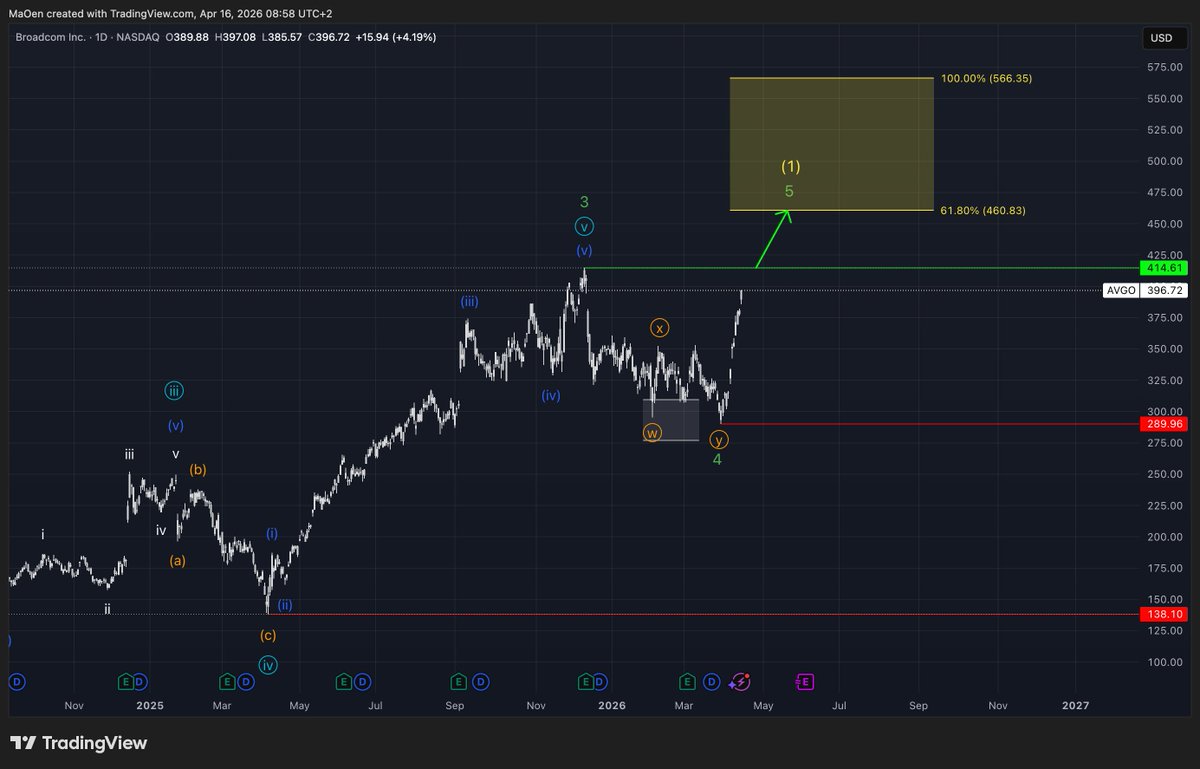
If you entered positions within our previously defined Fibonacci retracement zone (now marked as deactivated in grey), you should currently be in profit. From the upper boundary of that zone to the current price of $396.72, this represents a gain of approximately 28%. Should the market reach the lower bound of our target zone at the 61.8% Fibonacci level, potential gains could extend to nearly 49%. This highlights the strength and effectiveness of our analytical approach.
Broadcom (AVGO) Update
We have updated our wave count and now expect the formation of a new major all-time high, which will likely mark a long-term top ahead of a significant upcoming corrective phase.
https://t.co/JERvwoqKWj
SanDisk has shown a significant rally that is still ongoing. However, the structure and cyclical position vary from stock to stock. In our analysis about Intel, we highlight that the short-term rally—labeled as orange wave B—is not sustainable. This structure is interpreted as bearish; therefore, the current rise in price is also considered to be of a bearish nature. As a result, this short-term upward movement is identified as unsustainable.
If we take a closer look at SanDisk, the stock is currently displaying a completely different cycle compared to Intel—not only in the short term, but also over the longer term, despite its relatively short chart history. This suggests that the move in SanDisk can be interpreted as more sustainable. However, even this rally will eventually transition into a corrective phase, similar to what we are currently observing with Intel.
It is important to understand that Intel’s short-term structure is driven by an overshooting orange wave B, which is identified as bearish and therefore not sustainable. On the other hand, the long-term outlook presents a different picture. As outlined in our initial analysis of Intel, the broader trend remains very bullish and sustainable.
If you would like, I can also provide a detailed Elliott Wave–based analysis for SanDisk.