Élections présidentielles à Djibouti, 1999. Le début du premier mandat d’Ismaïl Omar Guelleh.
De 1999 à 2026, 27 années se sont écoulées. Aujourd’hui, Djibouti reste un pays de paix et de stabilité dans une région marquée par les conflits et l’insécurité.
Des populations venues d’Éthiopie, d’Érythrée, du Yémen et de Somalie, notamment du Somaliland, ont trouvé refuge sur son territoire.
Quand les populations fuient l’insécurité de leur pays, elles cherchent un endroit où vivre en paix. La présence de ces réfugiés et migrants témoigne aussi des défis humanitaires auxquels Djibouti fait face, malgré ses ressources limitées.
La paix est un bien précieux. Préserver la stabilité, protéger les populations et continuer à construire l’avenir : voilà les enjeux de Djibouti en 2026.
Djibouti, une terre de paix au cœur de la Corne de l’Afrique.
Arrêt sur image : Les autochtones somalis/issas à la porte d’Ambouli, à Djibouti-ville, à l’aube du XXᵉ siècle.
PS : La carte postale ci-contre est datée du 13 août 1903. Un précieux témoignage visuel de l’histoire de Djibouti. 🇩🇯
#Djibouti#Histoire#Archives#Somalis#Issa #Ambouli
A picture is worth a thousand words!
Djibouti, the ancestral land of the Somali/Issa people.
This photograph, taken in 1897, dates to one year after the ratification of the decree of May 20, 1896, which established the administrative organization of the French Somali Coast and its dependencies.
In the foreground: Indigenous Somali/Issa women selling firewood. In the background: the Gâmi an-Nür Mosque, also known as the Hamoudi Mosque, named after its founder, under construction at the time.
Source: Jacques Trampont, Djibouti hier, de 1887 à 1939, p. 65.
#Djibouti 🇩🇯 #History #Somali #Issa #Archives #Heritage
An overlooked anti-colonial resistance:
On March 19, 1967, the day of the referendum, indigenous Somali/Issa women in Djibouti openly expressed their support for NO to colonial rule and YES to national independence.
Their commitment is part of the history of our struggle for freedom.
#Djibouti #History #Independence #FLCS
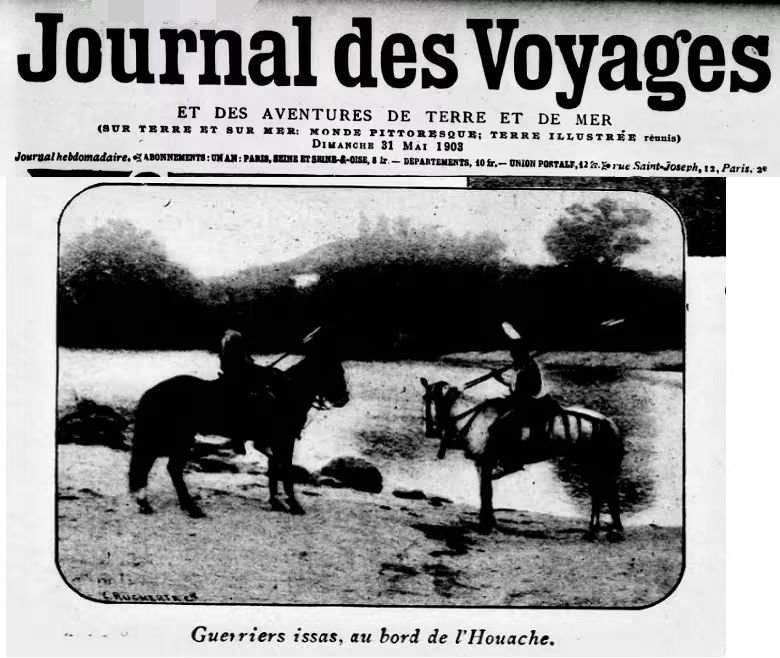
Two Somali/Issa warriors on the banks of the Awash River, a 1,200-kilometre waterway that rises in the Ethiopian Highlands, south of Addis Ababa, and flows through the western part of the Sitti region, in Issa country.
PS: This photograph was taken in January 1901 by Hugues Le Roux, a member of the French Superior Council of the Colonies, politician, writer and journalist.
In an article published in the French daily newspaper Le Figaro on March 14, 1901, Le Roux recounted the anti-colonial armed resistance of the indigenous Somali/Issa people:
“In my previous letter, I explained that the Issas occupy the entire territory, from the sea to the foothills of the Abyssinian massif. With this in mind, young men roam the bush in search of an enemy they can slaughter with their knives or pierce with a spear thrown from behind a bush, striking him between the shoulders with their formidable weapon. Needless to say, the white man (known here as the ‘Franghi’) is their preferred victim. Whoever kills one is entitled to a specially coloured feather, planted in his thick hair.
These customs are so deeply rooted in the hearts of the Issas, and so little has been done to eradicate them, that even today the inhabitants of Djibouti do not venture alone more than two kilometres beyond the town. Reckless hunters who disregard this danger stand a very good chance of becoming targets and prey themselves.
Under these circumstances, one can understand the difficulties encountered during the early construction of the railway. Workers who, despite warnings, wandered away from the camp or construction site were murdered behind a clump of mimosa bushes.
Two open attacks took place in 1899 and June 1900. They claimed around thirty lives. This sparked terror among the workers, which spread to Djibouti. Rumours circulated that the Issas were advancing en masse on the town. Frightened residents barricaded their homes or kept watch from their rooftops. Some, overcome with panic, hid in the sea, aboard Arab dhows that lay on their sides at low tide.
The echoes of this panic reached as far as Aden. Whether out of humanitarian concern or bitter irony, the British governor telegraphed an offer to send a warship to Djibouti to reassure the French population.”
Historical archives are essential to understanding the anti-colonial resistance of the Somali/Issa people and the colonial authorities’ perception of that resistance at the turn of the 20th century.
#Djibouti 🇩🇯 #Somali #Issa #Ciise #Sitti #AwashRiver #History #AfricanHistory #AntiColonialResistance #ColonialArchives #LeFigaro
A HISTORICAL SNAPSHOT — DJIBOUTI 🇩🇯
Somali/Issa women, guardians of the household and pillars of the family, at the heart of nomadic life.
In 1884, Gabriel Ferrand wrote:
“ Issa women follow their husbands everywhere. When travelling in a caravan, they lead the camels by a rope, carry firewood and cooking pots on their backs, and, when they have just given birth, carry their newborn baby wrapped in a goatskin.”
— Gabriel Ferrand, “Le çomal,” Bulletin de correspondance africaine, January 15, 1884, p. 284.
A historical account highlighting the courage, resilience, and essential role of Issa women in nomadic society.
A legacy, a history, a heritage worth preserving.
#Djibouti #Somalis #Issa #History
📍 Jaldessa — Issa Country, Ethiopia 🇪🇹
Jaldessa, a legendary settlement and former caravanserai located in the Garas-Joog area, in Issa territory, about 30 km as the crow flies from the city of Dire Dawa, Ethiopia.
These historical photographs were taken in 1888 by French explorer Édouard Joseph Bidault de Glatigné.
#History #Issa #Ethiopia #DireDawa
Les Danakils ont-ils lutté pour l’indépendance de notre pays comme le prétend Ahmed Dini dans un entretien accordé à Ahmed Dehli en 1993 ? 🤔
« Je suis né et j’ai grandi dans un milieu connu pour sa lutte incessante contre la pénétration coloniale. Certains membres de ma famille sont tombés sur le champ de bataille, d’autres ont été déportés à vie dans des pays lointains. »
— Ahmed Dini
AICHA BOGOREH DARAR — FIRST LADY OF THE REPUBLIC OF DJIBOUTI (1977–1999) 🇩🇯
May Allah have mercy on Hooyo Aicha Bogoreh Darar.
She served as the First Lady of the Republic of Djibouti from 1977 to 1999. Today, her name and legacy continue to live on in the hearts of the Djiboutian people.
Good people may leave this world, but their memories live on forever.
May Allah grant her Jannatul Firdaus. Ameen, Ya Rabb. 🤲🏾
Les médias djiboutiens laissent beaucoup à désirer en matière de professionnalisme et de traitement de l’information. La plupart ne maîtrisent pas les règles fondamentales pour présenter l’information de manière professionnelle, objective et attrayante. Nous avons encore beaucoup de progrès à faire dans le domaine du journalisme. Il est indispensable d’investir davantage dans la qualité, la formation et le sens des responsabilités.
Lorsque l’opposition djiboutienne a échoué sur le plan politique et perdu la confiance du peuple, elle s’est tournée vers les réseaux sociaux. Mais regardez bien ce qu’elle y publie !
Dans certains de leurs messages et vidéos, ses membres insultent le peuple djiboutien et diffusent des contenus qui portent atteinte à la dignité des Djiboutiens.
Personnellement, c’est notamment à cause de ce genre de comportement que je ne peux pas soutenir ceux qui se présentent comme des opposants. Être dans l’opposition ne signifie pas insulter ou humilier son propre peuple.
Personnellement, je suis convaincu qu’Ismaïl Omar Guelleh est le dirigeant en qui j’ai confiance pour bien gouverner Djibouti. Je ne vois personne d’autre en qui j’ai autant confiance pour diriger notre pays.
Le peuple djiboutien mérite le respect, même lorsque les opinions politiques divergent !
Djibouti est mon pays natal, le pays où je suis né, où j’ai grandi et où j’ai fait mes études. C’est le pays qui m’a donné la chance de bénéficier d’une éducation gratuite, de l’école primaire jusqu’à l’université.
Djibouti a joué un rôle essentiel dans la construction de la personne que je suis aujourd’hui. C’est ici que j’ai grandi, acquis des connaissances et de l’expérience, et créé des souvenirs que je n’oublierai jamais.
Chaque pays occupe une place particulière dans le cœur de ceux qui y ont grandi. Je suis fier d’être Djiboutien, né et élevé dans mon propre pays. 🇩🇯
Djibouti est mon pays, ma fierté et mon foyer. Qu’Allah protège notre nation, préserve sa paix et bénisse son peuple. Amine ! 🤲❤️
#Djibouti 🇩🇯
“We believe in President Sisi’s wisdom to build a better future, and we have started importing from Egypt.”
— Ilyas Moussa Dawaleh, Djibouti’s Minister of Economy and Finance, during an interview with Cairo 24 in Bangkok.
Djibouti–Egypt cooperation continues to strengthen! 🇩🇯🤝🇪🇬
When the Ambouli site (1) was inhabited exclusively by the indigenous Somali/Issa people, long before the large-scale arrival of foreign Yemenis of “Hakmi” origin (Arabs belonging to a lower social caste, brought from “Dhoubâb,” a town in western Yemen, by the colonial administration).
“Yemenis came to Djibouti with the colonizer, because of its presence and the opportunities it offered them,” notes Alain Rouaud in his article “Pour une histoire des Arabes de Djibouti” (“Towards a History of the Arabs of Djibouti”), published in 1997 in the journal Cahiers d’études africaines (Vol. 37, No. 146, pp. 319–348).
1) Located four kilometres from Djibouti city centre, the name “Ambouli” is etymologically derived from “Houmbo” (xumbo in Somali), meaning “foam,” and “leh,” meaning “having” or “possessing.” The name thus refers to a place with abundant foam, describing the stream that flows through the area.
P.S. The postcard shown here was published in the late 19th century by the GB agency, a publisher based in Lons-le-Saunier, in the Jura region of France.
#Djibouti 🇩🇯 #Ambouli #Issa #SomaliHistory #HistoireDeDjibouti #Zeila
A moment frozen in time: strong and proud, like a Somali/Issa warrior from Djibouti. 🇩🇯
A photographic testament to the strength, pride, and presence of the indigenous Somali/Issa people at the dawn of the 20th century.
PS: This photograph was published in the early 20th century by postcard publisher P. Mérignac.
#Djibouti #Somali #Issa #History
Did you know? On February 23, 1899, Somali/Issa warriors marched on Djibouti and came close to storming the stronghold of the occupying power: the Governor’s Palace. At the same time, in Paris, Paul Déroulède, the father of French nationalism, attempted a coup d’état to overthrow the Third Republic, the parliamentary regime that had been in power in France since September 1870.
Following the funeral of Félix Faure, President of the French Republic from 1895 to 1899, who died on February 16, 1899, in the arms of his mistress, Marguerite Steinheil, a woman from the demi-monde, the former president’s protégé, Léonce Lagarde (the first governor of Djibouti), was serving in the colonial administration when French deputy Paul Déroulède attempted a coup d’état on February 23, 1899. Déroulède tried to divert General Roget’s troops, who were returning from the funeral ceremony, toward the Élysée Palace “to save France and the Republic.”
The attempt failed. The would-be coup leader was arrested by the police and subsequently imprisoned. The founder of the League of Patriots, a movement established in 1882, would be acquitted on May 29, 1899, by the Seine Assize Court.
To learn more about this affair, we recommend Bertrand Joly’s excellent book, Déroulède, l’inventeur du nationalisme français (Déroulède: The Inventor of French Nationalism), a 440-page work published in 1998.
On the very same day, thousands of kilometres from Paris, Somali/Issa warriors attempted their own show of force by marching on Djibouti City, the administrative capital of the territory, in an effort to put an end to colonial occupation.
This is what the newspaper La Politique Coloniale reported in its March 12, 1899, edition:
«“There is great alarm in Djibouti. The most alarming rumours are circulating. Everyone is arming themselves with a military rifle. On the night of Thursday, the 23rd, to Friday, the 24th, many people believed that several thousand Issa warriors were about to attack.
News had arrived from Zeila that was truly extraordinary: the British Governor was reportedly prepared to bring in reinforcements from Aden to ensure the safety of the European inhabitants of Djibouti.
A telegram received by employees of the General Construction Company announced on Thursday evening that Issa warriors were prowling near Chebelé, 18 kilometres from Djibouti...
Many Europeans barricaded themselves inside their homes and kept watch throughout the night... Most French residents purchased weapons and military ammunition...
One is never better protected than by oneself; but, in the long run, it must be exhausting.”»
The newspaper La Croix, in its March 17, 1899, edition, also reported on the terror caused by the Somali/Issa guerrilla campaign in an article entitled “Djibouti on Alert”:
«“Correspondence from Djibouti informs us that the panic that broke out in the town following the murders of Europeans committed at the beginning of February was appalling.
Rumours that the Issa tribes were marching on the administrative capital of our establishments on the Somali Coast, together with the burning of several huts, triggered a general panic and flight.
The population sought refuge in boats moored in the harbour. The police askaris were the first to flee.
Nevertheless, one of our compatriots, Mr. de Leschaux, managed to keep his composure. He organised a small column of Europeans and entrusted its command to a bailiff who had recently arrived from France.
The column set off in such haste that three men died of thirst along the way...
We hope that our government will take measures to prevent events similar to those of February from happening again, and that it will send Hausa riflemen to Djibouti and, if necessary, even Malagasy riflemen.”»
Merci à TF1 de montrer la réalité sur le terrain. La colonisation israélienne en Cisjordanie, les violences des colons et les attaques contre les journalistes ne doivent plus être passées sous silence. Le peuple palestinien a droit à la liberté, à la dignité et à la justice. La vérité doit être montrée, et les droits des Palestiniens respectés. 🇵🇸✊