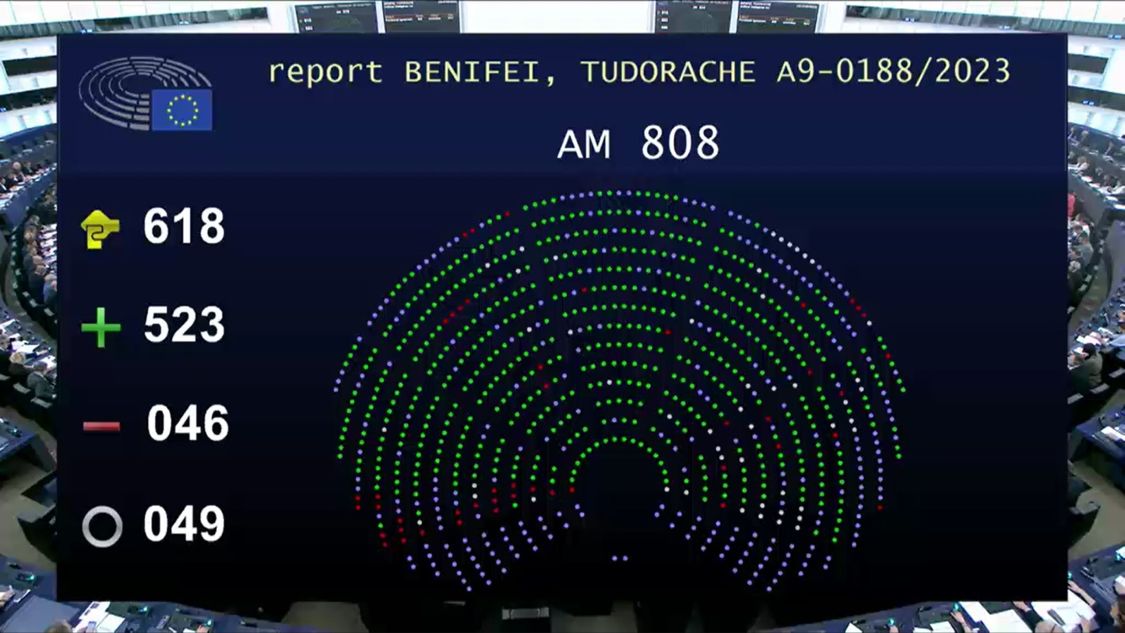
🚨BREAKING: The European Parliament has just APPROVED the AI Act. What everyone should know:
➵ The AI Act follows a risk-based approach. Some AI systems are banned, such as those involving:
- Cognitive behavioral manipulation of people or specific vulnerable groups;
- Social scoring: classifying people based on behavior, socioeconomic status, or personal characteristics;
- Biometric identification and categorization of people;
- Real-time and remote biometric identification systems, such as facial recognition.
➵ Some AI systems fall in the "high-risk" category, such as those involving:
- Critical infrastructures (e.g. transport) that could put the life and health of citizens at risk;
- Educational or vocational training that may determine the access to education and professional course of someone’s life (e.g. scoring of exams);
- Safety components of products (e.g. AI application in robot-assisted surgery);
- Employment, management of workers, and access to self-employment (e.g. CV-sorting software for recruitment procedures);
- Essential private and public services (e.g. credit scoring denying citizens opportunity to obtain a loan);
law enforcement that may interfere with people’s fundamental rights (e.g. evaluation of the reliability of evidence);
- Migration, asylum, and border control management (e.g. automated examination of visa applications);
- Administration of justice and democratic processes (e.g. AI solutions to search for court rulings).
➵ High-risk AI systems will be assessed before being put on the market and also throughout their lifecycle. People will have the right to file complaints about AI systems to designated national authorities.
➵ Generative AI, like ChatGPT, will not be classified as high-risk but will have to comply with transparency requirements and EU copyright law. Some of the obligations are:
- Disclosing that the content was generated by AI;
- Designing the model to prevent it from generating illegal content;
- Publishing summaries of copyrighted data used for training.
➵ The AI Act is expected to officially become law by May or June, and its provisions will start taking effect in stages:
- 6 months later: countries will be required to ban prohibited AI systems;
- 1 year later: rules for general-purpose AI systems will start applying;
- 2 years later: the whole AI Act will be enforceable.
➵ Fines for non-compliance can be up to 35 million Euros or 7% of worldwide annual turnover.
➵ If you want to learn more about the AI Act, including challenges, opportunities, and practical insights, join my live session with @BertuzLuca, @JcMalgieri & @RistoUuk on April 4th (register using the link below).
#GitHub has released critical fixes for 3 flaws in Enterprise Server, including CVE-2024-6800 (CVSS 9.5).
This flaw could allow attackers to gain admin privileges, posing serious risks to organizations using SAML SSO.
Details: https://t.co/ENMgfObGaY
#cybersecurity#infosec
🚨 ALERT: Cisco patches critical #vulnerability in Smart Software Manager On-Prem. This flaw could allow attackers to change any user's password, including admins.
CVE-2022-22948 could be exploited with crafted HTTP requests—Patch now!
Read: https://t.co/bwUDaTuGCN
#infosec
🚨 [AI REGULATION] A new AI law was introduced in the US to combat deepfakes, increase AI transparency, and empower creators. Here's what you need to know:
➡ The Content Origin Protection and Integrity from Edited and Deepfaked Media Act (COPIED ACT) was introduced last week by Senators Maria Cantwell (D-Wash.), Chair of the Senate Commerce Committee, Marsha Blackburn (R-Tenn.), member of the Commerce Committee, and Martin Heinrich (D-N.M.).
➡ According to the official release, among its highlights are:
➵ Creating transparency standards
➵ Putting journalists, artists, and musicians in control of their content
➵ Giving individuals a right to sue violators
➵ Prohibiting tampering with or disabling AI provenance information
➡ In this context, the COPIED ACT, among other provisions:
"➵ Requires developers and deployers of AI systems and applications used to generate covered content (digital representations of copyrighted works) to give users the option to attach content provenance information within 2 years;
➵ Prohibits removing, altering, tampering with, or disabling content provenance information, with a limited exception for security research purposes;
➵ Prohibits the use of “covered content” (digital representations of copyrighted works) with content provenance to either train an AI- /algorithm-based system or create synthetic content without the express, informed consent and adherence to the terms of use of such content, including compensation;"
➡ It was endorsed by various alliances and groups of creative professionals, such as @sagaftra, @NSAIofficial, @RecordingAcad, @NMPAorg, @RIAA, @nnaonline, @nabtweets, @artistrightsnow, and more.
➡ These are interesting developments in the context of AI regulation, although we still need to wait and see if this bill will survive the legislative process. Find all relevant links below.
🚨 Additional resources on AI regulation & compliance
➵ To learn more about AI policy & regulation, join 29,000 people who subscribe to my weekly newsletter (link below).
➵ To upskill and obtain AI training, check out our AI Bootcamps at the AI, Tech & Privacy Academy (link below).
Some audiobook recommendations:
The Story of Civilization by Durant
Iliad (Penguin Edition)
The Road to Serfdom by Hayek
American Caesar by Manchester
Masters of Doom by Kushner
The Wages of Destruction by Tooze
The Storm of Steel by Junger
The Guns of August by Tuchman
The Gallic Wars by Caesar
Twelve Against the Gods by Bolitho
Genghis Khan by Weatherford
The first one on the list will take a while to get through, but is very much worthwhile.
Admittedly, this is a list that appeals to those who think about Rome every day.
I hope someone makes an audiobook of The Encyclopedia of Military History by Dupuy and The Fifteen Decisive Battles of the World by Creasy.
A 22-year-old Russian national has been indicted in the U.S. for cyberattacks against Ukraine and its allies just before Russia's invasion in 2022.
US offers $10M reward. Read more: https://t.co/OycmJP1HON
#cybersecurity#hacking
🚨 BREAKING: The EU vs. Apple legal fight is HEATING UP. They suspect Apple is breaching the Digital Markets Act (DMA) and open a new investigation. Here's what you need to know:
➡ Today, the EU Commission announced:
1. it's preliminary view that App Store rules are in breach of the Digital Markets Act (DMA) and
2. New investigations against Apple under the DMA.
➡ Let's break these two down and understand in practice what it means:
-
➡ The preliminary findings that App Store rules are in breach of the DMA
➵ Article 5(4) of the DMA says:
“The gatekeeper shall allow business users, free of charge, to communicate and promote offers, including under different conditions, to end users acquired via its core platform service or through other channels, and to conclude contracts with those end users, regardless of whether, for that purpose, they use the core platform services of the gatekeeper.”
➵ On September 5th, 2023, Apple was designated a Gatekeeper under the DMA.
➵ According to the EU Commission’s preliminary findings, Apple is in breach of the DMA as they are preventing App Store developers from “freely steering consumers to alternative channels for offers and content” (see examples in the official release - link below).
-
➡ New non-compliance investigation into Apple's contract terms
➵ Today, the EU Commission opened another DMA non-compliance investigation into Apple’s new contractual terms for developers as a condition to accessing some of the new features enabled by the DMA, as these conditions might be in breach of Article 6(4).
➵ The EU Commission is investigating
- "Apple's Core Technology Fee, under which developers of third-party app stores and third-party apps must pay a €0.50 fee per installed app. (...)
- Apple's multi-step user journey to download and install alternative app stores or apps on iPhones (...).
- The eligibility requirements for developers related to the ability to offer alternative app stores or directly distribute apps from the web on iPhones (...).
-
➡ The EU Commission states that they continue investigating Apple, especially in the context of “the checks and reviews put in place by Apple to validate apps and alternative app stores to be sideloaded.”
➡ Apple can now defend itself and reply in writing to the Commission's preliminary findings.
➡ DMA fines can be up to 10% of the gatekeeper's total worldwide turnover, and in case of repeated infringements, they can be up to 20%.
➡ In case of systematic infringements, the EU Commission can then oblige a gatekeeper to sell a business or parts of it or ban the gatekeeper from acquiring additional services related to the systemic non-compliance.
-
➡ Stay up to date with the latest developments in tech & AI regulation: subscribe to my newsletter
➡ All relevant links below.
⚠️ North Korea-linked Kimsuky #hacking group has launched a new social engineering attack using fake #Facebook accounts to target individuals via Messenger.
Learn more: https://t.co/jYkwNahtaW
#cybersecurity
🚨 Google has addressed nine security issues in its Chrome browser, including a new zero-day exploit (CVE-2024-4947) that has been actively exploited in the wild.
Learn more: https://t.co/tgRd0L3331
Don't wait – update your browser now.
💻 Hackers linked to Russia have been exploiting a Windows bug for YEARS to deploy GooseEgg #malware for escalating attack access.
More insights here... https://t.co/YGxYDk2Fxe
#cybersecurity
Malicious cyber actors targeting artificial intelligence systems may use attack vectors unique to AI systems, as well as techniques used against traditional IT. Review the guide “Deploying AI Systems Securely” to best protect your org’s AI capabilities https://t.co/9N3Hn9IdXt
⚠️@CISAgov issued 4 NEW public #ICS advisories. This advisory provides info about current security issues, vulnerabilities, & exploits surrounding ICS. More at https://t.co/cQKHjOLwi7
U.S. Department of Justice indicts 7 Chinese nationals linked to hacking group APT31, implicated in cyber espionage targeting U.S. critics, journalists, officials, and businesses for over 14 years.
Learn more: https://t.co/kG42x6NySb
#cybersecurity#informationsecurity










![LuizaJarovsky's tweet photo. 🚨 [AI REGULATION] A new AI law was introduced in the US to combat deepfakes, increase AI transparency, and empower creators. Here's what you need to know:
➡ The Content Origin Protection and Integrity from Edited and Deepfaked Media Act (COPIED ACT) was introduced last week by Senators Maria Cantwell (D-Wash.), Chair of the Senate Commerce Committee, Marsha Blackburn (R-Tenn.), member of the Commerce Committee, and Martin Heinrich (D-N.M.).
➡ According to the official release, among its highlights are:
➵ Creating transparency standards
➵ Putting journalists, artists, and musicians in control of their content
➵ Giving individuals a right to sue violators
➵ Prohibiting tampering with or disabling AI provenance information
➡ In this context, the COPIED ACT, among other provisions:
"➵ Requires developers and deployers of AI systems and applications used to generate covered content (digital representations of copyrighted works) to give users the option to attach content provenance information within 2 years;
➵ Prohibits removing, altering, tampering with, or disabling content provenance information, with a limited exception for security research purposes;
➵ Prohibits the use of “covered content” (digital representations of copyrighted works) with content provenance to either train an AI- /algorithm-based system or create synthetic content without the express, informed consent and adherence to the terms of use of such content, including compensation;"
➡ It was endorsed by various alliances and groups of creative professionals, such as @sagaftra, @NSAIofficial, @RecordingAcad, @NMPAorg, @RIAA, @nnaonline, @nabtweets, @artistrightsnow, and more.
➡ These are interesting developments in the context of AI regulation, although we still need to wait and see if this bill will survive the legislative process. Find all relevant links below.
🚨 Additional resources on AI regulation & compliance
➵ To learn more about AI policy & regulation, join 29,000 people who subscribe to my weekly newsletter (link below).
➵ To upskill and obtain AI training, check out our AI Bootcamps at the AI, Tech & Privacy Academy (link below).](https://pbs.twimg.com/media/GSjiykNXMAA1c5j.jpg)