Export Trade
#TAXALERT
Recent TAT decision in Leaf Tobacco & Commodities v URA establishes vital parameters for taxpayer defence of export trade related tax relief claims(VAT-Zero Rating and Excise Duty remission.
If you're an exporter, find our breakdown of the decision below
UGANDA EXPORT TRADE #TAXALERT:
Uganda's Tax Appeals Tribunal has recently clarified a critical intersection in cross-border commerce: the interplay between export documentation and the strict evidentiary burden for tax relief in Export Trade.
In our latest MRT Tax Alert, we break down the key tax controversy themes from the recent decision in Leaf Tobacco v URA, in which the Tribunal affirmed that merely initiating a customs process is insufficient to secure VAT zero-rating and excise duty remission.
For manufacturers and exporters executing cross-border cargo movements, this ruling establishes vital parameters for tax defence of export trade tax relief claims.
Key themes from our analysis:
The Physical Exit Threshold:
Customs declarations, invoices, transit documents, and clearing-agent involvement do not replace the requirement to definitively prove the physical departure of goods(the actual declared quantities) from Uganda.
The Audit Friction:
Once the URA challenges export positions, and points out inconsistencies in the cargo trail, the evidentiary burden is entirely on the taxpayer to validate their commercial operations.
Operational Documentary Proof:
The absolute commercial necessity of aligning factory, border, and destination records to defend an export transaction in tax controversy.
Read our full analysis of the decision at the link below.
https://t.co/FjL51WUQF1
#TaxLaw #ExportTrade #CrossBorderTrade #TaxStructuring #UgandaTax #MRTTax #URA #TaxControversy #DoingBusinessInUganda
UGANDA EXPORT TRADE #TAXALERT:
Uganda's Tax Appeals Tribunal has recently clarified a critical intersection in cross-border commerce: the interplay between export documentation and the strict evidentiary burden for tax relief in Export Trade.
In our latest MRT Tax Alert, we break down the key tax controversy themes from the recent decision in Leaf Tobacco v URA, in which the Tribunal affirmed that merely initiating a customs process is insufficient to secure VAT zero-rating and excise duty remission.
For manufacturers and exporters executing cross-border cargo movements, this ruling establishes vital parameters for tax defence of export trade tax relief claims.
Key themes from our analysis:
The Physical Exit Threshold:
Customs declarations, invoices, transit documents, and clearing-agent involvement do not replace the requirement to definitively prove the physical departure of goods(the actual declared quantities) from Uganda.
The Audit Friction:
Once the URA challenges export positions, and points out inconsistencies in the cargo trail, the evidentiary burden is entirely on the taxpayer to validate their commercial operations.
Operational Documentary Proof:
The absolute commercial necessity of aligning factory, border, and destination records to defend an export transaction in tax controversy.
Read our full analysis of the decision at the link below.
https://t.co/FjL51WUQF1
#TaxLaw #ExportTrade #CrossBorderTrade #TaxStructuring #UgandaTax #MRTTax #URA #TaxControversy #DoingBusinessInUganda
MRT Tax FY 2026/27 Tax Outlook stakeholder memo:
2025/26 market retrospectives and emerging tax controversy trends. M&A scrutiny, CGT, VAT insights and much more
https://t.co/xZbnxSHIhH
Our FY 2026/27 commencement memo maps the exact tax risk forecast you need to navigate the financial year ahead.
Get the breakdown here: https://t.co/xZbnxSIg7f
Uganda FY 2026/27 Tax Outlook
Uganda has officially entered FY 2026/27 with a UGX 84 trillion national budget targeting job creation, digital transformation, and aggressive domestic revenue mobilization.
In our Financial Year commencement stakeholder memo, we examine:
• Key market developments from the past year
• The commercial impact of Uganda’s FY 2026/27 tax changes.
• Emerging controversy and dispute resolution trends from M&A, restructurings, VAT refunds, interest deductibility, offshore income and digital economy taxation.
• Practical tax controversy readiness.
We anticipate the Uganda Revenue Authority's (URA) aggressive shift into data and technology-driven compliance enforcement to continue.
Therefore, understanding the real-time interaction and cross-referencing of diverse commercial and tax data sets, from VAT(EFRIS), customs entries, Stamp duty, third party financial services and banking records, including Stamp Duty returns introduced in the 2026 amendment, among other transaction data, will be critical in both compliance enforcement and controversy defense.
Read our stakeholder tax outlook memo at the link below:
https://t.co/MU30loPZ8q
#MRTTax #UgandaTax #TaxOutlook #TaxControversy #CorporateTax #TaxGovernance #TaxCompliance
Uganda FY 2026/27 Tax Outlook
Uganda has officially entered FY 2026/27 with a UGX 84 trillion national budget targeting job creation, digital transformation, and aggressive domestic revenue mobilization.
In our Financial Year commencement stakeholder memo, we examine:
• Key market developments from the past year
• The commercial impact of Uganda’s FY 2026/27 tax changes.
• Emerging controversy and dispute resolution trends from M&A, restructurings, VAT refunds, interest deductibility, offshore income and digital economy taxation.
• Practical tax controversy readiness.
We anticipate the Uganda Revenue Authority's (URA) aggressive shift into data and technology-driven compliance enforcement to continue.
Therefore, understanding the real-time interaction and cross-referencing of diverse commercial and tax data sets, from VAT(EFRIS), customs entries, Stamp duty, third party financial services and banking records, including Stamp Duty returns introduced in the 2026 amendment, among other transaction data, will be critical in both compliance enforcement and controversy defense.
Read our stakeholder tax outlook memo at the link below:
https://t.co/MU30loPZ8q
#MRTTax #UgandaTax #TaxOutlook #TaxControversy #CorporateTax #TaxGovernance #TaxCompliance
UGANDA M&A and Restructuring Transactions #TAXALERT:
Uganda's High Court has just clarified one of the most contested intersections in corporate tax: the interplay between roll-over relief and withholding tax obligations.
In our latest MRT Tax Alert, we break down the controversy lessons from the recent decision in URA v Tunga Nutrition, in which the Court allowed the URA’s appeal and set aside the Tax Appeals Tribunal’s decision that had earlier interpreted(in the taxpayer’s favour), key Income Tax Act provisions governing roll-over relief in M&A and Corporate Restructuring transactions.
For corporate groups and dealmakers executing asset transfers and reorganizations, this ruling establishes vital parameters for tax defence.
Key themes from our analysis:
▪️ The Roll-Over Relief Threshold: When a corporate reorganization legally qualifies for tax neutrality under the statute.
▪️ The Withholding Tax Friction: How the High Court resolved URA's application of withholding tax on transactions that otherwise would have qualified for roll-over relief.
▪️ M&A Documentary Proof: The absolute commercial necessity of managing deal-close execution steps in a way that makes it easy to defend a deal structure in tax controversy.
Read our full analysis of the decision at the link below.
https://t.co/OHzDr4211T
#TaxLaw #CorporateTax #MandA #TaxStructuring #UgandaTax #MRTTax #URA #TaxControversy #DoingBusinessInUganda
UGANDA M&A and Restructuring Transactions #TAXALERT:
Uganda's High Court has just clarified one of the most contested intersections in corporate tax: the interplay between roll-over relief and withholding tax obligations.
In our latest MRT Tax Alert, we break down the controversy lessons from the recent decision in URA v Tunga Nutrition, in which the Court allowed the URA’s appeal and set aside the Tax Appeals Tribunal’s decision that had earlier interpreted(in the taxpayer’s favour), key Income Tax Act provisions governing roll-over relief in M&A and Corporate Restructuring transactions.
For corporate groups and dealmakers executing asset transfers and reorganizations, this ruling establishes vital parameters for tax defence.
Key themes from our analysis:
▪️ The Roll-Over Relief Threshold: When a corporate reorganization legally qualifies for tax neutrality under the statute.
▪️ The Withholding Tax Friction: How the High Court resolved URA's application of withholding tax on transactions that otherwise would have qualified for roll-over relief.
▪️ M&A Documentary Proof: The absolute commercial necessity of managing deal-close execution steps in a way that makes it easy to defend a deal structure in tax controversy.
Read our full analysis of the decision at the link below.
https://t.co/OHzDr4211T
#TaxLaw #CorporateTax #MandA #TaxStructuring #UgandaTax #MRTTax #URA #TaxControversy #DoingBusinessInUganda
TAT recently drew a line on these two major URA pain points:
VAT assessments premised entirely on VAT-to-income-tax turnover variances, and The enforcement of agency notices during an active statutory objection window. Read our full analysis of Ericsson AB v URA decision below.
Uganda VAT Controversy #TAXALERT
The Tax Appeals Tribunal has handed down a key VAT decision in Ericsson AB v Uganda Revenue Authority.
This decision draws a firm line on evidential discipline and statutory taxpayer rights and delivers crucial controversy lessons for corporate taxpayers navigating complex audits, and specifically dispute resolution around four central questions of law:
1. Turnover Variances: When may URA treat a VAT-to-income-tax turnover variance as VAT-exclusive rather than VAT-inclusive?
2. Shifting Assessment Bases: Can URA materially alter the underlying basis of an assessment during mediation without issuing a fresh tax decision?
3. Unbilled Revenue Timing: Does the mere accounting recognition of unbilled revenue prove that a statutory VAT obligation has accrued?
4. Enforcement Timelines: Can URA enforce recovery through third-party agency notices while a taxpayer’s statutory objection rights remain active?
In our latest MRT Tax Insights Commentary, we break down the crucial controversy lessons from the Tribunal’s ruling.
Key takeaways from our analysis include:
▪️ Variances ≠ Liability: A numerical mismatch between financial statements and tax returns is merely an audit lead. URA must still establish a strict statutory trigger to assess VAT.
▪️ Unbilled Revenue: Accounting recognition of unbilled revenue is not a proxy for VAT liability without evidence of a statutory time-of-supply event.
▪️ Agency Notices: The decision exposes the procedural unlawfulness of enforcing third-party agency notices (bank recoveries) while a taxpayer's statutory objection window remains active.
Read our full commentary to understand how this pivotal ruling shapes corporate tax defence and why maintaining proactive reconciliation files is now an absolute commercial necessity.
https://t.co/ViLQrq4D07
#TaxLaw #UgandaTax #TaxControversy #VAT #CorporateTaxation #MRTTax #URA #TaxAlert #DoingBusinessInUganda
Uganda VAT Controversy #TAXALERT
The Tax Appeals Tribunal has handed down a key VAT decision in Ericsson AB v Uganda Revenue Authority.
This decision draws a firm line on evidential discipline and statutory taxpayer rights and delivers crucial controversy lessons for corporate taxpayers navigating complex audits, and specifically dispute resolution around four central questions of law:
1. Turnover Variances: When may URA treat a VAT-to-income-tax turnover variance as VAT-exclusive rather than VAT-inclusive?
2. Shifting Assessment Bases: Can URA materially alter the underlying basis of an assessment during mediation without issuing a fresh tax decision?
3. Unbilled Revenue Timing: Does the mere accounting recognition of unbilled revenue prove that a statutory VAT obligation has accrued?
4. Enforcement Timelines: Can URA enforce recovery through third-party agency notices while a taxpayer’s statutory objection rights remain active?
In our latest MRT Tax Insights Commentary, we break down the crucial controversy lessons from the Tribunal’s ruling.
Key takeaways from our analysis include:
▪️ Variances ≠ Liability: A numerical mismatch between financial statements and tax returns is merely an audit lead. URA must still establish a strict statutory trigger to assess VAT.
▪️ Unbilled Revenue: Accounting recognition of unbilled revenue is not a proxy for VAT liability without evidence of a statutory time-of-supply event.
▪️ Agency Notices: The decision exposes the procedural unlawfulness of enforcing third-party agency notices (bank recoveries) while a taxpayer's statutory objection window remains active.
Read our full commentary to understand how this pivotal ruling shapes corporate tax defence and why maintaining proactive reconciliation files is now an absolute commercial necessity.
https://t.co/ViLQrq4D07
#TaxLaw #UgandaTax #TaxControversy #VAT #CorporateTaxation #MRTTax #URA #TaxAlert #DoingBusinessInUganda
CORPORATE FINANCE #TAXALERT
For corporate groups operating in Uganda, the tax treatment of debt financing has just undergone a crucial shift.
In our latest MRT Tax Insights Commentary, we unpack the commercial implications of the Tax Appeals Tribunal’s recent ruling in Micro-Haem v URA.
Building on the High Court’s precedent in Moil, the Tribunal confirmed a vital limitation on the URA’s enforcement of the section 25(3) interest cap: belonging to a corporate group does not, by itself, trigger the interest restriction if the financing involves genuine third-party debt from outside the group structure.
However, taxpayers should not misread this as a blanket victory.
The Tribunal’s ruling makes it clear that fighting interest-cap assessments is now an intensely evidence-driven exercise.
Claims of corporate dormancy, tax exemptions, and third-party independence will fail without rigorous, contemporaneous supporting documentation.
Read our full analysis to understand how this ruling impacts your capital structure, group/related-entity financing transactions:
https://t.co/vrjRYQj6xN
#TaxLaw #CorporateFinance #UgandaTax #TaxControversy #MRTTax #TransferPricing #TaxStrategy #URA #DoingBusinessInUganda
Uganda's interest deductibility rules and tax treatment of corporate debt financing have just undergone a crucial shift.
Read our practice note here:
https://t.co/eFNfW3fP2J
CORPORATE FINANCE #TAXALERT
For corporate groups operating in Uganda, the tax treatment of debt financing has just undergone a crucial shift.
In our latest MRT Tax Insights Commentary, we unpack the commercial implications of the Tax Appeals Tribunal’s recent ruling in Micro-Haem v URA.
Building on the High Court’s precedent in Moil, the Tribunal confirmed a vital limitation on the URA’s enforcement of the section 25(3) interest cap: belonging to a corporate group does not, by itself, trigger the interest restriction if the financing involves genuine third-party debt from outside the group structure.
However, taxpayers should not misread this as a blanket victory.
The Tribunal’s ruling makes it clear that fighting interest-cap assessments is now an intensely evidence-driven exercise.
Claims of corporate dormancy, tax exemptions, and third-party independence will fail without rigorous, contemporaneous supporting documentation.
Read our full analysis to understand how this ruling impacts your capital structure, group/related-entity financing transactions:
https://t.co/vrjRYQj6xN
#TaxLaw #CorporateFinance #UgandaTax #TaxControversy #MRTTax #TransferPricing #TaxStrategy #URA #DoingBusinessInUganda
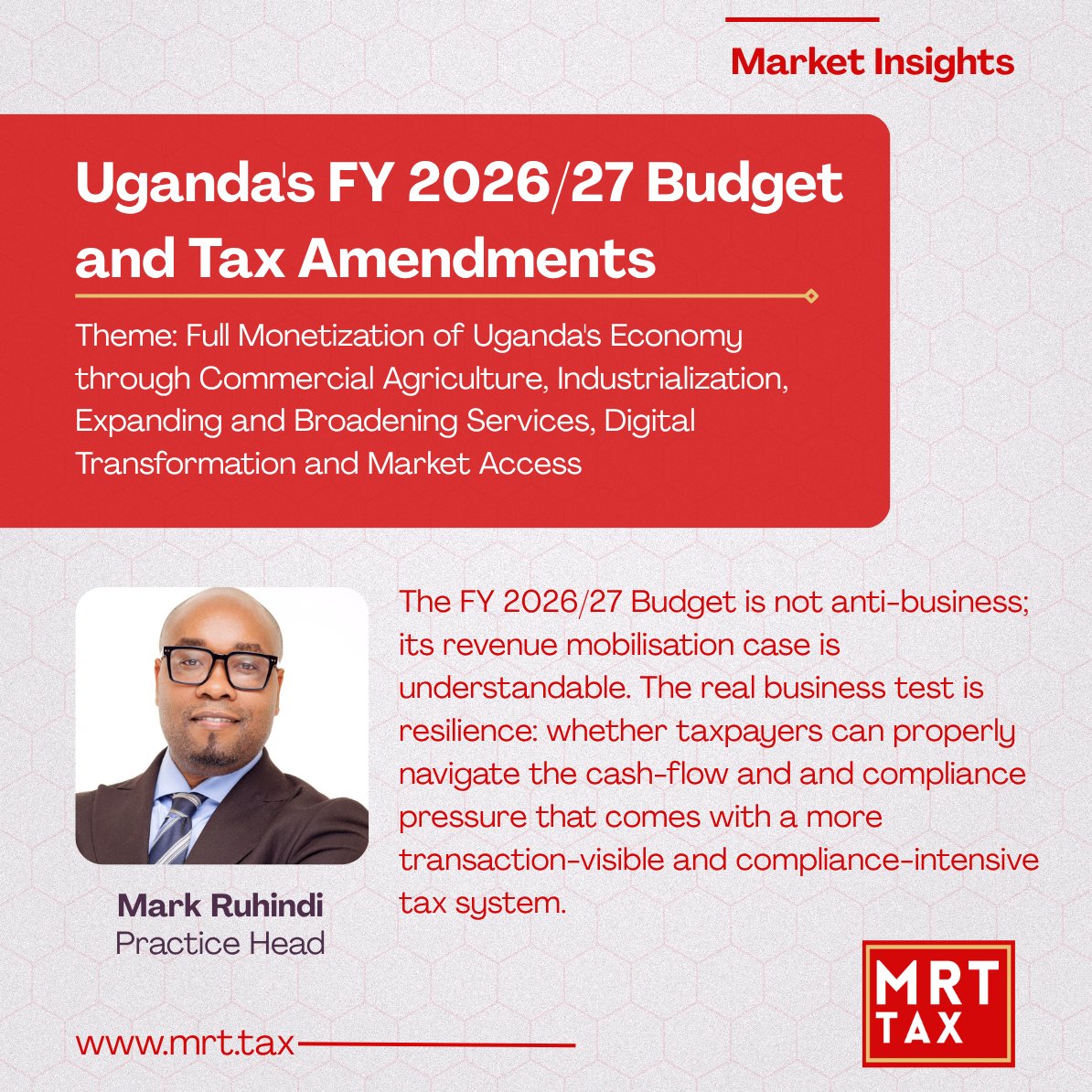
Uganda’s FY 2026/27 Budget and Tax Amendments: Revenue Mobilisation and the Business Resilience Test.
Read our full in-depth analysis of the Budget and Tax Amendments, and get to know how your specific sector is affected.
https://t.co/xKZVDeutvr
Uganda’s FY 2026/27 Budget and Tax Amendments: Revenue Mobilisation and the Business Resilience Test.
Read our full in-depth analysis of the Budget and Tax Amendments, and get to know how your specific sector is affected.
https://t.co/xKZVDeutvr
Uganda’s FY 2026/27 Budget: Revenue Mobilisation vs Business Resilience
The underlying message from the Minister's Speech: a strong drive toward full economic monetisation, industrialisation and domestic fiscal self-reliance.
In our latest commentary, we break down the fiscal logic of the new Budget and what it practically means for business resilience in Uganda.
While macro-economically understandable, the Budget will be commercially demanding for businesses.
Key takeaways:
Real-time digitalisation
Tax collection is moving directly to the transaction level, with e-invoicing now central to managing cash flow and avoiding heavy penalty exposure.
Heavier compliance burden
Compliance becomes highly recurring with monthly stamp-duty reporting, rental income returns and mandatory document-retention controls.
Targeted relief
The VAT threshold increase from Shs 150M to Shs 300M and PAYE adjustments offer relief to SMEs and low-income earners. Strategic sectors such as tourism, local manufacturing, health and agri-inputs also benefit from targeted incentives.
The catch
The targeted cushion is not broad enough to shield the wider business community from indirect taxes and liquidity pressures.
Success in the new fiscal year will depend heavily on operational and commercial discipline.
Read our full analysis here:
https://t.co/Dkg8KQGinE
#UgandaBudget2026 #TaxAmendments #BusinessResilience #EFRIS #TaxCompliance #MRTTax #CorporateFinance #TaxLaw #DoingBusinessInUganda