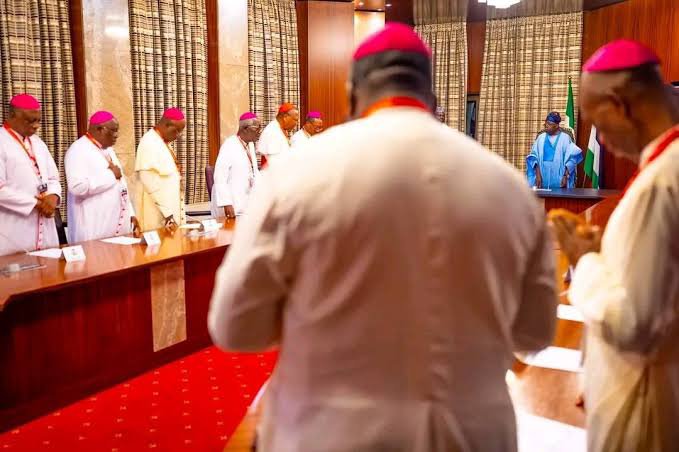
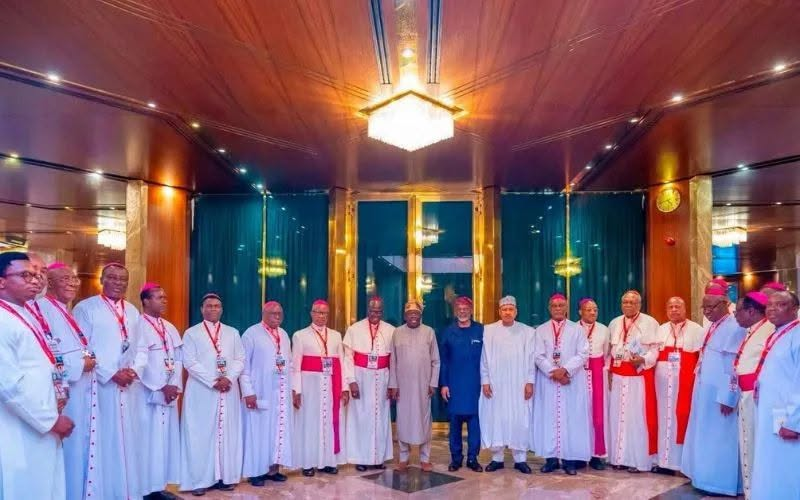
THEY TOOK THE CRY OF NIGERIANS TO THE PRESIDENT. THEY RETURNED WITH AN ANSWER THAT SHOULD WORRY US ALL.
The Catholic Bishops didn't go to Aso Rock seeking contracts.
They didn't go lobbying for appointments.
They didn't go "standing on any mandate."
They went carrying the pain of millions of Nigerians.
They said Nigerians are hungry.
The answer? "There has always been hunger before I was born."
They said the economy is crushing ordinary families.
The answer? "The economy is doing well."
They expressed concerns about public confidence in INEC.
The answer? "INEC is neutral."
They worried about whether the next election would offer a level playing field.
The answer? "Whoever wants power should be ready to wrestle for it."
And immediately, my mind went to Rehoboam.
The people begged him to reduce their suffering.
The elders pleaded with him: "Listen to your people."
His loyalists told him: "Show them who's boss."
He listened to the loyalists.
He ignored the people.
The result?
A kingdom that took generations to build split in a single day.
The people walked away shouting:
"To your tents, O Israel!" (1 Kings 12:16)
Every government should fear one thing more than criticism:
The day it stops listening.
The greatest threat to any president is not the opposition.
It is the army of professional cheerleaders who tell him that everything is working while the people are telling a different story.
A nation cannot be governed by applause.
Propaganda cannot fill empty stomachs.
Slogans cannot reduce the cost of living.
And praise-singers cannot rewrite reality.
History is littered with leaders who mistook loyalty for truth.
May President Tinubu never become another Rehoboam, surrounded by people who protect his ego while exposing his legacy.
Because when leaders stop listening, history starts speaking.
Think about it.
Credit: Stephen Ekwenugo
“Father please pray for me my neighbours are against me.”
“Why do you think they are against you?”
“Because I pray a lot and some of them are affected by the prayers.”
“They don’t like prayers?”
“I don’t know for them o. They complain that my prayers disturb them. Maybe their mind no pure.”
“By the way what time do you pray?”
“I wake up 12 midnight and pray till 3am.”
“Do you pray quietly or aloud?”
“Father you know how it is. We are facing many battles. We are not fighting against flesh and blood.”
“I see. How is your compound by the way, is your room close to others or you live in a stand alone?”
“My room is in the middle.”
“Well, my Sister. I think what they are complaining about is that you are not allowing them to sleep. Try praying very quietly and see if they will still complain. God is not deaf. You don’t need to shout. Be charitable to others when you pray. God can hear the thoughts of your heart. You can mumble the words like Hannah.”
“Thank you Father.”
“God bless you.”
It is a shame that truth has become so politicised in Nigeria. Today, if you speak the truth about the suffering of ordinary Nigerians, you are quickly labelled partisan. That should concern every Nigerian.
Cardinal Onaiyekan was not speaking for Catholics alone. He was speaking for millions of Nigerians who bear the weight of the present realities. The Church has always stood with the poor, the vulnerable and those whose voices are ignored. That is her mission.
Mr. Bwala, your statement is very divisive and by reducing a moral intervention by the Catholic Bishops on behalf of millions of suffering Nigerians to mere politics, you have lost all sense of the sacred. Not every voice that challenges those in power is a political voice.
The Church does not exist to defend any government or opposition. She exists to proclaim the Gospel, defend human dignity, and remind those in authority that power is a trust to be exercised for the good of the people. When we dismiss every uncomfortable truth as politics, we lose not only our moral compass but also our sense of what is sacred.
Happy 57th priestly ordination anniversary to Cardinal John Onaiyekan!
Cardinal John Olorunfemi Onaiyekan was ordained a priest in 1969 at the age of 25.
In 1982, 13 years after his priestly ordination, Pope St. John Paul II appointed him Titular Bishop of Thunusuda and Auxiliary Bishop of Ilorin at the age of 38. He was ordained a bishop on 6 January 1983.
In 1984, he was appointed the Bishop of Ilorin at the age of 40.
In 1990, he was appointed Coadjutor Bishop of Abuja at the age of 46, and in 1992, he succeeded as Bishop of Abuja at the age of 48.
In 1994, following the establishment of Abuja as a Metropolitan See, he became the first Archbishop of Abuja at the age of 50.
From 1999 to 2006, he served as President of the Catholic Bishops' Conference of Nigeria (CBCN).
In 2012, Pope Benedict XVI created him a Cardinal at the age of 68.
On November 9, 2019, he retired as the Archbishop of Abuja, Nigeria after reaching the canonical retirement age of 75.
Cardinal John Onaiyekan has remained one of the most respected voices of the Catholic Church in Africa, distinguished by his commitment to the Gospel, justice, peace, interreligious dialogue, good governance, and the common good. May God continue to bless and strengthen him.
It is quite telling that Cardinal Onaiyekan's interview with Arise News has attracted more responses from those close to this current administration than the issues the bishops raised about insecurity and the economy. Sometimes, it is easier to challenge the messenger than to address the message.
The Catholic Church has stood before emperors, kings, military rulers, and elected governments, speaking on justice, human dignity, peace, and the common good. It survived the persecutions of the Roman Empire, witnessed the rise and fall of empires, and has often challenged rulers when conscience demanded it.
In Nigeria, the Church spoke during military rule and continues to speak under democracy. Its mission has never been to endorse governments, but to remind those in power that authority carries a moral responsibility.
Expecting the Catholic Church to remain silent on governance is to misunderstand its history.
@Tony4PBAT@StepheniaOmeh So Catholic Church now have a candidate, 😂😂😂 Mumu people.
How has your candidate made your life better since he became president?
You guys are morons, you leave the main issue and argue like drunk men
A Response to Tope Ajayi’s Article "Cardinal Onaiyekan’s Abuse of Clerical Privilege"
I read the article titled “Cardinal Onaiyekan's Abuse of Clerical Privilege” by Temitope Ajayi with great interest. Surely, the article raises important questions about the relationship between the Church and the State. However, I believe some of its conclusions, particularly from the perspectives of constitutional democracy and the Church’s public mission, deserve a respectful and balanced response and clarifications.
Here is my point to point response to each of the concerns raised.
1. Was it improper for Cardinal Onaiyekan to speak publicly on Arise News?
Not necessarily. The meeting between President Tinubu and the Catholic Bishops of Nigeria was not a sacramental confession that requires utmost secrecy, a diplomatic negotiation under secrecy, or a legally confidential proceeding. Unless the participants expressly agreed to confidentiality, there is no legal or moral principle that absolutely prevents either party from commenting on the discussion afterward.
2. The Church has both the right and the duty to speak.
Catholic bishops are not merely private citizens expressing personal opinions. By virtue of their pastoral office, they have a responsibility to teach on moral and social issues. Catholic social teaching consistently affirms that the Church must speak whenever human dignity, justice, security, and the common good are at stake. That is exactly what the bishops did.
3. Speaking after a meeting is not necessarily a breach of trust.
Providing one’s understanding of a discussion is different from revealing confidential state secrets. Democratic engagement often includes explaining to the faithful what was discussed, particularly when the meeting like theirs concerns issues affecting millions of citizens.
4. Criticism of government is not a denial of progress.
One may acknowledge improvements while still concluding that much more remains to be done. Recognizing government achievements and identifying persistent failures are not mutually exclusive positions.
5. “Truth to power” remains relevant.
The fact that a president receives intelligence briefings does not eliminate the value of independent voices. Security reports, economic data, religious leaders, civil society, academics, journalists, and ordinary citizens each offer different perspectives. No single source possesses the whole truth.
6. Access to privileged information does not settle public debate.
The President undoubtedly possesses information unavailable to the public. However, democratic accountability also requires that government decisions remain open to public scrutiny and legitimate criticism.
7. Confidentiality should not become silence.
If public officials may explain their side of a meeting, religious leaders should not automatically be denied the same opportunity, provided they do so truthfully, respectfully, and without disclosing genuinely confidential matters.
8. Clerical office does not diminish civic responsibility.
The virtues expected of bishops such as prudence, temperance, and wisdom, do not require silence in the face of national concerns. History remembers many bishops who respectfully challenged civil authorities while remaining faithful to both the Gospel and legitimate constitutional order.
In all, the real issue is not whether Cardinal Onaiyekan spoke, but whether what he said was truthful, fair, and served the common good. I believe that in a constitutional democracy, respectful dialogue between religious leaders and civil authorities should continue not only behind closed doors but, when appropriate, also in the public square, just as Cardinal Onaiyekan did.
Fr. Ugochukwu Ugwoke, ISch
Everything is wrong with this article, beginning with its title.
In a constitutional democracy, the moment a person is elected or appointed to public office either as president, governor, senator, etc, he becomes a public servant. Receiving citizens, civil society organisations, and religious leaders is not an act of personal generosity or privilege; it is part of the constitutional and democratic responsibilities of the office.
Likewise, citizens and organised bodies including the Catholic Bishops' Conference of Nigeria do not approach their elected leaders as supplicants seeking favours. They exercise a legitimate democratic right to engage those entrusted with public authority, particularly on matters affecting the common good.
To portray the meeting as a privilege bestowed by the President rather than a normal exercise of democratic governance mischaracterises both the nature of public office and the relationship between elected officials and the people they serve.
So, the expression 'Abuse of Clerical Privilege' is fundamentally flawed.
From the era of Military rule and throughout the period of civilian Governments,the Catholic Bishops have a consistent history of telling truth to power.They have never been partisan.Every President they visited,they bring him a gift of Bitter Kola instead of Olive Oil.
Tonye Cole couldn't win a contract in Nigeria as a 27 year old Nigerian.
So he and his partners invented a white boss. Registered a company in the Isle of Man, gave it a European name, and walked into Lagos offices pretending to be his staff.
Worked for 3 years.
That company became Sahara Group.
New episode. Out now
My bro apart from me speaking Igbo and you understand me, there really isn't any big deal about the language thing.
Language does not form your identity. There are Igbos who have lived in the west long enough to speak and understand Yoruba, does that make them Yoruba as well?. We all speak English, does that make us English?.
Mind you, I have talked about giving my kids strictly Igbo names and no English name. A person's name to me is a major part of what forms their identity. When people see a Nwankwo, they automatically know this person is Igbo same way an Oluwatobi is Yoruba and Kovacic is Croatian.
For tradition, I still insist that some of our traditions are very stupid and should be abolished. There is no reason why we should be making the bereaved waste money on a burial. There is no reason why mbaise people should be making men waste so much money to marry their daughters, majority of whom are not even virgins.
Most of these so called traditions were made by men who did not know better. Why should we hold onto them so much and even make it a huge part of our identity just to preserve "culture and tradition"?.
The discussion was about how speaking Igbo will benefit our kids on the global stage, and sentiments aside, it will not. It is useless in the grand scheme of things.
I was also coming from the angle that we have let the white man strip us of every form of identity we have, why then is the language thing such a huge priority?. I won't take any Igbo person who is worshipping the white man's God, using their inventions and curriculum, dressing their way but holding onto their language seriously.
You can't be going to church 3 times a week, wear suit to work, have Nathan or Emmanuel as your first or middle name, tweet in English and then want to tell me anything about identity just because you speak Igbo. That is the actual identity crisis.
Physical touch = Too horny
Acts of service = I’m not your mom
Receiving gifts = Feminine
Quality time = ✅ doesn’t require effort
Word of affirmation = why you need to hear that