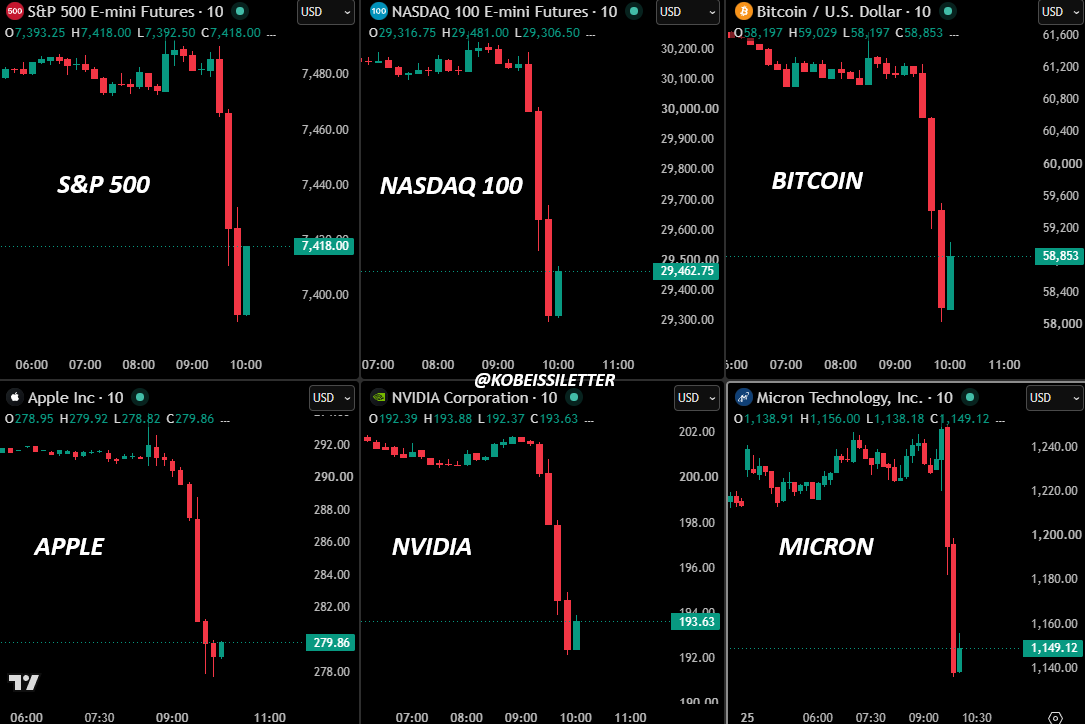
What just happened?
In just 27 minutes, the Nasdaq 100 just fell -1,000 points and the S&P 500 erased -$1 TRILLION without any major headlines.
The Nasdaq opened +1% higher then fell -3% between 9:30 AM and 9:57 AM ET.
What does it all mean? Let us explain.
(a thread)
The feeling you start to develop as a trader that something HAS TO HAPPEN is one of the most consistent contrarian things that can happen, especially if you can get positioning and sentiment data on top that show everyone doing the same.
Something being written off because even if it ends up working it's just broken...
Something that is too dangerous to short because its going to open up...
Something that will for sure breakdown because it hasn't been able to go the past few times...
Something that needs to breakout because its been hot for weeks...
Something that you can long without issue because its part of a supertrend even if it dips...
Some recent examples I remember.
-Oil long near Mid May.
(I was sitting by the pool with 5 great traders, will all agreed Oil looked like a big long, especially because Trump and Iran continued to escalate.... We purposefully avoided because it was consensus and laughed right there about it probably being a huge short).
-Longing $TSLA in May 2025, I was longing it with @TheOneLanceB and the consensus was they would never make a comeback, it was a safe short, even short term longs wouldnt work.
-Shorting Silver. Too risky, scary, part of a commodities super cycle, inflation was up, list goes on. Noone wanted to be short. It ended up having its worst day ever a week later.
....
Whenever something is too logical and too safe to avoid it usually presents a huge contrarian trade.
Keywords are:
-It will 100% go to XYZ because of these 10 reasons with no reasons for the reverse case.
-I'll long it/short it then, there is no point in doing it now, I'll wait for XYZ
-I'll wait until the resolution of XYZ (latest one was war end) to get long/short.
In markets pure oblivious confidence in either direction combined with the comfort of waiting for a clearer/more stable entry is often the enemy of outperformance.
Now it doesn't mean it always work, especially as it comes to big multi year catalysts like AI. It means sharpening your sense for emotional extremes, when most push against an idea for no real reason but recent price action and especially when its out of comfort reasons there usually is a discount baked into an asset/a mispricing.
This goes both ways, meaning a lot of the time a long or short can only be held unleveraged or with a max size because the market is extremely good at forming price action that excludes the ability to add add add in one direction.
Combining this last thought with the rest, the most uncomfortable positions at first that end up going your way end up giving you the opportunity to add heavily way more often than those where you are comfortable from the beginning.
The delta of outperformance becomes the comforts price.
It simplifies things,
I primarily base my trading on levels, contrary to popular belief that nothing good happens below a certain MA, my best profitable trades have been below major MA
I am not trading "Trend following system,", rather oversold bounce and reversal in strong stocks
@Positive_Equity Good morning, I filled out the application form this morning. I would, however, like to know if it is possible to do all the 'steps' from internship, training and trading from a remote country?
The $SPCX + $TSLA merger is going to melt people’s brains.
Robotics, autonomous vehicles, energy storage, LLMs, batteries, rockets, chips, compute, connectivity, satellites, solar, etc. all under one roof.
It’s inevitable.
The future of crypto is one where the user does not even realize they are using crypto.
For years, crypto has felt like its own separate world because the setup was too complex, the UX was too rough, and the average user had to understand too much.
That will change with AI, and Crypto will become AI rails or regular infrastructure.
In the future, people will simply ask for custom tools, workflows, payments, automations, identity checks, escrow, settlement, authentication, data access, ownership transfers, and agent-to-agent transactions.
Under the hood, crypto rails will be chosen because they are dramatically more efficient than the legacy financial system.
Anything that needs to transact, verify, authenticate, settle, permission, coordinate, or transfer value can run on open crypto infrastructure.
The user will not think, “I am using crypto.”
They will think, “This just works.”
And that is the real new bull market.
Crypto stops being a product people have to understand and becomes invisible infrastructure that lets users and AI agents build, coordinate, and transact at a fraction of today’s cost.
Growing into the winning relationship
Holding period and pyramiding/doubling down into a winner or loser have the biggest impact for the aspired master trader.
These are not small variables. For the trader who aspires to the top, they are the only true variables.
People like to begin with entries. Fine. Entries matter. But the first real work is finding the pockets of edge: small caps, mid caps, large caps, each one becoming over time a liquidity-driven sliding scale forcing the growing trader to shift into a new version of himself. What worked at one size stops working at another. What looked like skill at one level becomes noise at the next.
Then comes compounding. Usually through an R system, whether you fully systematize it or compound naturally. Directly or indirectly, you are always measuring risk. You are always deciding how much of yourself to put behind the idea.
Then comes noise reduction.
Seeing less. Focusing more. Finding structure inside chaos. Learning what not to look at. Learning what not to care about. Putting structural elements (like scanners, prep, automated systems) in place. This is harder than people think, because most traders are not defeated by what they miss. They are defeated by what they cannot stop seeing.
Only after that do you earn the right to size exponentially.
Adding to winners. Averaging in. Pressing when the trade improves. Holding when the easy exit appears. Accepting that win rate and risk/reward live on a sliding scale, and that every serious trader must eventually decide where he belongs on it.
At the end, the game becomes judgment.
Can you grade the setup as it moves from bucket to bucket? Can you recognize when a B has become an A, when an A has become an A++, or when the thing you thought was elite was only dressed that way for a few candles?
This is most true in deep value. It is also true in parabolic shorts. The opportunity does not arrive fully formed. It reveals itself. Then your sizing and your holding period must adjust to the reality in front of you.
So here is the question.
Should you wait for the A++ entry when the A is already available?
Or would you rather miss the first entry so you can pyramid with greater certainty once the trade begins to prove itself?
There is no free answer. There is only the trade-off you can actually live with.
Win rates are easy to manipulate. You can raise them by taking profits too early, sizing too small, avoiding discomfort, and calling cowardice discipline.
But risk/reward and dynamic sizing are where the real alpha hides.
That is where the market wizardry is.
Not in being right often. In being enormous when it matters and pushing beyond, by appreciating the power of the true outliers and the range they offer as they reverse (or continue for some breakout strategies).
And that privilege is not given cheaply. The ability to push, to pyramid, to become your biggest in the best opportunities, comes only after mastering every earlier step.
You do not get to size like a monster because you are excited.
You get to size because you have earned precision. You have earned conviction. You have lived through dozens of account pullbacks, recoveries, new highs, false dawns, and near-breaks in belief.
Only then can you tolerate a smaller win rate in exchange for a huge winning tail.
Only then can you hold the trade long enough for the rare thing to pay you.
That part is not technique.
That part is earned, respect, held on to like a religion.
At the end all that remains is the tail, the tail of the alpha that blows off into account growth.
Are you truly able to get to that last stage only depends on building the strong foundation needed to support the monument that might live on in history.
Paul Tudor Jones predicted the 1987 crash, made $100 million, then spent years trying to destroy this footage
you will watch him lose $6 million in one afternoon, sit in his chair and say "total devastation" then make it all back with 100% interest
This documentary will change how you think about risk forever
Bookmark & watch it. Then read the post below - $90 billion from being right just 54% of the time↓
IS YOUR TRADING EDGE-CONSTRAINED OR OPPORTUNITY-CONSTRAINED?
@Hormozi always emphasizes focusing on the #1 constraint in your business.
Most businesses are either demand-constrained or supply-constrained, and whichever constraint you have determines your entire strategy. If you don’t have demand, you focus on marketing and sales. If you don’t have supply, you focus on supply chain and operations.
Ok, Lance… how does this apply to trading?
Trading works the exact same way, but I’ve never see anyone frame it like this: you are either edge-constrained or opportunity-constrained, and your results are determined by which constraint you attack. The problem is most traders misdiagnose themselves, so they spend years solving the wrong problem.
If you don’t have a proven edge, you are edge-constrained. That means your job is not to trade more, not to scan more markets, and definitely not to take more setups hoping something sticks. Your job is to backtest, collect data, refine execution rules, and build a playbook that has real statistical backing, because without edge the more you trade the more you lose, and every hour spent hunting new opportunities is just accelerating drawdown.
Edge-constrained traders should be obsessed with proof and data. Until you can say with high certainty that your setup produces positive expectancy over hundreds of trades, nothing else matters, because you cannot scale something that has negative expected value.
Now flip it. If you have a proven edge and a defined playbook, you’re no longer edge-constrained. You’re opportunity-constrained, and now the game changes completely because the problem is no longer whether your setup works, but how often you can find and how to maximize each opportunity.
Opportunity-constrained traders should not be endlessly tweaking entries or second-guessing their system. Their effort should go toward finding more of their best setups, building scanners and filters to surface them faster, expanding into other product markets where the same pattern exists, or using instruments like options to express the same idea more efficiently. Once edge is proven, growth comes from better execution, better sizing, and wider expression of that edge, not from reinventing the strategy.
Most traders are trying to scale before they validate, or optimize before they prove. Identify your constraint first, because solving the wrong problem is why you feel busy but stay stuck. In trading, just like in business, the bottleneck determines the strategy, and if you attack the real constraint with full focus, progress becomes inevitable.
The same is true for your trading business. And that’s why you need use your noggin to reflect and find the right advice that applies to your situation. Not blindly follow what you read.
There are a handful of things that will remain hardwired into your memory until the end of days:
How to ride a bike.
Your first love.
The sound of a 90s boot sequence.