It’s been a minute.
2015–2018
- Exited FreeCharge. Spent time learning and investing.
- Pondered about: Why can't trust be rewarded? Started with $1M of personal capital.
- Launched CRED to reward people for paying credit card bills on time.
2019–2025
- Built a system run by a team that values ownership, judgment, and craft.
- Grew from 0 to 17M members by aligning incentives with behaviour.
- Built several products during COVID lockdowns.
- Raised $900M+ from global investors. Did 4 ESOP buybacks.
- Made Indiranagar and IPL ads slightly more interesting.
- Received a full stack of regulatory licences.
- Lost 35 kilos.
- Scaled from 0 to ~$325M ( ~₹3,200 crore) in annual revenue across payments, lending, insurance, commerce, wealth, and credit cards.
2026
- First profitable quarter (yet occasionally asked what our business model is)
- Raised another $900M from Meta in primary and secondary capital.
- Announcing our 5th ESOP buyback.
Today
CRED is ready for its next phase. I am stepping back and @miten steps in as interim CEO, partnered with an incredibly talented team. He has been heading strategy and finance and suffering me since 2020. I’m stepping away from the operating role and will continue as a shareholder. My commitment doesn’t change. Just the role.
Extremely grateful to our members, partners, regulators, and investors who made this possible. And to our board, Shailendra, Micky, Saurabh for their extraordinary conviction.
Team CRED, I’ll still expect you to be a 10x version of yourselves.
As for me, I’ll be joining Meta to lead WhatsApp globally.
Meta comes in as a minority investor in CRED. No access to member data.
While it’s come very far, the delta between WhatsApp today and its full potential is massive. I look forward to working with Mark, Chris, and the leadership across Meta for the next step in WhatsApp’s journey. Will, thank you for scaling something the world relies on quietly, and for making this transition smooth.
Onwards.
PM work becomes less about writing better PRDs and more about designing better operating systems for teams.
When agents can produce output fast, the bottleneck moves to judgment, prioritization, user context, QA, risk, and workflow design.
As AI agents accelerate coding, what is the future of software engineering? Some trends are clear, such as the Product Management Bottleneck, referring to the idea that we are more constrained by deciding what to build rather than the actual building. But many implications, like AI’s impact on the job market, how software teams will be organized, and more, are still being sorted out.
The theme of our AI Developer Conference on April 28-29 in San Francisco is The Future of Software Engineering. I look forward to speaking about this topic there, hearing from other speakers on this theme, and chatting with attendees about it. We’re shaping the future, and I hope you will join me there!
It is currently trendy in some technology and policy circles to forecast massive job losses due to AI. Even if they have not yet materialized, these losses certainly must be just over the horizon! I have a contrarian view that the AI jobpocalypse — the notion that AI will lead to massive unemployment, perhaps even rioting in the streets — won’t be nearly as bad as dire forecasts by pundits, especially pundits who are trying to paint a picture of how powerful their AI technology is.
Among professions, AI is accelerating software engineering most, given the rise of coding agents. According to a new report by Citadel Research, software engineering job postings are rising rapidly. So if software engineering is a harbinger of the impact AI will have on other professions, this expansion of software engineering jobs is encouraging.
Yes, fresh college graduates are having a hard time finding jobs. And yes, there have been layoffs that CEOs have attributed to AI, even if a large fraction of this was “AI washing,” where businesses choose to attribute layoffs to AI, even though AI has not changed their internal operations much yet. And yes, there is a subset of job roles, such as call center operator, that are more heavily impacted. Many people are feeling significant job insecurity, and I feel for everyone struggling with employment, whether or not the cause is AI-related. And many other factors, such as over-hiring during the pandemic and high interest rates, have contributed to the slowdown in the labor market, and the notion that AI is leading to unemployment is oversimplified.
In software engineering, I see a lot of exciting work ahead to adapt our workflows. It is already clear that: (i) As AI makes coding easier, a lot more people will be doing it. (ii) Writing code by hand and even reading (generated) code is not that important, because we can ask an LLM about the code and operate at a higher level than the raw syntax (although how high we can or should go is rapidly changing). (iii) There will be a lot more custom applications, because now it’s economical to write software for smaller and smaller audiences. (iv) Deciding what to build, more than the actual building, is becoming a bottleneck. (v) The cost of paying down technical debt is decreasing (since AI can refactor for you).
At the same time, there are also a lot of open questions for our profession, such as:
- In the future, what will be the key skills of a senior software engineer? And for junior levels, what should be the new Computer Science curriculum?
- If everyone can build features, what skills, strategies, or resources create competitive advantage for individuals and for businesses?
- What are the new building blocks (libraries, SDKs, etc.) of software? How do we organize coding agents to create software?
- What should a software team look like? For example, how many engineers, product managers, designers, and so on. What tooling do we need to manage their workflow?
- How do AI agents change the workflow of machine learning engineers and data scientists? For example, how can we use agents to accelerate exploring data, identifying hypotheses, and testing them?
I’m excited to explore these and other questions about the future of software engineering at AI Dev. I expect this to be an exciting event. Please join us!
[Original text: The Batch newsletter.]
https://t.co/i4bQevDG4i
GenAI has subtly created a new kind of mess
generate 5000 lines of code
generate docs no one reads
spend more time asking AI to explain what it produced
And then call it PRODUCTIVITY
Winning teams wont be ones producing the most output
But the ones that create least confusion
RAG is misunderstood
RAG is not “chat with your PDFs.”
Its the toy version
Real RAG is:
doc ranking
chunk strategy
metadata filtering
citation quality
retrieval eval
answer grounding
handle stale content
The hard part is not answering,
its what the answer should be based on
Most people confuse AI agents with Agentic AI.
An AI agent is like a digital worker.
Agentic AI is the system that gives that worker:
goals
tools
memory
reasoning
feedback
autonomy
One is a worker.
The other is the work operating model.
AI agents clicking through workflows look impressive.
But in healthcare and pharma, autonomy is not enough.
Are we okay sharing the proprietary data?
If it cannot be audited, permissioned, validated, and stopped.
It is a liability!
Soon industry stalwarts would understand.
Manus Browser Operator is a new extension from Manus AI. Their official policy includes strong safeguards like data minimization, content filters, and no user data for training. However, reviews note potential risks including privacy concerns (as it's from a Chinese company), vulnerabilities to manipulation, and transparency issues. Since it's brand new, monitor updates and review permissions before installing.
BREAKING 🚨: ANTHROPIC IS WORKING ON ITS OWN ALWAYS-ON AGENT SOLUTION CALLED CONWAY!
CONWAY WILL HAVE A SEPARATE UI INSTANCE, WILL BE ABLE TO OPERATE BROWSER, CONNECTORS, CLAUDE CODE (EPITAXY?) AND COULD BE INVOKED VIA WEBHOOKS.
IT WILL ALSO SUPPORT EXTENSIONS, AN UPCOMING CNW ZIP STANDARD FROM ANTHROPIC TO BUILD CUSTOM TOOLS, UI TABS, AND CONTEXT HANDLERS!
LET CLAUDE COOK 🔥
🚨 **Google’s TurboQuant** = 6x less KV cache memory + 8x faster LLM inference.
3-bit compression. Zero accuracy loss. No fine-tuning.
It just wiped **over $100B** in global market cap from memory chip giants (DRAM/HBM makers):
Micron, Samsung, SK Hynix & peers lost tens of billions each in days.
Software just ate hardware’s lunch? 👀
#TurboQuant #AI #MemoryStocks
The most overrated, yet understated application of GenAI in Healthcare?
RAG (Retrieval-Augmented Generation).
I was building it recently as part of a research-guideline checking workflow, and the real work was never “chat with PDFs.”
And this lead me to broader set of medical documents used in the domain.
Building a clinical RAG demo takes 15 minutes.
Building a compliant, production-grade system that doctors actually trust?
That’s a massive engineering challenge.
RAG architectures look flawless in the sandbox. Then they hit real clinical workflows.
Suddenly, the problem isn’t “can the LLM answer from the documents?” It becomes:
🔻 Fragmented Patient Context: Bad chunking breaks up longitudinal EHR data, missing critical historical context.
🔻 Dangerous Hallucinations: Naive retrieval pulls plausible but medically incorrect treatment protocols.
🔻 Compliance Risks: Missing metadata filters risk HIPAA breaches or serving pediatric guidelines for an adult case.
🔻 Buried Evidence: Without reranking, the latest FDA guidance or lab results never make it into the prompt.
🔻 Zero Trust: No direct citations to medical literature or patient charts? Clinicians will outright reject it.
🔻 Silent Degradation: No evaluation layer means clinical accuracy quietly drifts as medical protocols update.
Production RAG in healthcare isn’t about "adding a clinical chatbot."
It’s about building a defensible, compliant retrieval system that care teams can stake their licenses on.
The gap between a nice prototype and a product a hospital can actually ship lies in: hybrid retrieval, EMR metadata-aware search, rigorous reranking, and citation-first responses.
Just tried an AI tool off the Google's Experimental Suite that actually feels like real no-code magic. 🔥
Google Opal lets you build complete mini-apps in plain English.
No drag-and-drop.
No complex flows.
I just typed: “Create an app where I paste a YouTube URL for a long podcast, and it extracts the transcript, pulls out the top 3 actionable strategies, and saves them to a clean Google Doc/Sheets/Slides.”
Built the entire shareable web app in under a minute and it actually works perfectly.
Try it here (free & experimental) 👉 https://t.co/IydvCAcqA0
#NoCode #GoogleOpal #AIAutomation
The stack under the hood:
• Node.js + Express with EJS server-rendered views
• Playwright headless Chromium for Cloudflare-protected link previews
• Python
• Docker Compose multi-container orchestration • Luxon timezone-aware scheduling engine
• Per-user WAHA container auto-assignment on registration
• Activity + dispatch logging with full traceability
UI Designed with Stitch. Built using Antigravity and Codex.
Agentic AI at Core
Big Shoutout to @LauraBukavinaMD@CanDAydogdu It was a blast to build together 🔥
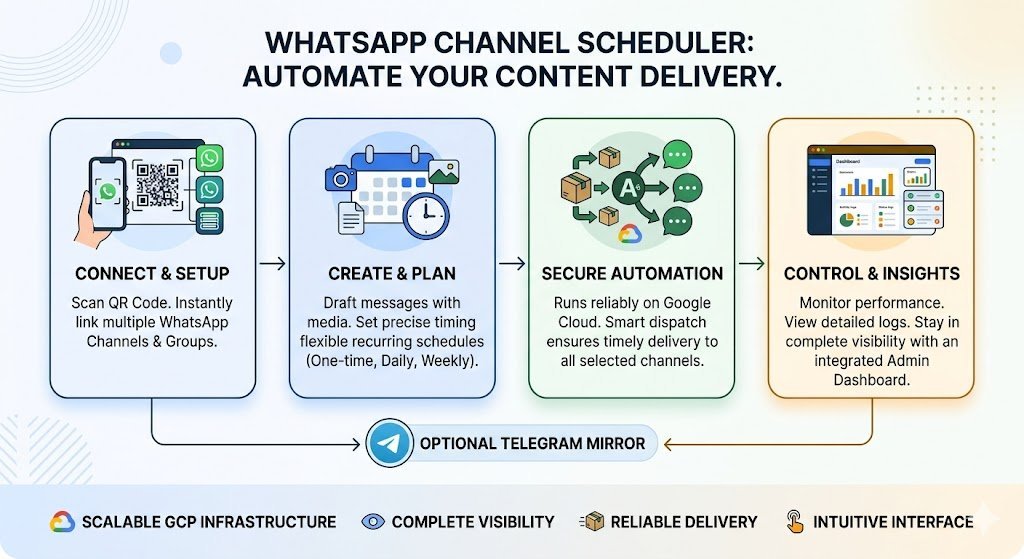
We just created a real production-grade WhatsApp Channel Automated Scheduler
- not a drag-and-drop n8n flow, a full multi-tenant platform.
Agentic AI capabilities unleashed with the tech stach and build process
Designed with Stitch, built using Antigravity & Codex.
Deployed on GCP Cloud, Completely Secure
#Stitch #Antigravity #Codex
#WhatsAppAutomation
Here's why it matters 🧵👇
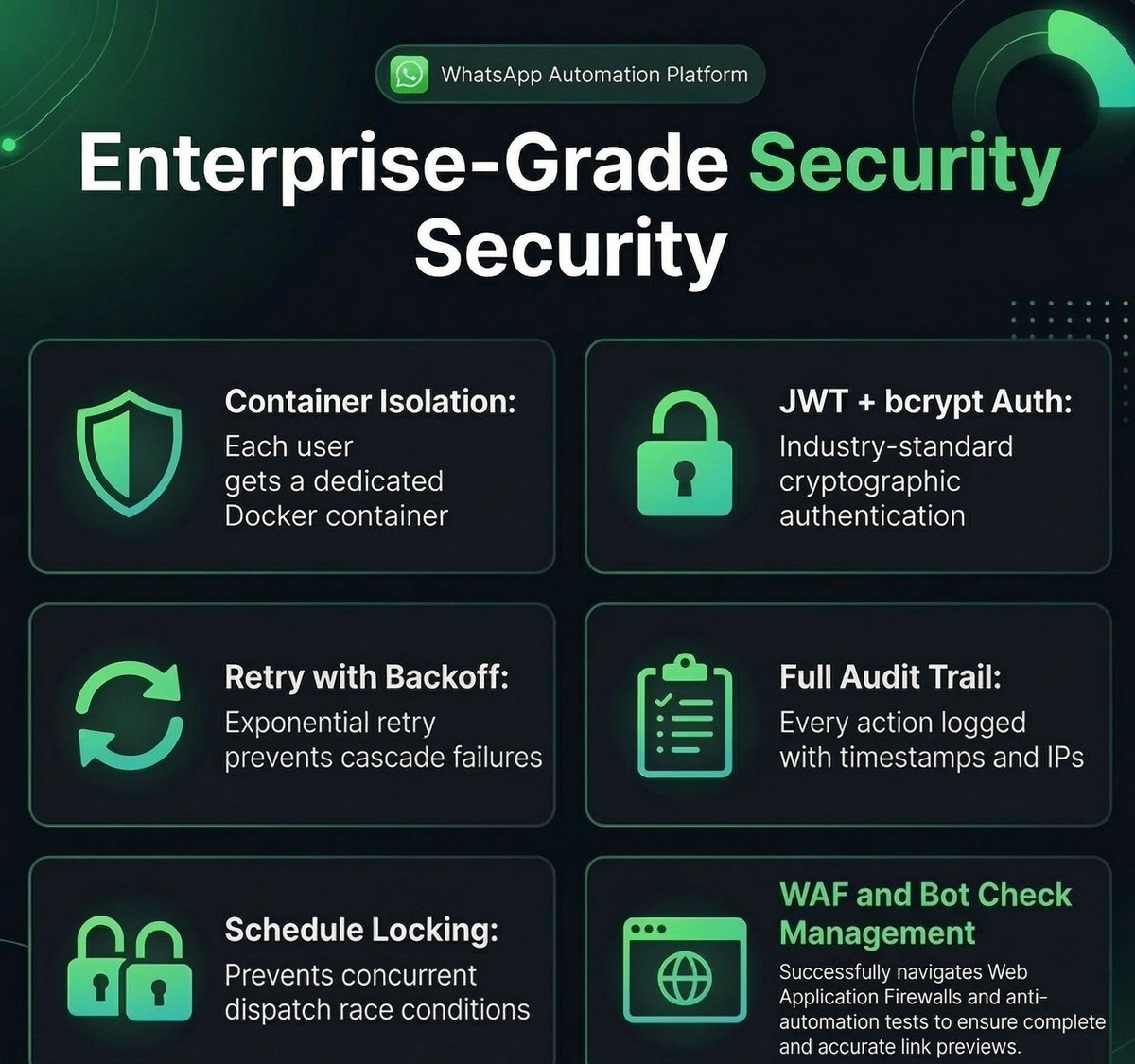
Security isn't an afterthought. It's the foundation.
🔒 Container isolation - each user in a dedicated Docker container
🔐 JWT + bcrypt - industry-standard cryptographic auth
🔄 Exponential backoff retries - prevents cascade failures
📋 Full audit trail - every action logged with IP
🔏 Schedule locking - prevents double-sends
🌐 Playwright engine (Used Web Scraping Expertise) - bypasses WAF for rich link previews, with image previews generally not available on protected websites in whatsapp
AI will:
- Automate 80% of our jobs
- Create unimaginable new jobs
The transition will be bumpy but it's inevitable.
We are mana to be farmed by the machines. Find a way to own them first.