Hello Mzansi 👋🏾 Meet popEd - A Podcast by My Vote Counts. 🎙️
South Africa heads into the Local Government Elections at a moment when the settlement of 1994 is coming undone.
So… how did we get here?
We spoke to six people who have played a role in holding our democracy together to unpack what happened between 1994 and now - from Marikana and the weakening of our labour movement to the rise of authoritarianism, ethno-nationalism and violence, and the ways ordinary people have been shut out of decision-making.
But popEd isn’t just about looking backwards.
It’s also about the people building something different - young people, shack dwellers, community movements and organised citizens imagining new ways of exercising power.
popEd is a podcast by My Vote Counts about how we got here - and what comes next.
🎙️ New episode every Wednesday at 12PM
👀 Episode teasers every Sunday at 6PM
Subscribe, follow the series and turn on notifications on YouTube 🔔: https://t.co/CYtCkjqrJ1
#popEd #MyVoteCounts #PeoplesPower #Democracy #SouthAfrica
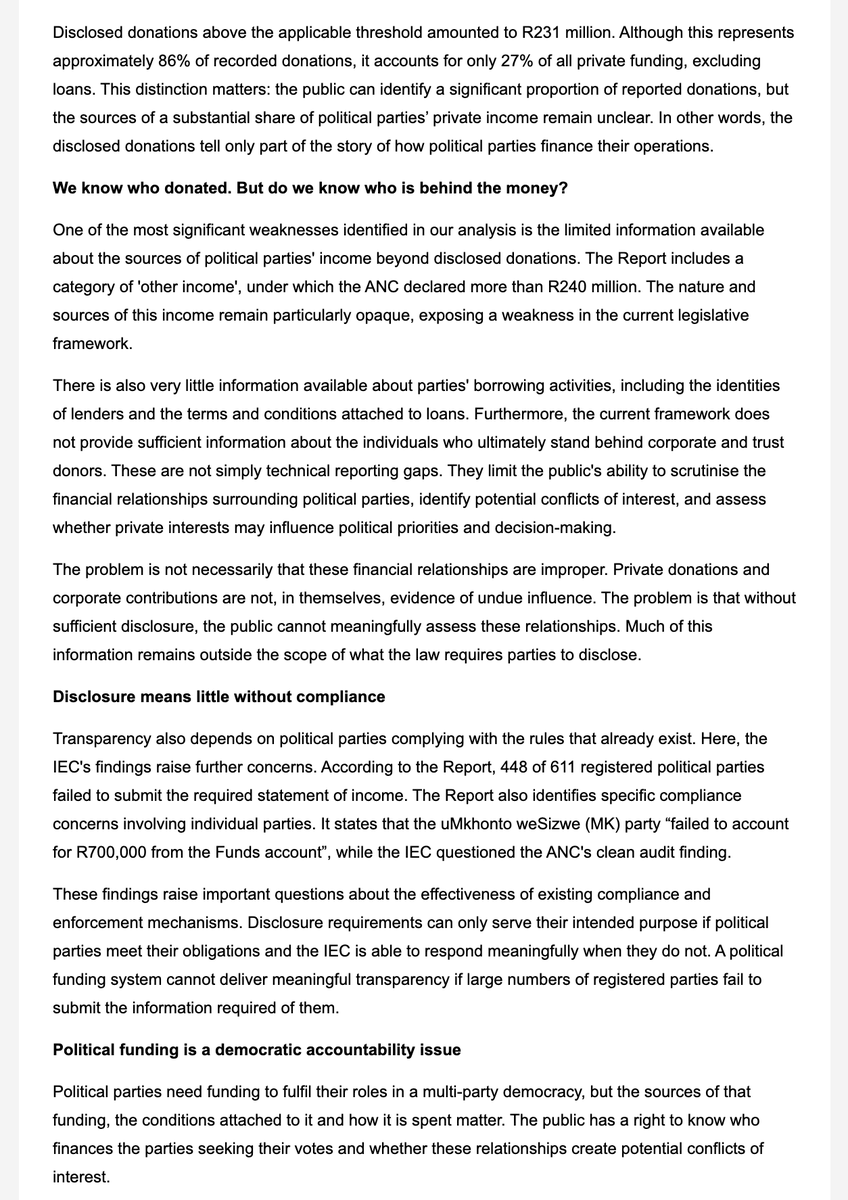
R3.07 billion went to South Africa’s political parties between April 2024 and March 2025 (excluding loans). But do we know where it all came from?
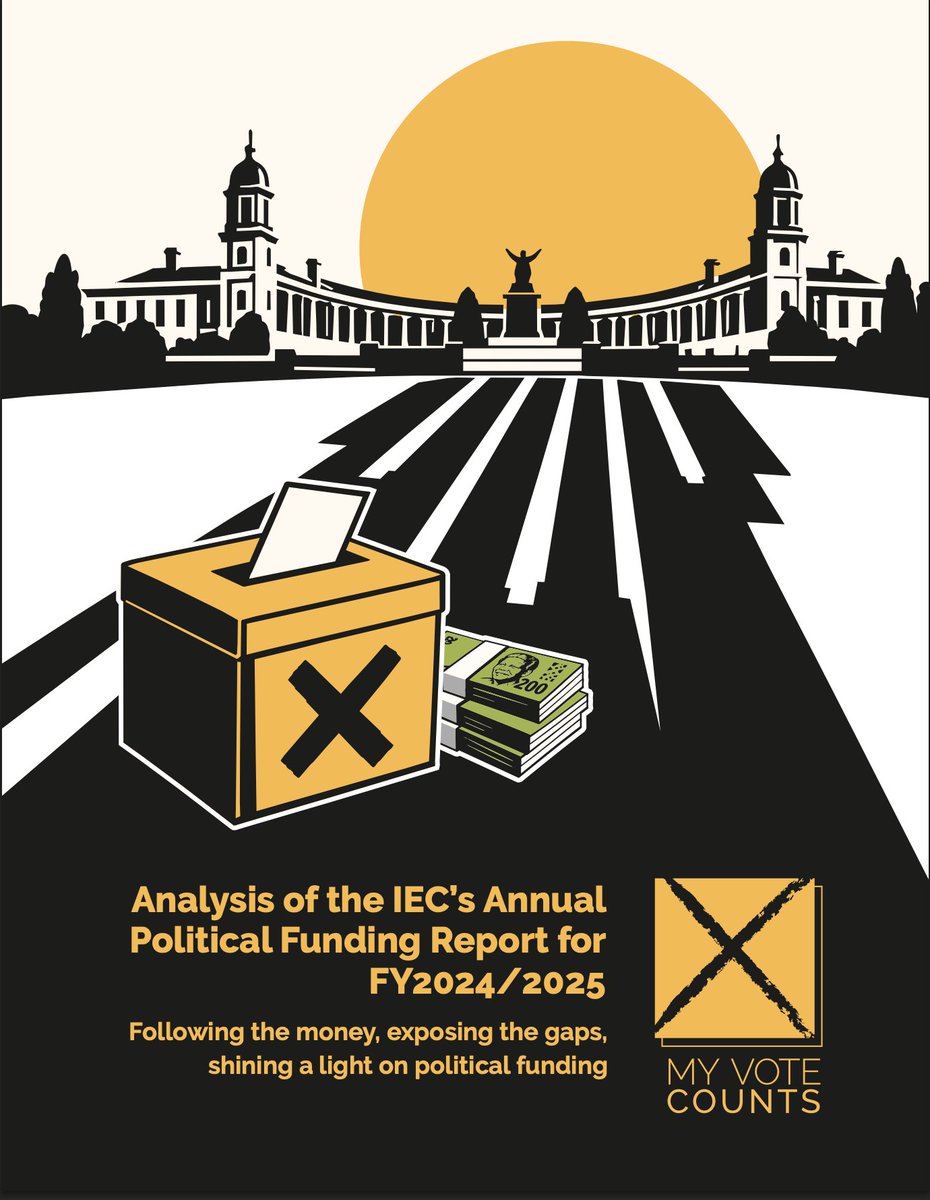
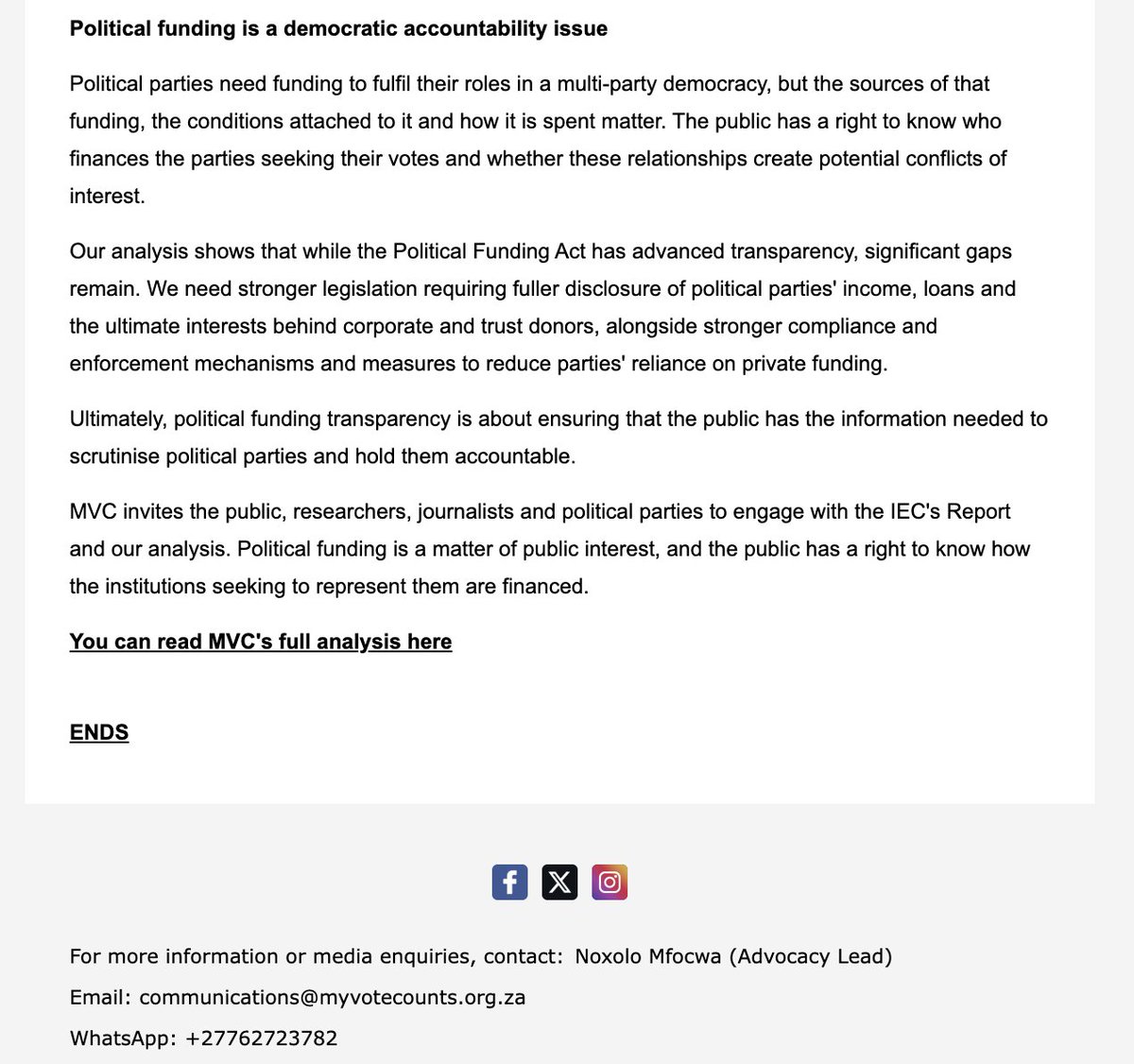
The IEC’s latest Annual Political Party Funding Report is out, and our analysis shows that while the Political Funding Act has made funding more visible, visibility isn’t the same as accountability.
Disclosed donations account for just 27% of private funding, and 448 of 611 registered parties didn’t submit the required statement of income.
The public has a right to know how the institutions seeking to represent them are financed. Read our analysis and engage with the IEC’s report here: https://t.co/AHHCvpxEPw
Voters have a right to know how political parties intend to share power, govern municipalities and deliver on the commitments they make during negotiations. My Vote Counts has called on political parties entering coalition governments across the country to publicly disclose their coalition agreements.
Read more here: https://t.co/K3XF2Mxa2Q
We joined Salaamedia to unpack coalition politics and examine the DA’s milestone of surpassing one million black voters.
Watch the interview here: https://t.co/7srSNjxcO1
Our Advocacy Lead, Noxolo Mfocwa and Wade Manning from Defend Our Democracy joined PowerFM to talk about the local government elections and voter turn out.
Listen to the interview here: https://t.co/qJSmVrwuJt
[ON AIR] Local Government Election Reflections & Voter Turnout.
Wade Manning, and Noxolo Mfocwa from Defend Our Democracy joins @ColleenMakhub on #POWERPerspective.
From the voting stations to the National Results Operations Centre (ROC), democracy was in focus.
The 2026 Local Government Elections were more than a moment at the ballot box. They were an opportunity to observe how our democracy works in practice, listen to voters’ experiences and interrogate what the results tell us about the state of local democracy.
As My Vote Counts, we were part of election observation efforts alongside Defend our Democracy, engaging with the voting process and documenting the experiences, challenges and concerns raised by voters.
We also took that work into the Results Operations Centre (ROC), where, in collaboration with The SA Comms Hub, we followed the unfolding results, analysed the electoral trends and reflected on what the changing political landscape means for representation, coalition governance and democratic accountability.
From voter access and the administration of elections to turnout, party performance and the coalition negotiations that lie ahead, our focus was on looking beyond who won and asking the bigger democratic questions.
Because observing elections is not only about watching ballots being cast. It is about paying attention to whether people can exercise their rights, whether the process inspires public confidence and whether those elected will be accountable to the communities they serve.
The results are in. But the work of democracy continues.
What can the world’s democracies teach us about our own?
Quite a lot. They show us how resilient democracy can be, and how fragile. Democracy can be performed to benefit the elite at the expense of the majority, and rights can be stripped away gradually, until citizens are left immobilised. That’s why strengthening democracy in South Africa can’t be done without a global perspective.
At home, thirty years of wins and losses have given us a chance to reflect. Corruption, unemployment, growing inequality and minimal accountability from the political elite are central to that conversation. Time and again, commissions of inquiry have recommended electoral reform as a vehicle for deeper accountability. When the Constitutional Court declared the Electoral Act unconstitutional in June 2020, it opened the door to change, and the review clause in the Electoral Amendment Act has brought us to the current reform process.
In response, MVC convened the Civil Society Electoral Reform Panel, working to participate in the State’s process, develop a civil society position on electoral reform and broader democracy, and keep the process in the public consciousness.
We are wrestling with new ways of being in an evolving, exclusionary political landscape, but we cannot be paralysed by the challenges we face. It is our duty to honour the lives lost to get us here by continuing to fight for the democracy we seek.
Read more from Boikanyo Moloto, our Political Systems Project Lead, in our annual report: https://t.co/M8eiTljFxO
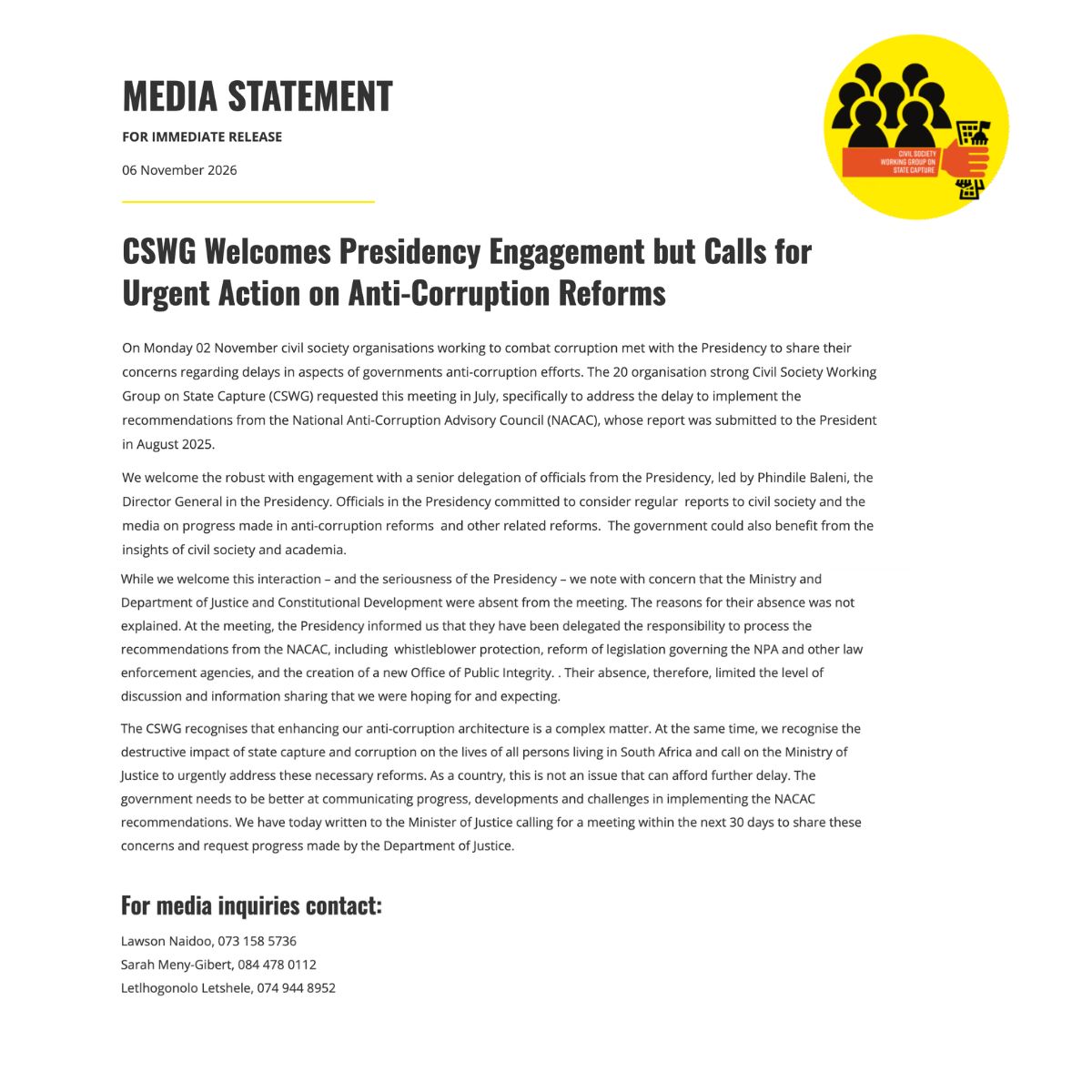
The Civil Society Working Group on State Capture (CSWG) Welcomes Presidency Engagement but Calls for Urgent Action on Anti-Corruption Reforms
On 2 November, the Civil Society Working Group on State Capture (CSWG) met with the Presidency to raise concerns about delays in implementing the National Anti-Corruption Advisory Council (NACAC) recommendations.
CSWG welcomes the Presidency’s engagement and its commitment to consider regular progress reports, but we are concerned that the Ministry and Department of Justice and Constitutional Development were absent, and therefore, the level of discussion and information sharing that we were hoping for and expecting was limited.
State capture and corruption continue to harm everyone in South Africa, and these reforms cannot afford further delay.
We have asked the Minister of Justice to meet with us within 30 days.
Read the full media statement here: https://t.co/FvLtUuhpTj
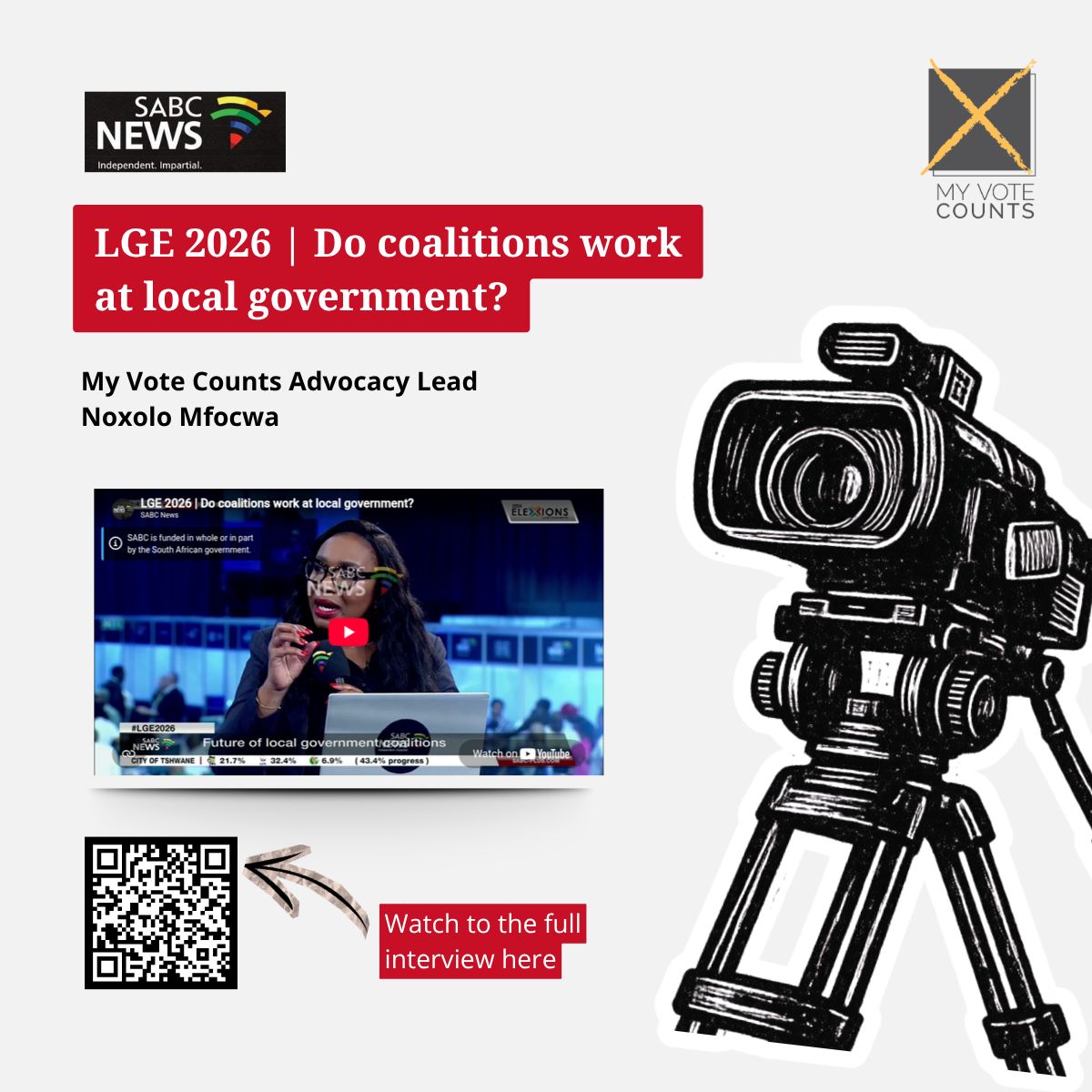
The emerging results suggest that coalition government will remain a significant feature of South Africa's local democracy. For My Vote Counts, this is not a reason to view coalitions as a democratic failure. In a proportional electoral system, coalitions are a legitimate outcome of how voters distribute political power.
However, the question has always been about how these coalitions are formed, what informs the compromises parties make, and who ultimately benefits from those arrangements.
Before the elections, MVC asked political parties to disclose the principles that would guide their coalition negotiations, their non-negotiable policy commitments, which parties they would or would not work with, and whether they would commit to publishing their coalition agreements. (Since the interview, both the Democratic Alliance and the Patriotic Alliance have made commitments to publishing their coalition agreements.)
Those questions are now more important than ever. Parties must be held to the positions they communicated to voters. Once agreements are reached, they should be published in full, including any side agreements or amendments.
We also need to move beyond agreements that simply allocate political positions. Coalition arrangements should establish a shared programme of action, clear governing responsibilities, mechanisms for resolving disputes and ways for residents to monitor performance.
The Coalitions Bill is an important part of the longer-term conversation about strengthening coalition governance, but parties do not need to wait for legislation to practise transparency and accountability.
Ultimately, the test of these coalitions will not simply be whether parties can secure a majority or keep a government together. It will be whether they can translate the mandates entrusted to them into functional municipalities that respond to the needs of residents.
Watch the full interview here: https://t.co/tQYB3F9Ott
What happens when communities stop waiting for political parties to save them and start issuing their own terms and conditions.
At a recent Futures of Democracy convening at the Nelson Mandela Foundation, Noxolo Mfocwa, our Advocacy Lead unpacked a different approach to citizen power. “By tying a block vote directly to community-driven manifestos, citizens force politicians to deliver on tangible local needs rather than empty party lines.”
Read the full article here: https://t.co/RcwhAx7VRF"
As South Africa prepared for the 2026 Local Government Elections, the focus was once again on political parties, their promises and the candidates asking for the public’s vote. But beyond the election campaigns and political slogans, important questions remain about transparency, accountability and the influence of money in our democracy.
My Vote Counts has consistently advocated for greater transparency in political party funding, stronger democratic accountability and a political system that places citizens at its centre.
Our Executive Director, Minhaj Jeenah joined Hilaal Tv to look at whether South Africa's electoral system is giving voters the transparency and accountability they deserve, and what reforms are still needed to strengthen our democracy.
Watch the full interview here: https://t.co/o1QDOOPCrP
How do we deepen democracy at a time when it feels so far removed from people?
2024’s journey to the general election felt like riding a conveyor belt on sand, with everything shifting beneath our feet. At My Vote Counts, we responded through our Democracy from Below work by taking the tools of democracy to people, and creating space for them to bring out their own ideas and demands.
That meant exploring concepts like the strategic vote with Abahlali baseMjondolo as practical organising tools, not abstract theory. It meant looking at how movements can use the demands of coalition agreements as power-building instruments, rather than waiting to see what deals elites strike.
It also led to a sectoral collaboration with Equal Education, the Basic Income Grant coalition, NU, AIDC and others to develop the People’s Analysis on Manifestos (PAM), a tool people can use to compare party promises with long-standing movement demands, and to hold parties accountable once in power.
The 30 Years of Democracy Gathering gave movements and organisations space to step back from the election frenzy, reflect honestly on three decades of democracy, and strategise together about the tools we need to build lasting democratic capacity from below.
Read more from Keamogetswe Seipato, our Democracy from Below Project Lead, in our annual report:
https://t.co/M8eiTljFxO
Before you make voting day a public holiday and call it a day… 👀
Democracy is more than casting a ballot every five years. It’s what happens between elections: the questions we ask, the decisions we challenge, the communities we organise and the accountability we demand from those elected to represent us.
In his latest reflection, Boikanyo Moloto, My Vote Counts’ Programme Lead: Electoral Systems, turns to the music that has accompanied South Africa’s democratic journey to explore how far we’ve come, what remains unfinished and why we all have a role to play in shaping what comes next.
From Senzeni Na? to Mannenberg, this is a reminder that democracy is a collective project. And the work doesn’t stop when the voting stations close.
🎶 The Ballot, the Beat and the Business of Democracy
Read the newsletter: https://t.co/mywIwznpOF
Political parties received more than R3 billion in combined public and private funding in 2024/25.
But here's the catch: disclosed donations account for just 27% of their private funding (excluding loans).
So, who is funding our politics beyond the donations we can see?
We've dug into the IEC's latest Annual Political Party Funding Report. The findings raise important questions about disclosure, compliance and accountability.
Read our analysis. Because the public deserves to know who's behind the money: https://t.co/AHHCvpxEPw
#WhoFundsOurPolitics
[ON AIR] South Africans Encouraged to Vote
Civil society organizations stress that the "democratic responsibility of voters doesn’t end at the ballot box," urging continuous civic engagement.
@ThabisoTema is in conversation
Advocacy Lead at My Vote Counts, Nox Mfocwa.
#POWERBreakfast
#POWERBreakfast with @ThabisoTema and the @Powerfm987 team @LeboPhokela & @_NyakalloT
TT, great work by civil society in filling the gap. The first challenge in following our votes is to influence the Next Generation of Integrated Development Plans.
November and December are critical months for that exercise as communities in wards must set and submit their 5-year priorities. Then track if priorities will be included in the draft IDPs and budgets to be tabled by 31 March 2027. Following the tabling, they'll be published for public participation and comments that will take place between April and May 2027.
@MVC_SA@Kagiso_Trust@rivonia_circle@ActivateZA@gwc_za@OUTASA
#LGE2026 #WozaLGE2026 #GetUpShowUpVote #LocalGovElections
"We continue to see a lot of instability in municipalities."
Hung councils have more than doubled, and municipal instability affects the very people who voted. That’s why we wrote to 20 political parties asking them to be open about their coalition talks and agreements ahead of the Local Government Elections.
Our Advocacy Lead, Noxolo Mfocwa spoke to ENCA News about our call for coalition agreement transparency. Watch the full interview here: https://t.co/DaaDb7R77R
Keep an eye out for an update next week!
LGE 2026 | Kagiso Trust has brought political rivals together in Boksburg to answer residents' questions on local government, accountability and how they plan to deliver on their election promises ahead of the 4 November polls.
The Local Government Elections will take place on Wednesday, 4 November. 🗳️ 🇿🇦
From water and sanitation to roads and refuse removal, municipalities shape our daily lives.
Do you know what your municipality is responsible for? Why should we vote? And how do municipal elections actually work?
🎥 Explore our short @civicsacademy videos in the #LocalGovernment series in English, Afrikaans & isiXhosa:
https://t.co/FsD2JUjCc8
#LGE2026 #Democracy 🌍 #SouthAfrica #UnityinDiversity #ActiveCitizenship
[READ] "Communities do not take to the streets because they have no understanding of democracy. In many cases, they do so because they’ve exhausted the formal democratic channels and are trying to make power listen."
Recently, we launched our Local Government Playbook: Democracy from Below, which was developed in collaboration with five community formations, one such formation being The Msunduzi Association of Residents, Ratepayers and Civics (Marrc). “The playbook is a tool for communities to use to influence the democratic process. This was best demonstrated by community dialogues that Marrc facilitated with communities who developed their own community manifestos and from three wards." And at these meetings, the majority of candidates signed the up to the manifesto!
Read the full article here: https://t.co/GxLqq7HnfQ
#democracyfrombelow
[READ] What are political parties promising? How have municipalities performed? What can previous coalition governments tell us about political stability? And where can communities find reliable information about their wards, councillors and municipal finances?
The Parliamentary Monitoring Group has compiled a selection of practical tools, research and authoritative resources to help stakeholders navigate these questions ahead of Election Day, including our M-PAM, which helps voters and civil society organisations assess whether campaign promises address community needs and fall within the responsibilities of municipalities.
Find the tools and resources here: https://t.co/uu0i33lNSC