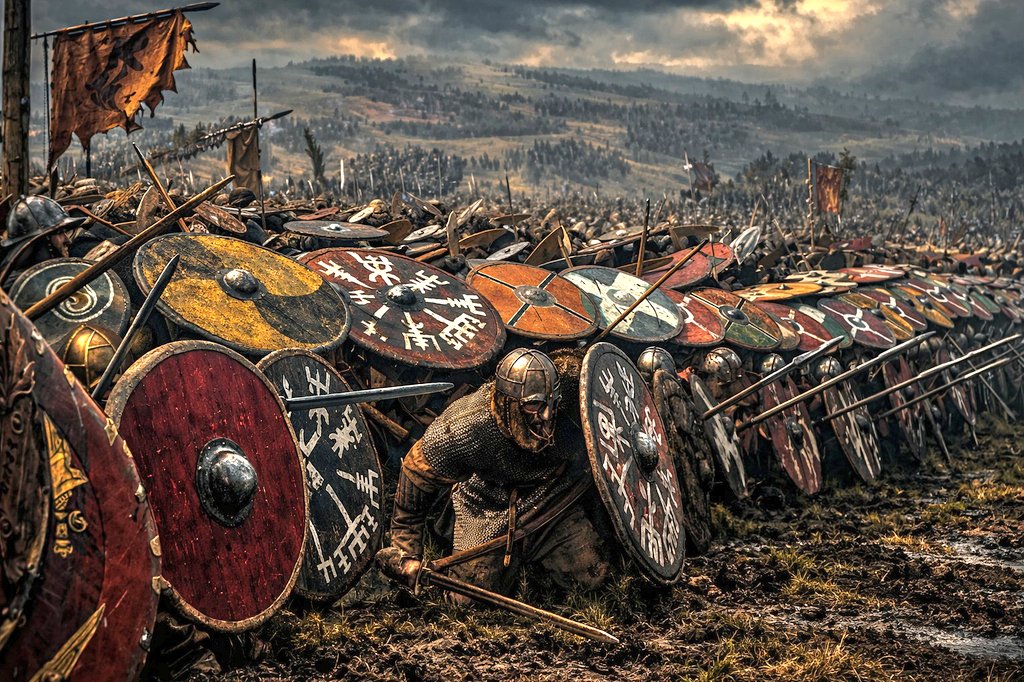
For centuries, the strength of the English lay in one simple idea: stand together and hold the line.
The shield wall was not just a battle formation. It was a brotherhood. Each man’s shield protected the man beside him. If one broke, the line broke. If all stood firm, nothing could pass.
This is how our ancestors fought, farmers, craftsmen, and warriors shoulder to shoulder, shields locked, spears forward, refusing to yield.
England was not built by men who stood alone. It was built by men who stood together and did not move.
The lesson is the same today as it was a thousand years ago:
Hold the line. 🏴
@Aurthuria@nonregemesse Half my folks are Kentish (Thanet), so the Jutes have always fascinated me. I am not sure if they ever saw themselves as Jutes. We are relying on Bede. Whereas, as JNL Myres (1986, p.113-15) points out, the kings of Kent referred to themselves as “Kings of the Angles.”
@nonregemesse Nah. While reading and translating pre-1066 texts I noticed that the Latin ones tended towards Anglosaxon and the English ones towards Engle/Angle and Angulcynn. Non-English sources from the continent also used Anglesaxon - possibly to differentiate them from continental saxons.
In AD 9, deep in the forests of northern Germania, something happened that would echo through the bloodlines of northern Europe.
At the Battle of the Teutoburg Forest, three Roman legions marched confidently into territory they believed was already under control. The governor Publius Quinctilius Varus was leading them through narrow woodland tracks, stretched out for miles.
Waiting in those forests were Germanic warriors led by Arminius.
Arminius had been raised in Rome, trained in Roman warfare, and understood exactly how the legions fought. But he was still a son of Germania. He united several Germanic tribes and lured the Roman army into an ambush.
For three days the legions were attacked in mud, rain, and dense forest. The Roman formations broke apart. The long marching column collapsed under relentless assaults.
When it was over, three Roman legions had been completely destroyed.
Rome never truly conquered Germania beyond the Rhine after that.
The men who fought in those forests were Germanic tribes, part of the same northern cultural world that later produced the Angles, Saxons, and Jutes, the people who crossed the North Sea centuries later and built the foundations of Anglo-Saxon England.
They spoke related Germanic tongues.
They lived by similar warrior traditions.
They came from the same northern lands.
The Anglo-Saxons who settled England were not strangers to those warriors of Teutoburg. They were part of the same Germanic family that stretched from Scandinavia down into northern Germany.
Before England was called England, the men who would become the English stood in those forests and showed the world that even the power of Rome could be broken. That fighting spirit never left.
Remember who you are. 🏴
@RupertLowe10 In Japan today they had a minute's silence to mark the 15th anniversary of the tohoku earthquake and tsunami. I'd like us to hold a similar memorial to these victims. A great evil was done to them.
I want to see senior police officers in prison.
With the evidence we are collecting, there is simply no way hundreds of men and women right at the top of their forces were not aware of the rapes. Hundreds, if not more.
Politicians, police, council officials, NHS, social care - all of them.
If they knew, and did nothing.
They shouldn’t just be sacked, they should be prosecuted.
A lot of people need to go to prison.
The White Dragon flag is one of the oldest emblems of the English ethnic people - a banner reaching back around 1,500 years, to the dawn of England itself. Long before the Norman invasion, before the lion or the Union Jack, the White Dragon flew over the early Christian kingdoms of Wessex, Mercia, and Northumbria, representing courage, purity, and divine protection.
Chroniclers such as Geoffrey of Monmouth wrote of the red and white dragons locked in battle - the red for the ancient Britons, the white for the English. That white dragon became the emblem of our nation and our ancestry, the symbol of a people forged in this land, united by faith, language, and blood.
When you see this flag, you’re looking at a banner that’s at least 1,500 years old, carried by our forefathers who built the churches, tilled the fields, defended the homeland, and passed down a living heritage that still runs in our veins today.
It’s not just a flag - it’s a symbol of English ancestry, English ethnicity, and the unbroken spirit of a people who have never lost their identity.
ƿē sindon Ēnglisc. 🏴
Fly it proudly - let the White Dragon rise once more over England.
@alisa_childers I tried using it for history research and it lies left-right and centre. It makes up references, makes up quotes, then doubles down. I had one instance where it insisted the quote existed, just not in any online versions of the text. ChatGPT: "Trust me bro."
@tag4UK 97% English. Maybe 3% Welsh. My father was RAF, both grandfathers fought in WW2. My great-grandfathers fought in WW1. An ancestor was in Wellington's army at Waterloo. Another fought at Crecy. I'm not the face of modern Britain.
Every country on Earth armed their police. Gave them military uniforms. Made them answer to the state.
Except one.
In 1829, Britain created the first police force in history that carried no weapons. Wore civilian clothes. And answered to the people, not the government.
Before that, London had no police force at all. It was the largest city in the world. Over 1.5 million people. And the best they had was a handful of night watchmen who were famously old and frequently asleep.
Then there were the thief-takers. Bounty hunters paid per conviction. Many of them were criminals themselves. The most notorious, Jonathan Wild, ran a criminal empire while claiming rewards for catching the very thieves he controlled.
The Bow Street Runners were the closest thing London had to real law enforcement. Established in 1749 by the magistrate Henry Fielding. But there were never more than a few dozen of them. For a city of millions.
Home Secretary Sir Robert Peel proposed something no country had ever attempted. A civilian police force. Accountable to the public, not the state. Not soldiers. Unarmed. They wore dark blue tailcoats instead of military red. That was deliberate.
The Metropolitan Police Act 1829 created the force. One thousand officers began their first patrols on 29 September 1829.
People called them Bobbies. After Bobby Peel. The name stuck for 200 years.
Two commissioners wrote the founding principles. Colonel Charles Rowan, a Waterloo veteran. And Richard Mayne, a barrister. Nine principles. The most radical idea in the history of policing.
Principle Seven: "The police are the public and the public are the police. The police being only members of the public who are paid to give full-time attention to duties which are incumbent on every citizen."
Not above you. Not against you. One of you.
No other country on Earth had ever said that.
In France, the Gendarmerie nationale had existed since 1791. Military police. Armed. Uniformed as soldiers. Serving the government, not the people. Most of the world copied France. Colonial police forces across every empire were built on the same model.
Britain chose consent.
For nearly 200 years, British police officers carried no firearms. Just a wooden truncheon, a rattle, and the trust of the people they served. That model spread to Australia, New Zealand, Canada, and became the foundation of democratic policing worldwide.
Most people in this country have absolutely no idea how rare that is. Or that it started here.
Be Proud Of Us. 🇬🇧