More evidence showing how many of us could benefit from shifting our internal monologue from self-criticism and doom-speak to encouragement and problem solving.
A Russian psychologist spent 10 years proving that the act of talking to yourself out loud is one of the most powerful cognitive tools the human brain has, and almost nobody outside his field has read the work.
His name was Lev Vygotsky.
He worked in Moscow in the 1920s and died of tuberculosis in 1934 at the age of 37. He had no laboratory, no funding, almost no English readers, and a body of work that the Soviet government suppressed for two decades after he died.
He produced the foundational theory of how human cognition actually develops, and the central piece of that theory was a behavior almost every adult is faintly embarrassed about.
Vygotsky noticed that young children talk to themselves constantly. They narrate their own actions, they argue with imaginary opponents, they instruct themselves through tasks out loud.
The dominant theory at the time, from the Swiss psychologist Jean Piaget, said this was a sign of cognitive immaturity that children would eventually grow out of as they learned to think properly.
Vygotsky said the exact opposite.
He argued that this self-directed speech was the most important cognitive event in the entire developmental window, because it was the moment a child first started to use language as a tool to control their own mind. The child was not failing to think. The child was learning how to think by externalizing the process and listening to themselves do it.
He predicted that as children matured, this out-loud self-talk would not disappear. It would go underground. It would become silent inner speech, which is the running monologue every adult has inside their own head for the rest of their life.
The voice you hear when you read this sentence is the direct descendant of a four-year-old narrating their own block tower.
For 50 years almost nobody outside Russia had access to his work, and the few researchers who did pick it up could not get funding to test it. Then in the early 2000s the experiments finally started to pile up, and what they found was that Vygotsky had been right about something even more important than he knew.
The first major study came from Gary Lupyan at the University of Wisconsin and Daniel Swingley at the University of Pennsylvania in 2012. They ran a simple visual search experiment. Participants were shown 20 images at once and asked to find a specific object, like a banana or a chair. In one condition they searched silently. In the other condition they were told to say the name of the object out loud to themselves while looking for it.
The participants who spoke the target name out loud found the object significantly faster, with higher accuracy, than the participants who searched in silence. The effect was strongest when the spoken word matched a familiar object the brain already had a strong category for.
Saying the word out loud literally tuned the visual system to detect that thing better. The researchers called it the label feedback effect, and the implication was that the act of vocalizing a goal physically changes how the brain processes the world while pursuing it.
The second major study came out of the University of Michigan and Michigan State in 2017. The lead researchers were Ethan Kross and Jason Moser, and they used both EEG and fMRI to record what happens inside the brain when people talk to themselves while emotionally upset.
They asked participants to recall painful autobiographical memories and reflect on them in two different ways. Some used the first person, saying things like "why am I feeling this way." Others used the third person, referring to themselves by their own name, saying things like "why is John feeling this way."
The brain scans showed that the simple act of switching from first person to third person, even silently, decreased activity in the medial prefrontal cortex, the region responsible for rumination and self-referential pain. Within a single second of using their own name instead of the word I, participants showed measurably lower emotional reactivity. The shift required no extra cognitive effort. It cost the brain nothing. And it worked.
Kross described the mechanism in his interviews. Talking to yourself by name creates a small amount of psychological distance from your own experience. Your brain processes the situation more like a problem belonging to someone else, which means it can analyze it instead of drowning in it.
What Vygotsky had intuited in 1934 turned out to be even more powerful than the developmental theory he built it into. The voice you use to talk to yourself is not background noise. It is one of the most precise cognitive tools the brain has, and you can change how it works just by changing the pronoun you use.
People who talk through problems out loud are not anxious or unstable. They are running an externalized version of a process the rest of us are running silently and worse. The kindergartener narrating their block tower, the surgeon muttering through a procedure, the engineer pacing a hallway describing a bug to nobody, the athlete repeating a cue to themselves before a free throw, they are all using the same ancient mechanism that builds and steers human thought.
You can run the experiment yourself the next time you are stuck on something hard. Stop trying to solve it silently in your head. Say it out loud. Describe what you are seeing. Walk yourself through the steps as if you were explaining it to a colleague who is not in the room.
And when something genuinely upsets you, switch to your own name. Ask why this person is feeling this way, instead of why I am feeling this way.
The voice you have been told to keep quiet your entire life is one of the oldest pieces of cognitive technology you own.
Most people are still embarrassed to use it.
I just finished reading Money and the Making of the American Revolution by @Historicaecon. Great reading for anyone interested in the economic and monetary forces which were leading causes of the war. Relevant today for Americans concerned about the pernicious effects of inflation and the dwindling purchasing power of their hard-earned dollar.
"Everyone knows that the founders waged a revolt against taxation without representation. Edwards shows that the dispute over taxes was really a dispute over money: what it was, who could make it, and how to keep it from being used at the expense of the colonists in North America. The colonial rebels refocused their resistance on democratic, local control—defending the power they had used to make money for themselves."
The dominant markets story in past 48 hours is interest rates. While the geopolitical picture is essentially unchanged (MOU unsigned, Hormuz near-zero flow, Iran "engaged with distrust" yet striking Kuwait's airport), labor data has moved the rate hike odds decisively. With so much focus on SpaceX and other upcoming AI-related IPOs, liquidity is moving from other markets, notably including $BTC and crypto generally.
A rate hike is now near-consensus. Markets now price an 85% probability of a quarter-point Fed rate hike by year-end. Rate hike probability has moved in just three weeks from 28% to 85% today. The 10-yr Treasury yield climbed on the ADP jobs report, which showed private-sector employment rose 122K in May, beating forecasts and reaching its highest level since January 2025.
Tuesday was a warning shot for equities at ATH. The Dow closed 600 points lower Tuesday as rising Treasury yields and oil prices simultaneously pressured stocks, the first session where both drivers hit at the same time with enough force to break through the market's habitual Iran-fatigue.
Oil prices remain elevated. Oil is approximately +45% above pre-war levels. The peak (WTI $108, Brent $117 in early May) represented approximately +70-75% above pre-war levels, the largest sustained oil shock since the 1973 embargo.
FED WARNING LIGHTS ARE FLASHING 🚨
@MW_Stormwall says incoming Fed Chair Kevin Warsh is stepping into an economy squeezed by persistent inflation, rising fuel costs, and consumers already feeling overwhelmed.
In the last year, the world has printed 9.3% more money.
Global M2 money supply has reached $141T in 2026.
When inflation starts to run hotter again, they will blame it on Iran and other proximate factors.
But the root driver is the money printer has been running hot for the last year. Where?
China increased their money supply by 13.6% in the last 12 months. Their M2 is now $50T, making it the largest global driver of fiat inflation.
US growth in M2 is just 4.6% over the last 12 months, making the US comparatively responsible. (But make no mistake, this means your dollars have been debased by almost 1/20th of their value in just a year.)
Since we live in a global economy, we're subject to the aggregate impact of GLOBAL money printing. The US has been accustomed to being the largest monetary base and therefore largely controlling global debasement.
But China's money supply is now 2x as large as the USA's. Your savings are being debased by Chinese monetary policy decisions and you have no control.
Nobody asked your permission. Nobody told you it was happening.
But your savings just got diluted by 9.3% in one year.
Note: I'm currently updating the Global Asset Landscape for 2026 (see prior tweet). It will be out in the next few weeks, stay tuned!
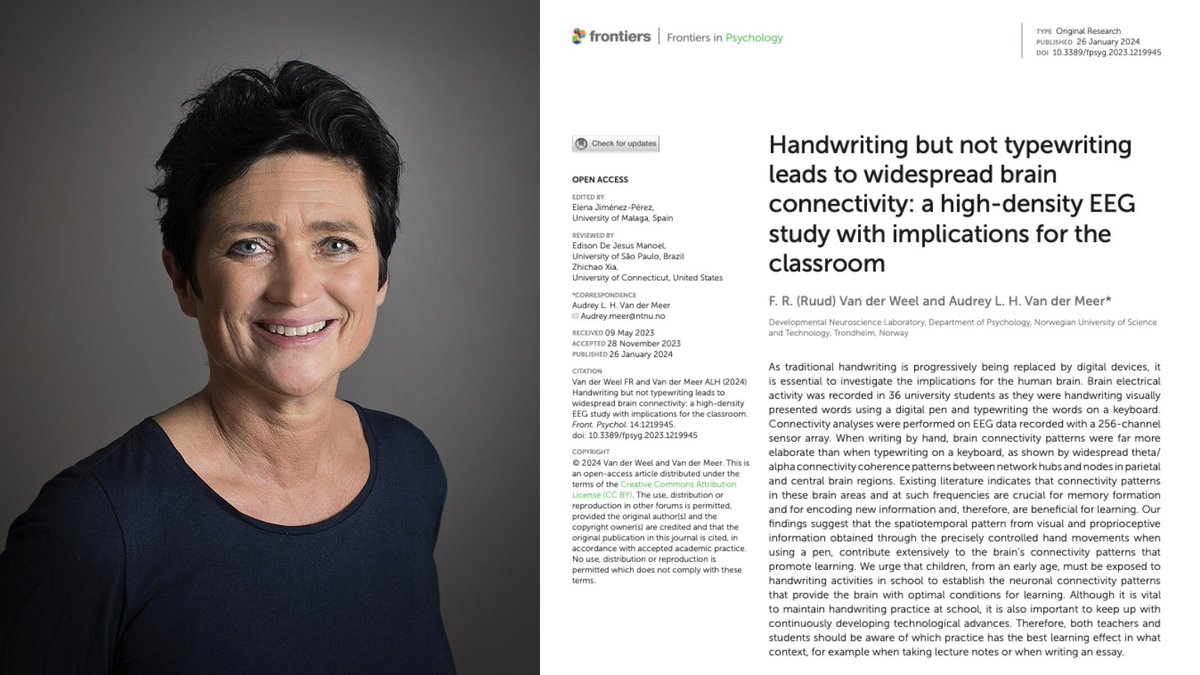
A Norwegian neuroscientist spent 20 years proving that the act of writing by hand changes the human brain in ways typing physically cannot, and almost nobody outside her field has read the paper.
Her name is Audrey van der Meer.
She runs a brain research lab in Trondheim, and the paper that closed the argument was published in 2024 in a journal called Frontiers in Psychology. The finding is brutal enough that it should have changed every classroom on Earth.
The experiment was simple. She recruited 36 university students and put each one in a cap with 256 sensors pressed against their scalp to record brain activity. Words flashed on a screen one at a time.
Sometimes the students wrote the word by hand on a touchscreen using a digital pen, and sometimes they typed the same word on a keyboard. Every neural response was recorded for the full five seconds the word stayed on screen.
Then her team looked at the part of the data most researchers had ignored for years, which is how different parts of the brain were communicating with each other during the task.
When the students wrote by hand, the brain lit up everywhere at once.
The regions responsible for memory, sensory integration, and the encoding of new information were all firing together in a coordinated pattern that spread across the entire cortex. The whole network was awake and connected.
When the same students typed the same word, that pattern collapsed almost completely.
Most of the brain went quiet, and the connections between regions that had been alive seconds earlier were nowhere to be found on the EEG.
Same word, same brain, same person, and two completely different neurological events.
The reason turned out to be something nobody had really paid attention to before her work. Writing by hand is not one motion but a sequence of thousands of tiny micro-movements coordinated with your eyes in real time, where each letter is a different shape that requires the brain to solve a slightly different spatial problem.
Your fingers, wrist, vision, and the parts of your brain that track position in space are all working together to produce one letter, then the next, then the next.
Typing throws all of that away. Every key on a keyboard requires the exact same finger motion regardless of which letter you are pressing, which means the brain has almost nothing to integrate and almost no problem to solve.
Van der Meer said it plainly in her interviews.
Pressing the same key with the same finger over and over does not stimulate the brain in any meaningful way, and she pointed out something that should scare every parent who handed their kid an iPad.
Children who learn to read and write on tablets often cannot tell letters like b and d apart, because they have never physically felt with their bodies what it takes to actually produce those letters on a page.
A decade before her, two researchers at Princeton ran the same fight using a completely different method and ended up at the same answer. Pam Mueller and Daniel Oppenheimer tested 327 students across three experiments, where half took notes on laptops with the internet disabled and half took notes by hand, before testing everyone on what they actually understood from the lectures they had watched.
The handwriting group won by a wide margin on every question that required real understanding rather than surface recall.
The reason was hiding in the transcripts of what the two groups had actually written down.
The laptop students typed almost word for word, capturing more total content but processing almost none of it as they went, while the handwriting students physically could not write fast enough to transcribe a lecture in real time, which forced them to listen carefully, decide what actually mattered, and put it in their own words on the page.
That single act of choosing what to keep was the learning itself, and the keyboard had quietly skipped the choosing and skipped the learning along with it.
Two studies. Two countries. Same answer.
Handwriting makes the brain work. Typing lets it coast.
Every note you have ever typed instead of written went into your brain through a thinner pipe. Every meeting, every book highlight, every idea you captured on your phone instead of on paper was processed at half depth.
You did not forget those things because your memory is bad. You forgot them because typing never woke the part of the brain that would have made them stick.
The fix is the thing your grandmother already knew.
Pick up a pen. Write the thing down. The slower road is the faster one.
We shouldn’t drain the SPR when there isn’t a US energy emergency.
I wrote this article for Jackson Home Ecomomics in the summer of 2022, after President Biden announced his intentions to tap the US Strategic Petroleum Reserve. I was critical of the decision as a political move, ie, an attempt to use price controls to influence the midterm outcomes. What was true in 2022 is still true in 2026, regardless of which administration takes the action.
The purpose of the SPR is to “counter a disruption in commercial oil supplies which could threaten the U.S. economy.” The SPR was never intended to be used as a backdoor method for price controls.
President Clinton’s Secretary of the Treasury, Larry Summers, affirmed as much when he said, to the apparent displeasure of his boss, “the SPR was created to respond to supply disruptions, [not] simply to respond to high prices or a tight market.” The temptation to use the SPR for political ends, or short-term economic relief, undermines America’s energy security and exposes the nation to unnecessary risks.”
https://t.co/aYaqKG3ID3
US government’s recent UAP disclosures (primarily the May 8, 2026, initial tranche of ~161+ declassified files on https://t.co/gNMECJDYOo seem like a nothing-burger. Reveals very little paradigm-changing information.
Supports the conspiracy theorist’s dilemma:
Find something?
“I told you so”
Find nothing?
“This proves they’re hiding it”
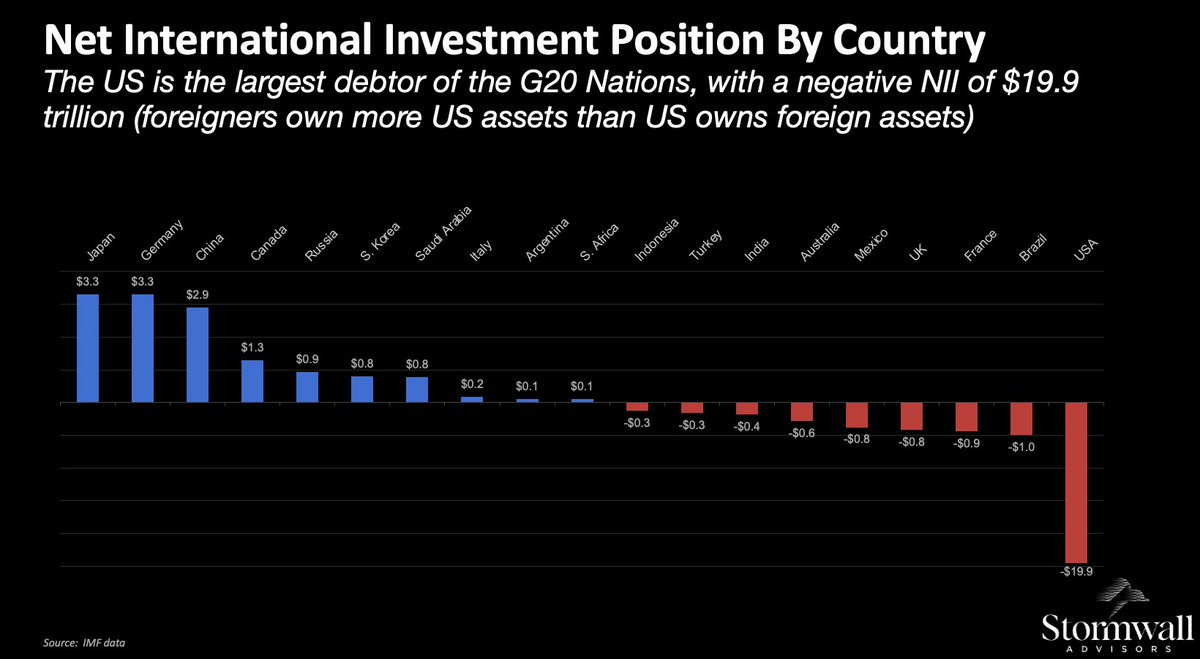
What is a rich country?
In relative financial terms, it is a country whose net international investment position is positive. The NII reflects how much one country owns of all other countries’ assets, less how much those countries own of it. Throughout most of the twentieth century, the U.S.’s NII was not only positive, but the highest in the world. Those days are over. Today, foreign governments, corporations, funds, and wealthy individuals own tens of trillions more of U.S. stocks, bonds, real estate, and other assets than we own of theirs. https://t.co/pxsZZ2XG18
FED TIGHTROPE: TOO HOT OR TOO COLD?
@MW_Stormwall says the next Fed move isn’t simple—it’s a “Goldilocks” moment. Cut rates too much, inflation roars back. Keep them high, the economy gets crushed. And with gas likely staying above $3, the pressure isn’t easing anytime soon.