Jensen Huang, $NVDA, CEO: “Resilience matters in success. I don’t know how to teach it to you, except for: I hope suffering happens to you .. because .. greatness comes from character. And character isn’t formed out of smart people. It’s formed out of people who suffered.
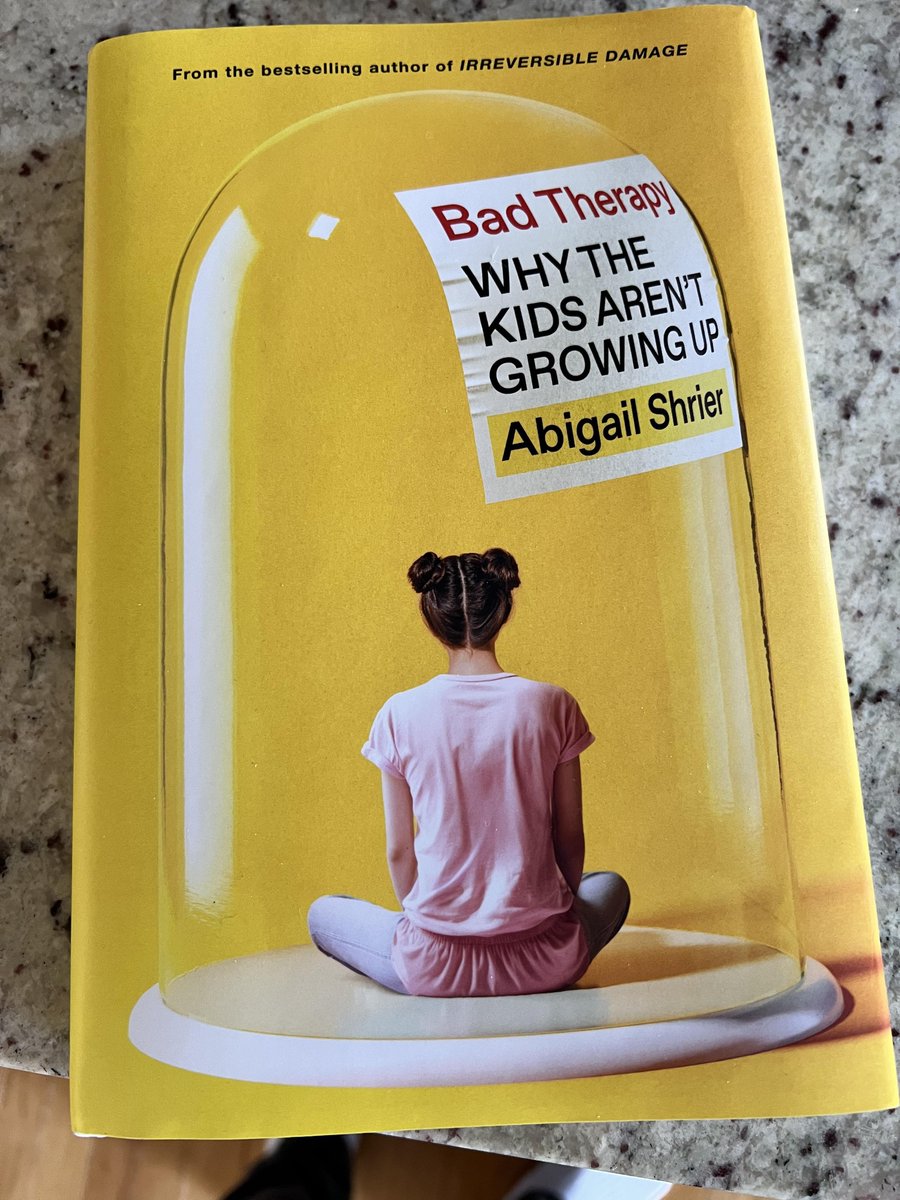
Just finished this book - Bad Therapy by @AbigailShrier
This is one of the most eye-opening books I've ever read. It's a must read for any parent, any teacher, and should be required reading for any school administrator as well.
The book dives into trying to figure out why kids are having so many mental health problems, when there are so many resources devoted to improving mental health outcomes.
Anxiety, depression, suicide, etc are all higher than they've ever been with kids, even though their lives are arguably better than ever before. It just doesn't make sense.
A few key takeaways from the book:
A constant attention on how kids are "feeling" or "thinking" is causing negative outcomes.
Constantly ruminating on your emotions and how you feel negatively impacts your mental health. If all you do is focus on your emotions, you are destined to be anxious or depressed.
We incessantly ask kids how they're feeling, if they're happy, how their mental health is, etc, and this is creating kids who think they're fragile instead of resilient.
Trying to solve every problem for kids has caused a generation who can't do anything for themselves.
We (Gen X) were told to "suck it up" or "you'll live" or "rub some dirt on it" all the time. Many of us came to the conclusion this is "bad parenting" because our feelings were neglected, and we vowed not to do this to our own children.
Because of that, kids immediately over-dramatize everything that happens to them, making mountains out of molehills, and thinking the world must revolve around their emotions and feelings.
You develop confidence and strong mental health by doing things, not by thinking or via therapy.
You can't think your way out of anxiety. You don't gain confidence by analysis of your thoughts or mental health issues.
You gain confidence and eliminate anxiety by doing gradually more difficult tasks, excelling at them, and realizing you are a competent, capable person.
The non-stop attention therapy gives to these small, common emotions we all feel blows them out of proportion to their seriousness (not talking about genuine disorders here, just normal anxieties that millions of people go to therapy to try to avoid).
One of the best ways to decrease your happiness is to chase it.
Our society constantly tells kids they should be "happy" and asks them if they are.
Happiness isn't a state you should be in 24/7. That's not realistic. Joy and bliss aren't permanent states - they are fleeting.
Contentment, stillness, and being even-keeled are much better goals to aim for mentally.
The happiest, most well adjusted kids come from families with loving parents that have strict rules for the household.
This one really set off the confirmation bias in me... I feel really blessed we have 2 well adjusted middle school kids who do great in school, are very respectful and well mannered, and we barely even need to parent them.
But for years, we were very strict with them. Bedtimes, family rules, how we do things, etc. The in-laws and lots of friends thought we were totalitarian.
In reality, we just had high standards. And it's really paying off right now. I found it really interesting that strict rules equals happy kids. Makes sense, though, as kids need to know what their boundaries are.
Constantly surveying school-age kids about their mental health causes more issues than it solves.
Mental health resources is big money. Districts need to validate all the resources allocated towards mental health, and they often do that via surveys.
Asking kids non-stop questions like:
- Have you thought about self harm?
- Have you thought about suicide?
- Have you been so anxious you can't get out of bed?
Etc, etc puts into their heads the idea that themselves, or many of their peers are broken and cannot function properly in the real world.
It normalizes situations that would be incredibly rare at any other time in history.
There's a lot of other takeaways, too, but I'll stop there.
It's a fantastic book. Go pick it up and read it. This isn't an affiliate thing or a promotion thing at all. I just really enjoyed it, and it will further shape the way I parent moving forward.
Agree your post is an accurate representation of the 2017 study. But it’s not very representative of the latest understanding of plastic pollution. Both our 2017 study (the first ever global river model) and the Schmidt 2017 study made the same ‘mistake’: we assumed the amount of plastic emissions coming out of a river is proportional to the total amount of mismanaged plastic in the catchment area of a river. But this doesn’t take into account the fact that it’s very unlikely for plastic >1km away from a river to end up in the river, and that plastic also gets stuck in the river, meaning that stuff that entered the river far upstream usually doesn’t make it to the ocean. Thus it’s no surprise that our 2017 papers predicted a small number of rivers - those with big catchment areas - to contribute most of the plastic pollution. The 2020 study corrects this mistake, and shows it’s actually many more rivers, albeit smaller ones.
Ages of the Founding Fathers on July 4, 1776
James Monroe, 18
Aaron Burr, 20
Alexander Hamilton, 21
James Madison, 25
Thomas Jefferson, 33
John Adams, 40
Paul Revere, 41
George Washington, 44
Now check the ages of our three branches of government in 2024...
Is it possible to reclaim the internet as a force for good? In his new talk, head of TED Chris Anderson (@TEDChris) shares inspiring stories of people around the world doing just that — and gives the 3 ingredients we can all use to nurture the spread of generosity
⚡️Powering progress!
The Central African Republic takes a massive leap towards sustainability. Its Danzi solar Plant will generate over US$4 million yearly for the city's energy utility. 💡
#AfricaACTs on #EnergyTransition: https://t.co/ZC3y6gb7Bs
Specifically, pessimism is easy to sell to young adults, since it sounds world-weary and wise. So it's a cheat code for cynics and depressives who want followings. It's only later that the kids realize they've been sold a bill of goods, and by then it's cost them dearly.
interesting that around 70%+ of our electricity generation (coal, gas, nuclear) use a thermal cycle:
* release energy: take higher energy molecules (coal/natural gas/oil) & burn they break down into lower energy molecules releasing energy in the form of heat.
alternatively - take a big/unstable nucleus like uranium and break it apart get smaller atoms that sum to slightly less mass. that missing mass is released as energy in form of heat
* efficiently capture that energy: water can absorb a lot of heat energy and will eventually boil expanding in volume and pressure (can capture 85-95% of the heat)
* convert heat energy to mechanical energy: now that we have a hot expanding gas at high pressure we can use that steam to spin a turbine converting the thermal energy into mechanical (30-60% of energy is converted - rest to waste heat -> lot of tricks here to get high efficiency)
* convert mechanical energy into electrical energy: let's then connect the spinning turbine to an electrical generator which is just a magnet spinning inside some coil to creating a moving magnetic field which induces an electric current hence transferring mechanical to electrical (90 to 97% is converted)
hydro & wind power skip straight to the last two steps converting kinetic energy of falling water and wind into mechanical energy and then into electricity (85-90% efficient in case of hydro and 35-45% in case of wind)
solar cells skip all the steps and directly convert sunlight to electricity. photons knock electrons free in a semiconductor material creating a current (15-22% of sun's energy hitting the cell is converted to electricity)
Italian design legend Giorgetto Giugiaro calls the Tesla Cybertruck "the Picasso of automobiles."
"It does not represent the search for harmony and perfection but for emotion and robustness." https://t.co/Rgww7d0Gwu
@alex_avoigt Imagine if you could see in all directions simultaneously and never get distracted or tired. How much better could you drive?
That what Tesla’s Autopilot vision AI is becoming.
This is an example of the greatness of the American justice system. A billion dollar company challenges a trillion dollar company over complex antitrust practices, and a jury of 9 citizens hears the testimony and renders a verdict. And here it is in writing!