The scientific bases for all U.S. state laws and proposed laws to go to 100% renewable, clean, 0-C, and/or 0-emissions & the #GreenNewDeal
https://t.co/pGaym7I46V
https://t.co/YGWhmF0LYS
https://t.co/p8savBkjTF
The only way to do any of these is with #WindWaterSolar
CAISO has the lowest US wholesale electricity prices thus the most stable US grid despite its huge growth in WindWaterSolar in the past three years.
In-state WWS has met 56.8% of all demand in 2026
Gas down 61.2%, solar up 55%, wind up 13%, batteries up 334% in 2026 vs 2023.
67th straight and 133/157 (84.7%) days in 2026 with WindWaterSolar >100% of demand, for an average of 5.03 hours/day among all days.
Despite CA's high retail prices, which has nothing to do with renewables
https://t.co/1yCwOF0w6s
Texans pay 23% higher electricity bills than Californians due mostly to the far greater energy efficiency in CA
https://t.co/ZWjRpD71uU
@3Sentinel4 Relevance?
Regardless, California regularly has the third-highest fossil gas prices in the U.S., so less gas use makes things less expensive.
Replacing fossil gas with solar and batteries has reduced wholesale CA prices as seen in Figure 8 here:
https://t.co/Z6t81tXJbw
CAISO has the lowest US wholesale electricity prices thus the most stable US grid despite its huge growth in WindWaterSolar in the past three years.
In-state WWS has met 56.8% of all demand in 2026
Gas down 61.2%, solar up 55%, wind up 13%, batteries up 334% in 2026 vs 2023.
67th straight and 133/157 (84.7%) days in 2026 with WindWaterSolar >100% of demand, for an average of 5.03 hours/day among all days.
Despite CA's high retail prices, which has nothing to do with renewables
https://t.co/1yCwOF0w6s
Texans pay 23% higher electricity bills than Californians due mostly to the far greater energy efficiency in CA
https://t.co/ZWjRpD71uU
@greenbiz_de Propped up?
Fossil gas has supplied only 14.2% of CA demand in 2026 so far, down from 37% in 2023.
It is nosediving and quickly becoming irrelevant as solar, wind and batteries crush it out of use.
@greenbiz_de Propped up?
Fossil gas has supplied only 14.2% of CA demand in 2026 so far, down from 37% in 2023.
It is nosediving and quickly becoming irrelevant as solar, wind and batteries crush it out of use.
@3Sentinel4 The opposite.
Gas use in California is down 61% in 3 years and down to a record low of meeting only 14.2% of demand (down from 37% in 2023).
California has the cheapest wholesale electricity prices in the country, and clean energy is the reason why
Free fuel (sun, wind, water) together with battery storage produces low wholesale costs. California's retail electricity prices are quite high for a few reasons, but renewable energy is not one of them.
https://t.co/iIVfmHkfij
@StanfordEnergy
Also, Figure 8 of this paper shows how the wholesale (spot) price of electricity on the CAISO grid dropped by 50% between 2023 and 2024 during a period when the CAISO grid saw 100% WWS for a period of 98 out of 116 days in 2024 with zero blackouts evidencing further that more renewables and storage make it easier to balance demand with supply, thus lowering the spot price of electricity. https://t.co/eMc4m9CTgN
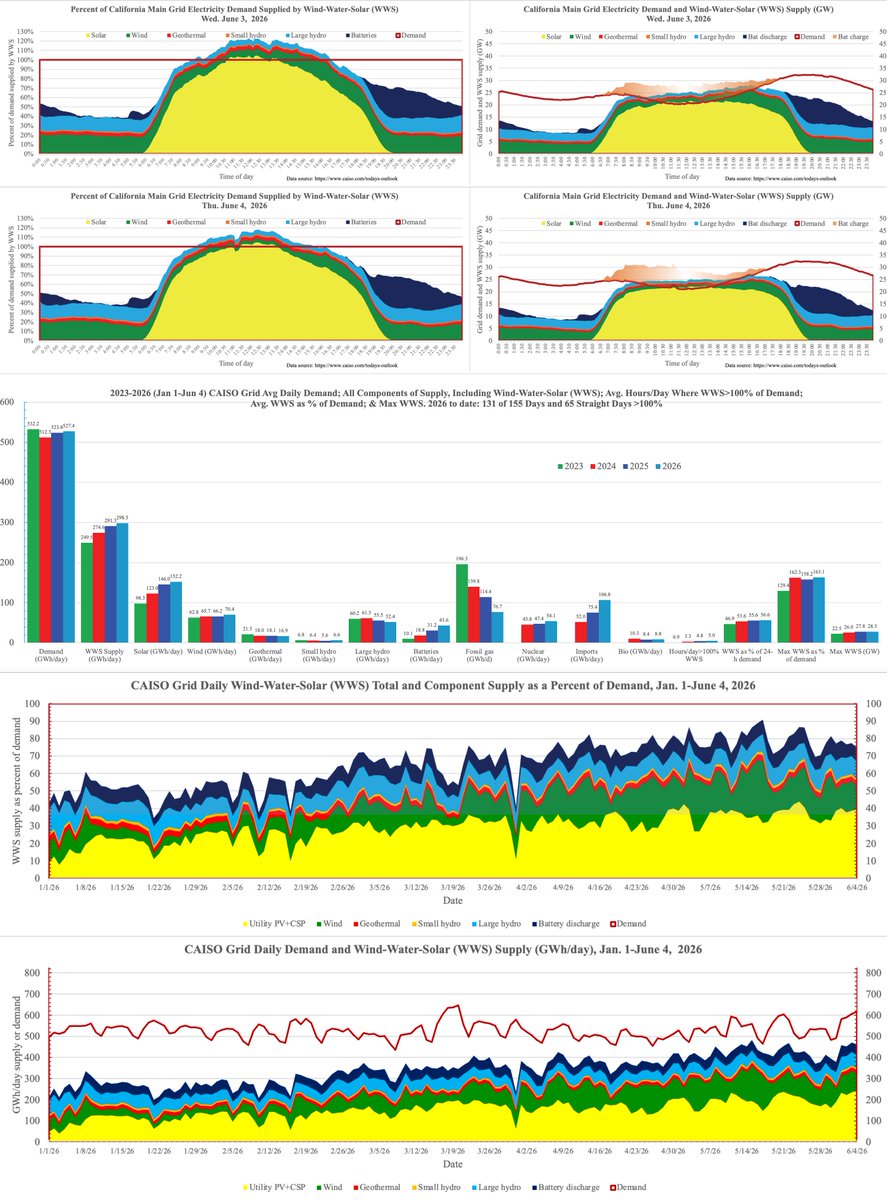
Record solar output on the California ISO grid: 243.3 GWh/day on Thursday June 4.
65th straight and 131 of 155 (84.5%) days in 2026 with WindWaterSolar meeting > 100% of demand for part of the day.
Fossil gas down 61%, solar up 55%, batteries up 333% in 2026 v 2023.
WWS has met 56.6% of demand so far in '26 vs 46.9% in '23
CAISO now has 16.25 GW/60.6 GWh of batteries.
https://t.co/vzKmG147w8
Average demand so far in 2026 is 22 GW, so the batteries can meet 74% of average demand for 3.7 hours.
The growth in solar + batteries displacing gas has led to CAISO having the lowest wholesale electricity prices in the U.S., thus the easiest grid to match demand with supply, thus the most reliable U.S. grid.
https://t.co/yrYc9Y4GXD
California has the cheapest wholesale electricity prices in the country, and clean energy is the reason why
Free fuel (sun, wind, water) together with battery storage produces low wholesale costs. California's retail electricity prices are quite high for a few reasons, but renewable energy is not one of them.
https://t.co/iIVfmHkfij
@StanfordEnergy
Also, Figure 8 of this paper shows how the wholesale (spot) price of electricity on the CAISO grid dropped by 50% between 2023 and 2024 during a period when the CAISO grid saw 100% WWS for a period of 98 out of 116 days in 2024 with zero blackouts evidencing further that more renewables and storage make it easier to balance demand with supply, thus lowering the spot price of electricity. https://t.co/eMc4m9CTgN
Spot (wholesale) prices are high when it is difficult to match demand with supply - when it is hard to find generators to meet demand.
Spot prices are low when it is easy to match demand with supply.
Renewables combined with storage have made it easier to match demand as evidenced by the low average and high-end spot prices in the last year in CAISO.
CAISO in fact has the most reliable grid in the U.S. as it has the lowest wholesale prices. Renewables not only reduce wholesale prices but also, statistically, retail prices.
https://t.co/ieapw8SHmp
China is on track for 100% renewables by 2051 and is expanding its clean energy infrastructure at 10 times the speed of either the US or India
Analysis based on @mzjacobson's "Projections of when each of 150 countries may eliminate air pollution and carbon emissions from all energy" (RSC Sustainability, 2026)
[Chart below: Real Clean Power Additions (Average Output in GW). The chart compares the true grid-adjusted, average annual power output added in 2025 alone, factoring in capacity drop-offs and transmission constraints]
This are retail, not wholesale, prices. Retail prices are high for the reasons described here:
https://t.co/eMc4m9CTgN
"Aside from the high cost of fossil gas in California, a big factor is wildfires. Utilities have passed on to customers the cost of wildfires caused by transmission line sparks [26], the cost of undergrounding transmission lines to reduce such fires [27], and other wildfire-related mitigation costs."
"Utilities have also passed on to customers the costs of the San Bruno [29] and Aliso Canyon gas disasters [30], the cost of retrofitting gas pipes following San Bruno [31], and the cost of keeping an aging nuclear power plant, Diablo Canyon, open [32]. Finally, transmission and distribution costs are rising faster than inflation [22]."
Record solar output on the California ISO grid: 243.3 GWh/day on Thursday June 4.
65th straight and 131 of 155 (84.5%) days in 2026 with WindWaterSolar meeting > 100% of demand for part of the day.
Fossil gas down 61%, solar up 55%, batteries up 333% in 2026 v 2023.
WWS has met 56.6% of demand so far in '26 vs 46.9% in '23
CAISO now has 16.25 GW/60.6 GWh of batteries.
https://t.co/vzKmG147w8
Average demand so far in 2026 is 22 GW, so the batteries can meet 74% of average demand for 3.7 hours.
The growth in solar + batteries displacing gas has led to CAISO having the lowest wholesale electricity prices in the U.S., thus the easiest grid to match demand with supply, thus the most reliable U.S. grid.
https://t.co/yrYc9Y4GXD
Figure 8 of this paper shows how the wholesale (spot) price of electricity on the CAISO grid dropped by 50% between 2023 and 2024 during a period when the CAISO grid saw 100% WWS for a period of 98 out of 116 days in 2024 with zero blackouts evidencing further that more renewables and storage make it easier to balance demand with supply, thus lowering the spot price of electricity.
https://t.co/eMc4m9CTgN
California — Lowest Wholesale Electricity Prices in the USA
-thus the most stable grids, despite the large amount of variable solar and wind on it - batteries are the key
https://t.co/fFqeml8Xes
@cleantechnica@zshahan3
Figure 8 of this paper shows how the wholesale (spot) price of electricity on the CAISO grid dropped by 50% between 2023 and 2024 during a period when the CAISO grid saw 100% WWS for a period of 98 out of 116 days in 2024 with zero blackouts evidencing further that more renewables and storage make it easier to balance demand with supply, thus lowering the spot price of electricity.
https://t.co/eMc4m9CTgN
Despite ~400,000 new EVs and ~200,000 new heat pumps in California during the past year and the 3rd-most data centers in the U.S., demand has hardly changed since 2025 and decreased 1.3% versus 2023, largely due to the growth in roof PV.
Roof PV reduces grid demand for electricity.
At the same time WindWaterSolar has supplied 56.4% of demand this year and >100% of demand for parts of 129 of 153 days, including 63 straight.
Gas is down 61% vs 2023, yet California's main grid is the most reliable in the US based on the lowest wholesale electricity prices in the past year.
Figure 8 of this paper shows how the wholesale (spot) price of electricity on the CAISO grid dropped by 50% between 2023 and 2024 during a period when the CAISO grid saw 100% WWS for a period of 98 out of 116 days in 2024 with zero blackouts evidencing further that more renewables and storage make it easier to balance demand with supply, thus lowering the spot price of electricity.
https://t.co/eMc4m9CTgN
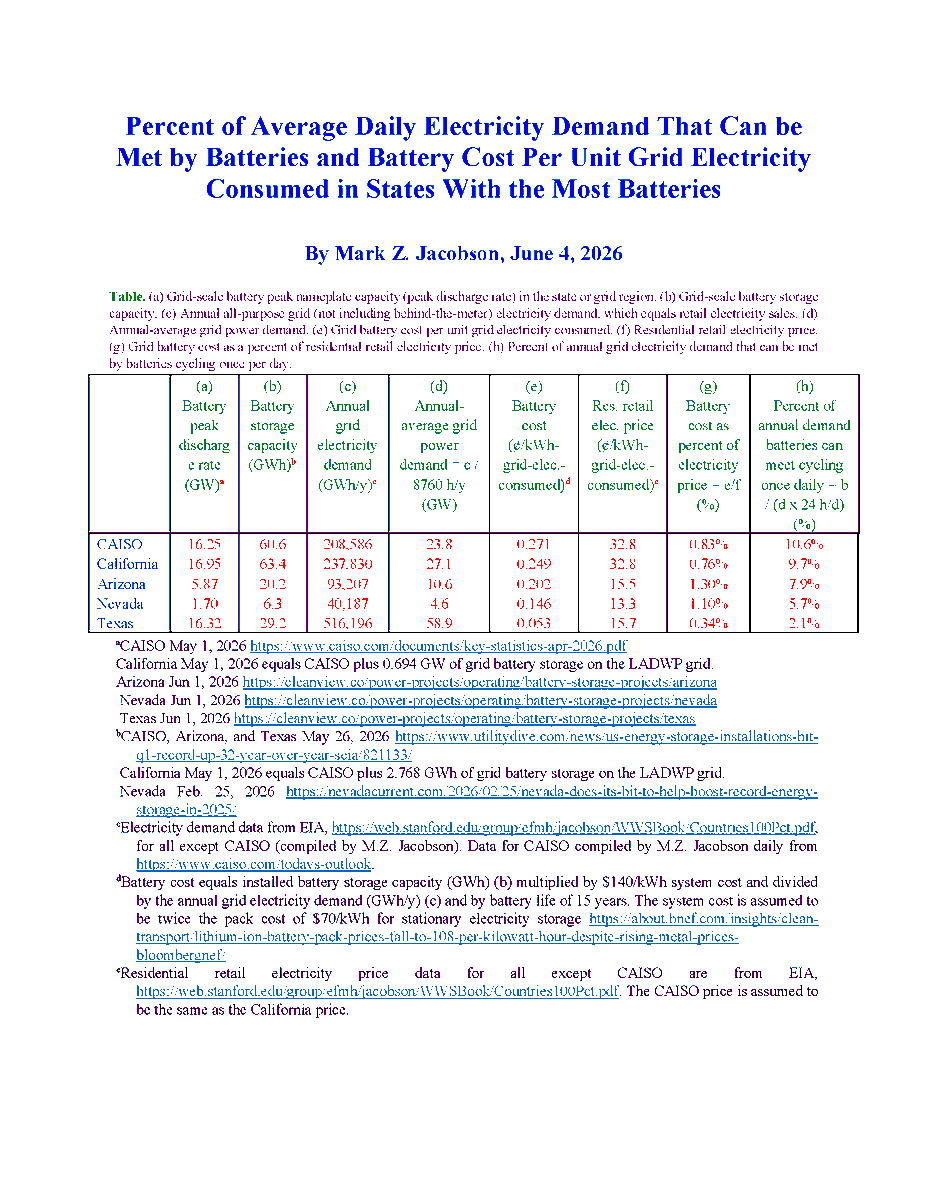
New eye-opening grid-scale battery data for the states with the most batteries in the U.S.
Ranking of states/grids that can meet the highest % of average demand with batteries cycling daily:
CA (CAISO) 10.6% of demand
AZ 7.9%
NV 5.7%
TX 2.1%
Cost of all the installed batteries as a % of electricity price:
CAISO 0.83%
AZ 1.3%
NV 1.1%
TX 0.34%
Most stable grid (based on lowest wholesale electricity prices: CAISO
Although CA and TX have similar battery peak discharge rates, CA has over 2x the storage capacity as TX since TX batteries are mostly 2-h batteries whereas CA batteries are mostly 4-h batteries.
Data do not include BTM batteries.
https://t.co/vzKmG147w8
Some summer reading on climate and solutions
Still No Miracles Needed
A Climate of Truth
Rethinking Climate Policy
Tipping Out of Trouble
https://t.co/LFdi1K6ODc @CambridgeUP
@EnviWood Not so. Gas is down 61% in 2026 vs 2023 and now supplies less than 15% of CAISO annual-average demand.
Imports, which are 57% WWS, easily replace gas during times where in-state WWS is not available.






![AssaadRazzouk's tweet photo. China is on track for 100% renewables by 2051 and is expanding its clean energy infrastructure at 10 times the speed of either the US or India
Analysis based on @mzjacobson's "Projections of when each of 150 countries may eliminate air pollution and carbon emissions from all energy" (RSC Sustainability, 2026)
[Chart below: Real Clean Power Additions (Average Output in GW). The chart compares the true grid-adjusted, average annual power output added in 2025 alone, factoring in capacity drop-offs and transmission constraints]](https://pbs.twimg.com/media/HKFOqTIWkAAPyXV.jpg)