Today, building a live trading system has never been easier thanks to LLMs.
The dangerous part is that operating these systems reliably at scale still hides a surprisingly large number of operational pitfalls that only emerge in production environments with real capital.
Over the years, while developing and maintaining automated trading and portfolio rebalancing infrastructures around Interactive Brokers, our team in @ConcretumR observed a recurring pattern: most failures do not originate from the strategy logic itself, but from the operational complexity surrounding live execution.
Today we decided to walk you through 10 real-world operational issues that traders and allocators often only discover after going live, from stale market data and multi-account routing problems to DST mismatches and early-close session failures.
If you are building systematic strategies, automating portfolio rebalancing, or managing multiple accounts simultaneously, this piece may save you a lot of time... and potentially some expensive mistakes.
Full article in the first comment.
#QuantFinance #InteractiveBrokers #AlgoTrading #SystematicTrading #PortfolioManagement #Automation #WealthManagement
Can you replicate the returns of one of the legends of the trend-following industry?
Just published.
We use 25 years of futures data and 4,320 synthetic CTAs to reverse-engineer the trading rules behind Paul Mulvaney.
The rules look simple.
The outcome is not.
Link in the comments 👇
Can you replicate the returns of one of the legends of the trend-following industry?
This Saturday we will publish on our Substack page a fascinating piece where we leverage 25 years of futures data and Mulvaney Capital Management's monthly returns to reverse-engineer the trading rules behind one of the most successful (albeit volatile) CTAs of the last two decades.
Make sure to subscribe to our Substack to receive the article directly in your inbox.
Link in the comments. 👇
#TrendFollowing #CTA #ManagedFutures #Quant #SystematicTrading #Mulvaney #Futures #HedgeFunds
There are tools I wish I had earlier in my career, the kind that would have saved me hours of CSV wrangling and Excel reformatting.
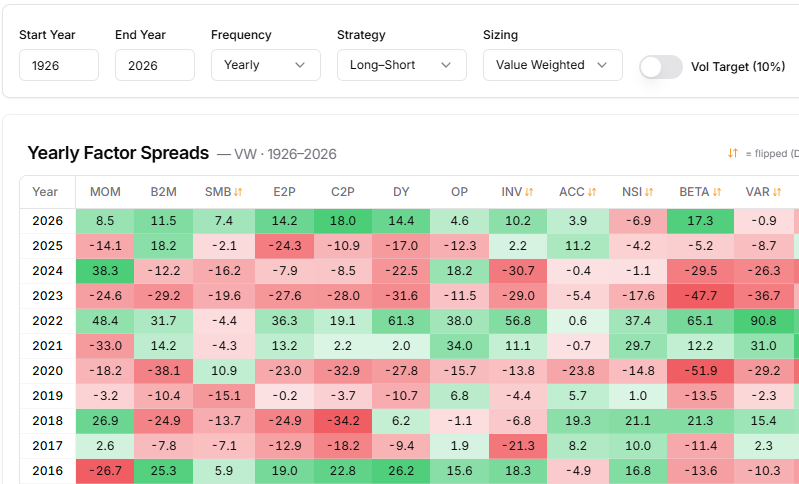
The Concretum Factor Tracker is one of them, and this week it just received a meaningful upgrade.
If you have ever worked with asset pricing data, you have likely used the Kennet French Data Library.
It is one of the most cited datasets in finance, covering decades of returns and a wide range of factor portfolios.
Its only real limitation? The interface.
Plain CSVs, static pages, and no easy way to monitor what factors are doing in real time. Most workflows still involve downloading, rebuilding, and repeating the same analysis over and over.
That is exactly the friction Factor Tracker was built to remove.
Last year, Concretum launched a free web tool to provide a more modern, visual reading of risk premia.
This week, a major upgrade went live.
The key addition is a new section designed to answer a simple question:
Which factors are actually working right now?
The analysis can be configured along three dimensions:
1️⃣ Time window (from 1 year to long-term history)
2️⃣ Implementation style (long-only, long/short, volatility parity)
3️⃣ Weighting scheme (market cap or equal weight)
The same factor can look very different depending on these choices, and being able to compare them quickly provides a clearer view of how they behave under different assumptions.
Free, no signup.
Link in the first comment 👇
#quant #finance #factorinvesting #riskpremia #assetmanagement #systematictrading #investing #portfolioanalytics
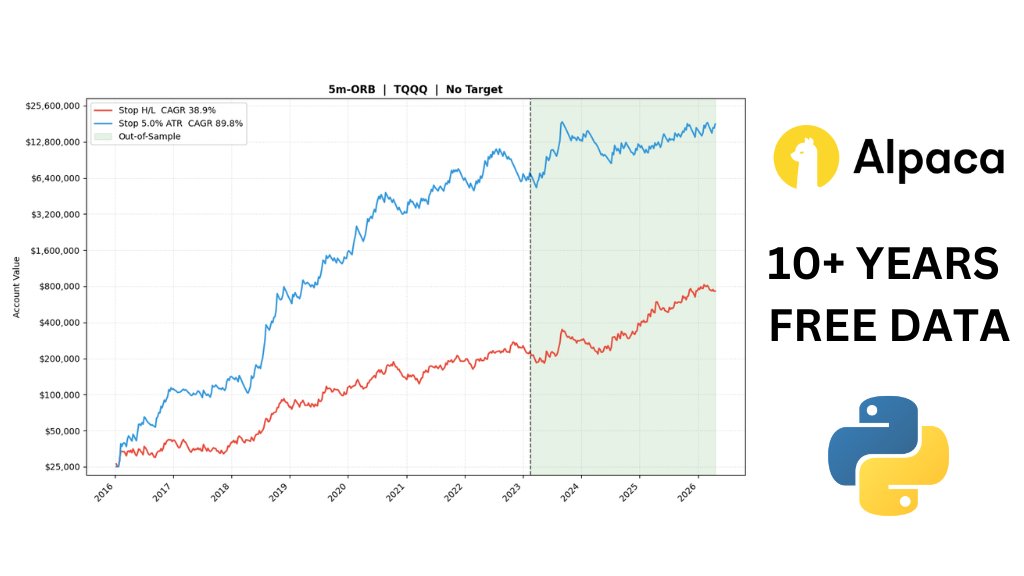
ORB Strategy Backtest in Python, now with 10+ years of intraday data
We’ve just published a new article with a full Python implementation of our ORB strategy from the paper "Can Day Trading Really Be Profitable?" with @BearBullTraders.
What’s new:
1⃣ ATR-based stop (not included in the original version)
2⃣ 10+ years of intraday data via Alpaca
3⃣ Fully reproducible, runs in the browser with Google Colab
Whether you’re an experienced trader or an aspiring quant, this is designed to be practical and easy to test.
Full article/code in the first comment 👇
Can you trust your intraday database?
We backtested the same intraday strategy, same code, same 10 years — across 4 data providers.
The result?
Portfolio values ranged from $226k to $726k. A 3x difference from identical logic.
We dug into the why...
1⃣ Phantom highs
2⃣ Stale bars
3⃣ Early-close leakage
4⃣ Tick-to-bar assignment issues
If you don't want to spend days analyzing backtest results only to find out they were driven by bad data....
This article is for you.
Link in the first comment 👇
@BearBullTraders
@MerlandoG No worries :)
I meant the original tweet is using a ready to use dataset from kaggle,
Like this one: https://t.co/w6HJbkLqTP
If you want to try it online with no need to download anything you can try: https://t.co/eMGgNDleaY
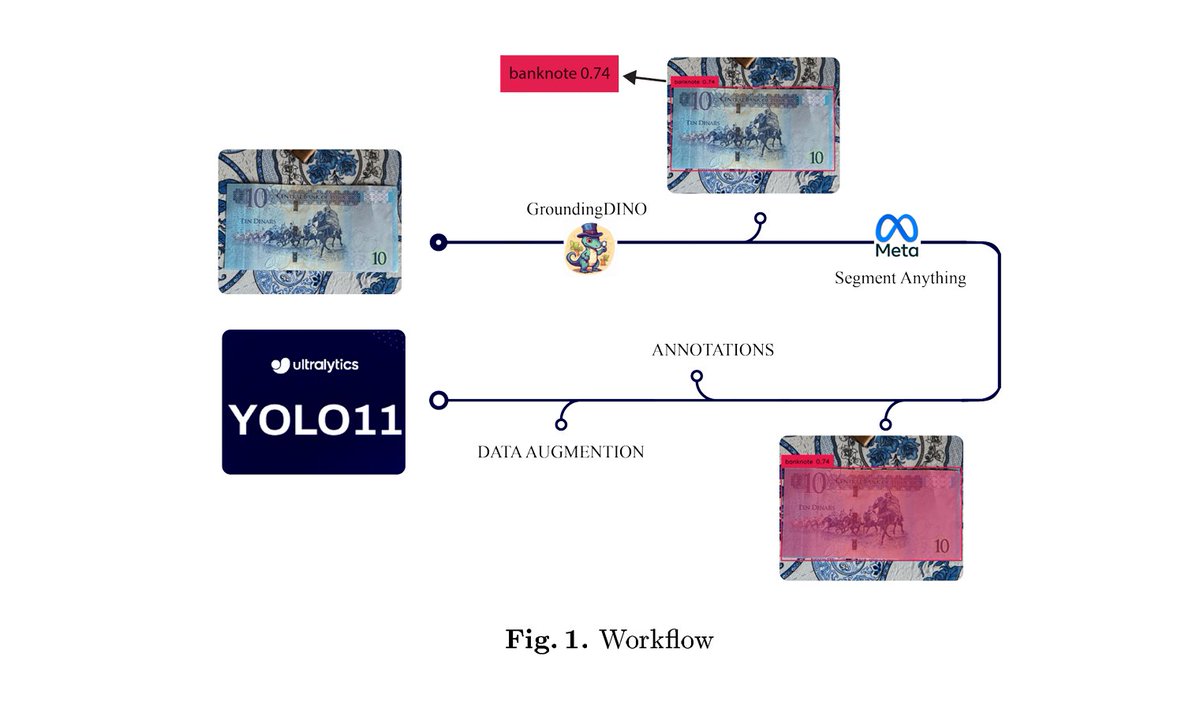
YOLO is truly amazing! We used it to create a model that helps the blind community in Libya identify different denominations of the national currency.
we even got it running on both iOS and Android, totally offline, no internet needed!
Video from Jan 27, 2025
This is the power of YOLO, trained on a laptop for ~1 hour, with a Kaggle dataset.
Oh, and just ~100 lines of Python. I can make a startup on this and it took me literally a couple of hours.
@MerlandoG If you decide to go on and learn about the infrastructure of this, i have a presentation that tries to show what happens under the hood, let me know if you want it :)
good luck!!
@MerlandoG for the machine learning part, it might seem complex but its actually simple and make sense if you follow it block by block
you can see the code of the blocks here: https://t.co/atMPl30xUv