Recreated part of SF2 using just one character and Lynx (using REA: https://t.co/z08mIYL8bG).
Animations, sounds, design, maps and game logic are almost identical to the original. Not the full game yet.
#AI
Claude Code can now run a Lighthouse audit on your website, fix what's slow, then prove it with a new score.
Add Google's official Chrome DevTools MCP:
claude mcp add chrome-devtools --scope user npx chrome-devtools-mcp@latest
Then open Claude Code in your site's folder and paste:
"Open [URL] in Chrome. Run a Lighthouse audit and a performance trace.
List the 5 biggest problems by impact, with the evidence for each.
Fix them in this codebase one at a time.
Run the audit again and show me the scores before and after."
It also reads network requests and console errors, and takes screenshots and memory snapshots.
Google collects usage statistics by default. Add --no-usage-statistics to opt out.
https://t.co/YQ3bQZlj6D
REA
https://t.co/z08mIYL8bG
It gives AI agents a reverse-engineering toolkit (decompilers, APK unpackers, etc.)
Instead of guessing how an app works, your agent can open up the app, decompile the logic, see how they built a feature, and help you recreate it.
#AIAgents#llms
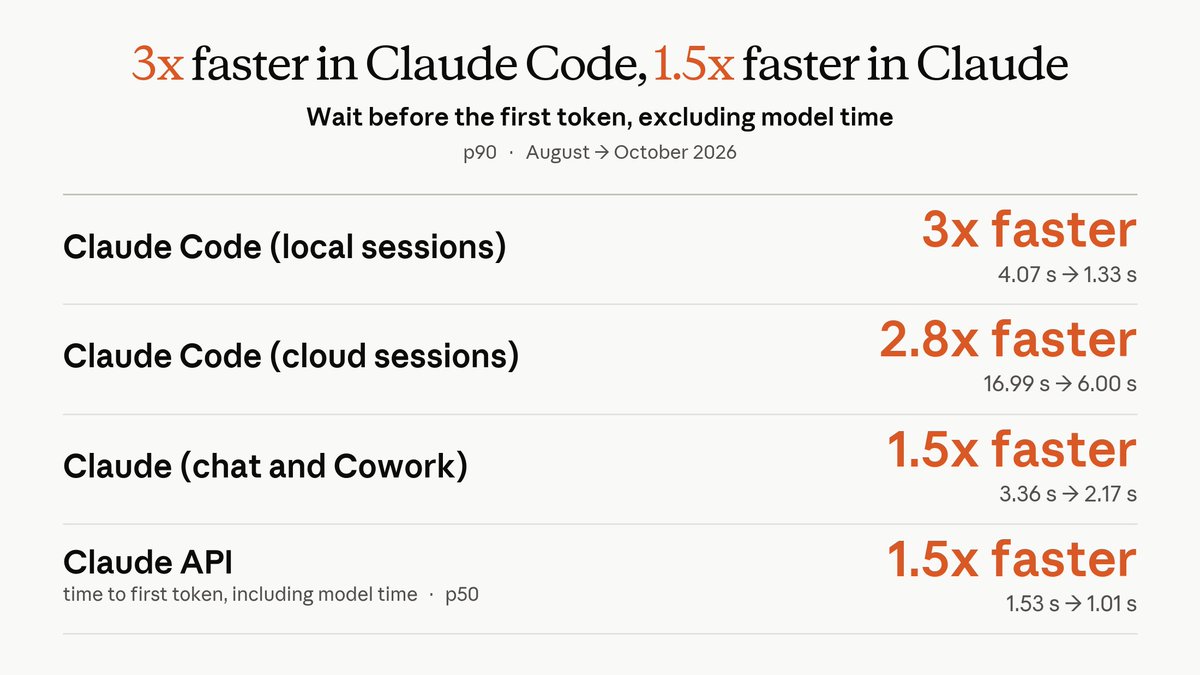
We keep improving performance across Claude, and you may have noticed it starts responding sooner!
Claude Code now gzips the conversation it sends on every turn, so it reaches the model faster. Cloud sessions also start up as soon as you start typing.
New on our Engineering blog: Creating in-house source control.
In May, we merged around 2,500 code changes per day. In September, we merged more than 30,000 per day. As a result, we became bottlenecked by developer infrastructure built for human (rather than agent) scale.
Here, we share how we built a new version control system—and fully migrated our monorepo from git—in five months: https://t.co/wzNkwHs7IN
Gemini 4 Argon is here.
It’s available globally today for developers and enterprises in the paid tier of the Gemini API and the Gemini platform, for Ultra subscribers in Google Antigravity, and Ultra and Pro subscribers in the Gemini app and Search.
Hope you all enjoy it!
introducing muse wonder
our new frontier model. state-of-the-art at personal agents and professional agents.
our largest and most capable model yet—rivals the big bois
🍉 MUSE WONDER 🍉
our research process starts with evals. we developed the Personal Superintelligence Index (PSI) internally to help us measure the important dimensions of what actually makes a model useful for personal agents, vs just focusing on external benchmarks.
the end result is that our model is incredible for personal agents in many subtle and important ways, including Active Memory and Active Focus.
i'm especially proud of our research team for taking a particular focus on developing useful models. the whole point of building advanced frontier models is to make them useful to real people, and we have thought about that every step of the way in our research process.
muse wonder is quite advanced across the board, and certainly has big model smell (which we quantified!), but is truly state of the art for personal agents.
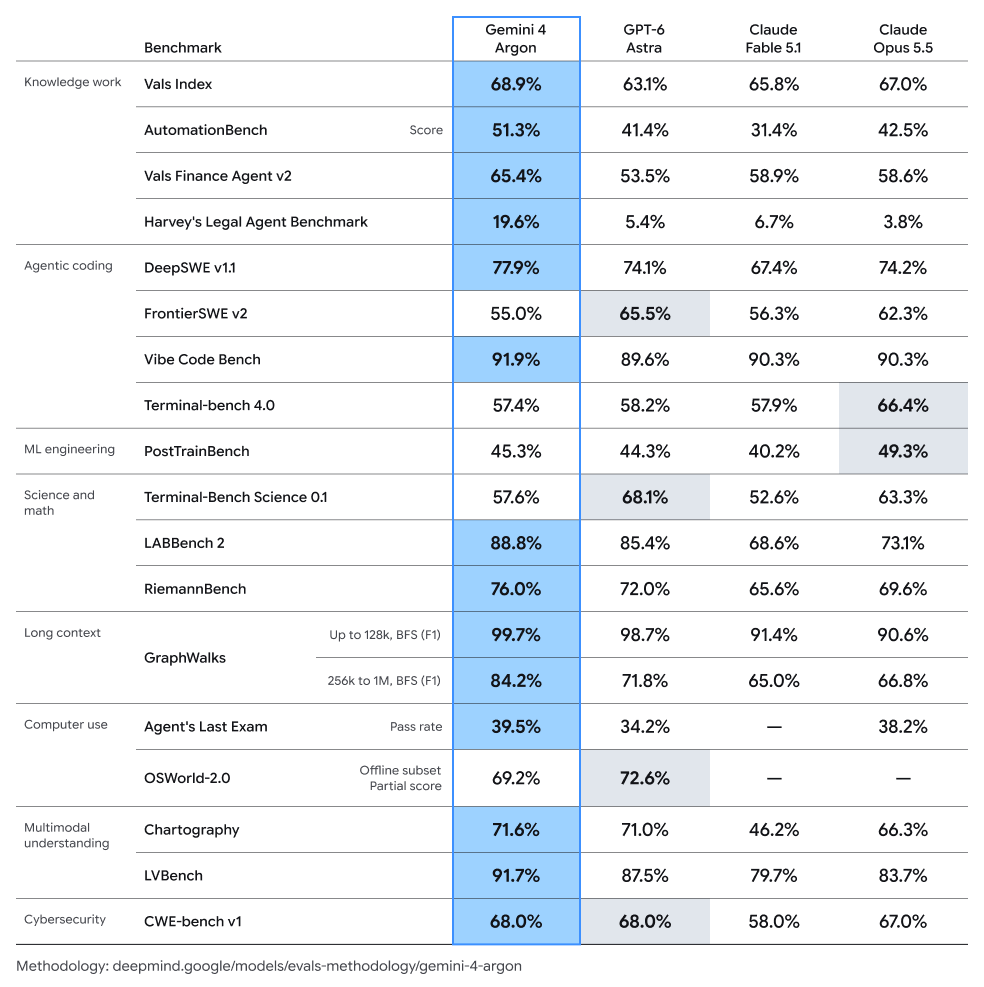
Today we’re introducing Gemini 4 Argon.
It delivers frontier performance in complex workflows across real-world software engineering, knowledge work, and cybersecurity defense with an industry-leading 1M token output limit.
Very excited to announce Gemini 4 Argon, our new Frontier AI model, and a huge step forward across key capabilities. We’re focused on rolling it out responsibly starting with government and trusted cyber defenders through our Fairwind Program today, before wider availability soon
How it works: Your main chat thread acts as the Orchestrator, and the sub-agents execute the tasks in parallel.
The best part is each sub-agent gets its own clean, full context window. The downside? You will burn through tokens much faster. 💸
One hack for AI coding tools:
The generic mode is a single context window (kinda like a single-threaded chat loop). If you want parallelism, explicitly prompt your harness to spawn multiple agents to tackle different parts of the codebase at the same time.
The Model (Claude, GPT-4) Harness (Cursor, Copilot, Codex)
The harness is just the wrapper that grabs your local context and runs the execution loop so the model can actually do things on your machine.
Codex, Claude Code, Cursor—they don’t just save us from copy-pasting to ChatGPT. They run an actual execution loop under the hood.
Here's how it works: