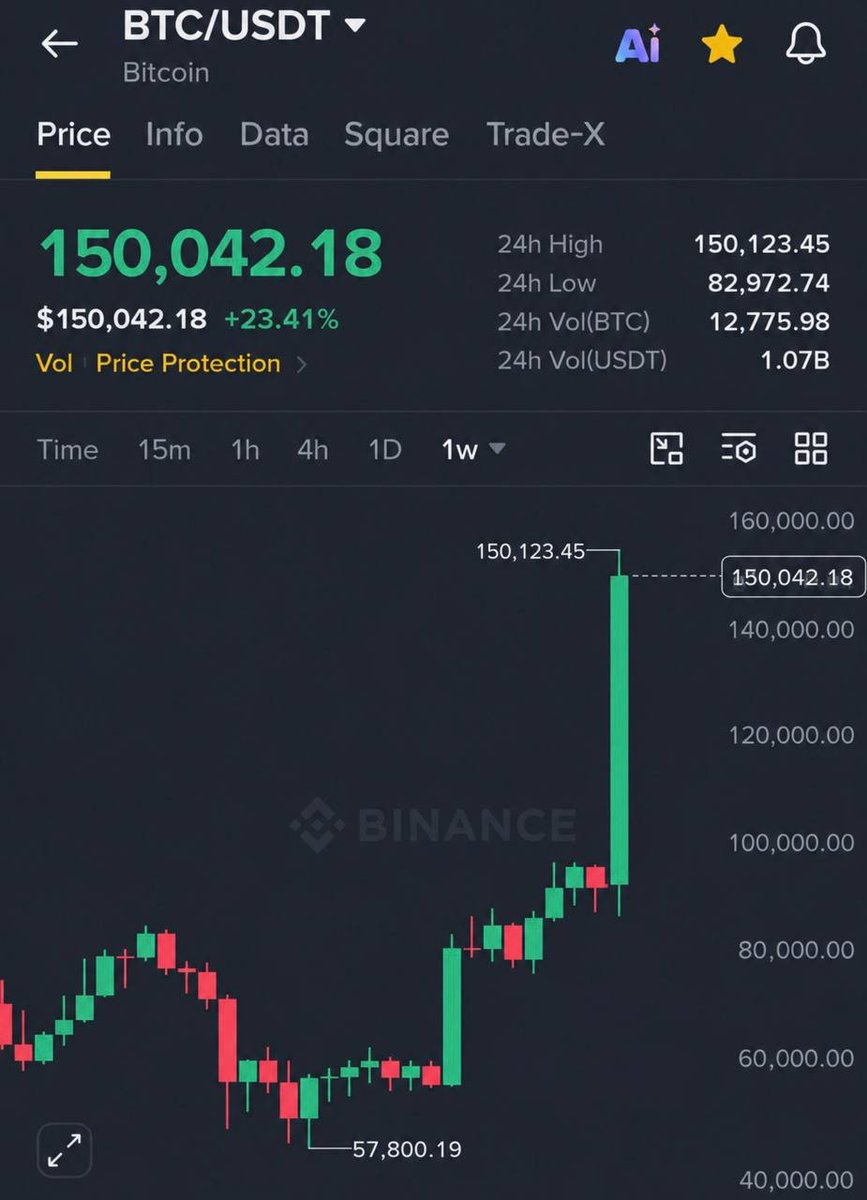
WHAT I’M EXPECTING FROM bitcoin:native RIGHT NOW
Here’s my current outlook on #BTC
THE PLAN:
1. Rally toward $83K–$88K — DONE
2. Consolidation around $83K–$85K — DONE
3. Altcoin rally — DONE
3. Final 5th sub-wave before the ABC correction — DONE?
4. ABC correction — IN PROGRESS
5. BTC buying zone: $72K–$80K
6. BTC above $100K in 2027
WHAT'S NEXT?
We are currently in an ABC correction, and I see two possible scenarios:
Scenario 1: bitcoin:native trades sideways in the $80K–$83K+ range before rallying toward $90K+.
Scenario 2: bitcoin:native bounces back above $83K, then trades sideways in the $80K–$83K+ range before another leg down into the $72K–$80K zone. I consider a drop all the way to $72K unlikely, but possible.
As I warned earlier, everyone was buying the dip, even those who didn't believe in further upside. The market needed to cool off, and yesterday we finally got that correction.
HAVE WE BOTTOMED?
I'm not sure, but I've already started accumulating spot altcoins, including $SOL
A deeper correction toward $72K would actually make me even more bullish long term.
10.10
Everyone seems afraid of this date. Imagine if crypto rallied instead, or a new memecoin reached a $1B market cap.
We're still following the 2023 fractal, but eventually it will break. The question is when.
My altcoin longs remain 2/3 open.
REMINDER: I warned about the BTC bull trap at $82K, the bounce from $62K, and a correction toward $74K when bitcoin:native was trading at $80K - before any of it happened.
HOLY SHIT, ONE TRADER TURNED FOMO INTO A MEMECOIN MONEY PRINTER 🤯
I’m not even kidding. The numbers are wild.He reportedly started with $100 and turned it into $3.2M in just 10 days.
He’s not an insider.
Not connected to some crypto whale.
He’s simply a trader using FOMO, bots and wallet activity to hunt meme coin setups.
Check → https://t.co/W7j0JGlJwl
I dug into his approach and honestly didn’t expect it to be this simple.
No huge trading operation.
No crazy infrastructure.
Nothing that sounds like “rocket science.”
Just smart-wallet tracking, rapid execution and automation.
His FULL strategy:
“Early entry” through smart wallets
The bot scans fresh meme coin launches and monitors wallets that repeatedly get into tokens before the wider market notices.
When multiple profitable wallets begin buying the same token, the system can flag the activity before momentum becomes obvious.
Fast meme coin flips
Instead of sitting on random tokens for days, the strategy focuses on short-term momentum.
The bot monitors volume, liquidity, wallet movements and price action to spot coins where buying activity is starting to accelerate.
While you’re manually checking hundreds of tokens, the bot is already narrowing the list down.
The real edge — automation
Meme coin markets move ridiculously fast.
By the time a human sees a token starting to trend, larger wallets can already be positioned.
Bots can scan huge numbers of transactions, track wallets and react within seconds.
Scale matters.
Hundreds of trades.
Thousands of wallets tracked.
Small edges repeated again and again.
That’s how individual meme coin setups can potentially compound into much larger results.
Bottom line:
There’s a serious bot battle happening across meme coins.
The advantage isn’t simply finding the next 100x.
It’s identifying the right wallets, catching momentum early and executing before everyone else notices.
FOMO simply makes the whole process faster.
Comment “TRADING” and I’ll send you the strategy.
I used Claude Fable 5.1 and GPT-6 Astra to build a self-learning trading algorithm
The result: +$1,840.82 in two days
It makes about 17 trades a day or 521 a month, with an average trade size of $53.2
Six AI agents track new coins on Solana and learn to make trading decisions as one system
I called it QuantumOrb
GitHub repo:https://t.co/r7jMRrjpd6
Here’s how it works:
SCOUT tracks new launches, bonding curve activity and PumpSwap swaps, then records the trading data
CARTOGRAPHER detects shared wallet funding sources, same-bundle activity and connections to the token creator
JUDGE analyzes traders from their transaction history and estimates their performance and edge after fees, entry delay and copybot activity
QUANT calculates execution on the curve or inside the pool, accounting for fees, market impact, priority fees and Jito tips
GUARD checks holder concentration, connected wallet groups and launch risks
EXECUTOR models opening and closing positions through take-profit, stop-loss or time expiry
At the center of the system is the Orb
Every launch is classified into three probability states:
+60% is reached first
−30% is reached first
Neither threshold is reached within 60 minutes
Most profitable trades:
$45 → $158 (+$113)
$37 → $146 (+$109)
$31 → $125 (+$94)
Organic buyer flow shifts probability toward one scenario
Connected-wallet activity, sells and holder concentration adjust the estimate in the opposite direction
With every new signal, the state updates. After that, QUANT determines whether the setup still makes sense after all execution costs, while GUARD decides whether the risk is acceptable
Every launch that passes GUARD is used for learning, including the ones the system decides to skip
One hour later, the actual outcome is recorded and fed back into the model
That feedback becomes part of the next decision.
I still don't understand why everyone isn't doing this yet. Elon Musk reposted this guide, and using this exact agent setup, I made $9,300 just last week
Eight Grok agents on the desk, costing $200 a month, service a trading floor that typically costs a crypto fund $500,000 a year in analyst salaries
A 5 AM morning call. I don't participate in it
How the agents are distributed:
SEARCH: gathers real-time alpha, developer repositories on GitHub, and unindexed Telegram signals before CT finds them
RISK: checks contract functions, minting rights, and LP locks, flagging honeypots before entry
SNIPER: places high-speed orders on-chain at the exact millisecond the risk clearance passes
WHALE: tracks smart money wallets and flags insider accumulation in real time.
RUG: monitors developer wallet activity 24/7 and dumps the entire position if they touch the LP
EXIT: dynamically trails stops, scaling out as liquidity accumulates
SHILL: tracks social volume, impulse speed, and key influencer calls
HEAD OF DESK: never trades, routes data, checks transmissions, and brings me the single decision that requires a human
While I was sleeping, the system scanned 164 tokens, selected 21 qualifying setups, and executed 8 trades. The result: net profit of $9,300 (already after fees)
Each agent has its own virtual browser, terminal, and local cloud memory. The trading floor remains active even when my laptop is closed
Setup is easier than it seems:
1. Download Grok Bot and create your Head of Desk
2. Give the remaining 7 agents task descriptions as if you were instructing new employees
3. Run the workflow once on your screen while they observe
4. Connect Telegram and wallet webhooks
No VPS, no code, no waiting for developers
Crypto trading used to mean 16 hours in front of a screen, paid alpha groups, and constant fatigue. Mine took one evening to set up
Save this before your next trade. Save the guide
This guy built an HFT algorithm on Polymarket with an average trade size of $35.88
Result: +$470,883
His algorithm trades short-term crypto Up/Down markets. It combines directional trading and dynamic hedging, while forming complete sets with part of its inventory:
1. Finds undervalued outcomes using its own fair value estimates
It factors in the underlying asset’s price relative to the opening price, the time remaining, momentum, volatility, the speed of price movements, and spot/perp data
If its model values Up at 65c and the price on Polymarket is 55c, it starts building a position
2. Buys the opposite side when the market changes direction
If the underlying asset reverses direction, it starts buying the opposite outcome to reduce its net directional exposure
This hedges part of its existing position
3. Turns the hedge into a complete set
If each matched Up + Down pair costs less than $1, that portion of the position has a structural edge regardless of how the market resolves
It keeps the unpaired remainder as a directional residual on the side its model considers undervalued
Its Polymarket account: mo-money
You can build your own trading bot here:
https://t.co/JVofcJa07i
(A trial is available after signing up)
The bot’s main edge comes from a combination of fair-value entry and dynamic hedging: it first builds a position in an undervalued outcome, then uses the opposite side to reduce exposure or form a complete set
I used to hold ETH, but the returns were practically non-existent. To make matters worse, some banks are now flat-out refusing to sell to individuals, and they’ve even locked me out of my own account. I seriously hope the regulators or proper authorities look into this.