@owenjonesjourno The risk of a child being subjected to a trans woman doing a sexual act in a woman's toilet is also high. You don't care about that though because in your head all trans women look like Hunter Schaefer when in reality a lot look like Roxy Tickle with a visible boner.
@SaulGPowell Because they do not care about truth.
They will use whatever they can to attack in the moment.
No consistency, no integrity, no principles.
Attention whores who hate men.
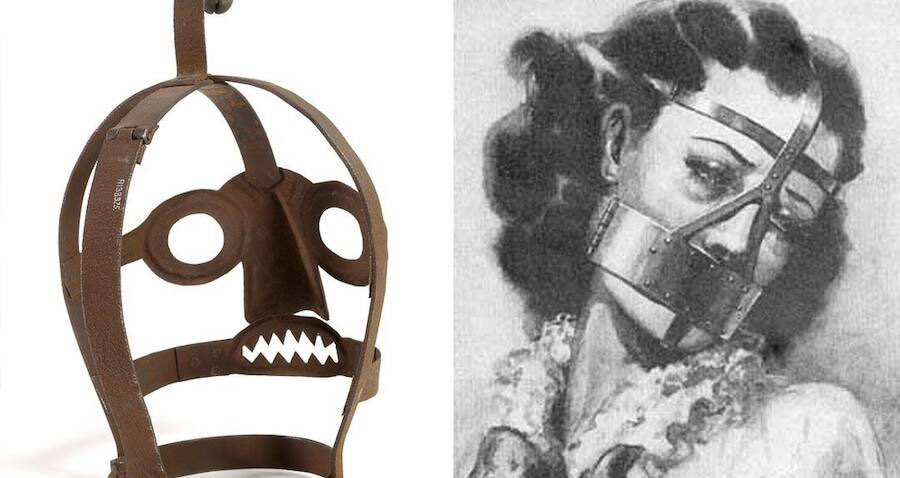
Between the 1500s and 1700s, women in Britain, Germany, and Scotland were punished with the Scold’s Bridle—a cruel iron mask that locked around their head, pressed down or pierced their tongue, and forced them into public humiliation. Women labeled as “too talkative” or “disrespectful” were chained, paraded through the streets, and ridiculed.
This wasn’t just about keeping someone quiet—it was a tool of patriarchal control, designed to punish women who dared to speak, stand up, or defy male authority. Some masks even had bells so everyone could hear their arrival, turning their suffering into a spectacle.
Today, surviving bridles in museums remind us how far societies went to silence women and why fighting misogyny and patriarchal control is still necessary.
@schiz04renic Focus on something you can do now. Something small like getting a glass of water. Go for a shower, or wash your face. Breathe. Repeat these small things until the tide goes out again.
"While many now understand that sexual violence is about power, few still connect that power to socially legitimized authority—the kind men perpetually hold more of than women, even when they aren’t socially or politically powerful. At its core, male authority stems from men’s cultural entitlement to be “knowers,” an entitlement inseparable from women who are simultaneously being categorized, and muted, as “pleasers..”
Why “cultivated ignorance”? A few years ago, at a party, I found myself talking to two men. We started discussing books, and they mentioned their long-running book club. When they learned I was a writer, they asked if I liked my work. I said yes, but added that being a woman writing nonfiction is frustrating because while everyone reads men’s work, men rarely read women’s. One man turned to the other and asked, “Have we ever read a book by a woman author in our book club?” The other thought for a moment before answering, “Hmm, no. I don’t think we have.” They were lovely people and considered themselves real progressives. “Honestly, I’ve never thought about it,” the man concluded. Their book club was more than ten years old.
This lack of interest, which he himself named, isn’t only a matter of personal preference; it is institutionalized in how our society identifies, produces, recognizes, and validates knowledge and, with it, authority. We see these imbalances in broader media, too.
Reading gaps: Men’s lack of interest in women authors and women subjects, fiction or nonfiction, has been documented for decades, and it maps onto larger patterns of how men perceive and treat women as thinkers, experts, and authorities. In 2015, author Nicola Griffith analyzed major literary prize winners (Pulitzer, Booker, National Book Award, etc.) and found that women write from diverse perspectives, while men write almost exclusively about men. Prize-winning books were overwhelmingly about men/boys, including those by women, and, because literary systems reward male-centered narratives, writers (including women) are incentivized to write about men.
Today, men buy and read fewer than 20 percent of bestselling women’s fiction and nonfiction; women read men’s and women’s books equally. Men also give women’s books lower ratings, avoid women protagonists, and, when they do read women, tend to prefer “the classics,” meaning books written by dead women from other eras. Women who can’t challenge their thinking in ongoing ways. The only bestselling woman author read consistently by men, according to a 2024 study, is Harper Lee, whose major work was published in 1960, when segregation stood, women couldn’t have bank accounts, and marital rape was legal. In the decade-plus since Griffith’s study, women have sometimes approached parity in almost all major literary awards. Stories about women, however, have not. During times when women have succeeded in higher numbers, they do so on male supremacist terms: they tend to be white, cisgender, non-disabled women. This tends to disguise the persistent exclusion of Indigenous, Black, Hispanic, Asian, and LGBTQ women. Nonetheless, during this same period, the issue of white men’s loss of visibility and opportunity in publishing has persisted, with critics framing it as a zero-sum loss for men rather than a reflection of the way the industry has (remarkably) expanded.
Listening gaps: A recent study using Spotify data, for instance, found that men host two-thirds of the top 100 podcasts (with their video corollaries), and roughly 75 percent of guests are men as well. Women are all but absent from sports, tech, comedy, fitness, and business podcasts. I know and love many women-focused podcasts, but it’s easy to lose sight of how male-dominated the sector is, and it’s not only male-dominated, but dominated by white men, who make up 77 percent of top hosts. These statistics mirror those in filmmaking, TV, and children’s programming. Today, women account for only about a third of new Intellectual Property (IP) and patents in the United States.
Imbalances like these don’t just shape our influence and incomes as writers; they shape authority by constraining men’s empathy and public imagination.
Why do awards and listening habits matter in particular? They have long tails and are a prime example of how men’s erasures of women’s thinking become institutionalized. The right likes to talk about how progressives have taken over college cultures, but this assertion is framed within male, and mainly white, supremacist parameters.
Syllabi: Award-winning books turn into other media, such as documentaries, movies, and podcasts. They are also more likely to end up in academia. Here, too, knowledge—and with it, authority—imbalances endure. In colleges and universities, men, the majority white, remain the majority of tenured professors, making decisions about texts and book buying, disproportionately assigning books by men and disproportionately citing other men and themselves more than they do women experts. White men remain the only demographic cohort whose representation continues to grow with each jump in tenure-track promotions. Studies across disciplines show that male professors assign far fewer works by women authors and experts than women do. In political science graduate studies, for instance, women make up only 19% of lead authors of recommended and required reading. When male professors assign male texts so disproportionately, many while defensively complaining that DEI has ruined the canon, they aren’t just teaching a subject; they are teaching students that “knowing” is a masculine verb, “knower” is a masculine noun.
Citations and collaborations: A large-scale study involving ~270,000 scientists found that men are more likely to collaborate with other men, while women collaborate more evenly across gender. Men also cite other men and self-cite far more than women (up to 70% more in some fields). Men even omit the work of even the most prominent women in their field; they seem to forget their contributions entirely.
To make matters worse (because I am nothing if not all sunshine and light at all times), forgetting or ignoring women’s intellectual and creative work and contributions has, historically, made stealing women’s work easy, a problem that, in the sciences, there is a name for it: the Mathilda Effect.
If men aren’t reading women, they aren’t citing them; if they aren’t citing them, they aren’t listening to them or sharing their thinking; and the result is that women’s authority is effectively erased from daily relevance and from the historical and scientific record. It means women are erased."
https://t.co/cmW3DqSrCx
And this is why the radfems be calling yall brainwashed. For “power play” to exist as a sexual concept you have to be from a society where there is power imbalance. Power disparity is not inherent. It’s a product of patrilineal & patriarchy society.
the thing about the endless radfem discourse on here is that the average radfem is genuinely operating from an extremely neurotic place, and they will never respond to reality testing. you can't "debunk" the statement "anal is abusive" because it isn't a logical or testable claim
This was me when I realised that there was no need for me to be rational about my feminism. Patriarchy itself is so absurd & illogical that my resistance to it doesn’t need to be neat or persuasive to the very people it benefits.