An insightful read! Manipulating stomatal aperture by silencing StSLAC1 affects potato plant–herbivore–parasitoid tritrophic interactions under drought stress - He - New Phytologist - Wiley Online Library https://t.co/yQxq29RFAH
Congratulations 🎉@AsimMunawar62 and team.
@moniquejrivera@Chemistophe He had already seen the paper..lol...
Christoph, are you particularly interested in bioluminescence as well? We can talk about this for sure!
Glowing belowground...Have you ever wondered about the ecological relevance of Photorhabdus bioluminescence?
Here you will find some answers: https://t.co/dlyUo1RYpr
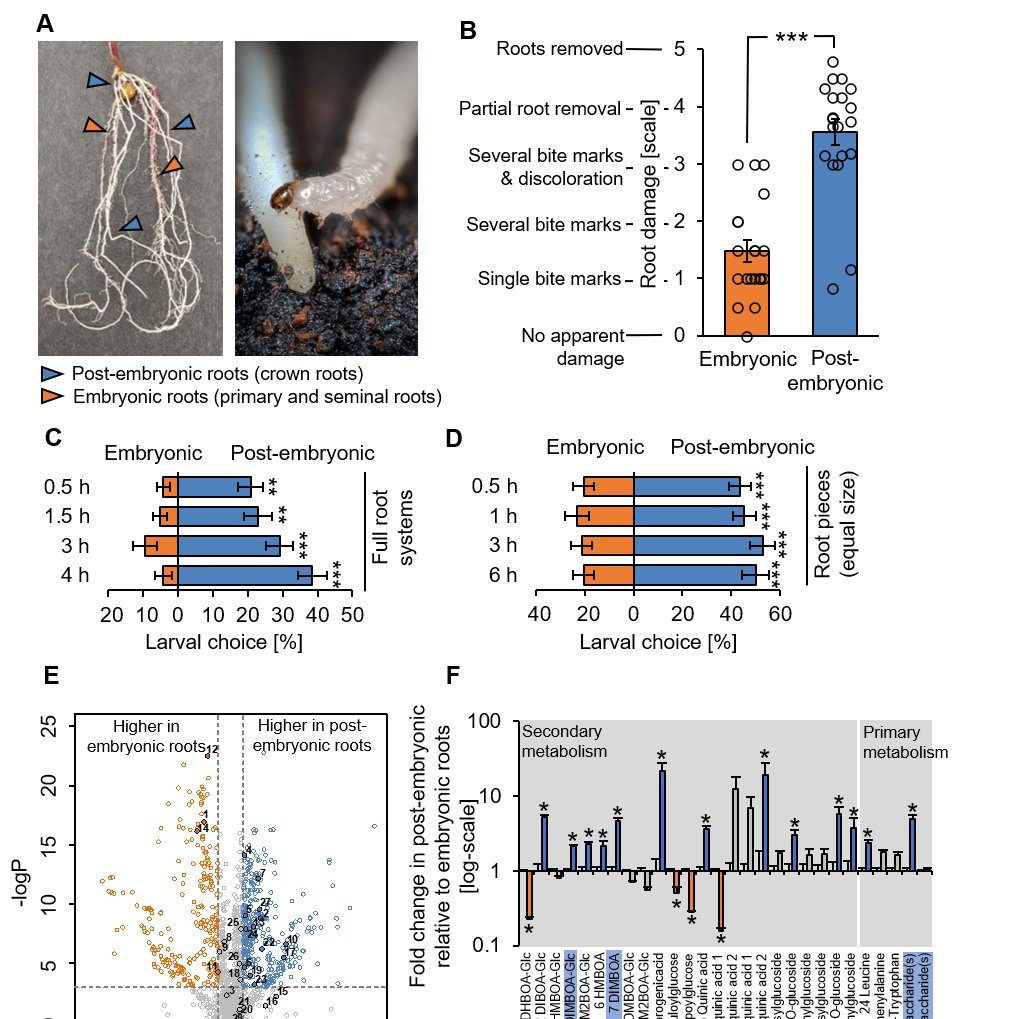
How an agricultural pest navigates the complexities of the maize rhizosphere to find the most nutritious roots: the western corn rootworm integrates nutrients (sugars) & plant defense compounds (benzoxazinoids) @Machado_RAR @ChemBiolEcol &co #PLOSBiology https://t.co/E6QvEHbdlq
How an agricultural pest navigates the complexities of the maize rhizosphere to find the most nutritious roots: the western corn rootworm integrates nutrients (sugars) & plant defense compounds (benzoxazinoids) @Machado_RAR @ChemBiolEcol &co #PLOSBiology https://t.co/E6QvEHbdlq
Herbivore‐induced volatiles from infested neighbours does not alter plant response to root herbivory in maize by Cong van Doan et al. @unibern https://t.co/tYq4RMCdG6
It is indeed great to know that @tobiaszuest great science on plant herbivore interactions is now supported by the ERC through an Stg grant. Looking forward to know about his new discoveries.
I am very pleased and thankful to have been awarded an ERC Starting Grant to continue my research into the evolution of novel chemical plant defenses and its consequences for plant herbivore interactions! @ERC_Research#ERCStG
Fantastic news for the Institute of Plant Sciences and @OneHealthUniBe at @UniofBern @unibern. Chemical ecology is off to new shores. Congratulations, Christelle!
Happy to know that @CAM_Robert_Bern will continue doing her great science and bringing tritrophic interactions research to a new level supported by an ERC grant. Looking forward to know about her new discoveries!
We have an open PhD position on the genomics of plant toxin resistance. Come work with us and discover the mechanisms underlying the success of biological control agents. P.S. We welcome and cherish diversity in all its forms.
https://t.co/LdPUMFQnLQ
Thanks to very constructive input from the @eLife board of editors and the unwavering commitment of @Machado_RAR, our study on the use of CO2 as a host quality assessment cue by a root herbivore got a major experimental upgrade.
https://t.co/P9LKrwj4DJ
The second paper from my Ph.D. is now on the preprint. We investigated the direct combined impacts of changes in CO2, temperature, and precipitation on four major groups of natural enemies of insect herbivores:
https://t.co/d7obtUxrly
New preprint from the lab (work led by @Machado_RAR). Herbivores integrate primary and secondary metabolites to navigate complex host metabolomes. Combining plant genetics and insect RNAi allows for detailed insights into this phenomenon.
https://t.co/Fzex39t2Eu
Root herbivores integrate different volatile cues to make relevant foraging decisions. CO2 acts in a distance specific manner, as we found out observing WCR larval behaviour.
https://t.co/kAIwJTDfD4
Now published in @eLife, our tale of remarkable chemical diversification in a hyperdiverse genus of plants: Independent evolution of ancestral and novel defenses in a genus of toxic plants (Erysimum, Brassicaceae) https://t.co/zEn99mDELV