@DeItaone Conditioning the start of Islamabad talks on preconditions being accepted signals Iran is negotiating the structure of the talks themselves before entering the negotiation phase.
@elonmusk Regulatory approval of supervised FSD in the Netherlands may become an early indicator of how Europe gradually opens the door to higher-level autonomy deployment.
Iran can signal leverage around the Strait, but keeping Hormuz closed long term would also damage its own export channels and regional positioning.
That’s why references to “rights” usually point more toward sanctions relief and security guarantees than permanent control over maritime access.
@DeItaone Ghalibaf saying Iran is ready for a deal if its “rights” are recognized suggests Tehran is signaling conditional openness rather than a shift in position ahead of the Islamabad talks.
Views from Orion on its return to Earth highlight how Artemis II is more than a historic mission — it marks the beginning of sustained human deep-space capability again as the lunar timeline becomes increasingly strategic.
Israel agreeing to continue talks with Lebanon while refusing a ceasefire discussion with Hezbollah highlights a clear distinction between the state track and the militia track in current negotiations.
הודעת שגרירות ישראל בוושינגטון:
שגריר ישראל בארה"ב ד"ר יחיאל לייטר: "בשיחת השגרירים בוושינגטון היום, ישראל הסכימה לפגישת המשך ביום שלישי כדי לקדם הסכם שלום עם לבנון, אך לא הסכימה לדון בהפסקת אש עם ארגון הטרור חיזבאללה שממשיך לתקוף את ישראל ושמהווה את המכשול העיקרי לשלום"
@Osint613 If reopening the Strait of Hormuz is already framed as the expected outcome of the Islamabad talks, it suggests maritime access is likely one of the primary negotiation pillars.
@DeItaone Asking Israel to pause operations against Hezbollah suggests the Lebanon front is being treated as a potential escalation trigger while diplomacy continues elsewhere.
CNN reports the parties will first agree on the agenda via Pakistan before holding an in-person meeting.
Setting the agenda through a mediator usually signals talks moving toward a structured negotiation phase.
Iran’s Parliament Speaker Ghalibaf in Islamabad says Tehran is ready for a deal if its “rights are recognized,” while stressing deep distrust after past negotiations.
This suggests the diplomatic channel remains open — but conditional.
Europe has been the hardest environment for advanced autonomy approvals. A rollout in the Netherlands could signal the beginning of a broader regulatory opening.
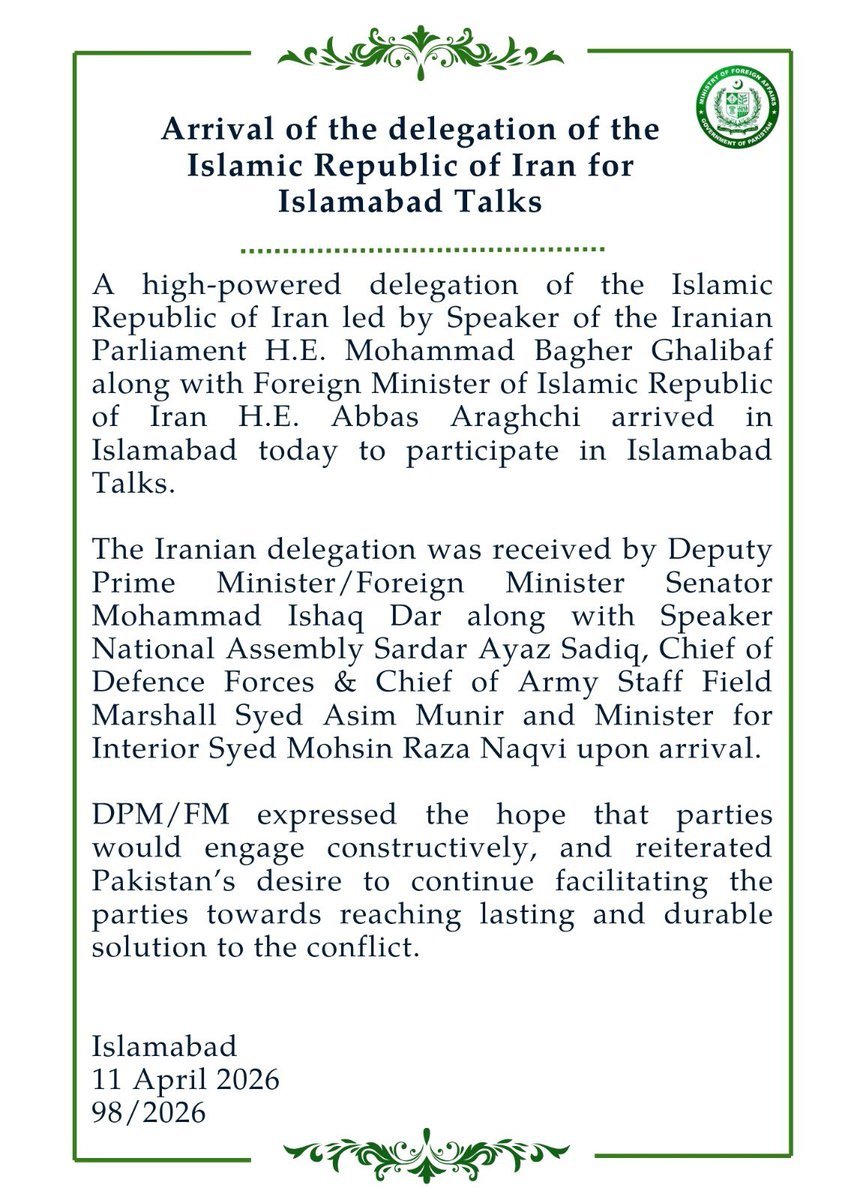
The presence of both Iran’s Parliament Speaker and Foreign Minister suggests the Islamabad channel is operating at a political decision level, not just a technical negotiation track.
Iranian Parliament Speaker Mohammad-Bagher Ghalibaf and Foreign Minister Abbas Araghchi have arrived in Islamabad for negotiations with the United States.
@Kalshi Moves in California governor odds tend to matter beyond state politics given the state’s influence on tech regulation, climate policy and capital flows.
@clashreport When access to Hormuz is framed as a coalition effort, it usually signals a move toward stabilizing maritime flows rather than short-term tactical reassurance.
@clashreport Saying “no nuclear weapon is 99% of the deal” narrows the objective significantly. That framing points toward capability limits rather than regime-level outcomes.