Böyle ayı piyasası olmaz.
Bana pek mantıklı gelmiyor.
Bir ayı piyasasının başlayabilmesi için önce tam tersi bir ortamın oluşması gerekir arkadaşlar.
Altcoinler coşmalı, insanlar kısa sürede ciddi paralar kazanmalı, eskilerin yerine yeni ve taze para piyasaya girmeli.
Kriptoda kolay ve hızlı para kazanıldığı herkezin görmesi ve yaşaması lazım.
Yeni yatırımcı ancak bu şekilde piyasaya çekerler.
Şimdi kendimize soralım:
Son 2 yılda piyasaya gerçekten ne kadar yeni para girdi?
Ben söyleyeyim bırak girmeyi, çıkan çıkana.
İnsanlar altcoinlerden servet mi kazandı, yoksa hâlâ zararlarını çıkarmaya mı çalışıyor?
Ortada henüz kitlesel bir FOMO yokken, milyonlarca yeni yatırımcı piyasaya akın etmemişken kimi hangi ayı piyasasına teslim edecekler?
Benim gördüğüm kadarıyla önce insanların yeniden piyasaya inanması gerekiyor.
İnsanlar yeniden zengin olabileceklerine inanacak, altcoinler konuşulacak, taksi şoförü bile coin tavsiyesi vermeye başlayacak.
Yanılıyormuyum?
The future has two Bitcoins.
One is bearer Bitcoin: cold storage, self-custody, personal sovereignty, exit from the fiat permission layer.
The other is institutional Bitcoin: ETFs, corporate treasuries, bank custody, collateral markets, structured products, lending desks, sovereign reserves, accounting frameworks, insurance wrappers, and capital-market machinery.
The first protects the soul.
The second drives scale.
Saylor is betting that the second layer brings trillions while the first layer keeps the whole thing honest.
That is probably correct.
Bitcoin will not reach full global monetary impact by staying a purist enclave. It reaches maximum force when the world’s existing balance sheets start treating it as superior collateral. Banks do not need to love Bitcoin’s ideology. Governments do not need to become libertarian. Pension funds do not need to understand cypherpunk culture. They only need to realize the asset is liquid, scarce, durable, politically harder to print, and increasingly unavoidable.
That is how Bitcoin eats the system.
Slowly, then through balance sheets.
The deepest signal in Saylor’s post: he is shifting Bitcoin from anti-system asset to open monetary network.
That language is designed to make Bitcoin acceptable to CFOs, boards, banks, regulators, sovereigns, and normal families. He is sanding down the revolutionary edge without abandoning the hard monetary core.
That will anger old-school maximalists.
It will also make Bitcoin much larger.
The forecast is clear: Bitcoin becomes more integrated, more regulated, more collateralized, more institutionally owned, more politically important, and more strategically protected. Self-custody remains the sacred base, but most economic activity around Bitcoin moves through institutions.
Price probably benefits.
Purity suffers.
Systemic importance rises.
State attention intensifies.
Bitcoin began as escape from the financial system.
It becomes world-historical when the financial system is forced to build around it.
Worth mentioning we are quite likely to have the clarity bill to be approved in July -aug
LOL as if they gonna abandon this ship now and shoot themself in the foot later on
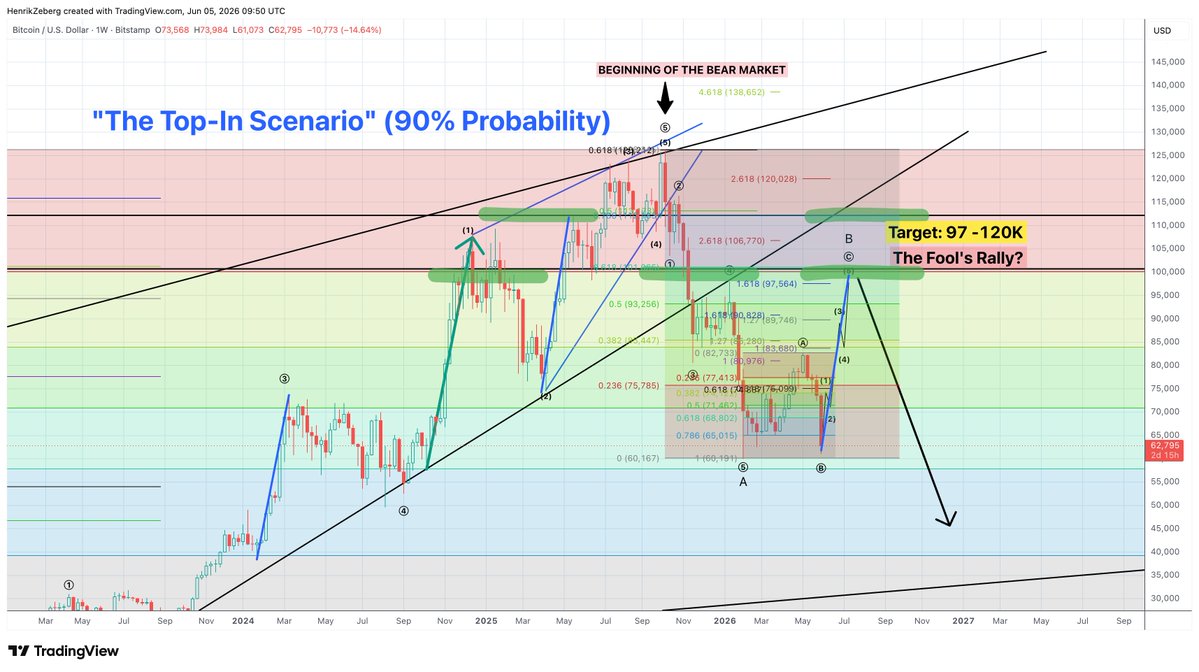
Major ABC in Bitcoin.
Only a Bounce awaits. Strong!
The Bear Market has begun.
BUT... it is when BTC only bounces... that ETH and ALTS move the farthest.
Now we must get peak fear - before the reversal - and massive rally - while sentiments build into Euphoria
⚡️Bitcoin is the first asset in modern history whose main product is refusing to die.
That is why Hal Finney’s line is so powerful.
He saw the actual mechanism before almost anyone else.
Bitcoin does not become valuable because someone promises yield, growth, dividends, guidance, or political backing.
Bitcoin becomes valuable because it keeps surviving every attempt to dismiss, ban, corrupt, fork, ridicule, financialize, and bury it.
Every day it survives, the world has to quietly update.
At $0.01, the bet was “this is probably a toy.”
At $15, the bet was “maybe this survives among weirdos.”
At $1,000, the bet was “maybe this becomes a speculative asset.”
At $20,000, the bet was “maybe this becomes digital gold.”
At $60,000+, the bet became “maybe this is a permanent monetary rail.”
The price is just the visible surface of that probability update.
Bitcoin’s real chart is not price. It is death probability collapsing over time.
That is what skeptics still do not understand.
They think Bitcoin has to keep proving itself with new arguments. It doesn’t. Time is the argument. Blocks are the argument. Halvings are the argument. Failed bans are the argument. Exchange collapses that fail to kill it are the argument. Bear markets that fail to erase it are the argument. Governments regulating it instead of destroying it are the argument. BlackRock packaging it is the argument. States discussing reserves are the argument.
Bitcoin wins by making disbelief more expensive each year.
The real genius of Bitcoin is that it turned survival into compounding credibility. Most assets need management teams to execute. Bitcoin needs the network to keep producing blocks and refusing invalid rules. That sounds simple, but simple is the point. It is a machine that converts time, energy, and consensus into monetary credibility.
Fiat credibility decays because humans keep modifying the promise.
Bitcoin credibility compounds because the promise keeps refusing modification.
That is the entire civilizational split.
Every fiat system eventually asks for trust again. Trust us through this emergency. Trust us through this deficit. Trust us through this war. Trust us through this bailout. Trust us through this inflation. Trust us through this temporary measure. Trust us through this debt spiral.
Bitcoin says: verify.
That is why it terrifies the old system. It exposes money as a credibility game and then offers a version where the rules do not need a priesthood.
The hardest truth: Bitcoin is no longer trying to become legitimate. Legitimacy is slowly being forced to route through Bitcoin.
That does not mean the path is clean. There will be crashes, confiscation attempts, custody failures, regulation, taxation, ETF paper games, political attacks, quantum fear cycles, and stupid leverage blowups. None of that changes the core. Those are stress tests.
The longer Bitcoin survives the stress tests, the more absurd the zero case becomes.
The zero case was plausible in 2010.
It is now mostly a psychological defense mechanism for people who missed the compounding of monetary credibility in real time.
Bitcoin is not just an asset anymore. It is a running referendum on whether trust in code-backed scarcity can outlast trust in political restraint.
And the answer keeps getting clearer.
Every block says the same thing:
The promise held again.
I have friends who were early Bitcoin investors. I met them in 2014 at various Bitcoin meetups. None of them have X accounts, and they often make fun of me for having one.
One of them owns a hotel in Greece, in Halkidiki. He’s living his best life, and from time to time we meet at his hotel.
Recently, he was joking with me about posting on X and trying to convince people that Bitcoin is the best asset of our lifetime. He said: “You can’t change people’s karma. Everyone creates their own aura. If someone lives in an aura of poverty, you can’t change that, even if you forcefully give them Bitcoin. A day later, Trump will tweet something negative, they’ll sell it, and then gamble the money on who will become President in 2028.”
I asked him, “What about those who have an energy of prosperity?”
He replied: “Those who have an energy of prosperity won’t pay much attention to Bitcoin’s short-term price action. We became this successful because when we discovered Bitcoin, the flow of information wasn’t this overwhelming. All we had was each other, and no one was constantly using psychological pressure to try to shake us out.”
I asked him to create an X account and help people who, like him, started from less than zero. (By the way, he didn’t start from zero - he started with debt inherited from his family line.)
I suggested that helping others break free from financial slavery could be a way of giving back to the world that had given him so much.
He refused, even though he has plenty of free time. He said that society often destroys the very people who contribute the most when doing so serves its own interests. As an example, he pointed to Saylor and the way the Bitcoin community treat him.
Masterpiece combining insight from @HenrikZeberg@Sykodelic_@FroehlichThors1
Love how these gentlemen here are collaborating, grounding their decisions in facts, figures & probability amid all the chaos we're facing right now.
There's a frequency under the tape right now, too low for the obituary to hear. No one's pricing it. It's the answer to the strongest bear case made on ETH.
It's here👇