@Doc8Il That is very true if you're a "me too" drug. Obefazimod is a differentiated drug that expands the pool and defines its own segment.
We have seen this repeatedly not hold true for Skyrizi, Entyvio, Humira et al.
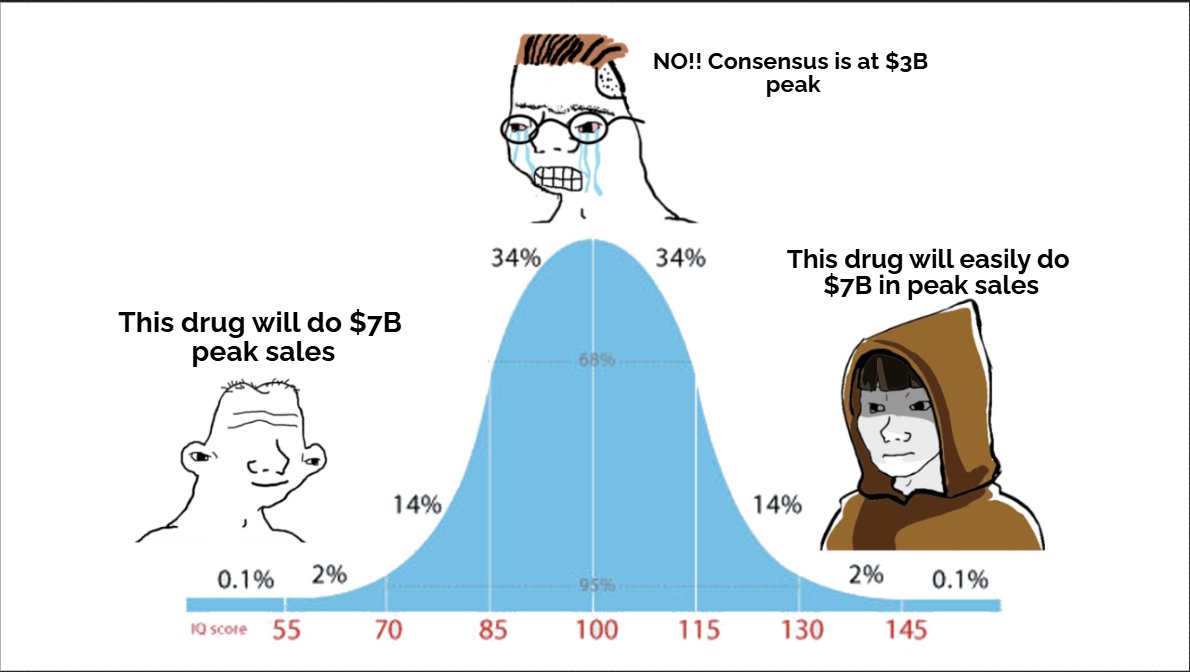
$ABVX - Folks need to stop quoting "Muh Sell-Side" on the peak sales numbers. Be it for this drug or any other.
THINK for yourself and try to build a peak sales number from the bottom up.
Ignore CD. You know this is the best in class for the time being, and drugs like these typically change the treatment landscape itself.
Non-immuno label could get the total US pool anywhere from 400-500k. Say 20-30% mkt share capture on that because easy admin as it's oral and at a 25% mid point & $32k/pt net you're gonna get $3.6B in the US alone.
Global likely will touch $7B or more.
If you see how street modeled Stelara, Entyvio, Skyrizi/Rinvoq in IBD vs how those drugs actually did -- then you'll know better than to take consensus ests at face value.
Say I'm being too bullish here, given the drug it could still very realistically do $5B in global peak just in UC.
And this is assuming Obefazimod wins big in only the advanced therapy setting.
If this becomes first line, might have to tick the pricing down but the prevalent pool over doubles and they can get to $8-$10 Billion in UC.
CD will be gravy on top of this.
This drug is going to be the non-immunosuppressive bridge, so even if they don't go much earlier in line, $6-$7 Billion peak in UC is very doable.
$SLS - Very erudite & classy crowd. Tells you all you need to know about this stock.
Win threshold implies no more than 31 of 80 deaths in the GPS arm.
Open-label salvage pulls the arms together. Delayed vaccine effect makes the curves overlap early, and the log-rank test leaks power against that shape.
CEO's own "long tail" claim literally breaks the primary analysis. Fit population living 20+ months raises the absolute bar if the effect is additive. And 80 events only rewards a monster the drug has never shown in a randomized setting.
$SLS CEO, Angelos Stergiou, has returned to LinkedIn to promote their upcoming catalysts.
This is now the 3rd time Stergiou has publicly endorsed/ advertised his pipeline via LinkedIn over the last 1.5 months, despite declaring in an early July post that it would be his “last brief posting around REGAL” before approaching the 80th even and entering an official quiet period.
Very bizarre behavior to say the least. He may want to look into Cobenfy when this saga is all said and done.
$ABVX - Folks need to stop quoting "Muh Sell-Side" on the peak sales numbers. Be it for this drug or any other.
THINK for yourself and try to build a peak sales number from the bottom up.
Ignore CD. You know this is the best in class for the time being, and drugs like these typically change the treatment landscape itself.
Non-immuno label could get the total US pool anywhere from 400-500k. Say 20-30% mkt share capture on that because easy admin as it's oral and at a 25% mid point & $32k/pt net you're gonna get $3.6B in the US alone.
Global likely will touch $7B or more.
If you see how street modeled Stelara, Entyvio, Skyrizi/Rinvoq in IBD vs how those drugs actually did -- then you'll know better than to take consensus ests at face value.
Say I'm being too bullish here, given the drug it could still very realistically do $5B in global peak just in UC.
And this is assuming Obefazimod wins big in only the advanced therapy setting.
If this becomes first line, might have to tick the pricing down but the prevalent pool over doubles and they can get to $8-$10 Billion in UC.
CD will be gravy on top of this.
This drug is going to be the non-immunosuppressive bridge, so even if they don't go much earlier in line, $6-$7 Billion peak in UC is very doable.
Atebi+Daraxonrasib, while it has the deepest tumor kill, it doesn't work because you're messing up the healthy tissue with tox and therapeutic window crashes.
But, Atebi+Zoldonrasib or G12C selective inhibitor achieves the same deep tumor kill but without that tox and a good therapeutic window.
$LQDA - This Stephen Ayers guy on SeekingAlpha is such a clown I'm lost for words.
First off, what kind of retard uses TTM sales to value a biotech?
Let me teach you some basic math, son. The supposed decel is purely arithmetic theatre. The percentage growth fell because the denominator rose. Shocker!
Calling this “decelerating fast” without showing a declining dollar addition, weakening demand, or a deteriorating cohort is incredibly dumb.
He turns management’s use of “stasis” into a fading-tailwind warning. The actual statement was that access had reached broad availability and general parity, leaving product choice to physicians and patients.
It simply means growth no longer needs additional payer unlocks. Coverage has moved from constraint to infrastructure is what they were saying.
His titration argument has the same missing model. A cohort’s dose ramp matures, but a launch that continues adding new cohorts also continues adding patients in their ramp period. The percentage contribution from titration can decline as the base grows while the dollar contribution persists. To convert that fact into a revenue headwind.. such a stupid leap.
I lol'd at the 30% attrition. Survival measured from diagnosis is not the same as forward survival from Yutrepia initiation.
Discontinuation cannot simply be stacked on top without a persistency curve and without separating deaths from other discontinuations. Cumulative starts are not the active treated population.
The TPIP comp is even more retarded. He suggests TPIP patients may have stopped at 640 because they had already achieved adequate benefit, making the lower dose a positive. Insmed has not published a randomized reason-for-dose-ceiling analysis showing that.
TPIP mgmt was on call saying "more is better" but now suddenly we have an adequate? This would be news to any PAH & PH-ILD physician.
The claim that TPIP cannot have been dose-constrained because the group achieved a 35% PVR reduction and 35.5-meter adjusted walk benefit is a category error. Average efficacy and individual dose limitation can coexist lmao.
You would legit have to have diminished mental capacity to comp TPIP against Winrevair. Literally different drugs used for different functions.
Also conveniently forgets to show TPIP's PH-ILD numbers, because he knows they suck.
Anyways, not gonna waste more time on this. Who even takes SeekingAlpha seriously? You folks need to stop sending me this crap.
@Biohazard3737 No idea why he is doing that. Biotech has a lot more sex appeal imo. You just need to phrase it in a way like "I work on curing cancer by funding research" -- bit of stolen valor, but all is fair in love and war or something like that.
$RVMD / $IMRX - Yes, very good point. But unfortunately it's not that simple.
Atebimetinib's low tox is not a feature of the molecule but that of it's schedule. The drug is tolerable because its 2.5hr half life produces a deep daily trough in which normal skin and gut recover between hits.
This recovery window is the entire source of the safety. BUT, if you add a continuous partner on top of it like Daraxonrasib, which has a 36hr half life and sits at near plateau then RAS stays roughly 90% occupied even at its daily nadir.
So darax holds the pathway suppressed in normal tissue straight through atebi's trough. Problem with this is recovery window gets totally abolished.
You don't get atebi's tolerability plus darax's efficacy. Instead you get toxicity of continuous vertical MAPK blockade in normal tissue, because the thing that made atebi gentle was the off-period, and the continuous partner repossesses it.
The cyclical safety net doesn't mean anything when it's running on a non-cyclical drug. I ran the simulations on this way back when.
The combo DOES produce the DEEPEST tumor kill of any regimen. Vertical blockade works, but therapeutic index collapsed below atebi monotherapy, because toxicity rose faster than the extra kill.
You can't really say that atebi only hits the escaped signaling. MEK is MEK at the end of the day, so atebi will suppresses MEK/ERK in normal tissue too, and now it's stacked on darax's RAS suppression in the same skin and gut.
Efficacy and toxicity here ride on a single shared axis. You cannot deepen pathway suppression in the tumor without deepening it in normal tissue by the same mechanism.
You can't stagger the doses to rebuild the window, because darax never troughs & timing atebi to darax's daily gap gave results identical to dosing them together, since the gap is still ~90% occupied. You can't cycle them in blocks to create real gaps without wrecking the point.
Separating them into alternating weeks does open recovery windows, but then the two drugs are never deep at the same time, so you lose the simultaneous vertical blockade that was the entire reason to combine.
The version that to some extent does work cleanly imo is one that only hits mutant RAS in the tumor and spares wild-type RAS in normal tissue. So you get full combination-level tumor kill, with toxicity dropping all the way to atebi-monotherapy levels, because now normal tissue only ever feels atebi's (recovering) pulse. But that selective partner is zoldonrasib or a G12C agent.
But combo with Darax is not gonna work.
@MadCowCapital@CloisterRes Physicians won't choose between Dax and atebimetinib in a vacuum. Instead, the future of oncology is moving toward a Dax + Atebimetinib combo.Dax will do the heavy lifting upstream, dampening RAS, PI3K, and Ral.Atebimetinib will act as a cyclic safety net downstream,
Yep. Neither has the FDA it would seem. It’s between charging what you want, or as Vinay Parsad admitted live — deny the company approval for bs reasons and then ask the patients to demand that drug at cost.
We need to find a way to meet in the middle between absolute capitalism and stupid luddite-ism. Pharmas have been lobbying for the former but you then get luddites like Vinay who unironically, in opposing new biotechs entrench the moat and pricing power of big pharmas.
$RVMD - While I empathize with the your rationale @JohnCendpts, I think pricing is justified.
RevMed was founded in October 2014 and has lost money every year since. Its accumulated deficit hit $4.0 billion at June 30, 2026, up from $2.0 billion just fifteen months earlier, so half the company's lifetime losses came in the final sprint to approval.
2025 net loss was $1.1 billion on $987 million of R&D (2024: $600 million loss), and 2026 operating expenses are guided to $1.6–1.7 billion. That was funded by repeated stock sales, buying EQRx for its cash, selling future royalties to Royalty Pharma, and convertible notes.
Deloitte puts the average cost per launched drug at $2.2 billion in 2024 and $2.7 billion in 2025 with failures included, and oncology runs highest at a median near $2.8 billion.
Darax also carries RevMed's dead ends i.e. the SHP2 program Sanofi walked away from, the mTORC1 asset, and eight years of platform work that produced nothing sellable. Industry-wide, roughly one in seven drugs entering Phase 1 is ever approved, and oncology is worse than that.
KRAS was identified as a human oncogene in 1982 and spent forty years labelled undruggable. RevMed spent 2014–2022 building the tri-complex platform before daraxonrasib dosed its first patient. First-in-human to approval took about 4.5 years, fast against an industry where Phase 1 to filing alone now averages more than 100 months. Twelve years from founding to first dollar of revenue, with capital that could have gone to zero at any point along the way.
Price x duration x patients has to repay the past and fund the future inside a finite window. At $39.8K list a median course is ~$290K, call it $250–300K net; 15–20K eligible US patients a year gives roughly $3–5B annually at maturity.
Against that sit $4B already sunk, ~$1.7B a year still burning for five-plus Phase 3s, and composition-of-matter exclusivity that ends in the mid-to-late 2030s, after which generics sell the same pill for tens of dollars a month forever.
12–14 years of premium pricing buys a permanent doubling of 2L pancreatic cancer survival. Priced at G12C-inhibitor levels (~$18–20K/month), the same math takes about twice as long to return the capital and pushes payback past the point where 1L, lung and CRC need funding.
Sure, their broader label is gravy. But I think what folks like you should focus on, is why luddites like @thakurfdn are lobbying against generics in the US and actively hindering the American patient's right to affordable healthcare. A more interesting rabbit hole to dive into.
P.S. - RVMD cannot and likely won't be acquired.
The FDA approval today of daraxonrasib will go down as the top OK of the year and a big step forward on pancreatic cancer. And that is worth celebrating.
What is not going to be celebrated:
At close to $40K for a month's supply, $480K a year, I wonder if it's been priced for a pharma company looking to buy the company. Every leap forward in innovation is also another bucketload of financial toxicity for cancer patients who don't have the insurance they need to cover it all. That much further out of reach for way too many patients desperate to get it.
Living longer means paying more. How do you balance all that out? #FuckCancer #CancerSurvivor
https://t.co/6Q0GCExojL
@future_eye@JohnCendpts Mgmt has a functioning brain to not sell. They got a broad label. This thing will be doing keytruda numbers in about 3 years. Would be stupid to sell.
Good starting point. But unfortunately problem very nuanced. That could work but it’s not a one size fits all solution.
Say you’re a company like $SPRB , who is working an rare orphan diseases where prevalence of the disease is very low like 1/200K and even those patients are misdiagnosed then patent life will only get you so far.
Remember how small the market was for PAH and PH-ILD 10 years ago? But as more companies started coming in, awareness about the disease increased and so did diagnosis rates and more patients could be saved.
Cancer is a vermin like disease with a mind of its own as you might know. Just developing a drug for any cancer is akin to moving mountains imo. Big Pharma like $LLY hiding their Ph1 pipeline sure doesn’t help.
If you and I decide to start a company to cure cancer, where do we start? Which pathway, should we do an agonist or antagonist, should we build a new platform for an already existed agonist like $INBX did with valency on the TNF family.
With a 20 year patent life the goal post becomes more attractive, but the race only gets even more competitive and expensive. If you want to create a drug for cancer as a small biotech today. You’d be gambling years and money away.
It’s like playing russian roulette. Not to mention the difficulty in recruiting patients if your Ph1/2 isn’t attractive enough given how fragile patient years are.
Pricing in cancer is very unfortunately unique to the vertical. Too many moving parts.
$LQDA - Was the hearing that the website showed this morning an error? Because it's no longer there. All the others since 9 AM are still present.. is today the day?