15yrs data center infra / hyperscaler. The answer to centralization
isn't a slogan — it's architecture. Building on @Polkadot.
Long-term holder | Validator
Polkadot OpenGov is voting on a major change to the network’s staking architecture.
Referendum 1890 proposes that validators on Polkadot are required to lock a minimum of 10,000 DOT of their own funds as self-stake.
This reform is a mandatory prerequisite for the next major staking upgrade:
• Nominators becoming unslashable
• Fast unbonding (~24-48h instead of ~28 days)
The logic is simple:
Validators absorb the slashing risk directly through significant self-bond exposure.
Nominators can continue earning staking rewards without exposing their principal to slashing.
If enacted, Polkadot staking would remove its two largest barriers to participation:
Lower risk. Faster exits.
End of May, the new mandatory pre-requirement for validator will be enacted depending on ref#1980.
A minimum self bond of 10k DOT will be enforced to secure the network. Non-compliant validators will face significant risk of chilling.
🧵
https://t.co/F624Q1znYM - Baremetal Blockchain Operator - 15+ years in Datacenter Industry serving now decentralisation - Also on Polkadot
ethereum:0x8d010bf9c26881788b4e6bf5fd1bdc358c8f90b8 #staking#nominator
Also built in:
→ Nominate guide for 4 wallets
→ Auto FR/EN detection
→ Live Polkadot news feed
→ Full specs + limitations — public
One static page. No backend. Everything verifiable.
https://t.co/F624Q1znYM — check it yourself.
— https://t.co/F624Q1znYM - $DOT
Transparency isn't a buzzword if you can verify it.
https://t.co/F624Q1znYM pull live data directly from Subscan's API. Commission, self-stake, nominators, era points -- not hardcoded.
If the data changes on-chain, the site updates.
Here's what else is under the hood ↓
Server status isn't a badge. It's a live endpoint.
A script runs every 60s on my node:
→ Validator process alive?
→ Peers connected?
→ Disk healthy?
→ Blocks producing?
If something degrades, the site shows it. No hiding.
Choose wisely your Validator, soon probably they will not be in the active set of not compliant the minimum selfstake.
ethereum:0x8d010bf9c26881788b4e6bf5fd1bdc358c8f90b8
- https://t.co/F624Q1znYM
$DOT validators: are you ready for the May 31 self-stake deadline?
10,000 DOT minimum, slashable. Non-compliant validators risk being chilled by the protocol.
#Polkadot#Validators#Staking
Every blockchain eventually hits the same problem of state bloat.
Applications want to publish data on-chain… but permanent storage is expensive and unnecessary for most use cases, and, ofc, not everything needs to exist forever.
This problem becomes especially prevalent when building fully on-chain applications with rich media that aim to provide users with an experience on par with what they are used to in their current apps.
Bulletin Chain introduces ephemeral storage for Polkadot, where data is available long enough for verification and usage, then automatically removed to create a cleaner chain, lower costs, and enable builders to create new classes of applications.
Let’s dive in 🥽
Cross-chain messaging + stablecoin FX is exactly the kind of real-world use case that makes Polkadot's shared infrastructure click.
Curious to see how HyperFX handles liquidity for non-USD pairs. March 23 is going to be a busy week for the ecosystem.
This is the best explanation of Polkadot I've seen in one thread.
Most people compare chains by TPS or TVL. Polkadot isn't playing that game.
It's shared infrastructure. Security as a service. That's the thing people keep missing.
Worth reading twice.
$DOT
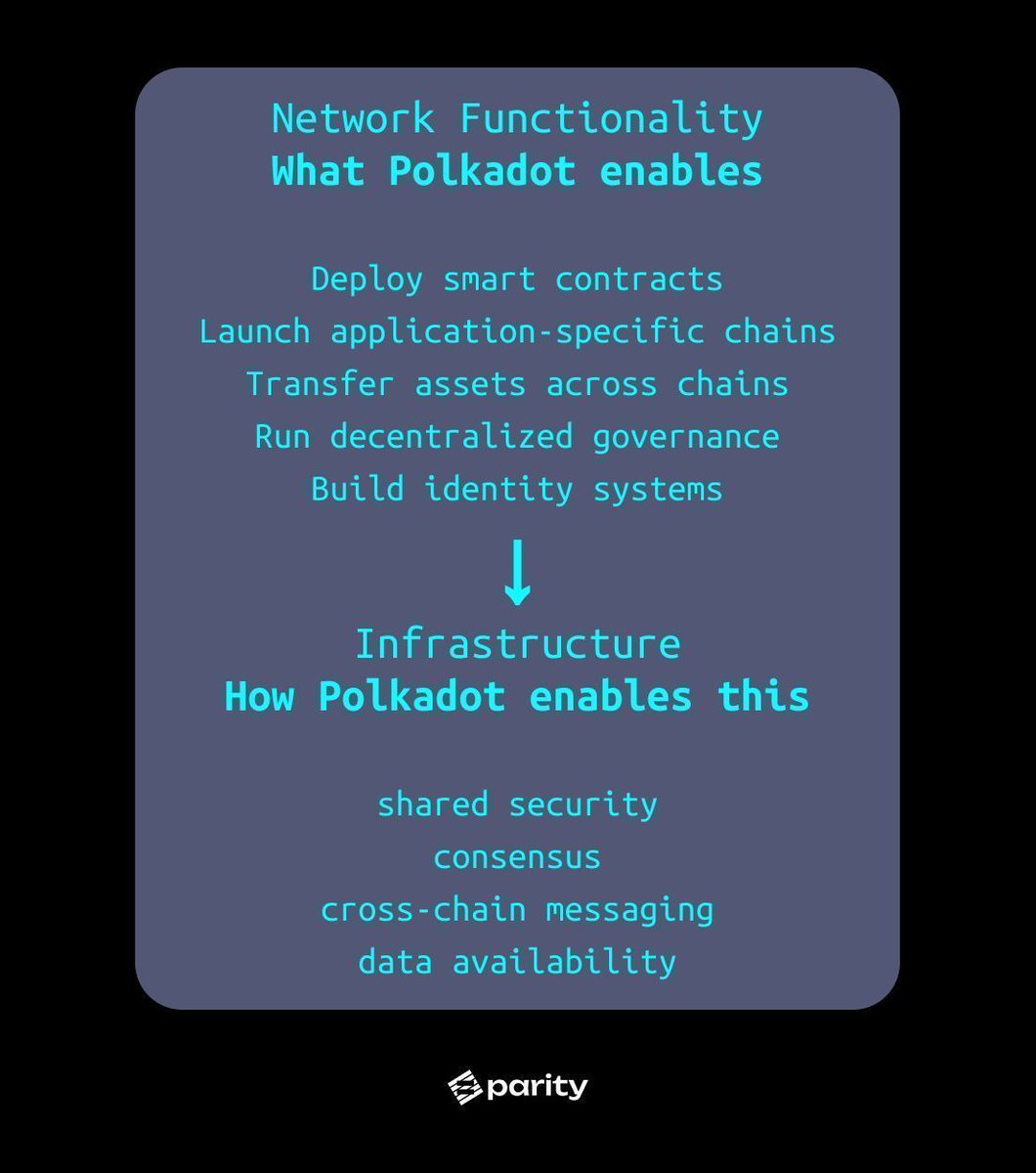
Polkadot is often misinterpreted as just another blockchain bridged to other chains, but that framing misses the architecture completely. Polkadot provides shared infrastructure:
security | consensus | data availability | cross-chain messaging
But sadly, many people still picture Polkadot like this:
Chain
├ parachain
├ parachain
├ parachain
That mental model is wrong, or at least unfinished, and it makes Polkadot look like many independent chains loosely connected, which conceals the real innovation of shared security & shared infrastructure.
Without this understanding, people ask the wrong questions, like…
“Why does the Polkadot Relay Chain show so few transactions?”
“Which parachain competes with Ethereum?”
“Which parachain is the main chain?”
A better question would be. What functionality does the Polkadot Network provide?
It provides:
Launching application-specific blockchains
Deploying smart contracts
Cross-chain functionality and asset transfers
Running decentralized governance systems
Some of these capabilities run directly on Polkadot Hub, while others are implemented by chains built on the network. But straight out of the box, Polkadot contains all the components that make this possible.
@paritytech Running a validator made this click for me.
You don't just validate "a chain." You secure the entire shared infrastructure — every parachain, every message, every block.
That's why the relay chain looks "empty." The work is invisible by design.
The Polkadot Cloud Staking dashboard filters out validators with 100% commission, blocked nominations, and no on-chain identity.
Clean data. Less guesswork. Better nominations.
$DOT