This Sunday, MÆCENAT is proud to announce a new publication: The MÆCENAT Folio.
Twice a month on Sunday, we will release a new Folio directly to your inbox. Each issue is divided into four roles:
-The Connoisseur points you toward what is worth seeing.
-The Provocateur takes a position on what is happening now.
-The Long Thinker reaches into history to make sense of the present.
-The Artist brings you into the studio of one maker whose work you can see — and acquire — at MÆCENAT.
This first issue will focus on topics near and dear to MÆCENAT: the barriers to accessing original art, and how nearly everyone can take concrete steps to become a patron in their own right, at a price that is feasible.
If you believe that original art should be accessible, that artists deserve better than the standard gallery deal, and that the conversation about art should be bent toward Beauty rather than transgression, this folio is for you.
Read our inaugural issue at the link below, and sign up to receive each new Folio directly to your inbox!
"Why does a beautiful sketch please us more than a beautiful painting? Because there is more life in it and fewer forms. As forms are introduced, life disappears."
-Denis Diderot, Salon de 1767
Diderot was the first modern art critic. He reviewed the Paris Salons for a private newsletter that circulated among European royalty, and he saw clearly what happened in the space between a painter's first idea and the finished canvas.
His conclusion was spartan: the sketch has more life. To his mind, the artist's thinking was more visible in the pressure of the hand, the speed of the decision, and the moment before revision and refinement. We might say that a finished painting shows you what the artist decided, but a sketch shows you how they thought.
This is why preparatory works have been collected for as long as art has been made. The quick study can be art as arresting as the fully realized work.
Months of work and the large bronze version of Tackle is finally done. The piece has come alive with a deep rich patina I am really pleased with.
I'm honoured to have been invited to show it, together with two other medium-sized bronzes, at the @fvdemocratie congress in Den Bosch on 21st November. See you there 🫡
The painter's room smelled of linseed. The sculptor's of clay. The patron climbed three flights. No placard on the wall, no intermediary. Just a man at work and what he'd made that week.
A silverpoint study for a few coins. A preparatory sketch for a commission not yet begun. The finished altarpiece would cost a fortune, but the study was yours for the price of a couple meals.
This was the atelier — the artist's workshop where you could share a few words and carry a new piece of original art home.
We are opening the MÆCENAT Atelier on November 27.
Nine artists. Works beginning at $100. Just in time for Christmas.
Issue 3 of The MÆCENAT Folio out today!
-The Connoisseur points you toward what is worth seeing.
-The Provocateur pines for simplicity.
-The Long Thinker hosts founder Landon Johnson on the power of art that collects time.
-The Artist contemplates William Paquet's @PaqWilly haunting "Martyr."
If you believe that original art should be accessible, that artists deserve better than the standard gallery deal, and that the conversation around art should be bent toward Beauty rather than transgression, this folio is for you.
Sign up for free to read Issue 3 at the link below, and receive each new Folio directly to your inbox!
Most art today is trapped by the current thing, the algo, the slop cycle. Throughout this year we've been working in our studios creating the exact opposite.
@MaecenatGallery founder Landon Johnson unpacks some of the philosophy behind our upcoming show in London!
Details 👇
@KarlTrewhelaArt Truly. I still vividly remember being in the bookshop as a child and plopping down in the middle of an aisle with Rime of the Ancient Mariner to drink in his engravings.
“Water, water, every where,
And all the boards did shrink;
Water, water, every where,
Nor any drop to drink.”
-Samuel Taylor Coleridge, The Rime of the Ancient Mariner
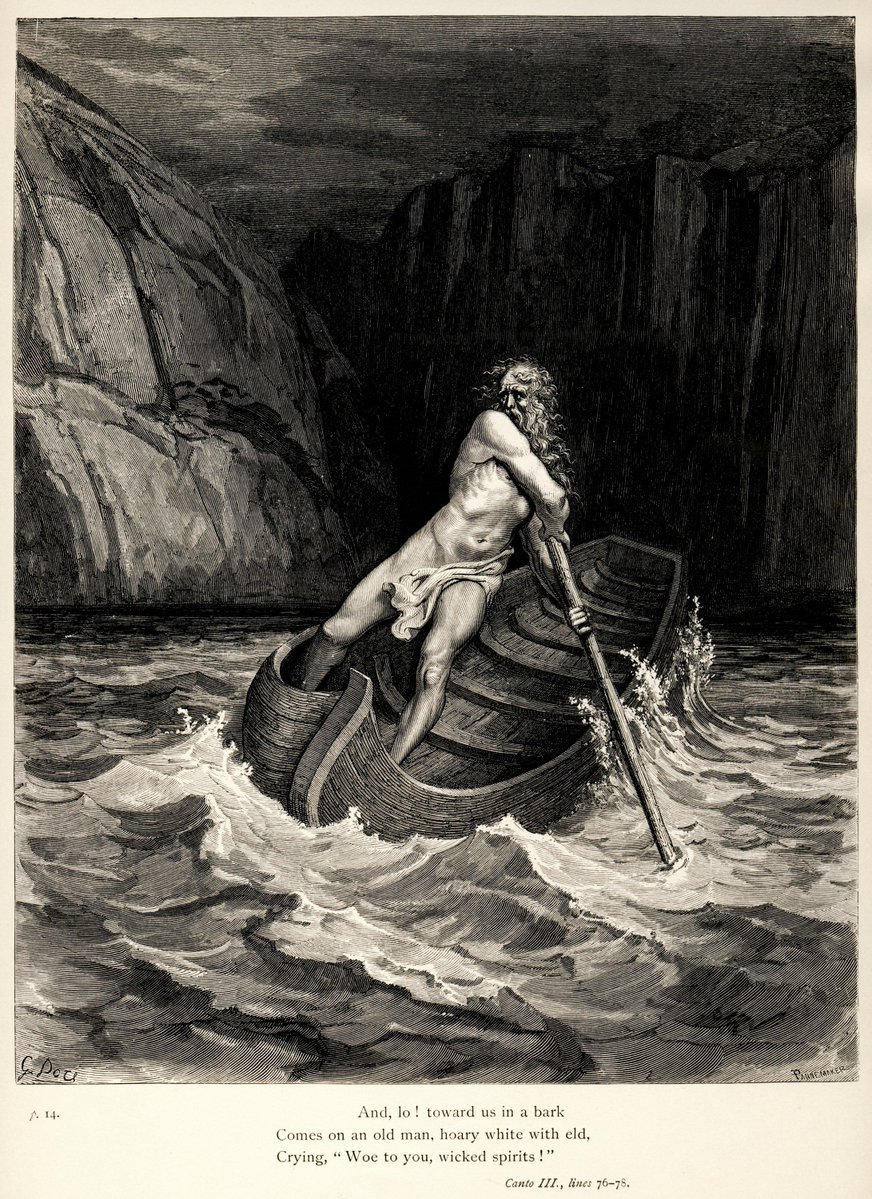
This Saturday, we look at the life and work for Gustave Doré, most famous for his incredible wood engravings.
Doré was, for a stretch of the nineteenth century, one of the most famous artist in Europe. His illustrated editions of Coleridge, Dante, the Bible, Cervantes, Milton, La Fontaine, and Poe reached millions of readers. His London gallery (Doré Gallery on New Bond Street) drew large crowds for decades. When he died in 1883 at 51, he had produced more than ten thousand illustrations across a career that began when he was 15.
Despite this popular success, or perhaps more accurately because of this popular success, the French art establishment never accepted him as a proper fine art painter.
The Salon treated illustration as commercial work. Skilled, perhaps, but subordinate to painting, which was a proper fine art. Doré wanted to be recognized as a painter. He produced enormous canvases of biblical and historical scenes, but the critics dismissed them. The establishment preferred to elevate works by artists like Meissonier and Cabanel, and had no room for a “mere illustrator,” however gifted.
History can be a harsh mistress. Doré’s illustrations have largely survived and continue to be seen and celebrated. The Salon paintings by Meissonier and Cabanel, for the most part, have faded from the public memory.
Doré's Dante engravings remain the definitive visual interpretation of the Divine Comedy. When you picture the circles of Hell, the chances are good that you are picturing Doré. His Rime of the Ancient Mariner plates — vast, moonlit seascapes with a ship the size of a splinter — set the standard for atmospheric book illustration.
His methods deserve a paragraph, because many people are not familiar with the process of wood engraving. Doré drew on wood blocks, which professional engravers then cut. The blocks were printed as relief engravings. The translation from pencil to cut wood to printed ink involved a chain of craftspeople, each one interpreting the artist's marks. Doré pushed the medium to its physical limit, establishing a new standard for what was possible with gradients of tone, extremes of scale, and light effects. He drew darkness the way a musician plays silence: as an active presence that defines the space around it.
The hierarchy that excluded Doré from the good graces of the fine art establishment has remained in place even to this day. Illustration is not fine art, commercial work is not fine art, the market's approval does not equal the academy's. Every artist who works on paper with a pen, who draws for a living, who builds images by hand in a medium the market codes as "illustration," encounters a version of it.
Doré answered the establishment by making the work so good that the category became irrelevant. There’s a valuable lesson for us all in that. Don’t seek the praise of men, seek the excellence of beauty. The former is fleeting, the latter is eternal.
Apparently Instagram is now allowing posts of 20 images at once. That's a bit overkill, but it was a fun exercise to look at the last 20 pieces of art posted by MAECENAT.
If you want more beauty in your life, give MAECENAT a follow and share with your friends!
On your phone right now, this image is roughly four inches tall, while Dürer's original is roughly ten inches tall. That difference is not trivial.
The Young Hare is a watercolor, painted in 1502 in Dürer's studio in Nuremberg. At actual size, you can see individual hairs — not a suggestion of fur but specific, countable strokes from a brush that was itself often a single hair wide. The reflection in the hare's eye includes the window of the studio. The level of detail is astonishing, but none of this reaches you through your phone.
Herein lies the problem of real vs reproduced. On a screen, every painting and drawing becomes the same size. Night Watch and a postcard. The Sistine ceiling and a snapshot. Sargent's 20 foot Gassed and a five-inch pen drawing. Your phone flattens them all to the same four-inch rectangle and strips the most important variable: what it feels like to stand in front of it.
This is one of the better arguments for living with physical art. A screen shows you what a piece of art looks like. The art itself shows you what it is. Find your own piece of art to live with at the link below.
New York art advisor Maria Brito published a piece in April that keeps surfacing in our reading. She argues that as AI floods the market with infinite generated images, objects that show the evidence of a human hand become scarcer and more valuable. (https://t.co/JU6oyPWECi)
She builds her argument using names like Rembrandt, Giacometti, and Lucian Freud, artists whose brushwork carries the fingerprint of a specific person (we would quibble with the inclusion of banal work by Agnes Martin). A prompt cannot reproduce the hesitation in a line, or fake the particular weight Freud put on a loaded brush.
Her best line: "Collecting has never been about owning more images; it's about choosing what deserves to stay."
We introduced Karl Trewhela to the gallery yesterday, an artist who draws spends a hundred hours on a single piece. The labor is visible in every square centimeter. You can see the hand. You can count the decisions. And the same is true of all the artists in Maecenat.
We agree with Brito's conclusion that the hand wins. A machine can generate a picture of a raven. It cannot make a Fire Raven.
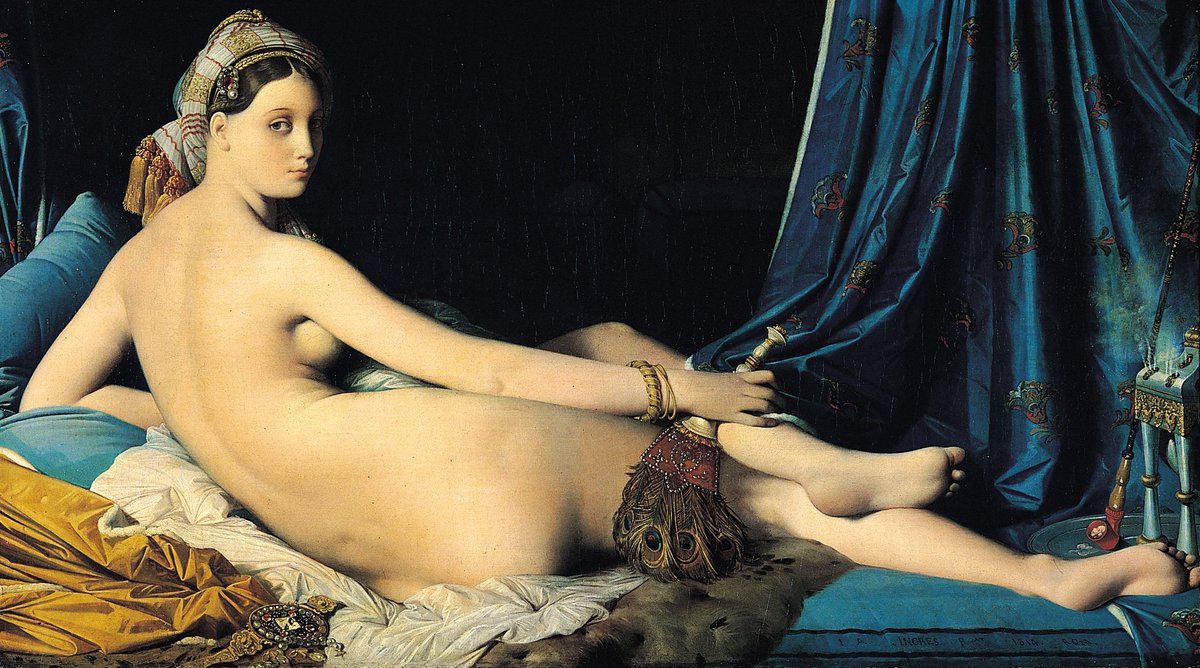
"Drawing is the probity of art."
We have visited this important quote from Ingres before, but in the spirit of repetition being a key to learning, we will be in the habit of returning to foundational ideas.
Ingres said this near the end of a career spent defending the supremacy of line over color. For him, drawing was not the warm-up to painting, a necessarily precursor to check off and then move on. "To draw does not mean simply to reproduce contours; drawing does not consist merely of line: drawing is also expression, the inner form, the plane, modeling."
Look at the Odalisque. The contour along her back is elongated, anatomically improbable. But to call that line an error would itself be an error. It was a decision. The curve produces a sensation that correct anatomy would not, and Ingres chose the sensation. That act of will reveals a critical element of the artist's vision.
If you want to know where an artist's honesty shows, Ingres would tell you to look at the lines.