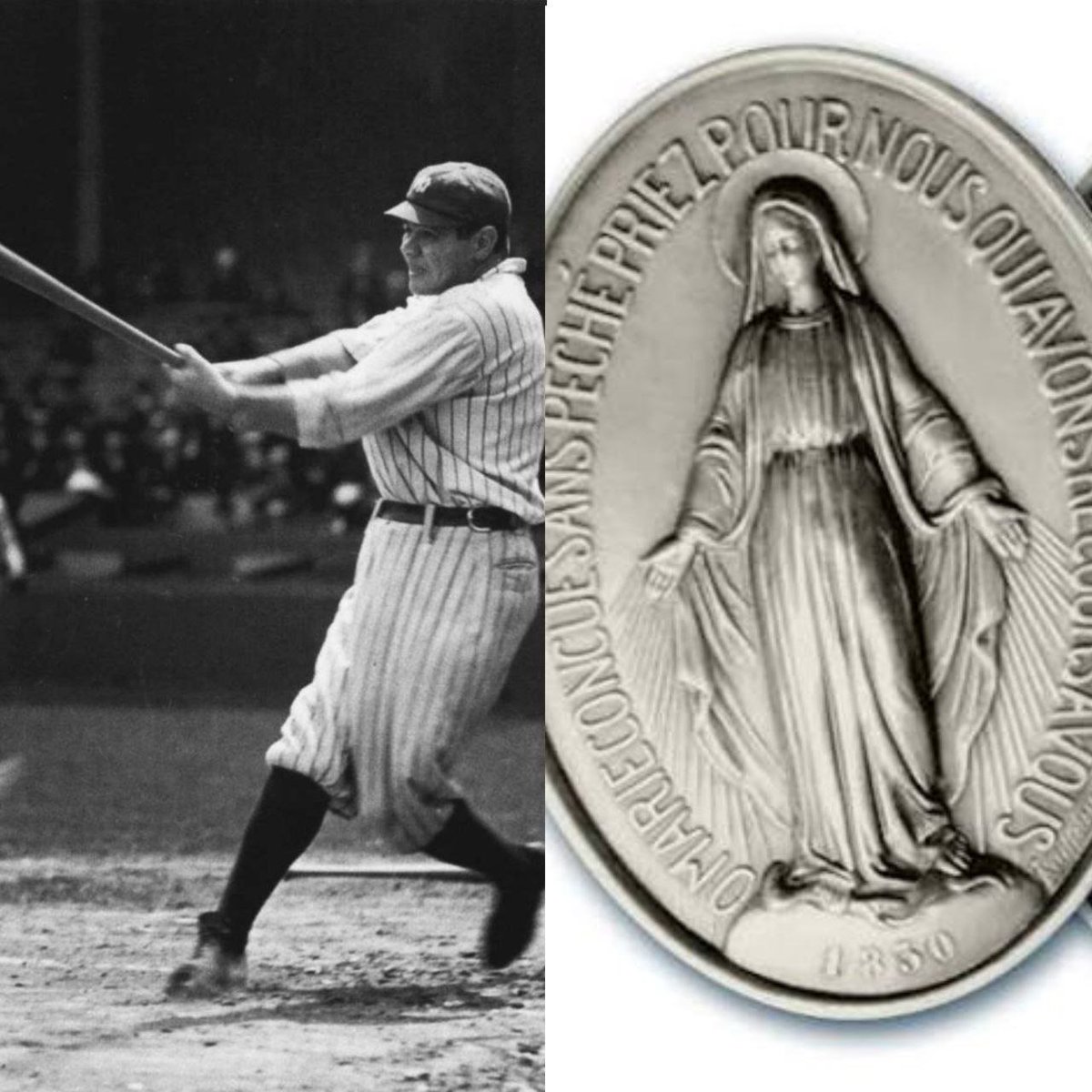
Today is the Feast of the Miraculous Medal
Baseball legend Babe Ruth was a Catholic who wrote this letter about Communion, Confession and the Miraculous Medal:
“In December, 1946, I was in French Hospital, New York, facing a serious operation. Paul Carey, one of my oldest and closest friends, was by my bed one night.
- They’re going to operate in the morning, Babe, Paul said. -Don’t you think you ought to put your house in order?
-I didn’t dodge the long, challenging look in his eyes. I knew what he meant. For the first time, I realized that death might strike me out. I nodded, and Paul got up, called in a chaplain, and I made a full confession.
-I’ll return in the morning and give you Holy Communion, the chaplain said, -But you don’t have to fast.
-I’ll fast, I said. I didn’t have even a drop of water.
-As I lay in bed that evening, I thought to myself what a comforting feeling to be free from fear and worries. I now could simply turn them over to God. Later on, my wife brought in a letter from a little kid in Jersey City.
‘Dear Babe,’ he wrote, ‘Everybody in the seventh grade class is pulling and praying for you. I am enclosing a medal, which if you wear will make you better. Your pal—Mike Quinlan. P.S. I know this will be your 61st homer. You’ll hit it.’
-I asked them to pin the Miraculous Medal to my pyjama coat. I’ve worn the medal constantly ever since. I’ll wear it to my grave"
For the first time since 1977, Nicollet Avenue connects through Lake Street, reconnecting south Minneapolis to Eat Street and downtown. Today we officially opened the road and celebrated all that’s ahead.
The @MinnesotaDFL and @StarTribune (excuse the redundancy, as @mitchpberg would say) remind me of adolescents who play tackle football in the house then stand around saying, "I wonder how that lamp got broken?"
0n last week's America This Week I mentioned (but failed to name) a fabulous app that allows you to read good books, old and new, in serialized form, at your own pace, and join a community of fellow readers.
Here it is.
Storyaliz, the brilliant brainchild of my friend @annbauerwriter
https://t.co/TSTL6uRR2T
“If you’ve read good books to kids, you’ve probably been surprised when they noticed a detail in the pictures that you didn’t see, or been humbled when they understood something about the story you couldn’t. That’s because children tend to be better readers – more open-minded, more diligent, and more passionate – than adults. (No offense.)” —Mac Barnett
https://t.co/IXC9jvVVum
@ChivalryGuild I'm thinking to add 'non-boomer-minded' to my bio. I was saved at a young age by a history professor who taught a completely different paradigm of modernity—David W. Noble. I am ever grateful to him. https://t.co/UqK9ba6LsQ
Did you know the custom of breaking the wishbone for luck has ancient roots?
The custom began with the ancient Etruscans in Italy who divinized birds.
They thought birds were like oracles.
After a bird was killed, they removed the the forked collarbone (furcula), dried it in the sun, then stroked it hoping to get the birds prophetic power.
When the Romans later adopted the custom, due to the high demand for poultry, they began the custom of two people pulling the furcula apart and the person with the larger piece was said to have their wish granted. As the Roman Empire expanded, the custom spread.
When the custom reached Britain, the bone began to be called the Merrythought. At that time, they primarily ate goose. This custom is recorded in writing in the mid-15th century and it was well established in the 1700s when English settlers brought it to the United States.
In early America, the "wishbone" terminology became popular. Turkey was established as the centerpiece of the American Thanksgiving meal in the mid-1800s and the custom of breaking the wishbone became widely associated with the holiday.
Interestingly, the term "lucky break" began with this custom.
This cute Thanksgiving card by Ellen Hattie Clapsaddle in the early 1900s wishes the recipient luck in their quest to have their wish granted.