What if you could support a blockchain judge without ever running a validator node?
That's possible on GenLayer, and it's called delegation.
To understand it, first think of validators as judges. They stake GEN and help the network reach decisions.
But running a validator isn't for everyone. It takes technical knowledge, infrastructure, and ongoing work.
So what if you want to participate without managing all of that?
That's where delegation comes in.
Imagine you have 42 GEN.
You choose a validator you trust and delegate your GEN to them. Your stake supports that validator, and you can share in the rewards they earn.
You don't need to run a node. You don't need to manage servers.
You simply choose who you want to back.
But there's one important detail: leaving isn't instant. When you undelegate, there's a seven-day waiting period before your GEN becomes available again.
And your validator choice matters. Their performance affects the rewards you receive.
My take?
I think delegation makes participation more accessible. Not everyone has the time or technical ability to operate a validator, but that shouldn't mean they can't support the network.
Still, I wouldn't choose a validator based only on advertised rewards. Reliability and consistency deserve just as much attention.
Because delegation isn't simply about earning rewards. It's also about choosing which validator you trust.
If you had 42 GEN, what would matter most when choosing a validator?
@GenLayer #GenLayer #GEN
GEN runs a court. Judges are paid in it, users pay it for every verdict, and builders earn it every time their app is used.
7 things to know about GEN tokenomics, in three minutes 👇
🚨 BITCOIN'S RECOVERY: REAL OR JUST A RELIEF RALLY?
BTC briefly touched $64.5K before pulling back toward $61K.
Here's what matters:
📉 Heavy ETF outflows
⚠️ Weak market sentiment
📊 Recovery still under pressure
👀 Fresh buying demand remains key
A green candle doesn't automatically mean a bull market is back.
What do you think? 👇
#Bitcoin #BTC #Crypto #Ethereum
Crypto is in Extreme Fear. Last time, I checked my portfolio 40+ times in one day and learned nothing new 😅
This time I run 3 rules:
1️⃣ Charts get 2 check-ins a day, morning and night. The same red number at 3pm tells me nothing the 9am one didn't.
2️⃣ Every time I want to doomscroll, I read one project's docs instead. Fear is loud, but builders keep building.
3️⃣ If a post makes my pulse jump, I wait 24 hours before acting on it. Panic is a terrible advisor.I can't control the market. I can control my habits.What's the one habit that keeps you sane when everything's red?
Safety: there's no buy/sell advice and no price predictions, and @RallyOnChain is included.
Join here:https://t.co/EunqfOJKP9
What if the biggest mistake Bitcoin investors make isn't buying at the wrong price, but using the wrong amount of leverage?
Most people think leverage is about making bigger profits.
But professional investors have understood something different for decades.
The real question isn't how much leverage you can get.
It's how much leverage actually makes sense.
So what's the secret behind this approach?
It's called the Kelly Criterion.
It's a mathematical strategy used to estimate how much capital should be exposed to risk based on expected returns and probabilities.
Instead of simply maximizing exposure, it tries to find a balance that supports long-term growth.
And here's something interesting.
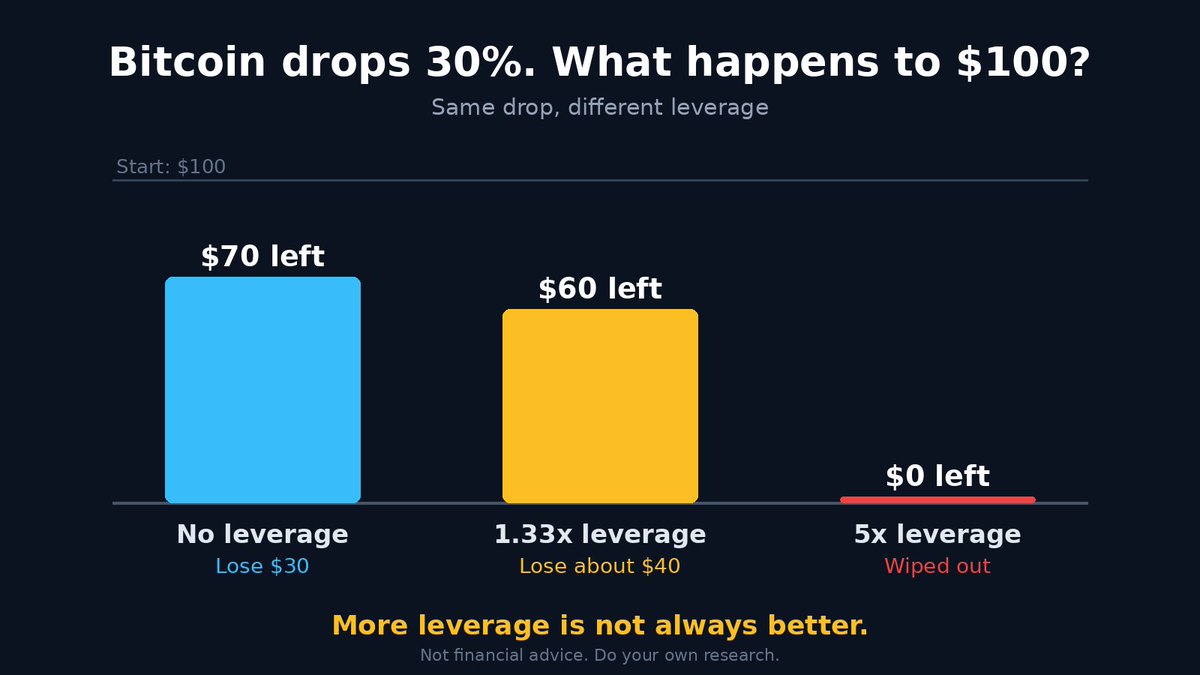
2Factor's model puts Bitcoin's Kelly-inspired leverage target around 1.33x.
For comparison, Berkshire Hathaway has historically operated with estimated leverage around 1.6x, according to some analyses.
This isn't a new idea. Institutional investors have used carefully managed leverage for years, while ordinary investors have often had fewer accessible ways to approach it.
So what did @2FactorFinance actually build?
A different way to access leveraged Bitcoin exposure on @base.
It has two layers:
cbBTC-Jr: The junior side, designed to provide approximately 1.33x leveraged exposure to cbBTC. It's designed to be held rather than constantly managed like a traditional margin position.
cbBTC-Sr: The senior side, whose capital helps support the junior side.
One interesting difference is that cbBTC-Jr is designed without conventional liquidation mechanics.
But don't confuse that with safety from losses.
If Bitcoin falls significantly, the junior side can still lose more than Bitcoin itself.
My honest opinion?
I like the philosophy behind this project.
Instead of encouraging people to chase 5x or 10x exposure, 2Factor is exploring a more measured approach to leverage.
The 1.33x target is interesting because it focuses on mathematical optimization rather than simply maximizing potential returns.
Of course, Kelly calculations depend on assumptions, and Bitcoin's volatility makes risk management extremely important.
It's not risk-free, but I think the concept deserves attention.
And here's what makes this worth watching.
2Factor is starting with Bitcoin, with a broader vision that could extend to stocks.
If you're interested in institutional-style leverage strategies becoming more accessible, this is a project worth researching.
Want to explore the 2Factor Points Program?
Here's my referral link:
🔥 JOIN 2FACTOR HERE:
https://t.co/x38mZgY5VX
Explore the project, understand the mechanics, and do your own research before participating.
Lost money on a trade where the price went exactly where you predicted?
Happens more than you'd think.
Quick example. Bitcoin goes from $100 to $150, then back to $100. Round trip, zero gain, zero loss.
A daily-reset 2x fund over that same ride? Starts at $100, ends near $67.
Nobody crashed. Nobody got liquidated. The math just eats a little every day. People call it volatility drag.
So why does this happen?
Because a daily-reset 2x fund multiplies each day's move, not the whole journey.
On the way up, that's great. But when BTC drops 33%, the fund drops 66%. Big fall, and now you're earning gains on a smaller pile.
Do that a few times and your results drift far away from 2x of whatever Bitcoin did.
Fees and borrowing costs nibble too. Slow leaks are hard to see and easy to ignore.
There's an old idea for picking leverage sensibly. It's called the Kelly criterion. It asks: how much leverage actually helps growth, and at what point extra risk starts hurting more than it helps?
It's not magic. The answer moves depending on your assumptions.
2Factor ran the numbers for Bitcoin and landed around 1.33x. That's their model, not some universal law.
Fun fact though. Berkshire has basically run at leverage for decades, something like 1.6x by most estimates. Normal people were told leverage is gambling while the pros quietly used it, carefully.
So what did @2FactorFinance actually build?
Two layers, on Base:
cbBTC-Jr: the leveraged side, targeting around 1.33x. This is the part you'd buy.
cbBTC-Sr: the senior side. Its capital helps fund the junior layer.
Their pitch: no margin calls, no liquidation clerk, just something you hold.
One honest warning. Skipping liquidation doesn't mean skipping losses. If Bitcoin dumps, this falls harder than Bitcoin. It's also brand new and in beta.
My honest opinion?
I like that somebody's trying to make leverage boring. Sized right, boring leverage beats exciting leverage most of the time.
But 1.33x is still leverage. Bad markets punish it. Know that going in.
The question I'd ask before buying any leveraged product isn't "how much can I make. It's "what happens to me when things go wrong.
If youre interested in this Points Program,then you can poke around yourself the link is here:
https://t.co/eLGRtkeiLO
🔥 BIG OPPORTUNITY ALERT! 🚀
Are you looking for a new online platform to explore? Here's something worth checking out! 👀
💎 INTRODUCING RAYCASH!
If you're interested in exploring online earning platforms and discovering new opportunities, take a look at Raycash.
🌟 Why check it out?
✅ Easy-to-access platform
✅ Explore its available features
✅ Discover potential opportunities
✅ Get started with a simple registration
🚀 DON'T MISS OUT!
Join Raycash today and explore the platform for yourself!
🔗 JOIN HERE:
https://t.co/MegfnX78SQ
💬 Check the platform's terms and conditions before participating.
#Raycash #OnlineOpportunities #DigitalPlatform #ExploreMore #OnlineCommunity #StayUpdated
👀 Still looking for crypto communities worth exploring?
Raycash is building a rewards-driven community where you can earn RP through activities, content creation and referrals.
🎥 Create a short video about Raycash → +500 RP
🤝 Invite friends → earn referral rewards
🚀 Join the community, explore tasks and participate.
You don't just join and watch — you can actually participate.
Join Raycash using my referral link:
https://t.co/MegfnX78SQ
Follow @raycashxyz on X and let's grow together.
#Raycash #Crypto #Web3 #Rewards
🚀 Something interesting is happening with @mememote!
It's not just about the product — it's about building an ecosystem where community participation and rewards go hand in hand.
💡 Explore the product\
🎁 Discover the rewards program\
🤝 Get involved with the community\
🔥 Stay active and follow upcoming opportunities.
The best opportunities start with getting involved early.
Keep an eye on @mememote 👀
#Mememote #Web3 #Rewards #Community