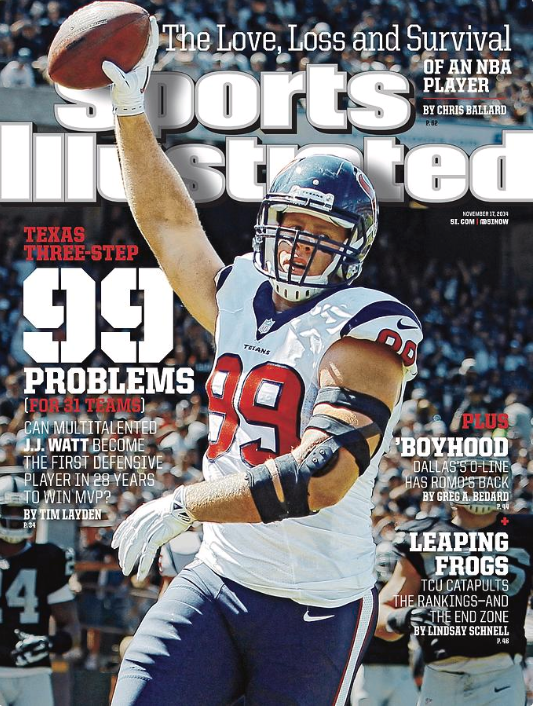
The cover story explicitly asked whether Watt could become the first defensive player to win NFL MVP since Lawrence Taylor in 1986. That was a rare and bold framing—defensive players almost never contend for the award.
At the time of the issue, Watt was already having an extraordinary year (sacks, tackles for loss, forced fumbles, batted passes, and multiple touchdowns, including on offense as a tight end). He finished with 20.5 sacks, multiple All-Pro honors, Defensive Player of the Year, and finished second in MVP voting (behind Aaron Rodgers)—one of the strongest defensive MVP cases in decades.
https://t.co/YShqfnQ4ED
Sports Illustrated Magazine- November 17th, 2014
J.J. Watt
📸Brian Bahr
✍️Tim Layden
This cover captured Watt at the height of one of the greatest individual defensive seasons of the 2010s and publicly framed him as a legitimate MVP candidate—something almost unheard of for a defensive lineman.
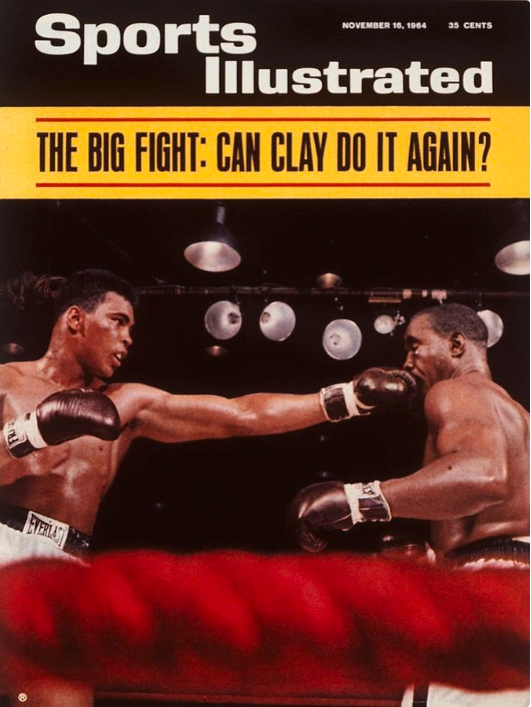
Liston was a fearsome, hard-hitting champion (often a 7-1 or 8-1 favorite) with a reputation as nearly invincible. The 22-year-old Clay, dismissed by most writers as a loudmouth, dominated and won when Liston stayed on his stool after the sixth round, claiming a shoulder injury. Clay immediately shouted that he had “shook up the world.” Sports Illustrated later ranked this fight among the four most influential sporting events of the 20th century.
In the days after the fight, Clay announced his membership in the Nation of Islam and adopted the name Muhammad Ali. What began as a boxing upset quickly became a social and political event. Being heavyweight champion amplified his stands on race, religion, and later the Vietnam War, turning him into a global icon far beyond sports.
The cover captured the skepticism and curiosity about whether Clay’s win was legitimate and whether he could beat Liston again. The fight was originally set for Boston around that November date but was postponed (Ali needed emergency hernia surgery; there were also issues with promoters, organized-crime concerns, and political tensions). It was eventually held on May 25, 1965, in Lewiston, Maine, and ended in the first round amid the famous “phantom punch” controversy and Neil Leifer’s iconic photo of Ali standing over Liston.
Sports Illustrated Magazine- November 16th, 1964
Cassius Clay & Sonny Liston
📸Herb Scharfman
✍️Gilbert Rogin
Preview of the scheduled World Heavyweight Championship rematch between champion Clay and Liston. Clay had dethroned Liston in their first fight (Liston retired on his stool after the sixth round). The rematch was originally set for Boston around that period but was postponed due to injury and other issues; it ultimately took place on May 25, 1965, in Lewiston, Maine
In the magazine’s 2019 retrospective “From Next to now,” the cover was highlighted for correctly recognizing that Garnett’s skill set “changed the NBA forever.” He was a 6'11" forward who handled the ball like a guard, scored from anywhere, rebounded at a high level, and defended multiple positions—redefining what a big man could do in the post-Jordan era.
This was early in the 1999-2000 season (the first full season after the lockout). Garnett, already a high-school-to-NBA pioneer (drafted 5th overall in 1995), was emerging as one of the league’s dominant young stars with the Timberwolves.
Around the time the issue hit, he was putting up big numbers (including a career-high 35 points in a win over the Knicks just days earlier) and was widely seen as a potential face of the next generation.
https://t.co/wEmcyGkyiu
ESPN Magazine- November 15th, 1999
Kevin Garnett
📸Dah Len
This issue appeared near the start of the 1999-2000 NBA season, the first full campaign after the 1998-99 lockout. By then, Kevin Garnett was already a rising star with the Minnesota Timberwolves. The cover is significant primarily for the way it framed him as a transformative player early in his career.
Dan Marino’s 1983 rookie season with the Miami Dolphins was a striking debut. Drafted 27th overall out of Pittsburgh, he began the year as a backup to David Woodley. After early relief appearances, Shula gave him his first start in Week 6 against Buffalo. From that point he was the starter.
In nine starts he completed 173 of 296 passes for 2,210 yards, 20 touchdowns and only six interceptions, posting a 96.0 passer rating. He led the AFC in rating, earned a Pro Bowl selection and second-team All-Pro honors, and was named The Sporting News Rookie of the Year. The Dolphins went 7–2 in his starts, finished 12–4, won the AFC East, and reached the playoffs.
The season marked the sudden arrival of a quarterback whose quick release and accuracy would redefine Miami’s offense.
https://t.co/5Lo7P9WmV1
THIS DAY IN DOLPHINS HISTORY: September 19, 1983 - Dan Marino makes his NFL Debut on MNF vs. the LA Raiders. With Miami down 27-0, Don Shula put Marino in, and Dan went 11 for 17 for 90 yards and 2 TDs
Sports Illustrated Magazine- November 14th, 1983
Dan Marino
📸Andy Hayt
This was Marino’s breakout rookie season (1983). He started the year behind David Woodley, got his first start in Week 6 vs. the Bills, and finished with strong numbers (roughly 2,210 yards, 20 TDs, 6 INTs in 9 starts), helping Miami to a 12-4 record and the playoffs. He earned Pro Bowl and Rookie of the Year honors.
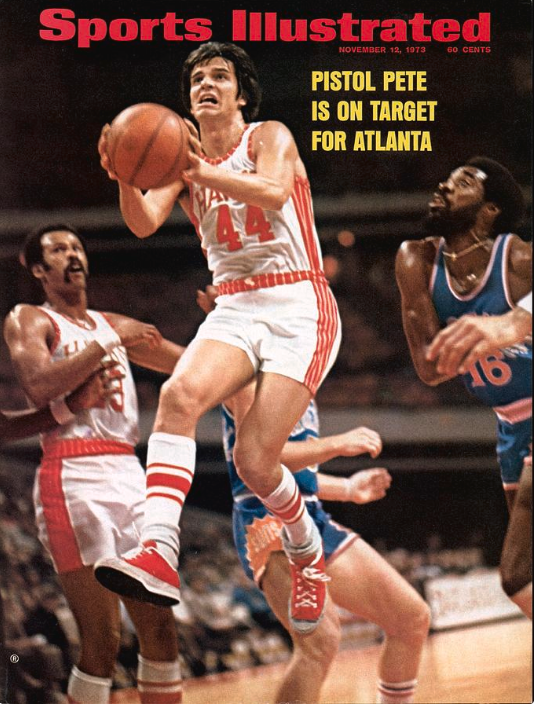
He was one of the most exciting and influential players of his era—NCAA all-time scoring leader (44.2 PPG in college with no three-point line), a five-time NBA All-Star, 1977 scoring champion, Hall of Famer, and a showman whose behind-the-back dribbles, no-look passes, and creative scoring helped open up the modern game. This cover captures him in his early NBA prime with the Hawks.
https://t.co/TO6OxVpWRs
Sports Illustrated Magazine- November 12th, 1973
Pete Maravich
📸Heinz Kluetmeier
✍️Peter Carry
The lead story, “He’s Shooting the Works” by Peter Carry, covers Maravich leading the NBA in scoring (about 29.6 PPG early in the season) alongside “Sweet Lou” Hudson (around 23.8 PPG). The duo was keeping the Atlanta Hawks competitive in the Central Division (the team was roughly 7-5 at the time). It highlights their contrasting styles and the Hawks’ offense.
Snead was already a long-established all-time great (record 82 PGA Tour wins). Palmer was the charismatic rising star of the early 1960s who was helping popularize golf with a broader audience. Pairing them as the U.S. team made for a powerful, marketable image.
The Canada Cup, founded in the 1950s, was an early major effort to grow golf worldwide through national team competition and goodwill. Featuring the American pair on the cover of a major U.S. magazine underscored American dominance while highlighting the event’s global reach.
https://t.co/lGYO5AFJLK
Sports Illustrated Magazine- November 12th, 1962
Arnold Palmer & Sam Snead
📸John G. Zimmerman
✍️Gwilym S. Brown
The magazine previewed the 10th Canada Cup (the forerunner of the modern World Cup of Golf), held November 8–11 at Jockey Club Golf in San Isidro, near Buenos Aires, Argentina. Palmer and Snead won the team title by two strokes over the host Argentine team (Fidel de Luca and Roberto De Vicenzo).
De Vicenzo took the individual title. This was one of several Canada Cup team wins for the U.S. in that era, with Snead having partnered successfully in prior editions as well.
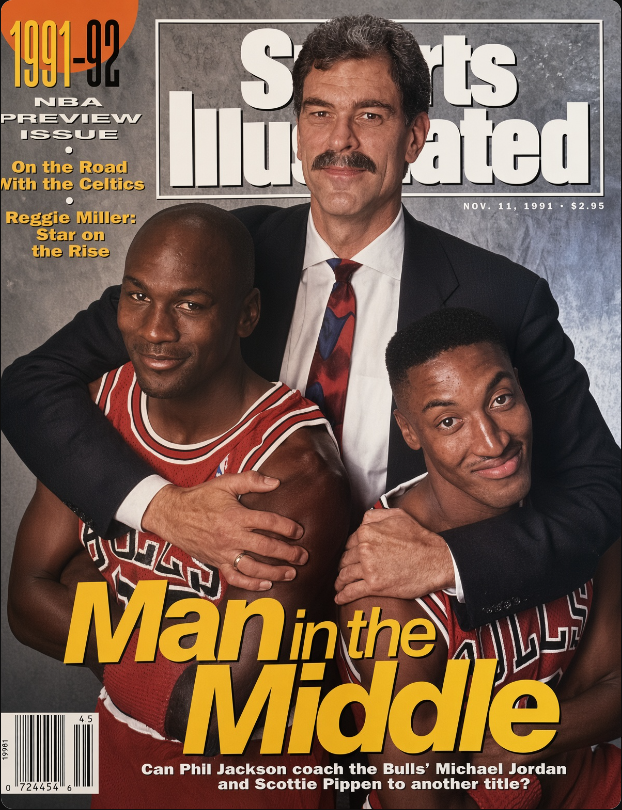
It captured the Bulls at the start of their run as defending champions. They would go on to win the 1992 title (and the 1993 title), completing their first three-peat. The cover reflected the shift from Jordan carrying the team to a more balanced system under Jackson’s triangle offense and leadership.
This was the first Sports Illustrated cover appearance for both Phil Jackson and Scottie Pippen (Jordan’s roughly 18th). That makes it a collectible “rookie” cover for the two key supporting pieces of the dynasty.
https://t.co/jVT7Zd9ktd
June 14, 1992: Chicago Bulls set an NBA Finals record by storming back from a 15-PT deficit going into the 4th quarter (later surpassed) to defeat the Portland Trail Blazers in Game 6. SG Michael Jordan became the 1st player to win back-to-back NBA Finals MVP awards
Sports Illustrated Magazine- November 11th, 1991
Michael Jordan & Scottie Pippen & Phil Jackson
📸Jean Moss
✍️Rick Telander
It was the 1991-92 NBA Preview Issue, published just months after the Bulls won their first NBA championship in June 1991 (beating the Lakers in the Finals after sweeping the Detroit Pistons in the Eastern Conference Finals).
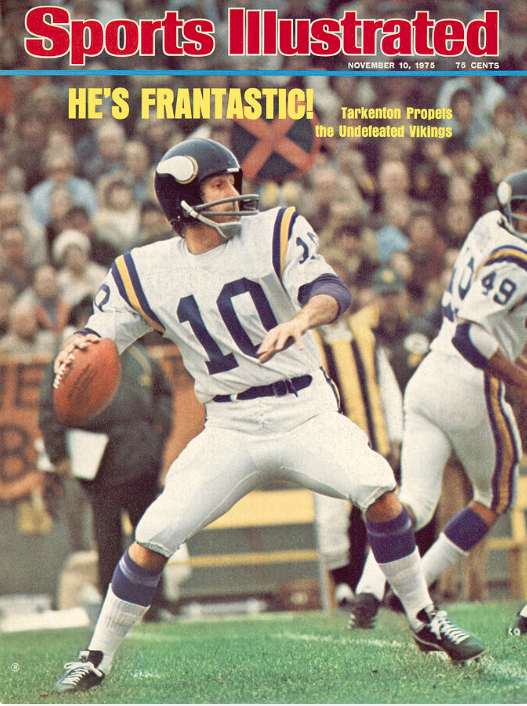
At age 35, 1975 was widely regarded as one of his best years. He threw for 2,994 yards, 25 touchdowns, and only 13 interceptions (64.2% completion), helping lead the Vikings to a dominant regular season. He won the NFL MVP and Offensive Player of the Year awards and was a first-team All-Pro.
The cover celebrated the Vikings as a top NFC team (they had also gone to the previous Super Bowl). Inside features highlighted Tarkenton closing in on Johnny Unitas’s career passing records while keeping the team rolling.
The Vikings were viewed as a legitimate Super Bowl contender. Their season ended in heartbreak in the NFC Divisional Round on the famous Roger Staubach-to-Drew Pearson “Hail Mary” play (17-14 loss to Dallas). They never won a Super Bowl in Tarkenton’s era despite multiple appearances.
https://t.co/9x1zdgLBLY
The historic Vikings-Bills matchup in snowy Orchard Park in the final week of the 1975 regular season
NFL MVP Fran Tarkenton surpassed Johnny Unitas to become the NFL's all-time career leader in touchdown passes with 291.
Chuck Foreman scored four touchdowns in the Vikings' 35-13 win, temporarily tying O.J. Simpson for a then NFL single-season record of 22.
Foreman was then hit in the eye with a snowball, which ended his day and allowed Simpson to set the record of 23.
Sports Illustrated Magazine- November 10th, 1975
Fran Tarkenton
📸Neil Leifer
Fran Tarkenton was on the verge of breaking the NFL's all-time career passing touchdown record, a feat he accomplished just days after this issue hit newsstands.
In June 1992, the 76ers sent Barkley (then a six-time All-Star and perennial All-NBA talent) to Phoenix for Jeff Hornacek, Tim Perry, and Andrew Lang. It was widely viewed as a high-stakes move for both teams. Barkley was a dominant force (often averaging 20+ points and 10+ rebounds) but had grown frustrated in Philadelphia amid team struggles, public criticism of management, and off-court incidents. The Suns, already a strong regular-season team, added him to push for a championship.
The cover caption—“In the year of the trade, the Suns deal for the wildest card”—positioned Barkley’s move as the defining storyline of the offseason. It reflected the broader NBA landscape of major personnel shifts (including the end of the Magic Johnson/Larry Bird era) and the rise of high-profile deals. Barkley was coming off a high-profile stint with the 1992 U.S. Olympic “Dream Team,” which amplified his star power.
Barkley thrived in Phoenix. He won the 1992–93 NBA MVP award, helped the Suns to a league-best 62–20 record, and led them to the NBA Finals (where they lost to Michael Jordan’s Chicago Bulls). The Suns also debuted a new arena (America West Arena) and new uniforms that season.
https://t.co/4Fbu6nKtou
Charles Barkley was traded to the Suns 34 years ago today for Jeff Hornacek, Andrew Lang & Tim Perry
1992-93 SEASON
37 PTS, 21 REB, 8 AST in Suns' debut
Best record in the NBA (62-20)
Wins MVP (Hakeem was 2nd)
Lost in NBA Finals
Sports Illustrated Magazine- November 9th, 1992
Charles Barkley
📸Manny Millan
✍️Jack McCallum
In July 1992, the Suns acquired Barkley from the Philadelphia 76ers in a trade for Jeff Hornacek, Tim Perry, and Andrew Lang. Barkley, fresh off the 1992 Dream Team Olympics, was one of the league’s biggest stars and most colorful personalities. The deal was widely viewed as a high-upside gamble that instantly raised Phoenix’s championship expectations as they opened a new arena and looked to contend in the West.