Explore Minas Americas in 103 seconds.
See the location of our exploration-stage rare earth project in Minas Gerais, Brazil, its drilling history and grades down four selected drill holes.
Public results and our September investor presentation are in the reply.
US$3.47 BILLION has already voted.
In 2026:
→ USA Rare Earth completed its ~US$2.8bn combination with Serra Verde.
→ Lynas agreed a ~US$672m deal for Meteoric.
Different buyers. Same destination: Brazilian ionic clay.
Why does that matter?
Because rare-earth investors are learning to look beyond headline grade and ask harder questions:
What actually goes into solution?
How much Nd, Pr, Dy and Tb can be recovered?
How complicated is the flowsheet?
How much capital does it take to build?
And what does each tonne ultimately produce?
Ionic clay has the potential to change that equation — particularly for scarce heavy rare earths.
At Magnes Rare Earths, a wholly owned subsidiary of Verde AgriTech (TSX:NPK | OTCQX:VNPKF), we are advancing Minas Americas in Minas Gerais under an ionic-adsorption clay exploration model.
We are still at the exploration stage. We still have to prove representative recovery, resource scale and economics.
But that is also what makes the next chapter interesting:
Drilling.
Assays.
Metallurgy.
Resource definition.
More evidence.
The industry is paying attention to Brazilian ionic clay.
Our job now is to earn our place in that conversation.
Capital is voting.
Follow Magnes Rare Earths.
Before robots take their first steps, someone has to get their boots dirty.
At Magnes Rare Earths, we're exploring Brazil's ionic clays for the elements behind high-performance magnets.
The future isn't just coded. It's discovered.
Follow our drilling story.
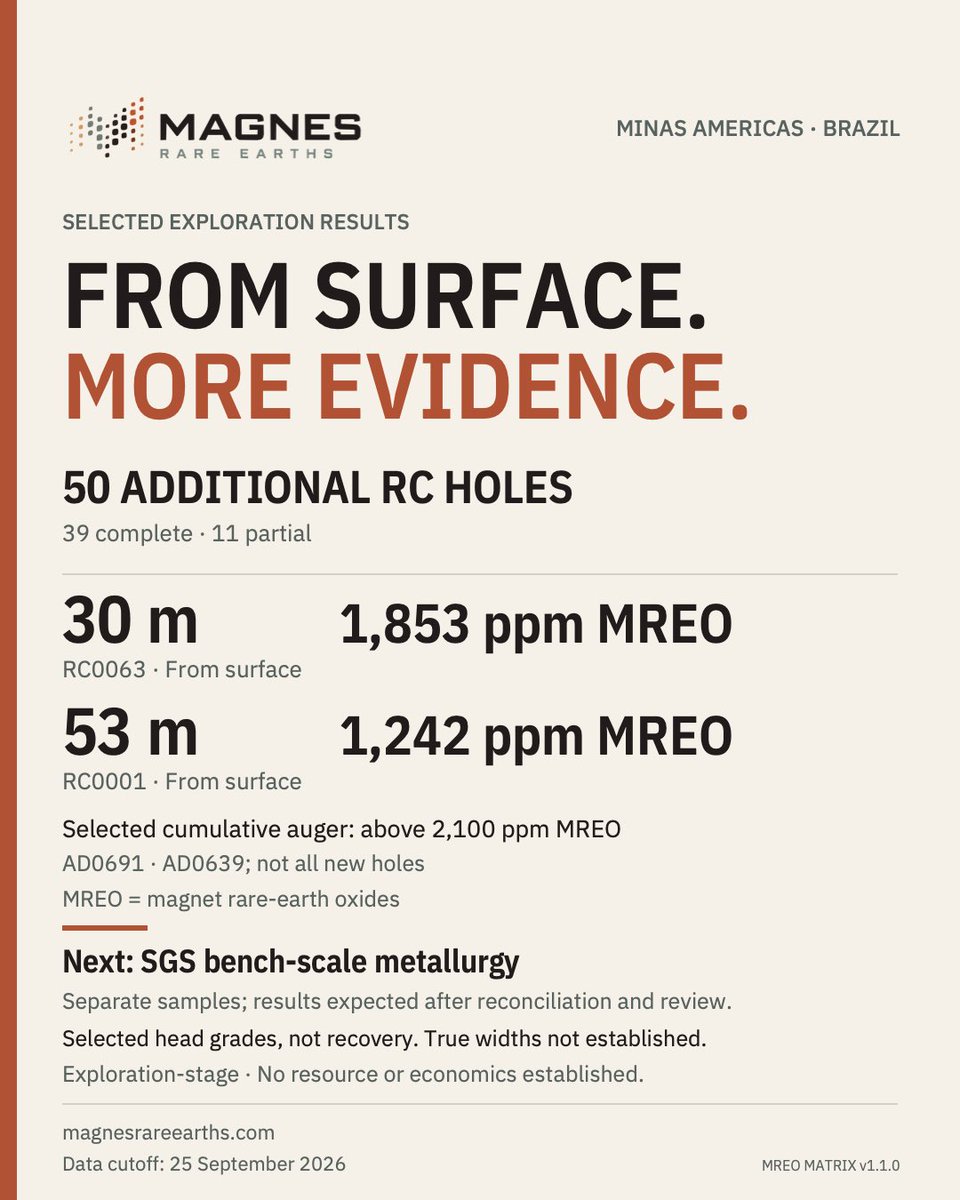
30 m. 53 m. Both from surface.
Minas Americas, Brazil: RC0063 at 1,853 ppm magnet rare-earth oxides (MREO); RC0001 at 1,242 ppm MREO.
Cumulative auger profiles above 2,100 ppm MREO.
Selected head grades, not recovery. True widths not established.
https://t.co/LWBwBBckKx
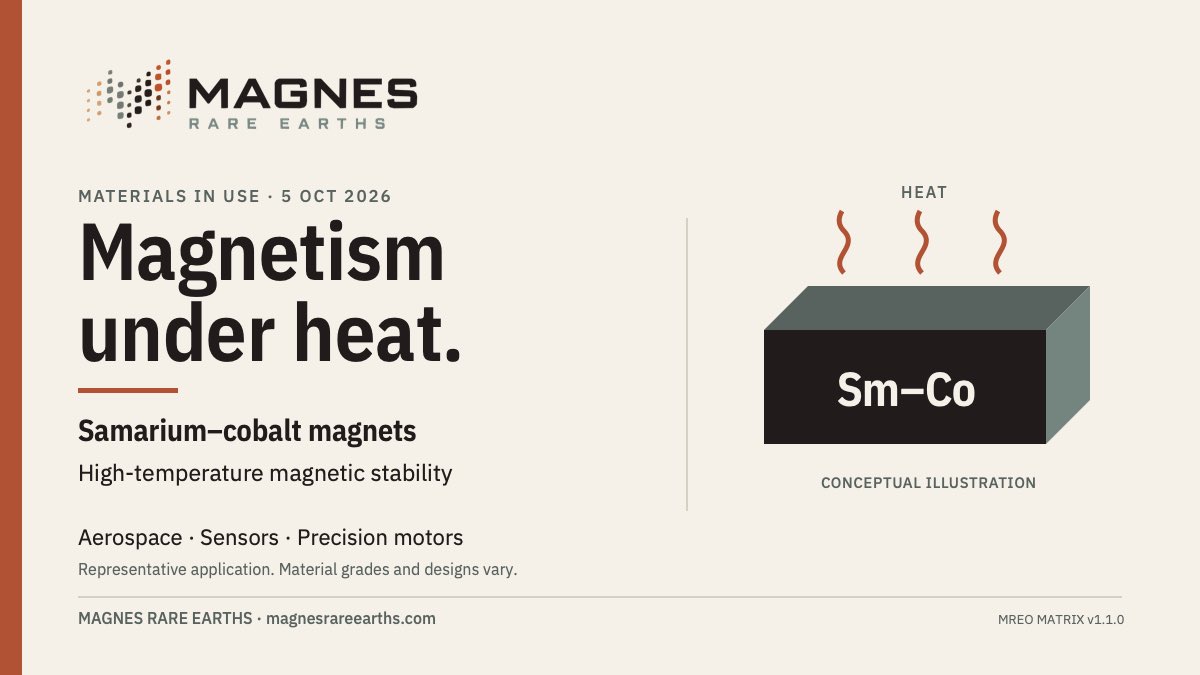
Some magnets have to work in the heat. Samarium-cobalt magnets offer high-temperature magnetic stability for aerospace systems, sensors and precision motors. Explore the role of samarium: https://t.co/HJwlo7Opxd
US$3.47 BILLION.
That is the headline acquisition value that has gone into TWO Brazilian ionic-clay rare-earth assets in this cycle.
Serra Verde: ~US$2.8bn.
Meteoric: ~US$672m.
Large development-stage hard-rock REE acquisitions >US$500m that I can find in 2026: ZERO.
Capital has voted.
And this is not retail money chasing a new geological buzzword.
USA Rare Earth completed its acquisition of Serra Verde, owner of the producing Pela Ema ionic-clay operation in Brazil.
Now Lynas Rare Earths — arguably the most experienced successful hard-rock rare-earth producer outside China — has agreed a A$968m deal for Meteoric Resources and its Caldeira ionic-clay project in Minas Gerais.
That is what makes the Lynas transaction so interesting.
Lynas knows hard rock.
It built its business on Mt Weld. It understands crushing, beneficiation, cracking, leaching, separation, commissioning, capex and operating complexity better than almost anyone outside China.
And when Lynas went looking for its next source of rare earths — particularly heavy rare earths — it started publicly talking about ionic clay.
Then it bought one.
That deserves attention.
This is not because the world has somehow run out of large hard-rock rare-earth projects.
There are plenty of substantial public companies advancing mineral-hosted projects:
$MP — MP Materials
$LYC — Lynas Rare Earths
$CRML — Critical Metals / Tanbreez
$BRE — Brazilian Rare Earths
$ARU — Arafura Rare Earths
Investors can debate their merits individually. Some may become excellent businesses.
But the M&A scoreboard in this cycle is striking:
IONIC CLAY
→ Serra Verde: ~US$2.8bn
→ Meteoric: ~US$672m
→ Total: ~US$3.47bn
HARD-ROCK DEVELOPMENT PROJECTS
→ Comparable >US$500m acquisitions I can identify in 2026: US$0
Why?
Because rare-earth investing is finally becoming less obsessed with what is IN the rock — and more interested in how difficult it is to get the valuable elements OUT.
That distinction is enormous.
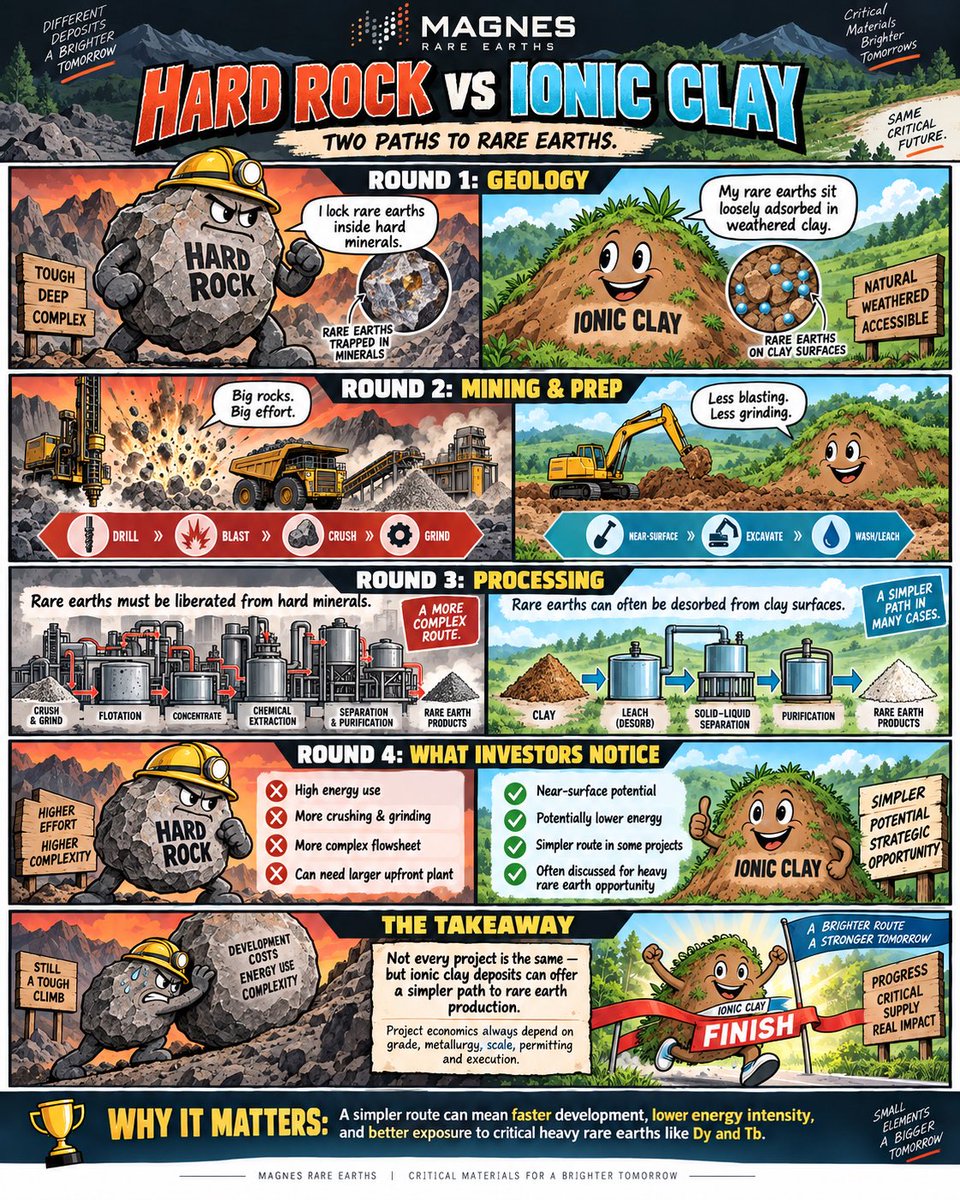
In conventional mineral-hosted rare-earth deposits, the REEs can be locked inside minerals.
You may need to:
mine
→ crush
→ grind
→ beneficiate
→ concentrate
→ chemically crack the mineral
→ leach
→ purify
→ separate
→ make a saleable product
Every step adds capital.
Every step adds operating cost.
Every step creates another opportunity for the real plant to disappoint the feasibility study.
The last rare-earth cycle taught investors that lesson painfully.
A huge resource and spectacular head grade do not automatically create shareholder returns.
True ionic-adsorption clay is fundamentally different.
Weathering has already done part of the work.
A portion of the rare earths can be weakly adsorbed onto clay surfaces and potentially released using comparatively mild salt-based desorption rather than first destroying a resistant mineral lattice.
That can mean:
less comminution
less beneficiation
no conventional mineral cracking for the exchangeable fraction
simpler front-end processing
potentially lower capital intensity
And perhaps most importantly, ionic-clay systems have historically been particularly important sources of the scarce heavy rare earths — including Dy and Tb.
Those are not trivial differences.
They go directly to the question every investor should eventually ask:
How many PAYABLE grams of Nd + Pr + Dy + Tb come out of every tonne processed — and what does it cost to get them?
Not:
“What is the prettiest TREO number in the investor presentation?”
Of course, not every clay deposit is ionic.
And “ionic clay” is not a magic phrase.
A serious project still needs to demonstrate representative desorption, variability, impurities, reagent consumption, water balance, residue management, downstream purification, product specifications and ultimately economics.
That is exactly why technical validation matters.
But increasingly, capital is validating the geological model as well.
A drill-result footprint shows where reported results occur—not a resource boundary or proof of continuous mineralisation. That distinction matters: exploration evidence and a defined resource are not the same thing. https://t.co/90A6mANGYB
The world’s dominant rare-earth processor has suppliers of its own. China refined 91% of magnet rare earths in 2024—but also used foreign feedstock. Dysprosium and terbium reveal the paradox. Read our research: https://t.co/2yrKS0vnTJ #RareEarths
From drill sample to reported result, the assurance chain matters.
For our 8 September results: lithium-borate fusion followed by ICP-MS/OES, blanks, certified reference materials, field duplicates and laboratory controls—plus independent QP review.
https://t.co/u8a8ZBb9jd
One selected solution test cannot answer four different questions.
Our responsible-development framework separates original material, primary leach solution, residues and any potential product. Each needs its own evidence—and a complete mass balance.
https://t.co/38JOe0zoWn
Four selected RC holes, shown by drilled depth.
This excerpt compares reported rare earth head grades at Minas Americas. It does not establish continuity between holes or recovery.
Full film pinned on our profile; public results in its first reply.
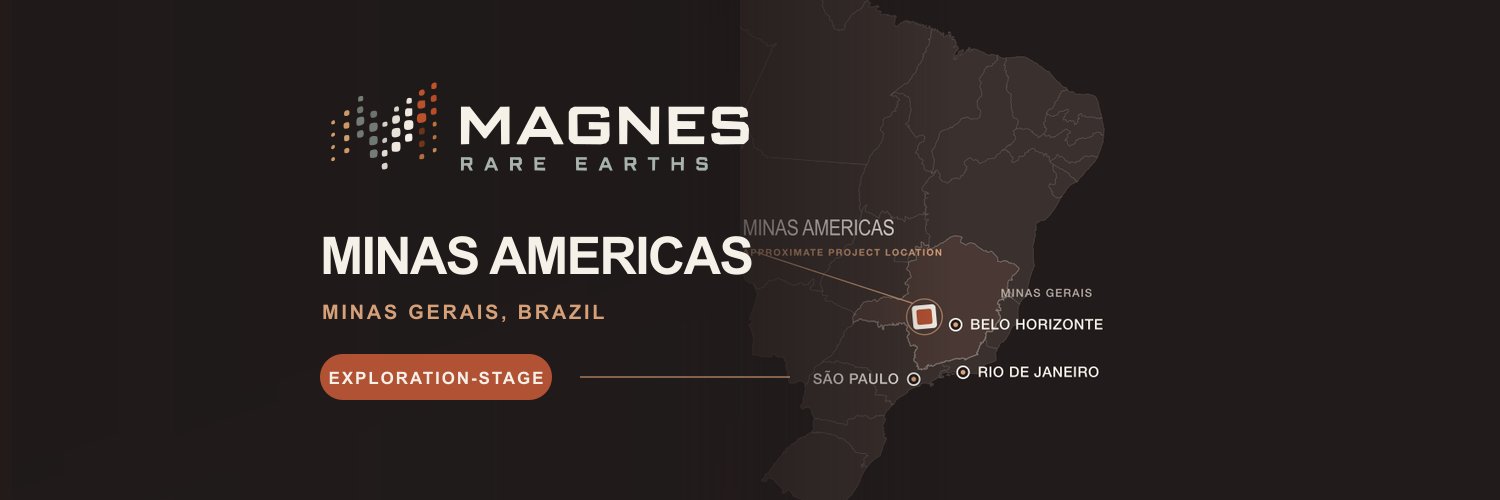
Minas Americas in geographic context.
A short excerpt from our film places the exploration-stage rare earth project in Minas Gerais, Brazil, with roads and facilities shown for context.
Watch the full film pinned on our profile.
Published results (8 September 2026):
https://t.co/6SoLmtx0at
September investor presentation:
https://t.co/a9rQPqK6Z0
Reported grades are head grades. They do not establish recovery, continuity or a mineral resource.
Explore Minas Americas in 103 seconds.
See the location of our exploration-stage rare earth project in Minas Gerais, Brazil, its drilling history and grades down four selected drill holes.
Public results and our September investor presentation are in the reply.
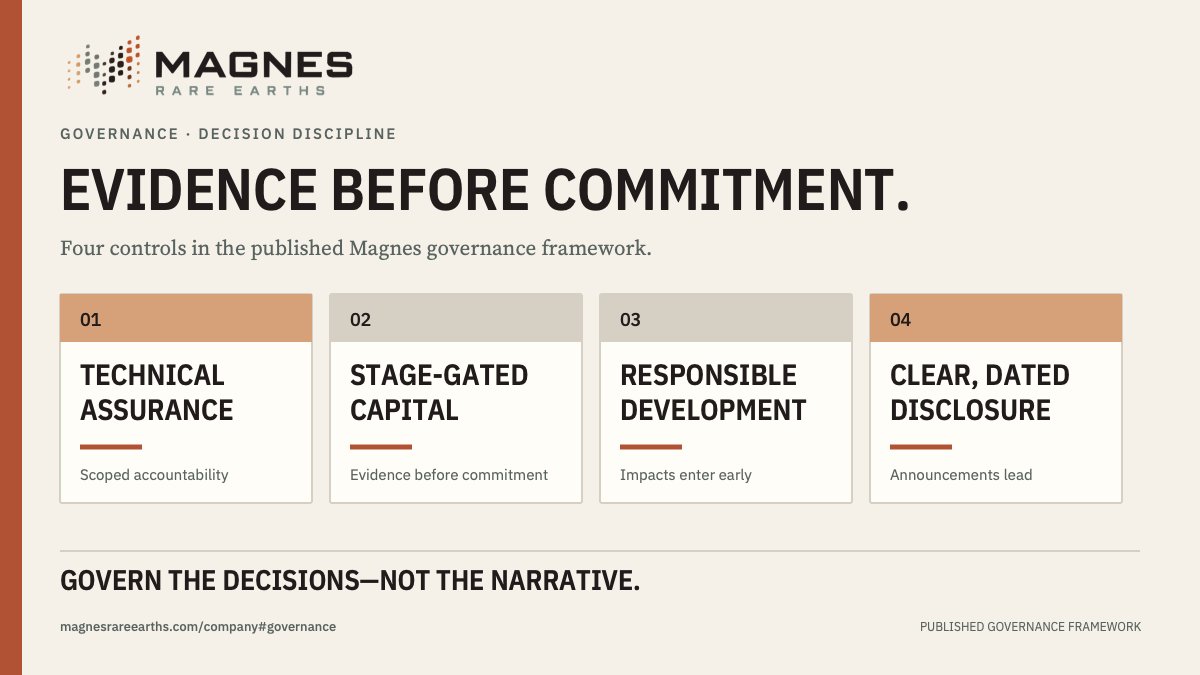
Before commitment comes evidence.
Our published governance framework puts four controls into the decision process: technical assurance, stage-gated capital, responsible development and clear, dated disclosure.
https://t.co/lt4t8NJJhs
Why the first RC results matter: they add depth.
MAV_RC_0012 returned 29 m from 31–60 m EOH at 0.58% TREO. Separately, MAV_AD_0375 returned 15 m from surface to EOH at 1.15% TREO.
Head grades; drilled lengths; true thickness undetermined.
https://t.co/6SoLmtx0at
Before investors could follow Minas Americas, it needed a name in the issued record.
On 14 October 2025, the project was formally named and a phased exploration programme described. Later releases provide the current technical record.
https://t.co/LrU2rSeO0w
The world needs another source—not another supply shock.
As some Chinese suppliers halt US rare-earth shipments, Magnes is advancing Minas Americas in Brazil, focused on Nd, Pr, Dy and Tb.
297 drill holes with reported assays.
Supply security starts at the source.