Focusing on political and military analysis, with a focus on understanding how strategy, power, and security dynamics shape global affairs. My work examines the intersection of geopolitics, military doctrine, and statecraft.
To an extent, let’s take the BTR-22.
It has a total combat crew capacity of 11 people.
In the current conditions of a war of attrition, a single FPV drone could destroy a vehicle carrying 11 personnel. This makes the use of infiltration tactics more logical. It is not worth losing 11 people and a BTR when infantry can instead infiltrate, disperse, and avoid drone observation.
Within Ukraines environment, avoiding drone's is more important than the speed and protection offered by armoured transport.
@M0nstas They are doing lots of minor offensives. Pushing on all fronts to create pressure. The issue for myself is with the exception of Stepnohirs'k currently. These offesnives are costly without the ability to capture major defensive nodes.
Update incoming tonight on the Stepnohirsk offensive.
TLDR: this is a genuine victory for the Ukrainians, as they managed to secure a defensive node that can be used to leverage the wider frontline situation.
I am currently studying for my final exam in japanese.
Update incoming tonight on the Stepnohirsk offensive.
TLDR: this is a genuine victory for the Ukrainians, as they managed to secure a defensive node that can be used to leverage the wider frontline situation.
Give this six weeks to properly test the effectiveness of this strategy. If Ukraine can maintain its current ability to strike Russian logistics this far behind the front line, then it should be considered a clear operational victory. It would show that Ukraine can consistently disrupt Russian supply routes, increase the cost of maintaining forward positions, and place pressure on Russia’s rear-area logistics network.
However, if Russia develops an effective counter-strategy through improved air defence, electronic warfare, dispersal of logistics hubs, or alternative supply routes then this should be viewed more as a successful short-term tactical victory rather than a permanent shift in battlefield control.
The case study is the: Excalibur smart shells. 6 weeks of effectinvess until counter mesaures were introduced.
Furthermore, Ukraine is harassing and disrupting logistics, not exercising “control over the land bridge to Crimea.” Control implies to "dominate that territory". At this stage, Ukraine is increasing the risk and cost of Russian movement through the corridor, but that is not the same as controlling it .
@Steveisking1 My rule is give it 6 weeks. To judge the effectiveness of a strategy/system in the long term.
As a effective new equipment or strategy takes time to develop counter measures.
This 6 week period will decide the longevity of the campaign.
I disagree with the idea that this fully “redefines the depth of the kill zone.” In the 3rd and 4th echelons, drones are not necessarily creating a continuous kill zone in the same way FPVs do near the line of contact. Instead, they are acting more like opportunity predators: searching for exposed logistics, fuel trucks, air defence systems, depots, and other high-value targets.
The closest modern comparison is not a traditional frontline kill zone, but something closer to close air support applied against logistics and rear-area movement from World War 2.
Because drones are cheap, flexible, and supported by systems such as Starlink, Ukraine can increasingly harass and disrupt Russian logistics deeper behind the front. This will raise costs, slow movement, and force Russia to spread air defence and electronic warfare assets along key logistics routes.
However, I do not think this alone will force Russia to abandon positions in Crimea, Kherson, or other rear areas. Even near the line of contact, both sides can still accumulate armoured forces when enough concealment, dispersal, and protection are used.
These drones do not make the entire rear impossible to operate in. Rather, they make logistics more expensive, more dangerous, and more complicated. This will force Russia to spread out its AD to maintain its logtics web or employ new forms of electronic warfare.
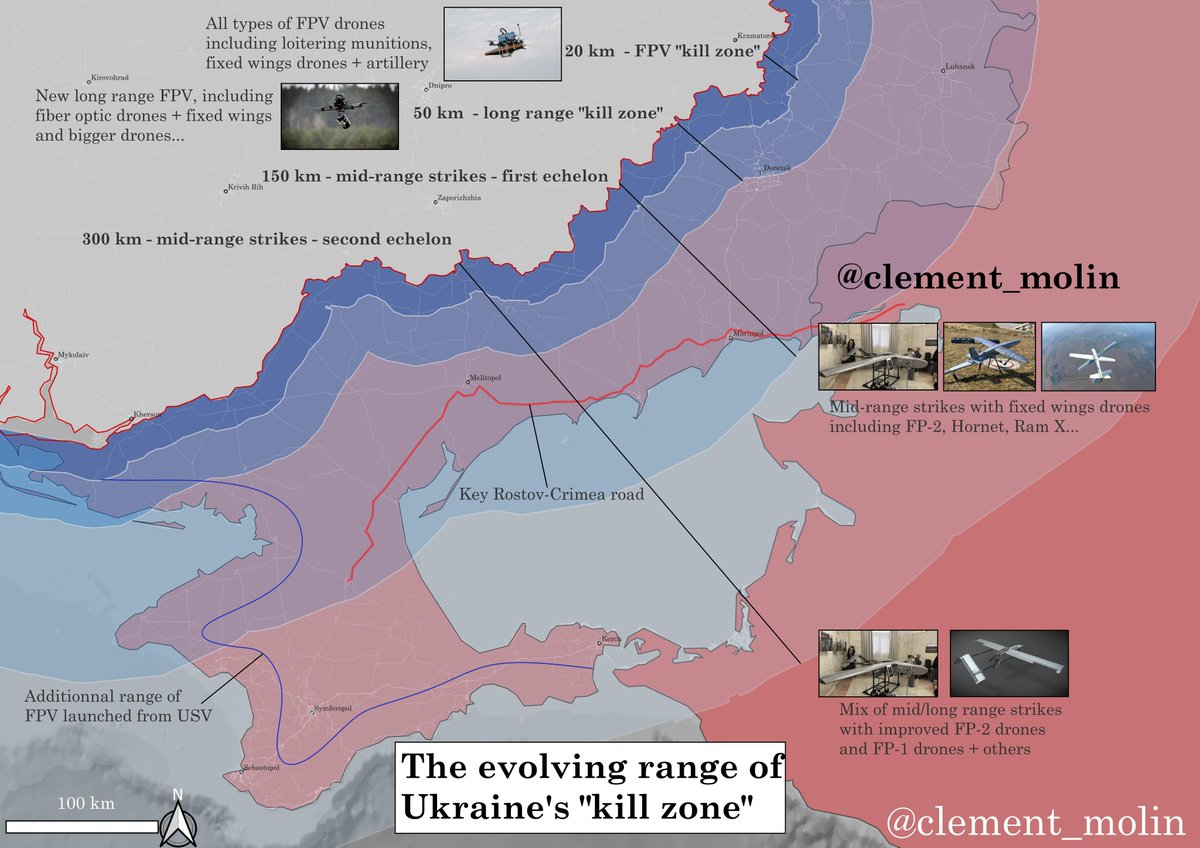
With more and more drone strikes reaching the key Rostov-Crimea highway, Ukraine 🇺🇦 redefines the depth of the "kill zone".
🔹The first echelon extends to approximately 20 km (this is the case on both sides of the front). It primarily consists of FPV drone strikes, which generally operate at a depth of 5 to 15 km, although some drones with wings fly further. This is the basic kill zone; anything that moves is quickly targeted, movement is severely restricted, and losses are high.
🔹The second echelon is very recent, extending to 50 km or more, with enhanced conventional FPV strikes, notably via Starlink or sometimes with added wings, increasing their range. This is particularly the case around Donetsk. In this instance, the targets are logistics, deployment points, and key roads leading to the front. Losses are also significant, especially in terms of vehicles, which are often unarmored.
🔹The third echelon is twofold: on the one hand, there are tactical strikes against high-value targets carried out primarily by FP-2 drones (rear bases, training centers, ammunition depots, repair facilities, air defenses, radar installations, etc.), and now also by roving munitions that fly over key routes and target Russian logistics, particularly military equipment and fuel trucks.
🔹The fourth echelon extends even further, towards Crimea and Russia. This echelon mainly involves the FP-1 drone, but also frequently the FP-2 and other long-range drones. Targets include the foundations of the Russian economy (refineries, ports, industries), the Russian army in Crimea, fuel depots, and command centers.
🔹An additional echelon is made possible by the launch of conventional FPV drones from the decks of naval drones (USVs) and sometimes aerial drones, enabling FPV strikes far from the front lines.
My map with a basic understanding of the different echelons ⬇️
This could well be the most important battle of 2026 of the war in Ukraine, if the momentum from 2025 does not pick up again. Everything seems to indicate that the first phase of the Ukrainian collapse in Kostiantynivka is beginning.
I disagree to a extent. In drone warfare Ukraine has been innovating faster than the Russians.
In ground operations. Russia has been innovating faster than Ukraine.
A example: motorcycles have been used to effectively "Cross-country" attack postions in Drone saturated environments. This tactic wss first used by Russians and now is used by Ukraine.
Again, I do not understand the optimism within parts of the Ukrainian community.
There was only limited success with the Huliaipole offensive, while Kostiantynivka is currently under serious threat of falling, and the Lyman front remains under heavy pressure.
Russia apparently found itself in Ukraine's 2022 position.
The enemy can reach you everywhere and you are not mentally/operationally prepared for that.
But Ukraine never expected to dominate the battlefield.
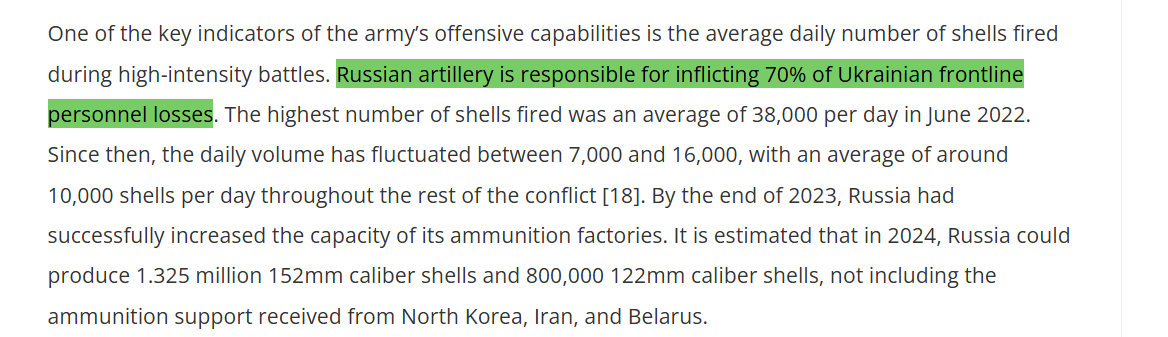
It appears that around 70% of Ukrainian casualties are being caused by Russian artillery, SPGs, and other gun systems.
Artillery remains one of the main killers on the battlefield and still plays a decisive role in shaping the tactical situation.
Source: https://t.co/rnHXIXD5u9
https://t.co/K6wd6OwcOL
Pokrovsk is the city.
Modern cauldrons do not always require a fully sealed pocket. They can be created through flank pressure, infiltration, drone surveillance, artillery fire control, and the collapse of reliable resupply routes.
Russia worked the flanks, infiltrated the city, pressured the supply routes, and used heavy systems like TOS to make continued defence increasingly untenable. It was a gradual operational squeeze until Ukraine could no longer reliably hold or resupply.
Drones are essentially guided munitions. They are excellent for identifying, tracking, and striking individual targets, but they remain vulnerable to electronic warfare and carry limited payloads.
SPGs and conventional artillery are still the systems that provide the weight of fire needed to blunt Russian or Ukrainian assaults. Drones can punish exposed units, logistics, and armour, but artillery provides the sustained mass firepower needed to break up attacks, suppress positions, and stop advances at scale.
"Do you even know what causes 90% of casualties at this point in the war ? Hint, it's not fucking tanks. "
Yes I know its SPG (artillery). Which I make several mentions of which you conveniently downplay. Despite them being arguably the most tool in Ukraine next to drones.
Second of all, where are your statistics? You claim OPSEC but come on man. If your going to argue. Bring atleast something to prove