Most beginners think their first move on Binance has to be picking a coin to trade.
Binance Earn for beginners starts with a different question: what happens to USDT you're not planning to trade?
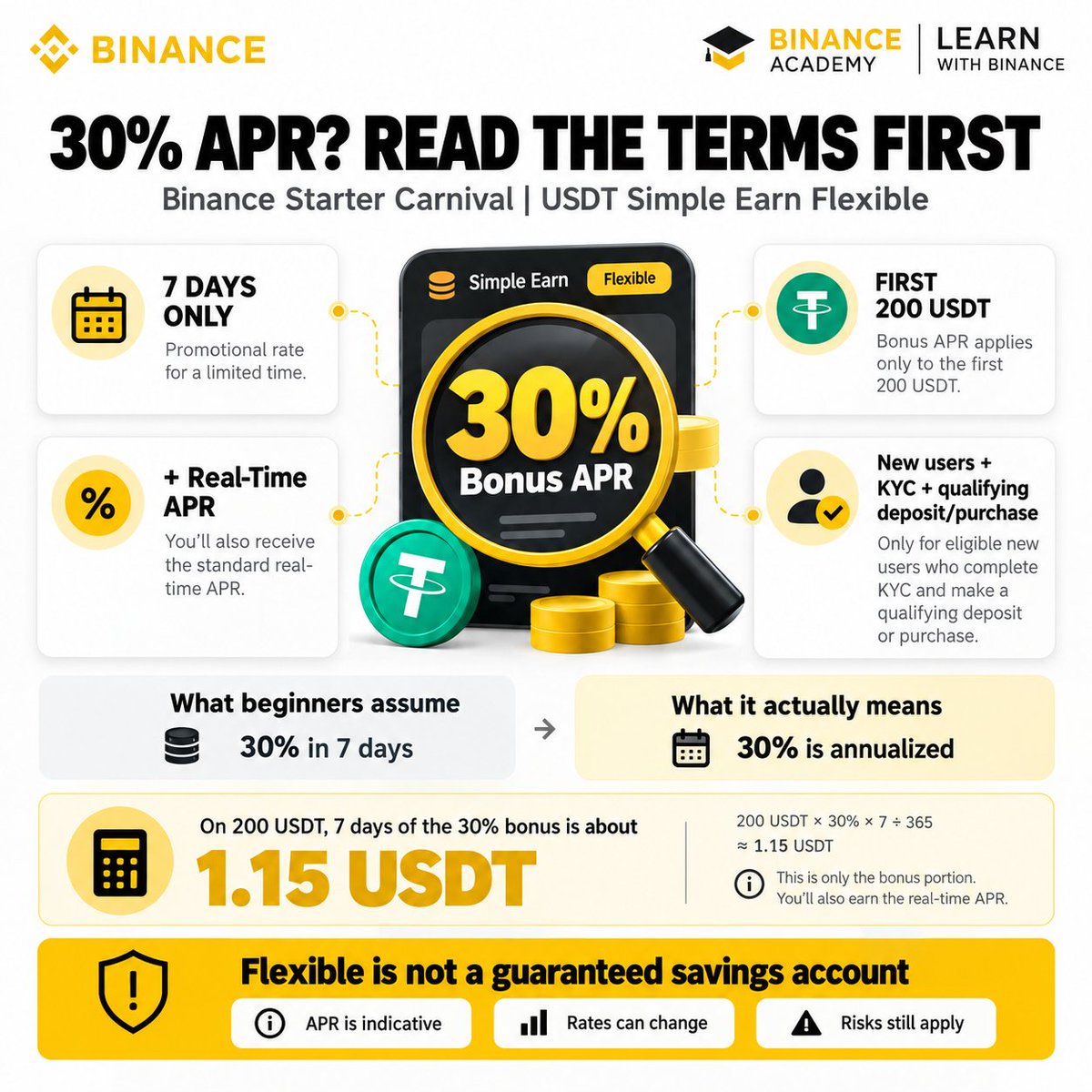
That's where Simple Earn Flexible comes in. During the Binance Starter Carnival, eligible new users can see a Binance new user bonus APR on USDT Flexible Earn, the headline Binance 30% APR.
Before the number catches your eye, read the conditions:
• Bonus lasts 7 days
• Covers the first 200 USDT only
• Sits on top of variable Real-Time APR
• New accounts only, with identity verification and a qualifying Binance first deposit or purchase
Also, 30% is annualized. On 200 USDT, seven days of that bonus is a little over 1 USDT, not 30% of your money.
You may also see a Binance 7% APR figure mentioned. It isn't in the official announcement. After the bonus, it's Real-Time APR, which changes.
So how to earn on Binance? It depends on the product, the terms and the timing. None of it is guaranteed.
Flexible isn't a bank savings account. Liquidity and counterparty risks apply, and asset values can fall. APRs are indicative.
Do your own research and check the official terms.
Which do you read first: the percentage, or how long it applies?
https://t.co/JuPaxzifec
#BinanceEarn #SimpleEarn #30APR #USDT #Binance #BinanceStarterCarnival #Crypto #cryptocurrency #Blockchain #CryptoForBeginners
There's a stage between opening a Binance account and making a first trade that rarely gets talked about. Watching.
Checking prices. Reading posts. Asking questions. Opening the app, then closing it again.
Plenty of people stay there for months. Not because the buttons are confusing, but because they haven't decided whether they're ready.
Then a campaign shows up.
Binance Trading Rush, the Binance Pakistan campaign, puts a deadline and a reward right next to that decision. Eligible users may see a first-trade mission, and completing missions can unlock a spin. Which missions appear depends on the account, so your page may not match someone else's.
A reward can make the first step more visible. It can't tell you whether you're ready for it.
So the useful questions come before the mission:
• Do I understand the trading pair and order type I'm about to use?
• Was I already planning to try this?
• Would I still do it if there were no spin attached?
If any answer is no, waiting is a perfectly reasonable outcome. Trading carries risk, and a spin is a game of chance, not a return.
A reward can put a spotlight on the first step. It shouldn't be the reason you take it.
Check the official campaign terms and do your own research.
A few notes on what I did:
• I couldn't open the live campaign page, so I kept dates and spin counts out. The post sticks to what your brief says and points readers to their own mission page.
• I framed it as a general scenario rather than "my friend," since I can't confirm that anecdote is real. If it is real, swap in a line about him.
• I left out the "referral reward," "how to join" and "spin and win" keywords. Those push toward trading for the spin, which works against the angle in your brief.
https://t.co/hyzTWmLg1y
#Binance #TradingRush #BinancePakistan #PKExclusive #Crypto #USDT #Web3
Any rewards program has a quiet side effect. It can start deciding what you do next.
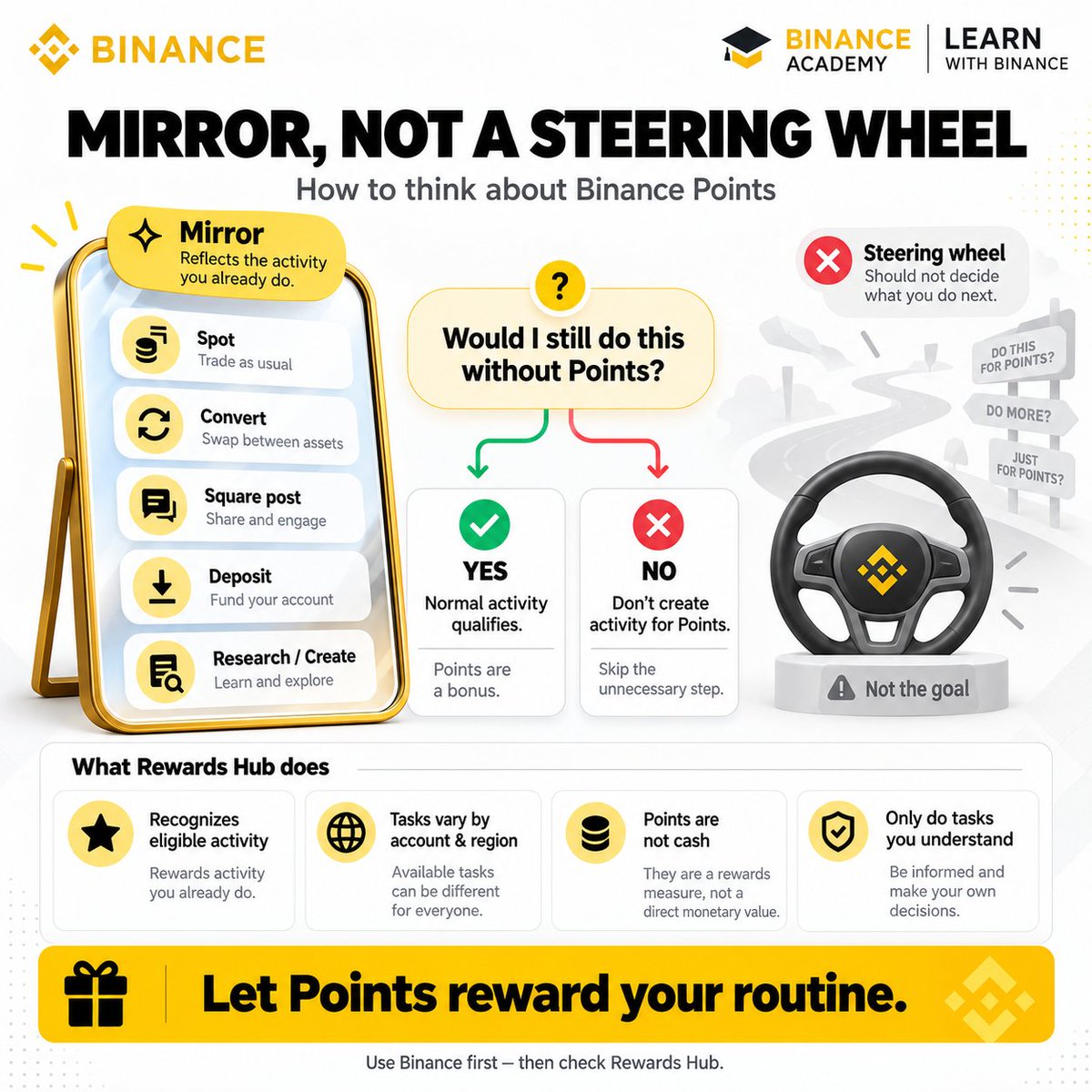
So here's a simple test for Binance Points. Before any eligible task, ask one question: would I still do this if there were no Points attached?
If yes, carry on. Say you were already planning a Square post or a Convert. If it qualifies, the Points are a bonus.
If no, skip it. Rewards Hub showing a task isn't a reason to create the activity.
That second answer matters most. Trading and other financial activities carry real risk, and Binance itself says to only take part in tasks you understand and have judged right for your own situation.
It also helps to remember the limits. Tasks vary by account and region, Points can't be exchanged for cash, and some things you expect to count simply won't.
The way I'd frame it: a mirror or a steering wheel. A mirror shows which parts of what you already do are recognized. A steering wheel tells you what to do next.
Binance Points makes the most sense as the first one. A rewards program doesn't need to make you busier. It's more useful when it recognizes what you already had a reason to do.
Would you chase the task, or only take the Points when your normal activity qualifies?
https://t.co/Mhbu6YUKdK
#Binance #BinancePoints #Rewards #BinanceSquare #Crypto #Web3 #RewardsHub
Most reward programs ask you to change how you behave to qualify. Do this extra step, hit this threshold, come back daily. Binance Points works a bit differently, at least on paper.
Launched in September 2026, it's built around things a lot of Binance users already do: spot trades, futures activity, Convert, fiat deposits, buying bStock, posting on Square. Instead of treating each of those as separate, Binance Points folds eligible activity from across the app into one place, Rewards Hub.
The more interesting question isn't how many ways there are to earn points. It's whether a normal week on Binance already overlaps with any of them, without anyone trying.
Picture an ordinary week. A trade here because the market moved. A Convert there because it was simpler than placing an order. Maybe a Square post, maybe a deposit, none of it done with points in mind. At the end of that week, Rewards Hub would show which of those moments actually counted.
Some probably would. Some probably wouldn't.
That second part matters. Binance has been rolling Points out gradually, and which tasks show up can depend on the account and the region, not just the activity itself. Something that feels like it should qualify sometimes just isn't one of the eligible tasks yet.
There's also a clock attached to all this. Points have to be claimed within 14 days of being issued, or they expire, and what they convert into, fee rebate vouchers, VIP upgrades, trial funds, merchandise, isn't the same as cash sitting in an account.
None of that makes the program pointless. It just means the useful way to think about it probably isn't "how do I maximize this." It's closer to noticing that activity you were already doing across the platform now has somewhere to add up, when it happens to qualify.
Explore more:
https://t.co/Mhbu6YUKdK
#Binance #BinancePoints #Rewards #BinanceSquare #Crypto #Web3 #RewardsHub
Tokenisation & stablecoin aren’t a crypto story, it's a capital efficiency strategy.
Pakistan received a record $ 41.6bn in remittances in FY26. Shave 1% off the cost using stablecoins, and roughly $416M a year stays with Pakistani families instead of intermediaries.
That's just money moving in. The bigger shift is making the assets available for capital injection!
Put sovereign debt, credit and real estate onchain, and they become easier to price, trade and settle, and reachable by global investors who could never access them before.
For emerging economies, the digital asset wave isn't optional, it's how we stop waiting in line for capital & show emerging opportunities to the world.
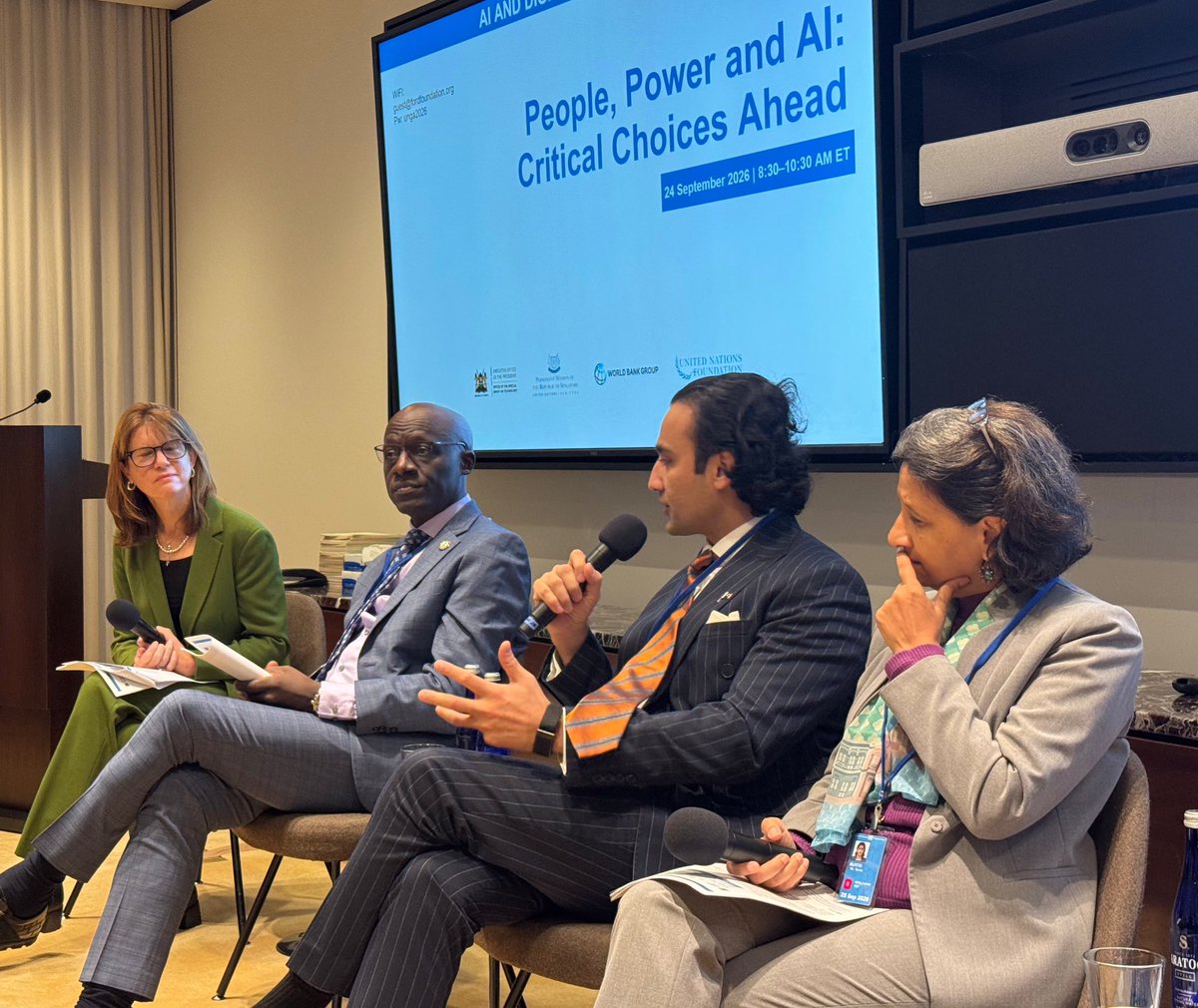
This morning in New York, I joined the “People, Power and AI: Critical Choices Ahead” dialogue, convened by the United Nations Foundation during UNGA, to discuss what the AI transition will mean for societies, economies and developing countries, alongside leaders from the World Bank, Singapore, Kenya, the Gates Foundation and other global institutions.
AI is no longer just a technology conversation. It is becoming a conversation about power, opportunity and who gets to shape the next era of economic growth.