మేడ్చల్లోని టెక్ మహీంద్రా కంపెనీ ముందు ధర్నాకు దిగిన సాఫ్ట్వేర్ ఉద్యోగిని భావన
తనను అకారణంగా జాబ్లో నుంచి తీసివేశారని, పాపకు ఆరోగ్యం బాగాలేదని 3 రోజులు సెలవు కావాలని కోరితే ఉద్యోగం నుంచి తీసేశారని భావన ఆవేదన
ఆరోగ్యం బాగాలేక కంపెనీలో పడిపోతే కనీసం పట్టించుకోలేదని, 14 రోజులు ట్రీట్మెంట్ తీసుకుంటే ఆ సమయంలో కూడా ఉద్యోగంలో నుంచి తీసేస్తామని బెదిరించారని యాజమాన్యంపై ఆగ్రహం
ఉద్దేశపూర్వకంగానే తనను జాబ్లో నుంచి తీసేశారని పోలీస్ స్టేషన్లో ఫిర్యాదు
తనకు న్యాయం కావాలని కంపెనీ ముందు ధర్నాకు దిగిన భావన
@AzureSupport I accidentally tied my personal credit card and PAN to an Azure FreeTrial on my locked-down corporate email. Phone support keeps hanging up on me with https://t.co/eHm7gHOIdO links.I need a billing agent to help me cancel this so I can use my card on my prsnal acnt
What makes an Italian artist dedicate five years of his life to painting the Mahabharata?
For Giampaolo Tomassetti, it was a story too profound to belong to just one culture.
Born and raised in Italy, Tomassetti built his career restoring murals, recreating classical masterpieces, and mastering Renaissance art techniques.
But his growing interest in spirituality led him towards Vedic philosophy and frequent journeys to India, where he developed a deep connection with its culture and traditions.
That connection eventually inspired his most ambitious work: a 25-painting series based on the Mahabharata.
Before picking up his brush, Tomassetti spent years studying the epic, immersing himself in the emotions, dilemmas, and inner conflicts of its characters, his paintings bring the ancient epic to life through bold colours and a unique blend of European and Indian artistic traditions.
Scroll down to see how an artist from Italy reimagined one of India's greatest epics through a breathtaking collection of paintings. >>
#Mahabharata #IndianHeritage #VedicCulture #RenaissanceArt
[Mahabharata, Giampaolo Tomassetti, Indian epic, Vedic culture, Renaissance art]
A real-life hero at just 11! 🇮🇳❤️
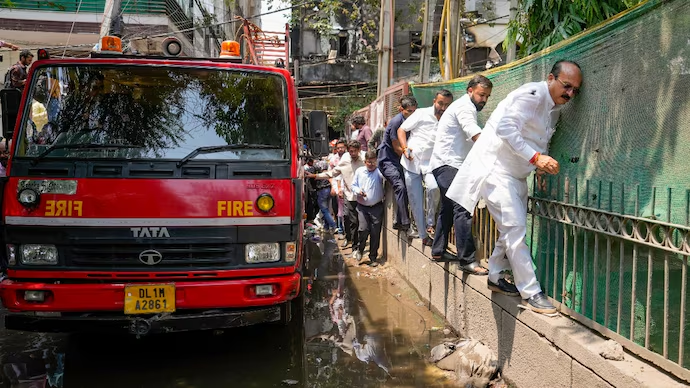
When a deadly fire put dozens of lives at risk, 11-year-old **Om Prakash Yadav** did something extraordinary.
Instead of running away from the danger, he rushed into it.
Displaying incredible courage and presence of mind, Om Prakash Yadav reportedly rescued 18 children from the fire, risking his own life to ensure others made it to safety.
His selfless act and fearless determination earned him the prestigious National Bravery Award, making the entire nation proud. 🏅✨
At an age when most children are busy with school and games, Om Prakash showed what true courage looks like.
Heroes don't wear capes.
Sometimes, they wear a school uniform and carry a heart full of bravery.
Salute to this young hero whose actions remind us that age is never a barrier to courage. 🙏🇮🇳
#OmPrakashYadav #NationalBraveryAward #YoungHero #IndiaProud #RealHero #Bravery #Inspiration #Humanity #Courage 🇮🇳❤️
𝐆𝐫𝐨𝐜𝐞𝐫𝐢𝐞𝐬 𝐢𝐧 𝟏𝟎 𝐦𝐢𝐧𝐮𝐭𝐞𝐬, 𝐞𝐦𝐞𝐫𝐠𝐞𝐧𝐜𝐲 𝐬𝐞𝐫𝐯𝐢𝐜𝐞𝐬 𝐢𝐧 𝟔𝟎: 𝐃𝐞𝐥𝐡𝐢 𝐟𝐢𝐫𝐞 𝐞𝐱𝐩𝐨𝐬𝐞𝐬 𝐜𝐫𝐮𝐞𝐥 𝐢𝐫𝐨𝐧𝐲
In a country where groceries and fast food can arrive at your doorstep in 10 minutes, why can't life-saving emergency services reach people just as quickly?
Read more: https://t.co/S3kg6Rr5fD
TCS, which employs 584,519 people and is a renowned IT company, lost the CBSE OSM bid to COEMPT, which has only 51-200 employees, because COEMPT’s bid value was ₹566 crore lower than that of TCS.
The only priority of CBSE was to save money, not to safeguard the future of young students. Their greed to save costs has ruined the lives of lakhs of students.
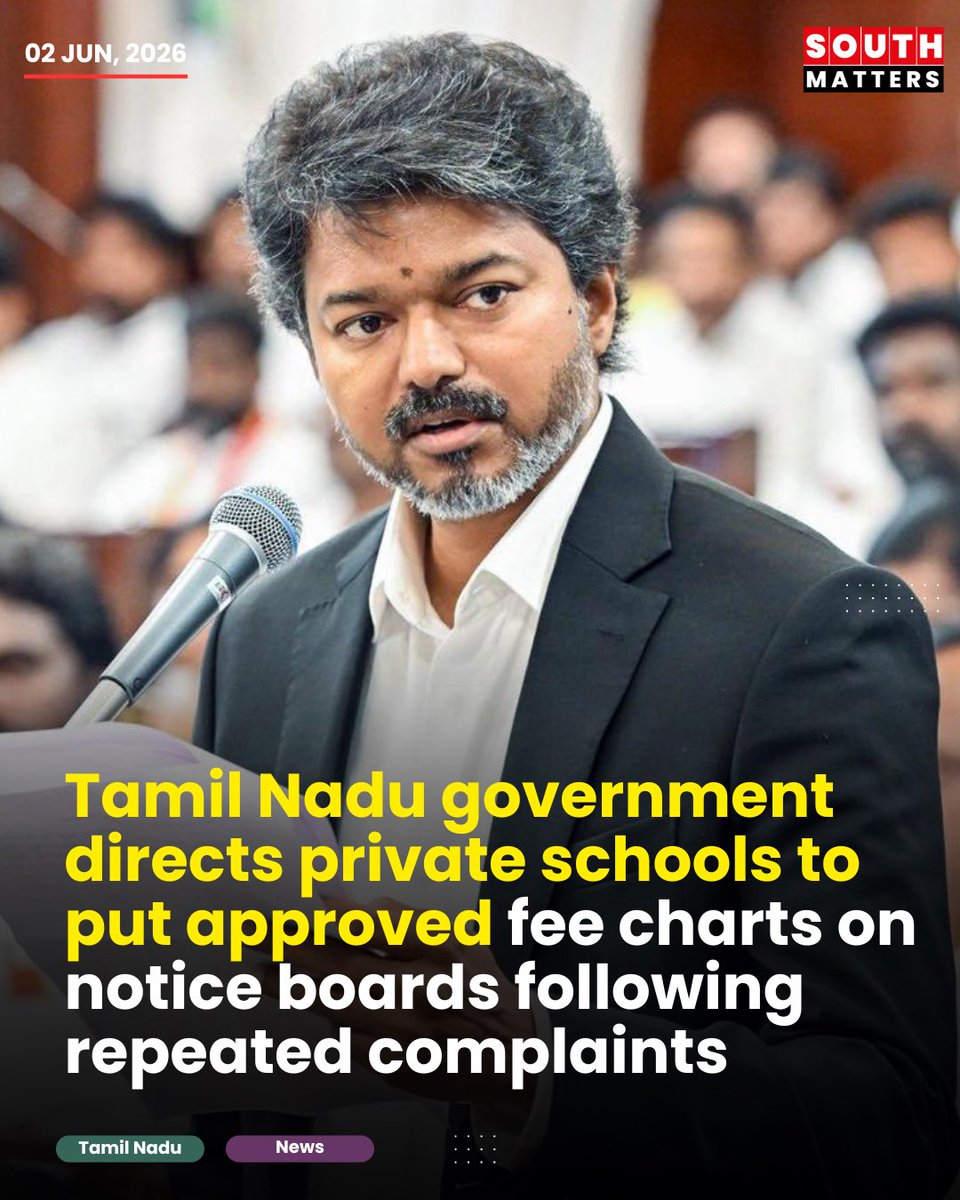
The Tamil Nadu government has directed officials to make it mandatory for all private schools to display, on their notice boards, the tuition fee details as fixed by the government. The School Education Department’s move came in response to several complaints that many private schools were collecting huge amounts beyond the fixed norms. 
All government and private schools will reopen from June 4. A senior official from the department warned that if any private school charges more fees than the nominated amount, its recognition will be cancelled. 
The fee details must be prominently displayed on the notice boards at the main entrance of the school, published on the school’s official website, and printed on the student admission application forms
The @naralokesh data centre water debate has everyone arguing past each other.
“Data centres will drain Andhra Pradesh dry. There is no environmental flow after water allocation”
I have seen these wrong claims everywhere this week. I am a water resources engineer from IIT Bombay. I did my master’s thesis on Polavaram and just finished a 29 year daily simulation of the reservoir. Let me show you what the Godavari actually does with its water every year. 🧵 (1/15)
A Bengaluru man's frustration turned into a protest that has sparked a bigger conversation across the country.
His pregnant wife was stuck in a traffic jam caused by a VIP convoy, prompting him to sit on the road in protest and question why ordinary citizens should face delays for the movement of a few.
The incident quickly went viral, reigniting a debate that many Indians have had for years. When someone is rushing to a hospital, an exam, work, or home, should public roads be brought to a standstill for VIP movement?
Interestingly, countries like Japan and Nepal have largely phased out widespread VIP roadblocks, focusing on security measures that minimise disruption to citizens.
Should India rethink its VIP convoy culture?
Tell us what you think in the comments.
#Bengaluru #VIPCulture #TrafficJam
[India Traffic Management, VIP Convoy Culture, Public Road Safety, Urban Traffic Issues, Citizen Rights India]
What if our lakes could quietly power millions of homes... while saving water and protecting farmland too?
China is expanding floating solar farms on lakes and reservoirs, turning unused water surfaces into clean energy hubs. These panels stay cooler on water, improve solar efficiency, and even help reduce evaporation from reservoirs.
For countries like India, where every acre of farmland matters, this raises a powerful question: What if India could generate clean energy without taking away a single acre from its farmers?
#FloatingSolar #SolarEnergy #RenewableEnergy #Sustainability #ClimateAction
[Floating Solar Farms, Floating Solar Panels, Renewable Energy]
Your driver accepted the ride for ₹1150, but after travelling a couple of kilometres, he started insisting on taking the ORR route, which would increase the fare to nearly ₹1700.
I asked why he didn’t check this before accepting and picking me up. His answer: “Mobile data was off.” What kind of excuse is that?
I refused and asked him to drop me back at the pickup point. He did and still charged ₹200. Who’s going to compensate me for that?
Also, dealing with your in-app support system is unbelievably frustrating. @ola_supports@Olacabs@Ola_Hyderabad
Rahul Bhakre, a Passionate Innovator Conserving and Improving the Groundwater Quality & Quantity with Sustainable Solutions & Technology. Watch an inspiring story. #MeriKahani#VocalForLocal#InspiringStories https://t.co/spdmKJ10zR
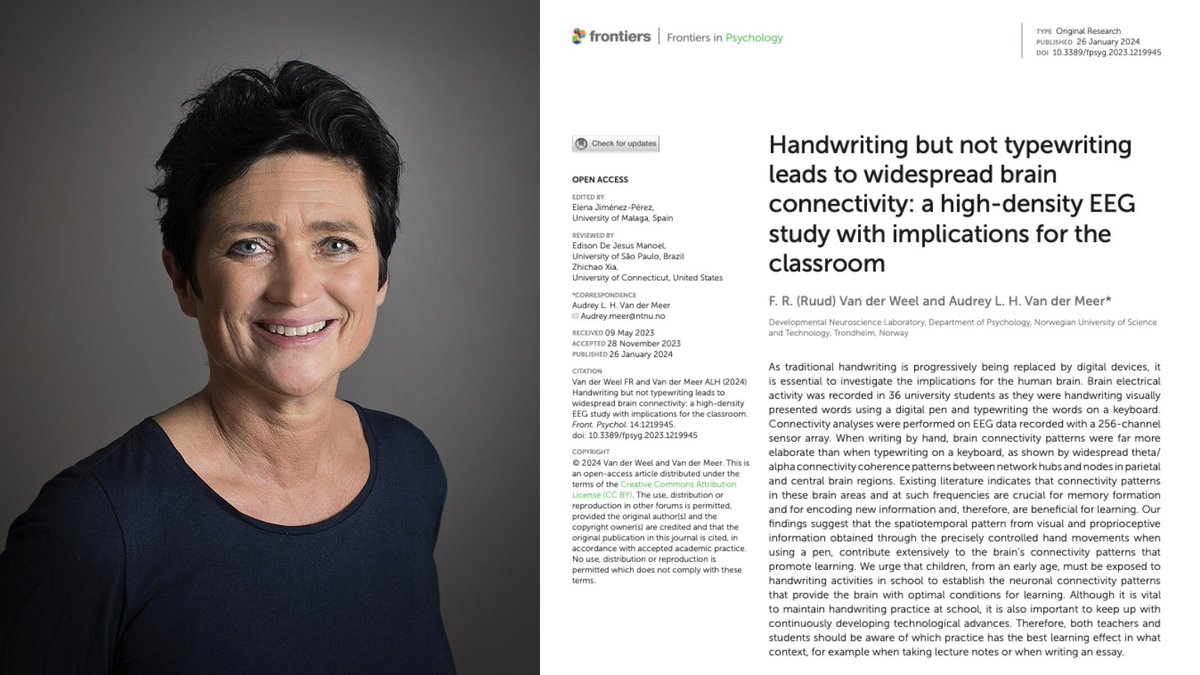
A Norwegian neuroscientist spent 20 years proving that the act of writing by hand changes the human brain in ways typing physically cannot, and almost nobody outside her field has read the paper.
Her name is Audrey van der Meer.
She runs a brain research lab in Trondheim, and the paper that closed the argument was published in 2024 in a journal called Frontiers in Psychology. The finding is brutal enough that it should have changed every classroom on Earth.
The experiment was simple. She recruited 36 university students and put each one in a cap with 256 sensors pressed against their scalp to record brain activity. Words flashed on a screen one at a time.
Sometimes the students wrote the word by hand on a touchscreen using a digital pen, and sometimes they typed the same word on a keyboard. Every neural response was recorded for the full five seconds the word stayed on screen.
Then her team looked at the part of the data most researchers had ignored for years, which is how different parts of the brain were communicating with each other during the task.
When the students wrote by hand, the brain lit up everywhere at once.
The regions responsible for memory, sensory integration, and the encoding of new information were all firing together in a coordinated pattern that spread across the entire cortex. The whole network was awake and connected.
When the same students typed the same word, that pattern collapsed almost completely.
Most of the brain went quiet, and the connections between regions that had been alive seconds earlier were nowhere to be found on the EEG.
Same word, same brain, same person, and two completely different neurological events.
The reason turned out to be something nobody had really paid attention to before her work. Writing by hand is not one motion but a sequence of thousands of tiny micro-movements coordinated with your eyes in real time, where each letter is a different shape that requires the brain to solve a slightly different spatial problem.
Your fingers, wrist, vision, and the parts of your brain that track position in space are all working together to produce one letter, then the next, then the next.
Typing throws all of that away. Every key on a keyboard requires the exact same finger motion regardless of which letter you are pressing, which means the brain has almost nothing to integrate and almost no problem to solve.
Van der Meer said it plainly in her interviews.
Pressing the same key with the same finger over and over does not stimulate the brain in any meaningful way, and she pointed out something that should scare every parent who handed their kid an iPad.
Children who learn to read and write on tablets often cannot tell letters like b and d apart, because they have never physically felt with their bodies what it takes to actually produce those letters on a page.
A decade before her, two researchers at Princeton ran the same fight using a completely different method and ended up at the same answer. Pam Mueller and Daniel Oppenheimer tested 327 students across three experiments, where half took notes on laptops with the internet disabled and half took notes by hand, before testing everyone on what they actually understood from the lectures they had watched.
The handwriting group won by a wide margin on every question that required real understanding rather than surface recall.
The reason was hiding in the transcripts of what the two groups had actually written down.
The laptop students typed almost word for word, capturing more total content but processing almost none of it as they went, while the handwriting students physically could not write fast enough to transcribe a lecture in real time, which forced them to listen carefully, decide what actually mattered, and put it in their own words on the page.
That single act of choosing what to keep was the learning itself, and the keyboard had quietly skipped the choosing and skipped the learning along with it.
Two studies. Two countries. Same answer.
Handwriting makes the brain work. Typing lets it coast.
Every note you have ever typed instead of written went into your brain through a thinner pipe. Every meeting, every book highlight, every idea you captured on your phone instead of on paper was processed at half depth.
You did not forget those things because your memory is bad. You forgot them because typing never woke the part of the brain that would have made them stick.
The fix is the thing your grandmother already knew.
Pick up a pen. Write the thing down. The slower road is the faster one.
These comprised 158 district, 18 state, and 37 national level cases, spanning 444 locations; including the NCDRC headquarters in Delhi, state, and district commissions.





![thebetterindia's tweet photo. What makes an Italian artist dedicate five years of his life to painting the Mahabharata?
For Giampaolo Tomassetti, it was a story too profound to belong to just one culture.
Born and raised in Italy, Tomassetti built his career restoring murals, recreating classical masterpieces, and mastering Renaissance art techniques.
But his growing interest in spirituality led him towards Vedic philosophy and frequent journeys to India, where he developed a deep connection with its culture and traditions.
That connection eventually inspired his most ambitious work: a 25-painting series based on the Mahabharata.
Before picking up his brush, Tomassetti spent years studying the epic, immersing himself in the emotions, dilemmas, and inner conflicts of its characters, his paintings bring the ancient epic to life through bold colours and a unique blend of European and Indian artistic traditions.
Scroll down to see how an artist from Italy reimagined one of India's greatest epics through a breathtaking collection of paintings. >>
#Mahabharata #IndianHeritage #VedicCulture #RenaissanceArt
[Mahabharata, Giampaolo Tomassetti, Indian epic, Vedic culture, Renaissance art]](https://pbs.twimg.com/media/HKXJhKAawAA9kIl.jpg)




![thebetterindia's tweet photo. A Bengaluru man's frustration turned into a protest that has sparked a bigger conversation across the country.
His pregnant wife was stuck in a traffic jam caused by a VIP convoy, prompting him to sit on the road in protest and question why ordinary citizens should face delays for the movement of a few.
The incident quickly went viral, reigniting a debate that many Indians have had for years. When someone is rushing to a hospital, an exam, work, or home, should public roads be brought to a standstill for VIP movement?
Interestingly, countries like Japan and Nepal have largely phased out widespread VIP roadblocks, focusing on security measures that minimise disruption to citizens.
Should India rethink its VIP convoy culture?
Tell us what you think in the comments.
#Bengaluru #VIPCulture #TrafficJam
[India Traffic Management, VIP Convoy Culture, Public Road Safety, Urban Traffic Issues, Citizen Rights India]](https://pbs.twimg.com/media/HJ0O6CRagAAL8-j.jpg)