Egypt's Former Irrigation Minister Came to Bury Ethiopia's Dam. He Buried Egypt's Own Case Instead.
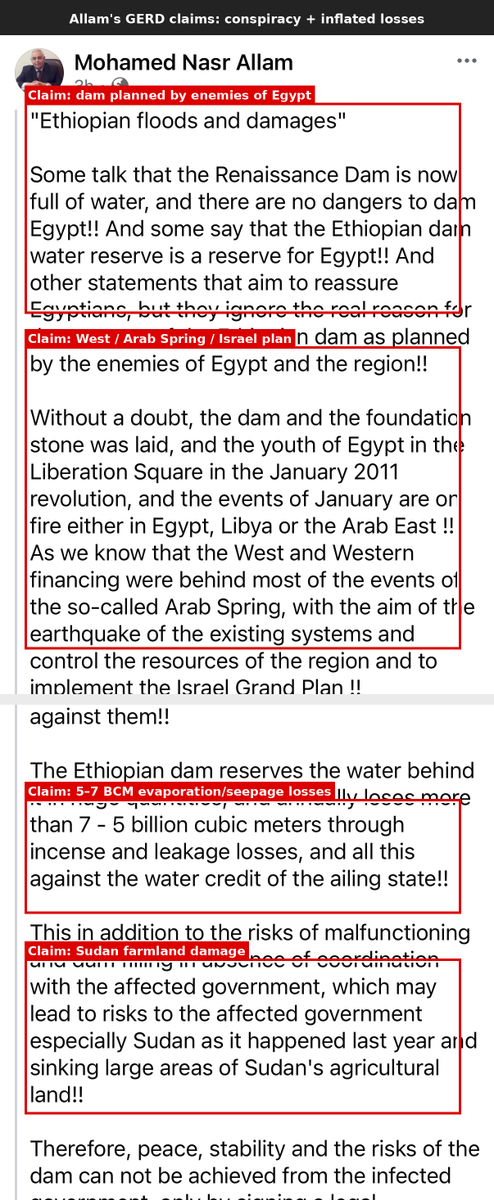
Another day, another sermon from Cairo about Ethiopia. They never stop. Every single day a new voice rises to warn that the Renaissance Dam is draining the life out of Egypt, and today it is the turn of Mohamed Nasr Allam, Egypt's former Minister of Irrigation. He wrote three calm posts this week to build the case against the dam. 𝗥𝗲𝗮𝗱 𝘁𝗵𝗲𝗺 𝗶𝗻 𝗵𝗶𝘀 𝗼𝘄𝗻 𝘄𝗼𝗿𝗱𝘀, 𝗮𝗻𝗱 𝘁𝗵𝗲 𝗰𝗮𝘀𝗲 𝘁𝘂𝗿𝗻𝘀 𝗮𝗿𝗼𝘂𝗻𝗱 𝗼𝗻 𝘁𝗵𝗲 𝗺𝗮𝗻 𝗺𝗮𝗸𝗶𝗻𝗴 𝗶𝘁.
He is not a careless voice. He is a former minister, one of anti-dam writers Cairo has, which is exactly why the three strands he braids together are worth separating one at a time. Egypt's thirst. Egypt's history. A foreign plot. Pull them apart and see what is left standing.
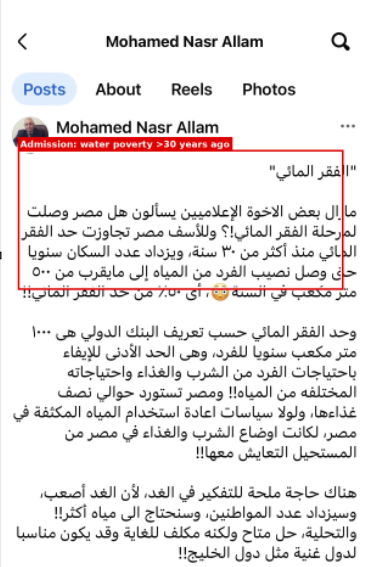
Start with the thirst, because here he stands on solid ground and I will give it to him plainly. Egypt is water-stressed country as any country in the world and he claim that Water per person has fallen to around 500 cubic meters a year.
But look at his own clock. He says Egypt crossed the water-poverty line "more than thirty years ago," in the early 1990s. The Renaissance Dam was not begun until 2011, and filling did not begin until 2020. 𝗦𝗼 𝗯𝘆 𝗵𝗶𝘀 𝗼𝘄𝗻 𝗱𝗮𝘁𝗲, 𝗘𝗴𝘆𝗽𝘁 𝘄𝗮𝘀 𝗮𝗹𝗿𝗲𝗮𝗱𝘆 𝘄𝗮𝘁𝗲𝗿-𝗽𝗼𝗼𝗿 𝘁𝘄𝗼 𝗳𝘂𝗹𝗹 𝗱𝗲𝗰𝗮𝗱𝗲𝘀 𝗯𝗲𝗳𝗼𝗿𝗲 𝗮 𝘀𝗶𝗻𝗴𝗹𝗲 𝘀𝘁𝗼𝗻𝗲 𝗼𝗳 𝘁𝗵𝗮𝘁 𝗱𝗮𝗺 𝘄𝗮𝘀 𝗹𝗮𝗶𝗱. Whatever drained Egypt's cup, it was not a reservoir that did not yet exist. And the cause he reaches for is his own: a population that doubled, and keeps doubling. 𝗧𝗵𝗲 claim 𝗶𝘀 𝗿𝗲𝗮𝗹. 𝗧𝗵𝗲 𝗱𝗲𝗳𝗲𝗻𝗱𝗮𝗻𝘁 𝗶𝘀 𝘁𝗵𝗲 𝘄𝗿𝗼𝗻𝗴 𝗼𝗻𝗲.
And Egypt's own choices keep proving it. Even now, while Cairo speaks the language of water poverty, it is routing Nile water into desert expansion. Reuters reported that Egypt's new "Jirian" project, Arabic for "Flow," is set to carry about ten million cubic meters of Nile water a day, roughly 7 percent of what Egypt calls its annual Nile quota, away from the fertile delta toward an upscale desert city and a vast new farming scheme. 𝗔 𝗻𝗮𝘁𝗶𝗼𝗻 𝘁𝗿𝘂𝗹𝘆 𝗼𝘂𝘁 𝗼𝗳 𝘄𝗮𝘁𝗲𝗿 𝗱𝗼𝗲𝘀 𝗻𝗼𝘁 𝗻𝗮𝗺𝗲 𝗮 𝗱𝗲𝘀𝗲𝗿𝘁 𝗱𝗶𝘃𝗲𝗿𝘀𝗶𝗼𝗻 "𝗙𝗹𝗼𝘄" 𝗮𝗻𝗱 𝗯𝘂𝗶𝗹𝗱 𝗻𝗲𝘄 𝗿𝗶𝘃𝗲𝗿𝘀 𝗶𝗻 𝘁𝗵𝗲 𝘀𝗮𝗻𝗱. So the question answers itself: is this water poverty, or water politics?
Now the history, the part he is proudest of. He praises Nasser for the High Dam and the 1959 agreement, built to store the flood and carry Egypt through the dry years. He praises Sadat for the Jonglei Canal, meant to capture water "lost" in the south. Look at what he is actually saying. Storing the flood to survive drought is not a crime he can pin on Ethiopia. It is the entire purpose of the Renaissance Dam. 𝗛𝗲 𝗵𝗮𝘀 𝗷𝘂𝘀𝘁 𝗽𝗿𝗮𝗶𝘀𝗲𝗱 𝘁𝗵𝗲 𝗽𝗿𝗶𝗻𝗰𝗶𝗽𝗹𝗲. 𝗛𝗲 𝗼𝗻𝗹𝘆 𝗼𝗯𝗷𝗲𝗰𝘁𝘀 𝘁𝗼 𝘁𝗵𝗲 𝗺𝗮𝗽.
And the 1959 agreement he calls foresight deserves a closer look, because it turns on him twice. First, it was signed by Egypt and Sudan alone, Egypt's self-claimed 55.5 billion cubic meters and Sudan's 18.5, with no allocation to Ethiopia, the highlands that produce roughly 85 percent of the water. Ethiopia never signed it and has never recognized it. 𝗬𝗼𝘂 𝗰𝗮𝗻𝗻𝗼𝘁 𝘄𝗮𝘃𝗲 𝗮 𝗰𝗼𝗻𝘁𝗿𝗮𝗰𝘁 𝗮𝘁 𝘁𝗵𝗲 𝗰𝗼𝘂𝗻𝘁𝗿𝘆 𝘄𝗵𝗲𝗿𝗲 𝘁𝗵𝗲 𝗿𝗶𝘃𝗲𝗿 𝗶𝘀 𝗯𝗼𝗿𝗻 𝘄𝗵𝗲𝗻 𝘁𝗵𝗮𝘁 𝗰𝗼𝘂𝗻𝘁𝗿𝘆 𝘄𝗮𝘀 𝗻𝗲𝘃𝗲𝗿 𝗶𝗻 𝘁𝗵𝗲 𝗿𝗼𝗼𝗺.
Second, that same 1959 arithmetic quietly set aside ten billion cubic meters every year as evaporation loss at the High Dam, and called it normal. Hold that number, because evaporation is Allam's loudest charge against the Renaissance Dam. He says the Ethiopian dam "loses five to seven billion cubic meters a year" through evaporation and seepage. The peer-reviewed evaporation figure is about 1.7 billion, because the dam sits in a deep highland gorge where the surface is small and the highland air is cooler. If he wants to climb to five or seven by adding seepage, he has to prove permanent measured seepage, not throw a fear number at the public.
So grant him his frightening number anyway, every drop of it. 𝗧𝗵𝗲 𝗱𝗲𝘀𝗲𝗿𝘁 𝗹𝗮𝗸𝗲 𝗵𝗲 𝗱𝗲𝗳𝗲𝗻𝗱𝘀 𝘀𝘁𝗶𝗹𝗹 𝗯𝗼𝗶𝗹𝘀 𝗼𝗳𝗳 𝗺𝗼𝗿𝗲, 𝘁𝗲𝗻 𝘁𝗼 𝘀𝗶𝘅𝘁𝗲𝗲𝗻 𝗯𝗶𝗹𝗹𝗶𝗼𝗻 𝗮 𝘆𝗲𝗮𝗿 𝘂𝗻𝗱𝗲𝗿 𝘁𝗵𝗲 𝗼𝗽𝗲𝗻 𝗦𝗮𝗵𝗮𝗿𝗮 𝘀𝘂𝗻. Egypt budgeted ten billion a year to vanish at Aswan and called it the cost of doing business, then cried about a fraction of that in an Ethiopian canyon. 𝗧𝗵𝗮𝘁 𝗶𝘀 𝗻𝗼𝘁 𝗵𝘆𝗱𝗿𝗼𝗹𝗼𝗴𝘆. 𝗧𝗵𝗮𝘁 𝗶𝘀 𝗵𝗶𝗲𝗿𝗮𝗿𝗰𝗵𝘆.
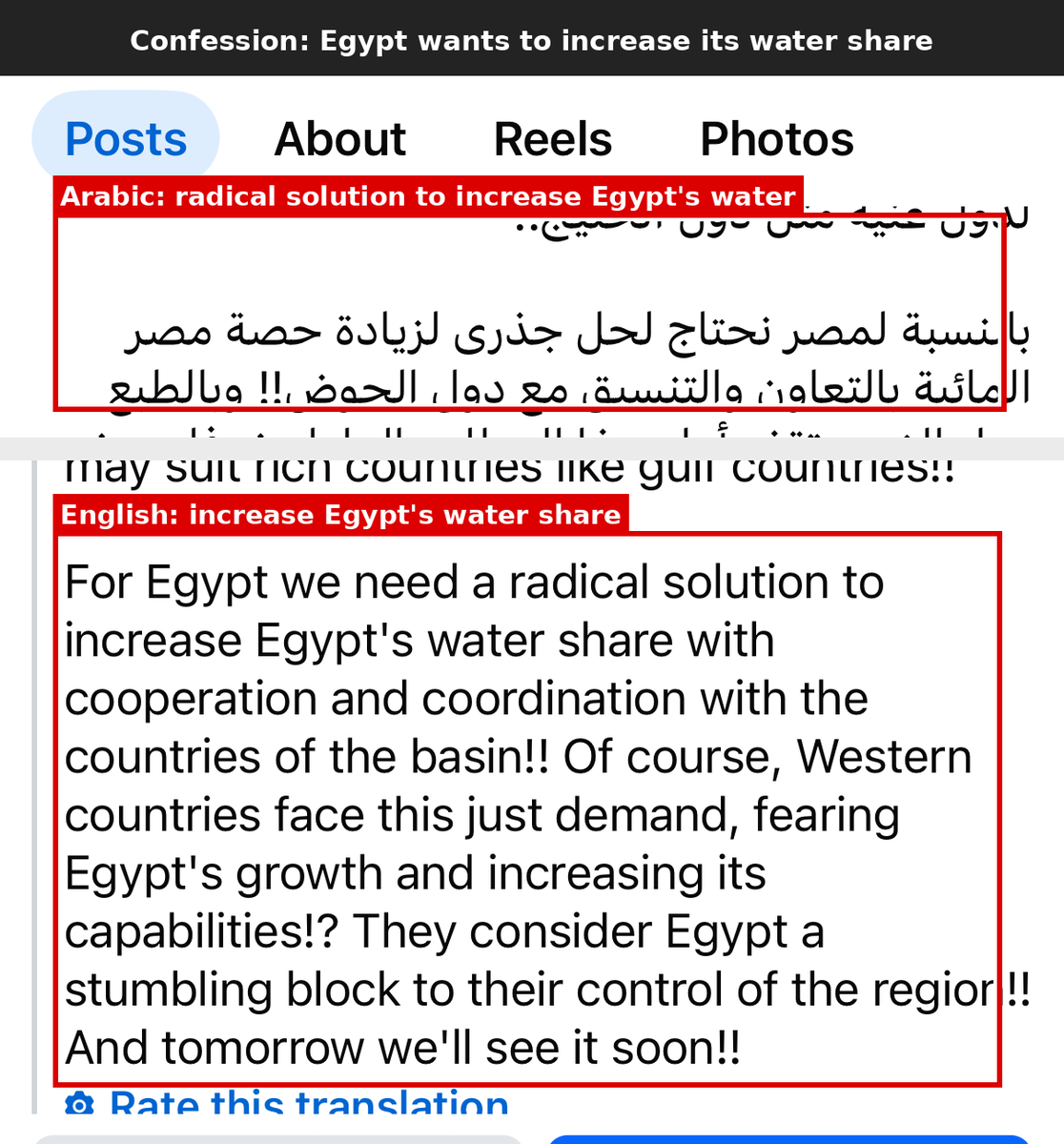
And then, in the middle of the history, he says the quiet part out loud. Egypt, he writes, needs "a radical solution to increase Egypt's water share." Read that twice. This was never only about the safety of a dam. It is about allocation. 𝗘𝗴𝘆𝗽𝘁 𝘄𝗮𝗻𝘁𝘀 𝗺𝗼𝗿𝗲 𝗼𝗳 𝘁𝗵𝗲 𝗿𝗶𝘃𝗲𝗿. That is the demand hiding underneath every gentle word about "coordination" and every call for a "legal agreement." Jonglei is the proof of the habit. Cairo's answer to its own thirst was to drain the wetlands of South Sudan and send the water north, and it called that "recovering losses," losses being water that had committed the crime of not yet reaching Egypt. For the people of the Sudd it meant their grazing land, their cattle, and their fisheries. 𝗖𝗮𝗶𝗿𝗼 𝗰𝗮𝗹𝗹𝘀 𝘂𝗽𝘀𝘁𝗿𝗲𝗮𝗺 𝘄𝗮𝘁𝗲𝗿 "𝘄𝗮𝘀𝘁𝗲" 𝘂𝗻𝘁𝗶𝗹 𝘁𝗵𝗲 𝗺𝗼𝗺𝗲𝗻𝘁 𝗶𝘁 𝗿𝗲𝗮𝗰𝗵𝗲𝘀 𝗘𝗴𝘆𝗽𝘁.
That leaves the third strand, the plot. When the numbers thin out, Allam reaches for ghosts, a "Zionist plan," "Western financing," a dam built by "the enemies of Egypt." There is a simple problem with that. 𝗡𝗼 𝗳𝗼𝗿𝗲𝗶𝗴𝗻 𝗹𝗼𝗮𝗻 𝗯𝘂𝗶𝗹𝘁 𝘁𝗵𝗶𝘀 𝗱𝗮𝗺. It was financed inside Ethiopia, by the state and by ordinary Ethiopians buying bonds out of their own salaries. Neither the IMF nor the World Bank put a dollar into financing it. The role of foreign pressure was not to finance the dam, but to help keep international financing away from it. A man who calls a self-funded African dam a foreign conspiracy has run out of argument.
He has one charge left, that the dam drowned Sudan's farmland. Sudan's own engineers describe the opposite. The manager of the Roseires Dam, downstream and inside Sudan, said the Renaissance Dam helped tame the overflow that "used to be extremely big," and cut the silt that was choking his reservoir. Peer-reviewed modeling of the river shows the flood-alarm days at Khartoum falling sharply once the dam steadies the flow. 𝗔 𝘄𝗮𝗹𝗹 𝘁𝗵𝗮𝘁 𝘀𝗺𝗼𝗼𝘁𝗵𝘀 𝘁𝗵𝗲 𝗕𝗹𝘂𝗲 𝗡𝗶𝗹𝗲'𝘀 𝘃𝗶𝗼𝗹𝗲𝗻𝘁 𝘀𝘂𝗺𝗺𝗲𝗿 𝘀𝘂𝗿𝗴𝗲 𝘀𝗵𝗶𝗲𝗹𝗱𝘀 𝘁𝗵𝗲 𝗹𝗮𝗻𝗱 𝗯𝗲𝗹𝗼𝘄 𝗶𝘁. 𝗜𝘁 𝗱𝗼𝗲𝘀 𝗻𝗼𝘁 𝗱𝗿𝗼𝘄𝗻 𝗶𝘁.
So strip the three strands away, the thirst, the history, the plot, and what remains is the oldest claim in the file wearing new clothes: that the Nile belongs to Egypt, and everyone upstream is a guest. Ethiopia has heard it for a century. The answer has not changed.
The dry years will come. They always do. And that is the point Cairo keeps stepping over: 𝗱𝗿𝘆 𝘆𝗲𝗮𝗿𝘀 𝗮𝗿𝗲 𝘁𝗵𝗲 𝗿𝗲𝗮𝘀𝗼𝗻 𝘁𝗼 𝘀𝘁𝗼𝗿𝗲 𝘄𝗮𝘁𝗲𝗿, 𝗻𝗼𝘁 𝘁𝗵𝗲 𝗿𝗲𝗮𝘀𝗼𝗻 𝘁𝗼 𝗳𝗲𝗮𝗿 𝗶𝘁. Egypt sits safe behind Aswan. Sudan sits safe behind Roseires. Both built their walls and call it prudence. Let the country where the river is actually born store part of its own flood, and suddenly the same wall is a crime. What Ethiopia holds is the flood-season surplus that Egypt could never use twice, kept during the high water, not taken from the low. Allam spent three posts calling Egypt's reservoirs its salvation. 𝗛𝗲 𝗻𝗲𝘃𝗲𝗿 𝗻𝗼𝘁𝗶𝗰𝗲𝗱 𝗵𝗲 𝘄𝗮𝘀 𝗵𝗮𝗻𝗱𝗶𝗻𝗴 𝗘𝘁𝗵𝗶𝗼𝗽𝗶𝗮 𝘁𝗵𝗲 𝘀𝗮𝗺𝗲 𝘀𝗵𝗶𝗲𝗹𝗱.
𝗖𝗼𝗼𝗿𝗱𝗶𝗻𝗮𝘁𝗲 𝘁𝗵𝗲 𝗿𝗶𝘃𝗲𝗿? 𝗚𝗹𝗮𝗱𝗹𝘆. 𝗛𝗮𝗻𝗱 𝗘𝗴𝘆𝗽𝘁 𝗮 𝘃𝗲𝘁𝗼 𝗼𝘃𝗲𝗿 𝗶𝘁? 𝗡𝗲𝘃𝗲𝗿.
Egypt's water poverty is not Ethiopia's debt. Egypt's food bill is not Ethiopia's burden. 𝗘𝗴𝘆𝗽𝘁'𝘀 𝘀𝗲𝗹𝗳-𝗰𝗹𝗮𝗶𝗺𝗲𝗱 𝟱𝟱.𝟱 𝗯𝗶𝗹𝗹𝗶𝗼𝗻 𝗰𝘂𝗯𝗶𝗰 𝗺𝗲𝘁𝗲𝗿𝘀 𝗶𝘀 𝗻𝗼𝘁 𝗘𝘁𝗵𝗶𝗼𝗽𝗶𝗮'𝘀 𝗹𝗮𝘄.
𝗔𝗯𝗯𝗮𝘆 𝗶𝘀 𝗻𝗼𝘁 𝗖𝗮𝗶𝗿𝗼'𝘀 𝗽𝗿𝗶𝘃𝗮𝘁𝗲 𝗽𝗶𝗽𝗲𝗹𝗶𝗻𝗲.
𝗛𝗲 𝘀𝗲𝘁 𝗼𝘂𝘁 𝘁𝗼 𝘄𝗿𝗶𝘁𝗲 𝗘𝘁𝗵𝗶𝗼𝗽𝗶𝗮'𝘀 𝗴𝘂𝗶𝗹𝘁. 𝗛𝗲 𝘄𝗿𝗼𝘁𝗲 𝗘𝗴𝘆𝗽𝘁'𝘀 𝗰𝗼𝗻𝗳𝗲𝘀𝘀𝗶𝗼𝗻 𝗶𝗻𝘀𝘁𝗲𝗮𝗱.
#Ethiopia #GERD #Abbay #BlueNile #NileJustice #WaterSovereignty #Sudan #Egyptian
Dr. 𝗡𝗮𝗱𝗲𝗿 𝗡𝗼𝘂𝗿 𝗘𝗹-𝗗𝗶𝗻 𝗣𝘂𝘁 𝗥𝗲𝗹𝗶𝗴𝗶𝗼𝗻, 𝗪𝗲𝗮𝘁𝗵𝗲𝗿, 𝗮𝗻𝗱 𝘁𝗵𝗲 𝗗𝗮𝗺 𝗶𝗻 𝗢𝗻𝗲 𝗣𝗼𝘀𝘁. 𝗣𝘂𝗹𝗹 𝗧𝗵𝗲𝗺 𝗔𝗽𝗮𝗿𝘁, 𝗮𝗻𝗱 And, almost by accident, he hands Ethiopia the whole argument.
Dr. Nader Nour El-Din is a Cairo professor of water and agriculture, and one of the steadiest anti-dam voices Egypt has. His latest post is calm and clever, which is exactly why it is worth answering slowly. He braids three different things into one rope: the story of Prophet Joseph, a weather forecast, and a political claim about the dam. Pull the three strands apart and watch what holds.
Start with the scripture. Seven fat years, seven lean, the dream of the Prophet Joseph. It is a beautiful lesson, and it is about one thing: save in the good years so you survive the bad ones. It teaches wisdom. It does not measure rainfall. You cannot read this year's Blue Nile flow from a story written thousands of years ago, and no hydrologist would try. Faith tells you to prepare. It does not tell you the flow at the gauge.
Then the weather. Here he is on real ground, and I will give it to him plainly: El Niño is forming, NOAA says so, and a drier-than-usual season is a genuine risk this year. Nobody serious waves that away. But a risk is not a result. As I write this, the regional forecast still shows heavy rain, and even flood warnings, across western and northern Ethiopia. And the calendar matters: in the highlands, late June is the opening of Kiremt, the great rains that actually fill the river. He is calling the match at kickoff. The season that decides the Blue Nile has barely begun.
Now the part he most wants you to believe, the tidy clock. Seven wet years, seven dry, six average, around and around. It sounds orderly. It is not true. Run it backward yourself. Seven years before now lands on 2019. Was the river starving then? The opposite. The rains of 2019 refilled Egypt's Toshka lakes, lifted Lake Nasser to the highest level ever recorded in 2020, and crowded the flood marks again in 2021. Egypt was not parched in those years. It was so awash it was pouring the extra into the open desert. A country drowning its surplus in the sand is not a country in drought. The Nile keeps no calendar. It answers to El Niño and La Niña, and they arrive whenever they please.
And here, almost by accident, he hands Ethiopia the whole argument. He scolds his own side for a contradiction, and he is right to. You cannot call the dam Egypt's emergency reservoir and Egypt's drought machine in the same breath. Pick one. Because think about what those wet filling years actually were. Egypt had so much water it was dumping it into Toshka. The water Ethiopia held back came from that same flood, the water Cairo could not productively use. Stored during surplus. Not taken from deficit. That single line ends the theft story, and an Egyptian professor is the one who walked us to it.
Yes, dry years will come. They always do. And that is the point everyone keeps stepping over: dry years are the whole reason to store water, not the reason to fear it. Egypt holds the Nile behind Aswan. Sudan holds the Blue Nile behind Roseires. Both built their walls and call it prudence. But let the country where the river is actually born hold a drop of its own, and suddenly it is a crisis. Remember the 1980s. When drought hammered the region, downstream Egypt sat safe behind years of stored water at the High Dam. Upstream Ethiopia, the source of the flood, had nothing to fall back on. That is the real lesson of a dry year, and it is the opposite of the one Cairo preaches. Storage is not the threat. Storage is the shield. And the only nation forbidden to carry one is the nation that gives the river its life.
So strip away the scripture and the weather, and what is left of his post is the oldest claim in the file, dressed in new clothes: that the Nile belongs to Egypt and everyone upstream is a guest. Ethiopia has heard it for a century. The answer has not changed.
Coordinate the river? Gladly. Hand Egypt a veto over it? Never.
Abbay is not Cairo's private pipeline.
#Ethiopia #GERD #Abbay #BlueNile #NileJustice #WaterSovereignty #Sudan #NaderNourElDin #نادر_نور_الدين #NileJustice #Egypt
𝗜𝗿𝗮𝗻 𝗖𝗮𝗺𝗲 𝗢𝘂𝘁 𝗦𝘁𝗿𝗼𝗻𝗴𝗲𝗿 𝗘𝘃𝗲𝗻 𝗔𝗳𝘁𝗲𝗿 𝘁𝗵𝗲 𝗪𝗼𝗿𝗹𝗱'𝘀 𝗠𝗼𝘀𝘁 𝗣𝗼𝘄𝗲𝗿𝗳𝘂𝗹 𝗠𝗶𝗹𝗶𝘁𝗮𝗿𝗶𝗲𝘀 𝗛𝗶𝘁 𝗜𝘁. 𝗘𝗴𝘆𝗽𝘁 𝗚𝗲𝘁𝘀 𝘁𝗵𝗲 𝗡𝗶𝗹𝗲 𝗙𝗿𝗲𝗲 𝗧𝗼𝗱𝗮𝘆. 𝗔 𝗗𝗶𝗿𝗲𝗰𝘁 𝗔𝘁𝘁𝗮𝗰𝗸 𝗼𝗻 𝗘𝘁𝗵𝗶𝗼𝗽𝗶𝗮 𝗪𝗼𝘂𝗹𝗱 𝗖𝘂𝗿𝘀𝗲 𝘁𝗵𝗲 𝗡𝗲𝘅𝘁 𝟭𝟬 𝗘𝗴𝘆𝗽𝘁𝗶𝗮𝗻 𝗚𝗲𝗻𝗲𝗿𝗮𝘁𝗶𝗼𝗻𝘀.
Let me extend the point from my last post, because Egypt's threats deserve a straight answer.
You hear it constantly. On Egyptian television, on Facebook, from politicians and generals, the same line on repeat. Strike the dam. Go to war with Ethiopia. 𝗖𝗮𝗶𝗿𝗼 𝗵𝗮𝘀 𝗯𝗲𝗲𝗻 𝗴𝗼𝗶𝗻𝗴 𝘁𝗼 𝘄𝗮𝗿 𝘄𝗶𝘁𝗵 𝗘𝘁𝗵𝗶𝗼𝗽𝗶𝗮 𝗼𝗻 𝘁𝗲𝗹𝗲𝘃𝗶𝘀𝗶𝗼𝗻 𝗳𝗼𝗿 𝘆𝗲𝗮𝗿𝘀 𝗻𝗼𝘄. 𝗧𝗵𝗲 𝗱𝗮𝗺 𝘀𝘁𝗶𝗹𝗹 𝘀𝘁𝗮𝗻𝗱𝘀.
So let me answer the threat plainly. Egypt will not launch a direct war on Ethiopia, and deep down Cairo knows exactly why. The water is born in Ethiopia. Strike the source of your own lifeline and you do not punish this Ethiopian generation, you create a Nile crisis for Egyptian generations after you. 𝗔 𝗰𝗼𝘂𝗻𝘁𝗿𝘆 𝗱𝗼𝗲𝘀 𝗻𝗼𝘁 𝗯𝗼𝗺𝗯 𝘁𝗵𝗲 𝘄𝗲𝗹𝗹 𝗶𝘁 𝗱𝗿𝗶𝗻𝗸𝘀 𝗳𝗿𝗼𝗺. Egypt is many things, but it is not suicidal.
And if anyone still doubts it, look at what just happened to Iran. The United States, the world's strongest military, and Israel, the region's most aggressive military power, did exactly what Egypt only talks about. They struck Iran at the highest level. And months later they were not dictating surrender. They were signing a memorandum, bargaining over a strait Iran still had its hand on. Think about what Iran came away with. Before the war, closing Hormuz was only a threat. After it, Iran is sitting at the table negotiating the terms of that strait, transit conditions, even talk of fees and transit terms for global shipping. 𝗧𝗵𝗲 𝗮𝘁𝘁𝗮𝗰𝗸𝗲𝗿𝘀 𝗽𝗮𝗶𝗱 𝗮 𝗽𝗿𝗶𝗰𝗲, 𝗮𝗻𝗱 𝘁𝗵𝗲 𝗰𝗼𝘂𝗻𝘁𝗿𝘆 𝘁𝗵𝗲𝘆 𝗮𝘁𝘁𝗮𝗰𝗸𝗲𝗱 𝘄𝗮𝗹𝗸𝗲𝗱 𝗼𝘂𝘁 𝘄𝗶𝘁𝗵 𝗹𝗲𝘃𝗲𝗿𝗮𝗴𝗲 𝗶𝘁 𝗻𝗲𝘃𝗲𝗿 𝗵𝗮𝗱 𝗯𝗲𝗳𝗼𝗿𝗲. Egypt is not stronger than the United States and Israel combined. If they paid that price, what exactly does Cairo imagine it would pay.
Now bring it home, because Ethiopia's position is stronger than Iran's, not weaker. Iran's leverage over Hormuz is military, and military leverage is legally exposed. It can be called piracy, it can be blockaded, it can be answered with a fleet. 𝗘𝘁𝗵𝗶𝗼𝗽𝗶𝗮'𝘀 𝗹𝗲𝘃𝗲𝗿𝗮𝗴𝗲 𝗶𝘀 𝗻𝗼𝘁 𝗮 𝘄𝗲𝗮𝗽𝗼𝗻. 𝗜𝘁 𝗶𝘀 𝗴𝗲𝗼𝗴𝗿𝗮𝗽𝗵𝘆 𝗮𝗻𝗱 𝗹𝗮𝘄 𝘁𝗼𝗴𝗲𝘁𝗵𝗲𝗿. Abbay is born in Ethiopian highlands, fed by Ethiopian rain, carved through Ethiopian mountains, and under equitable and reasonable use Ethiopia holds a lawful right to it. 𝗧𝗵𝗮𝘁 𝗶𝘀 𝗹𝗲𝘃𝗲𝗿𝗮𝗴𝗲 𝗻𝗼 𝗳𝗹𝗲𝗲𝘁 𝗰𝗮𝗻 𝘀𝗶𝗻𝗸 𝗮𝗻𝗱 𝗻𝗼 𝗰𝗼𝗹𝗼𝗻𝗶𝗮𝗹 𝘁𝗿𝗲𝗮𝘁𝘆 𝗰𝗮𝗻 𝗲𝗿𝗮𝘀𝗲. Iran has to threaten to close something to be heard. Ethiopia only has to stand on its own land and its own law.
And here is the part Cairo should think about hardest. 𝗘𝘁𝗵𝗶𝗼𝗽𝗶𝗮 𝗱𝗼𝗲𝘀 𝗻𝗼𝘁 𝗻𝗲𝗲𝗱 𝘁𝗼 𝗰𝗵𝗮𝗿𝗴𝗲 𝗘𝗴𝘆𝗽𝘁 𝗮 𝘀𝗶𝗻𝗴𝗹𝗲 𝗰𝗲𝗻𝘁 𝗼𝗿 𝗯𝗹𝗼𝗰𝗸 𝗮 𝘀𝗶𝗻𝗴𝗹𝗲 𝗱𝗿𝗼𝗽 𝘁𝗼 𝗰𝗵𝗮𝗻𝗴𝗲 𝘁𝗵𝗶𝘀 𝗿𝗶𝘃𝗲𝗿. It only needs to do what every sovereign nation does on its own water. This generation and the next will keep building: irrigation across the highlands, power stations, small dams, medium dams, large dams, and projects on the tributaries that feed the Blue Nile. That is not a threat. 𝗜𝘁 𝗶𝘀 𝗹𝗮𝘄𝗳𝘂𝗹 𝗱𝗲𝘃𝗲𝗹𝗼𝗽𝗺𝗲𝗻𝘁, 𝗮𝗻𝗱 𝗶𝘁 𝗶𝘀 𝘂𝗻𝘀𝘁𝗼𝗽𝗽𝗮𝗯𝗹𝗲, 𝗯𝗲𝗰𝗮𝘂𝘀𝗲 𝗶𝘁 𝗶𝘀 𝗘𝘁𝗵𝗶𝗼𝗽𝗶𝗮 𝘂𝘀𝗶𝗻𝗴 𝘄𝗵𝗮𝘁 𝗶𝘀 𝗘𝘁𝗵𝗶𝗼𝗽𝗶𝗮'𝘀. The river that reaches Egypt has always been shaped at its source. As Ethiopia rises, the old arrangement where Cairo simply assumed the whole river ends on its own, and Egypt is left with one rational choice, to come to the table as an equal and negotiate. Not because anyone forced it, but because the map and the law left it no other path.
So understand what Egypt is really sitting on. Egypt claims about 55.5 billion cubic meters of Nile water a year under a 1959 deal Ethiopia never signed, the same deal that gave Sudan 18.5 and gave Ethiopia, the source of most of the river, zero. And the overwhelming majority of that water is born on Ethiopian soil and arrives at no cost to Cairo. Tens of billions of cubic meters of strategic water flow north every year, 𝗳𝗿𝗲𝗲 𝗼𝗳 𝗰𝗵𝗮𝗿𝗴𝗲 𝗮𝗻𝗱 𝗮𝗽𝗽𝗮𝗿𝗲𝗻𝘁𝗹𝘆 𝗳𝗿𝗲𝗲 𝗼𝗳 𝗴𝗿𝗮𝘁𝗶𝘁𝘂𝗱𝗲, from the country Egypt keeps threatening and treating as if it had no rights at all. That is not a bill and not a threat. It is simply the scale of what Ethiopia already provides, while Egypt tries to block Ethiopia's own development.
Iran needs a chokepoint to be heard. Ethiopia only needs to stand on its source, its law, and its land. The threats are loud, but the map does not lie. 𝗔𝗯𝗯𝗮𝘆 𝗶𝘀 𝗻𝗼𝘁 𝗖𝗮𝗶𝗿𝗼'𝘀 𝗽𝗿𝗼𝗽𝗲𝗿𝘁𝘆. 𝗔𝗯𝗯𝗮𝘆 𝗶𝘀 𝗘𝘁𝗵𝗶𝗼𝗽𝗶𝗮'𝘀 𝗯𝗶𝗿𝘁𝗵𝗿𝗶𝗴𝗵𝘁.
#Ethiopia #GERD #Abbay #BlueNile #NileJustice #WaterSovereignty #Geopolitics #Hormuz #Sudan
Title: What I Saw in Trump’s Talk With Sisi Yesterday
I may see yesterday’s Trump talk with Egyptian President Abdel Fattah el-Sisi differently from many people.
Yes, many Ethiopians are angry, and I understand that. But on the flip side, I see at least two good things for Ethiopia.
First, it exposed the very weakness of those two Ethiopian experts who keep telling us Ethiopia should negotiate with anyone, anywhere, anytime, under any condition. The same people who speak so confidently on zoom and podcasts, as if they understand diplomacy better than everyone else. The irony is that they thank each other for their failure. Now the Ethiopian people can see their disaster idea clearly. They were wrong before, and yesterday exposed it again. Who’s a dump can listen them anymore? and that is a good thing.
Second, Trump made the situation very clear. He did not hide where he stands. He showed plainly that he is helping Egypt’s framing, not Ethiopia’s interest. No mask, no pretense of being neutral. And strangely, that clarity helps Ethiopia. If the government now chooses to enter a negotiation while Trump is openly taking Egypt’s side, it can no longer say it did not know. When a mediator already speaks like Egypt’s lawyer before the process even begins, there is no reason to pretend the table is neutral.
In 2020, when Ethiopia nearly walked into the Washington draft trap, many gave Prime Minister @AbiyAhmedAli the benefit of the doubt. He was less experienced in this file then, and many of us believed the government had learned from it. But there is no excuse now. The government is more experienced, the bias is clearer, the danger is in plain sight. If Ethiopia enters another mediation already highly tilted toward Egypt’s interest, it will be judged by the Ethiopian people and by the generations that come after.
And this is not really about today’s politics. Abbay is more than a river. It is the backbone of Ethiopia’s 70% surface-water future, the inheritance of every Ethiopian child not yet born. A binding deal under a mediator who has already framed Egypt as the victim does not settle the dam. It could chain the future of the river, every farm, every city, the power Ethiopia needs to grow, the reserve it needs to survive a drought, to a colonial number Ethiopia never signed. That is not diplomacy. That is handing away what belongs to the unborn.
Government cadres and online defenders will not save anyone from history. And history is not kind to governments that sign away the survival of their own nation. The Ottoman government signed the Treaty of Sèvres in 1920, the deal that would have torn apart the Turkish heartland. The nation rejected it, the old order lost all legitimacy, the sultanate was abolished, and Sèvres was buried and replaced by Lausanne. In China, the moment the Versailles settlement handed Shandong to Japan instead of returning it, the people rose in the May Fourth Movement, officials were dismissed, and the cabinet was forced out within weeks. China refused to sign. When a government trades away what the people believe is their survival, it does not keep their trust for long.
So that is the positive side I take from yesterday. The pressure is now visible, and so is the bias. The government has no excuse left. Talk where talk is fair, technical cooperation, data sharing, dam safety, drought coordination, under African Union leadership and the principle of equitable and reasonable use. But hold the lines that do not move. No 1959 quota. No fixed release that protects Egypt’s quota while Ethiopia’s share remains undefined. No foreign veto over Ethiopia’s own dams. And no mediator who framed Egypt as the victim before a balanced process even began.
2020 was the year Ethiopia stood firm and was proven right. Stand again. This water is not yours to trade away, and not yours to hand to a biased referee. It belongs to those not yet born, and one day they will read what was done in their name.
You said water shares were never part of the talks. Only filling and operation. Then sit down, because you are going to explain your own number to me.
In every round, in Washington, at the African Union, in the trilateral talks, Egypt’s central demand was a guaranteed 40 billion cubic meters released downstream every year. Forty. A fixed floor, regardless of drought or flood. Remember that number.
Now here is the part you are hoping nobody does in their head. The Blue Nile’s average flow is about 49 billion cubic meters a year. Egypt wanted 40 of that 49 guaranteed downstream. That is about 80 percent of the river, fixed, before Ethiopia can meaningfully store or use a single drop of its own water. Four fifths of the flow that is born on Ethiopia’s own mountains, spoken for, every year. That is the deal you call purely technical.
So I will ask the question you keep dodging. If this was only about operation, why is the number 40? Why not 30, why not 20? Where does 40 come from? It does not fall from the sky. It comes from protecting Egypt’s old 55.5 from the 1959 agreement that gave Ethiopia exactly zero. The point is not that 40 equals 55.5 to the drop. The point is that a fixed, permanent 40 locks the 1959 structure into place through the back door of operation rules, while Ethiopia’s own share stays undefined. That is not a filling schedule. That is the old quota with a new haircut, walking in pretending to be a technical rule.
And now you see why Egypt wants it binding, not guidelines, binding. Because a binding 40 forever turns the old structure into permanent law. The day Ethiopia finally uses more of its own water and the release dips below the number, Ethiopia is the criminal, in violation, hauled up for breaking a figure Egypt invented. That is the whole game. Lock the 40, and Ethiopia can never grow without becoming an outlaw on its own river.
So pick a lane, because you cannot keep both. Either the talks are not about shares, and then Egypt has no business demanding a fixed 40 to guard its quota. Or they are about shares, in which case we start at the top: what is Ethiopia’s fair share of the Blue Nile, the country the water comes from? Answer that first.
Nobody here is dumb. You said shares were never on the table, but you buried them inside one number and hoped no one would divide. Forty out of forty-nine is not operation. It is allocation in a costume. No hidden quota through the back door, no veto dressed up as no significant harm, no binding Ethiopia to zero. Define the real shares honestly, then we talk about operation. Until then, your 40 is just 1959 wearing a technical suit.
Egypt’s Per-Capita Water Share Is 490 m³? Then Why Is Cairo Pouring the Nile Into the Desert?
Egypt’s Water Minister tells the World Bank that per capita water has fallen to 490 cubic meters. He wants the world to picture thirsty families denied drinking water by Ethiopia. Let us do the math honestly.
490 m³ per person per year is about 1,342 litres per person per day. That is not a drinking water figure. That is Egypt’s entire national supply divided by its population, then presented emotionally, as if Ethiopia is emptying Egyptian taps. That is the trick.
Where does the water actually go? Around 85% of Egypt’s water is consumed by agriculture, much of it through wasteful irrigation, according to the U.S. International Trade Administration’s Egypt water sector guide. Out of every 100 litres, roughly 85 never reach a household. The “thirsty families” story is theater built on agricultural waste.
And while the minister cries scarcity in Washington, Cairo is pumping the Nile into open desert. Reuters reported that Egypt’s New Delta scheme and its new desert city would reroute about 10 million cubic metres of Nile water every day, roughly 7% of Egypt’s entire annual Nile quota(Self Claim) to irrigate 2.28 million acres of sand.
Ten million cubic metres a day is ten billion litres a day. By WHO guidance, 100 litres covers one person’s basic daily domestic needs. So Egypt’s desert diversion alone equals the basic daily water needs of 100 million people. Poured into sand. While Cairo tells the World Bank it is dying of thirst.
NASA describes the New Delta as a project transporting water into the desert west of the Nile, fed not only by treated wastewater but by pumped groundwater and a canal connected to the Rosetta Branch of the Nile itself. The Guardian reported the hydrologists’ warning: desert irrigation water does not come back. It vanishes into evaporation, salinity, and depleted groundwater.
Even Cairo’s own numbers expose the game. Egypt claims national water needs of nearly 120 billion cubic metres a year, roughly 1,000 m³ per person. Then it tells the world Egyptians survive on 490. The missing half is not Ethiopian natural rights usage . It is Egyptian appetite: desert expansion, thirsty crops in arid land, leaking canals, free water.
So let the record be clear.
They pour the river into farms.
They pour the farms into deserts.
They lose billions of cubic metres to inefficiency.
Then they stand before the World Bank and point at Ethiopia.
No.
Scarcity is not ownership. Scarcity is not a veto. Scarcity is not a colonial title over the Blue Nile.
If 85% of the water goes to agriculture, reform the agriculture. If desert farms are draining the quota, stop planting farms in sand. If the water is free, price it, conserve it, reuse it, desalinate it. The Ethiopian highlands do not exist to irrigate Egyptian desert.
Ethiopia did not write Egypt’s population policy.
Ethiopia did not design Egypt’s desert megaprojects.
Ethiopia did not dig Egypt’s leaking canals.
Yet Ethiopia is expected to carry the cost forever.
That era is over.
Let me repeat myself , Egypt is a sovereign nation like any other, and sovereignty means carrying your own burdens. Ethiopia has its own problems to solve. It will not carry Egypt’s water failures on its shoulders. Cairo created this crisis, and Cairo alone must fix it.
@MwriEgypt@HaniSewilam
#Ethiopia #Egypt #Nile #GERD #AbbayDam #BlueNile #WaterRights #NileBasin #Sudan #SouthSudan #Uganda #Kenya #Tanzania #Rwanda #Burundi #DRC
Title: Top of the Dam Is Not the Top of the Water: @sharaky_abbas's 5-Meter GERD Error
A note on @sharaky_abbas 's GERD “5-meter secret.”
There is a great deal to question in the recent interview about GERD’s storage capacity, but I want to set the rest aside and stay with a single technical claim, because it is the foundation the whole argument rests on, and it does not hold.
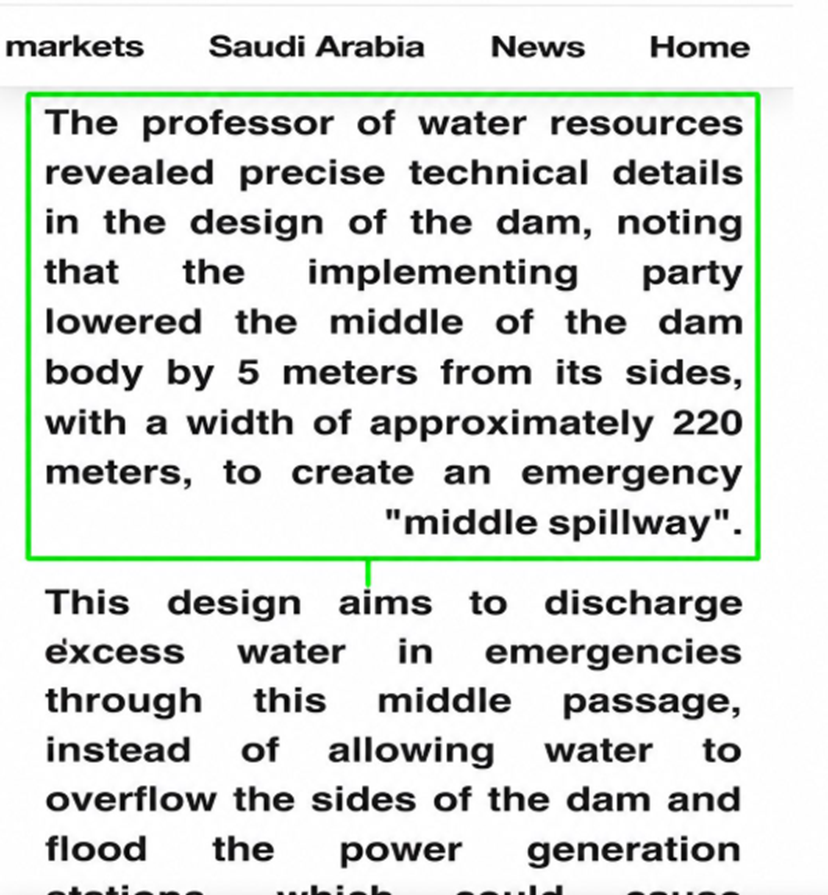
Sharaky told an Egyptian outlet that GERD’s real capacity is not the 74 billion cubic meters Ethiopia announces but about 64 billion, because the middle of the dam sits roughly five meters lower than its sides, across a stretch of about 220 meters. His reasoning runs about like this: the dam tops out near 645 meters, the central spillway sill sits at 640, the difference is five meters, each meter near that level holds something like two billion cubic meters, so the notch erases about ten billion, and 74 quietly becomes 64. It sounds simple, and it sounds mathematical, and that is exactly why it is worth slowing down, because underneath it lies a confusion between three things that are not the same: the dam crest, the spillway sill, and the Full Supply Level.
The dam crest is the structural top of the dam, the dry concrete with its roadway and parapet, the part built to stay above the water. The spillway sill is the overflow lip where water begins to pass. The Full Supply Level, or FSL, is the highest the reservoir is meant to hold under normal operation. Sharaky’s mistake is that he treats the top of the concrete as if it were the top of the water, and every step that follows inherits the error.
At GERD the crest is about 645 meters, but the reservoir was never meant to store water to 645. Its normal Full Supply Level is 640, and the central ungated spillway sill sits at 640 as well. So the five meters between 640 and 645 are not lost storage. They are freeboard: the deliberately empty safety margin every large dam keeps above its waterline, room for waves and for routing an extreme flood before water ever reaches the parts of the structure meant to stay dry.
The central section Sharaky points to is not a quiet downgrade. It is an ungated spillway, its lip set at 640 so that any water climbing above the normal full level spills straight back out. The 640 waterline and the 645 crest sit together in the design from the beginning; the lower middle was always a spillway, never a subtraction. No storage level was lowered, and no reservoir capacity was lost through that feature.
The interview presents it as something revealed, a quiet detail uncovered, but it is neither. A spillway whose sill sits at the full supply level is ordinary dam design. There was nothing hidden to find.
And if anyone wants to insist there really was a change, that the dam was first meant to fill to 645 and was later brought down to 640, the burden is a simple one: show the old Full Supply Level, the new one, the revision that altered it, and the storage curve before and after. Without that, this is not engineering evidence. It is interpretation.
It is true that in an extreme flood the surface can rise briefly above 640, perhaps to 642 or 643, while the spillways are running at full discharge. But that is not stored water. It is water on its way out, occupying the safety margin for the hours of the flood before the level settles back to 640. To count it as capacity is to get the direction exactly backwards.
So when Sharaky subtracts ten billion cubic meters for the band between 640 and 645, he is removing water that was never in the count to begin with. GERD’s capacity is measured to the 640 waterline, not to the 645 crest. He has not uncovered a hidden loss. He has double-counted the freeboard.
This is also why his “two billion per meter” figure is a distraction. Near full pool, a vertical meter can indeed be worth roughly 1.8 to 2 billion cubic meters. The arithmetic is not the problem. The premise is. You can only subtract that volume if it was inside normal reservoir capacity, and the 640-to-645 band never was.
Set aside the 64 versus 74 debate for a moment. Even if someone points to an older storage frame near 63 or 64 billion cubic meters, that still does not prove Sharaky’s claim. Why? Because his claim is not based on an official elevation-storage curve. It is based on subtracting the 640-to-645 meter freeboard as if that space had once been normal storage.
That is the error.
A 63 or 64 billion cubic meter figure, if argued seriously, must come from a storage-elevation table, survey, terrain model, reservoir boundary, or gross-versus-usable storage definition. It cannot come from saying “the middle is five meters lower, therefore ten billion was lost.” The spillway Sharaky blames does not move the Full Supply Level; it defines it.
So the question is not whether someone can find a 64 billion cubic meter figure somewhere. The question is whether Sharaky’s five-meter explanation proves it.
It does not.
That is where the argument collapses. He may be pointing at a number that resembles an older frame, but he reached it through the wrong logic.
A careful analyst would have said something different: that there are competing GERD storage frames, one near 63 to 64 at FSL 640 and another near 74 at the same level, and that settling the current capacity requires the official elevation-storage curve and the as-built table. That would be a serious argument.
“The middle is five meters lower, therefore ten billion was lost” is not.
It confuses structural height with water level, dam crest with spillway sill, freeboard with storage, and flood-routing space with reservoir capacity. It dresses a routine dam-safety feature as a hidden scandal.
This is worth caring about because of how it travels. When a professor says it, the public hears settled engineering rather than one man’s reading of a drawing. But the question here is not a geological one. It belongs to dam hydraulics and reservoir accounting, and on that ground the claim does not survive. A reservoir’s capacity is not found by locating the highest point of concrete and subtracting a notch from it. It is read from the elevation-storage curve, at the level the dam is built to hold.
The top of the dam is not the top of the water.
Freeboard is not lost storage.
Flood surcharge is not normal capacity.
If anyone wants to argue that GERD’s real capacity is 64 billion cubic meters, the way to do it is to produce the official elevation-storage curve, not to subtract five meters of freeboard from a storage figure already tied to FSL 640.
That is not a hidden technical discovery.
It is among the first things one learns about how a reservoir is measured.
#GERD #GrandEthiopianRenaissanceDam #Ethiopia #BlueNile #Nile #DamEngineering #Hydrology #WaterResources #Spillway #Freeboard #Reservoir #AbbasSharaky
ይህንን ስንት ኢትዮጵያዊ ያውቃል?
የቅርብ ጊዜ ዘገባዎች ኢትዮጵያ፣ ግብፅ እና ሱዳን ከኢትዮጵያ ምርጫ በኋላ ወደ ዋሽንግተን ድርድር ሊመለሱ እንደሚችሉ ይናገራሉ።
አደጋው ደግሞ።፡ድርድሩ ከባዶ ወረቀት አይጀምርም።
የድሮው የዋሽንግተን ሰነድ በተወሰነ ማሻሻያ መልኩ እንደሚያንሰራራ አል-አራቢ ዘግቧል። ያ ማለት ያው መርዛማው የ2020 ረቂቅ፣ ያ የቅኝ ግዛት ወጥመድ በአዲስ የቃላት አገባብ ለብሶ ወደ ጠረጴዛው ይመለሳል ማለት ነው።
ስለዚህ ራስህን ጠይቅ፦
በዚያ ሰነድ ውስጥ ምን እንደነበር ታውቃለህ? አንቀጾቹን አንብበሃል?
ወጥመዱን ተረድተሃል?
ትናንት የለጠፍኩትን Part One አንብቡ።
ከዚያም ከታች ያለውን Part Two አንብብ።
ይህን እንደ ፖለቲካ አታንብ። ልክ እንደ የሀገርህ የወደፊት ዕጣ ፈንታ በፊትህ እየተጻፈ እንዳለ አንብብ።
Before you read Part Two, one thing. Some people ask why we should worry about a draft from February 2020. That is the past, they say. It is not.
DW Amharic reported last week that negotiations between Ethiopia, Egypt, and Sudan in Washington would reportedly start after Ethiopia’s election.
Around two weeks ago, Al-Araby also reported that, according to an Egyptian source, Cairo is waiting for a new U.S. track that would revive the old Washington document in amended form, with the GERD file reportedly returning from the State Department to the Treasury Department.
So this is not history for its own sake. If an old document can come back wearing new wording, every Ethiopian must understand what was inside the old one before anyone repackages it in our name.
Read. Understand. Question. Do not leave this only to politicians, because officials often react after the trap is already written. Protect your country, and do not pass a colonial water burden to the next Ethiopian generation.
Part One showed the empty box. Part Two shows the lock.
How Egypt Tried to Fool Ethiopia: Article 10.1, the Beautiful Sentence in the 2020 Draft That Was Just an Empty Box (Part Two)
The lock on the box. How a single disclaimer could have been turned into a cage Ethiopia could not open without downstream agreement.
Welcome back.
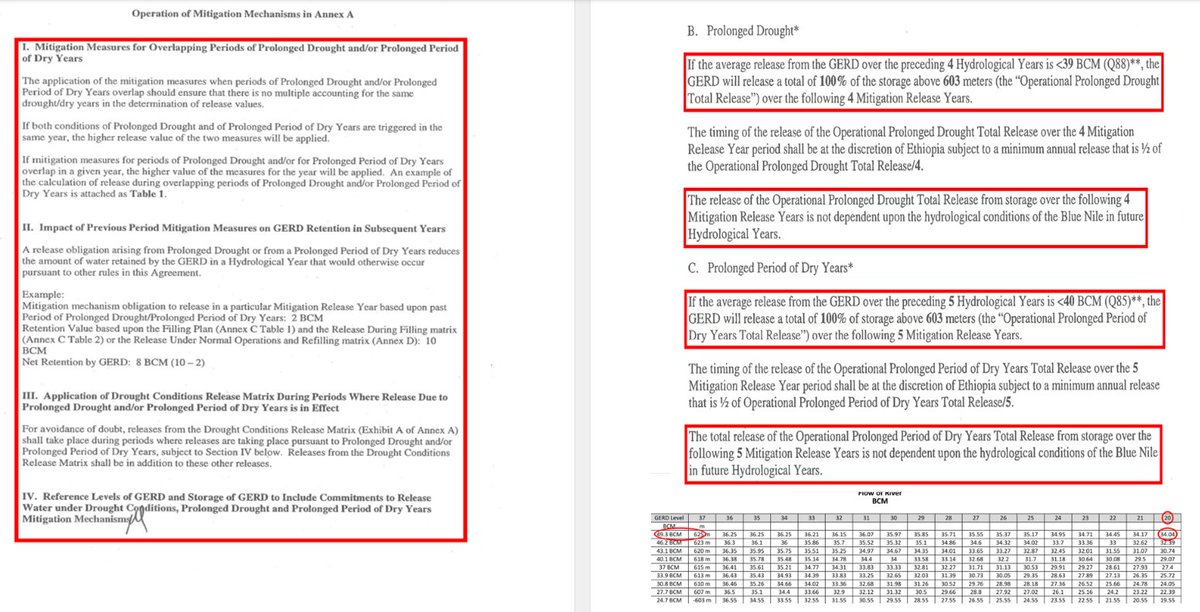
In Part One, I showed you the empty box. I showed you the candy. I showed you Exhibit A and its terrible little number, 34.04, the release the draft would require at the high GERD level of 625 meters / 49.3 BCM when the river flow is only 20 BCM. I showed you Annex A requiring release of 100% of storage above 603 meters over mitigation years, and that cruel line saying the releases are not dependent on future drought. I showed you Exhibit B turning one dry year into a chain, Article 2 turning your own success into the reason you must pay, and Article 10.2 promising a future it had already mortgaged.
If Part One made you uneasy, good. Because now I have to show you the worse half.
In Part One, the draft was merely dangerous. It told you how much water to give away. But a dangerous rule is only dangerous if it can reach you. A snake behind glass cannot bite. So the real question is the one I left you with: once these release rules exist, what makes them bite? What turns a bad table into a binding obligation, a bad obligation into a permanent one, and a permanent one into a door that locks from the outside?
That is Part Two. This is the lock on the box. And I warn you now, this is the part that should make you angry, because this is the part that was built so that, if Ethiopia had signed it as written, Ethiopia could not easily have changed course without downstream agreement.
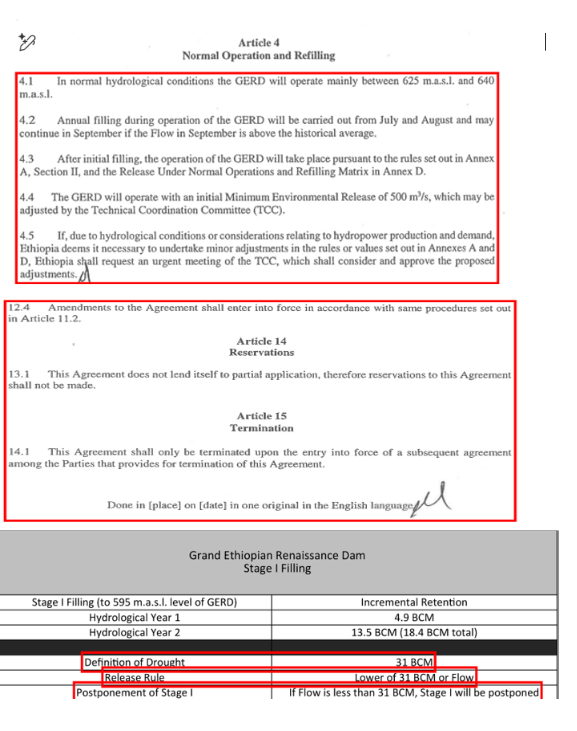
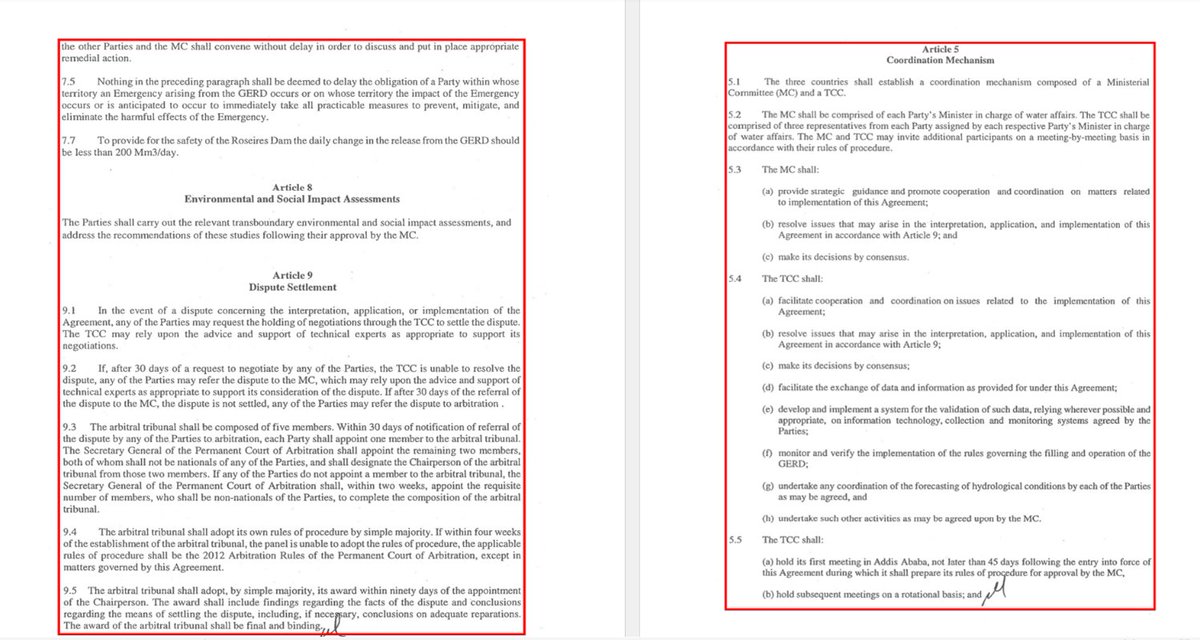
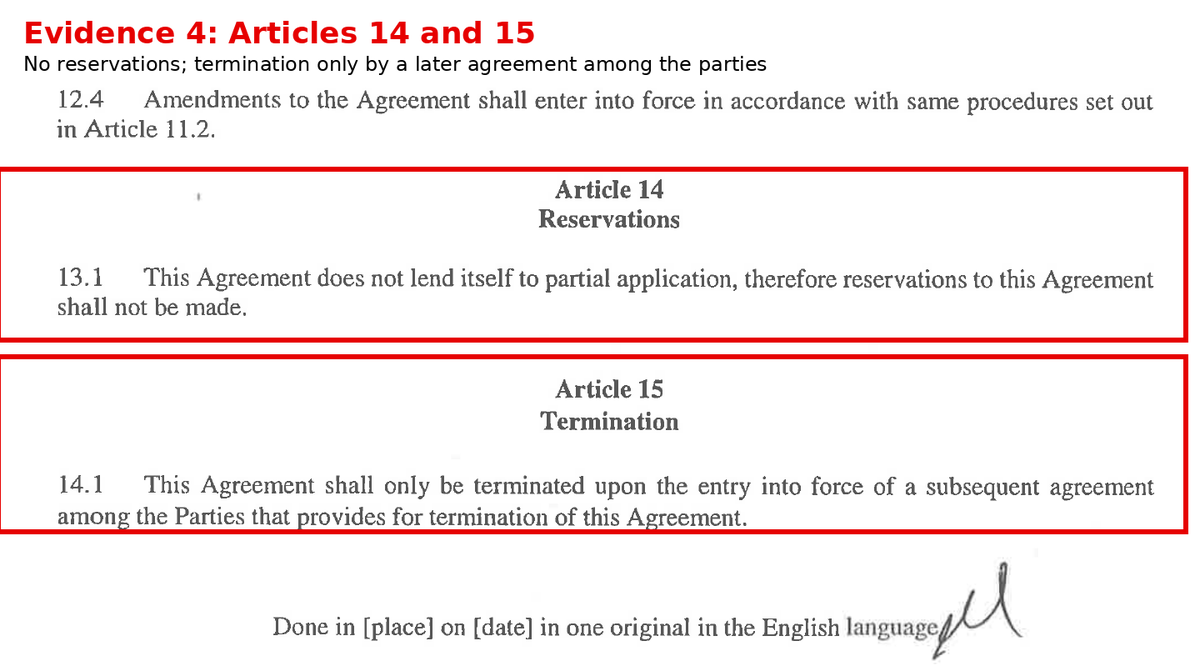
The evidence for this Part Two is Article 4.5, Article 9, Article 12, Article 14, and Article 15 of the February 2020 Washington draft. Every quote below is lifted straight from that text.
Let me show you the five bolts, one by one.
Bolt one. Article 4.5: they took the key to your own house.
Go back to the house I described in Part One, the one you built with your own hands, stone by stone, while your children carried water up the hill. Imagine you finally move in. Then imagine you reach for the light switch in your own home, and a stranger grabs your wrist and says: not without our permission.
That is Article 4.5. And I am not exaggerating. Here is what it says, word for word:
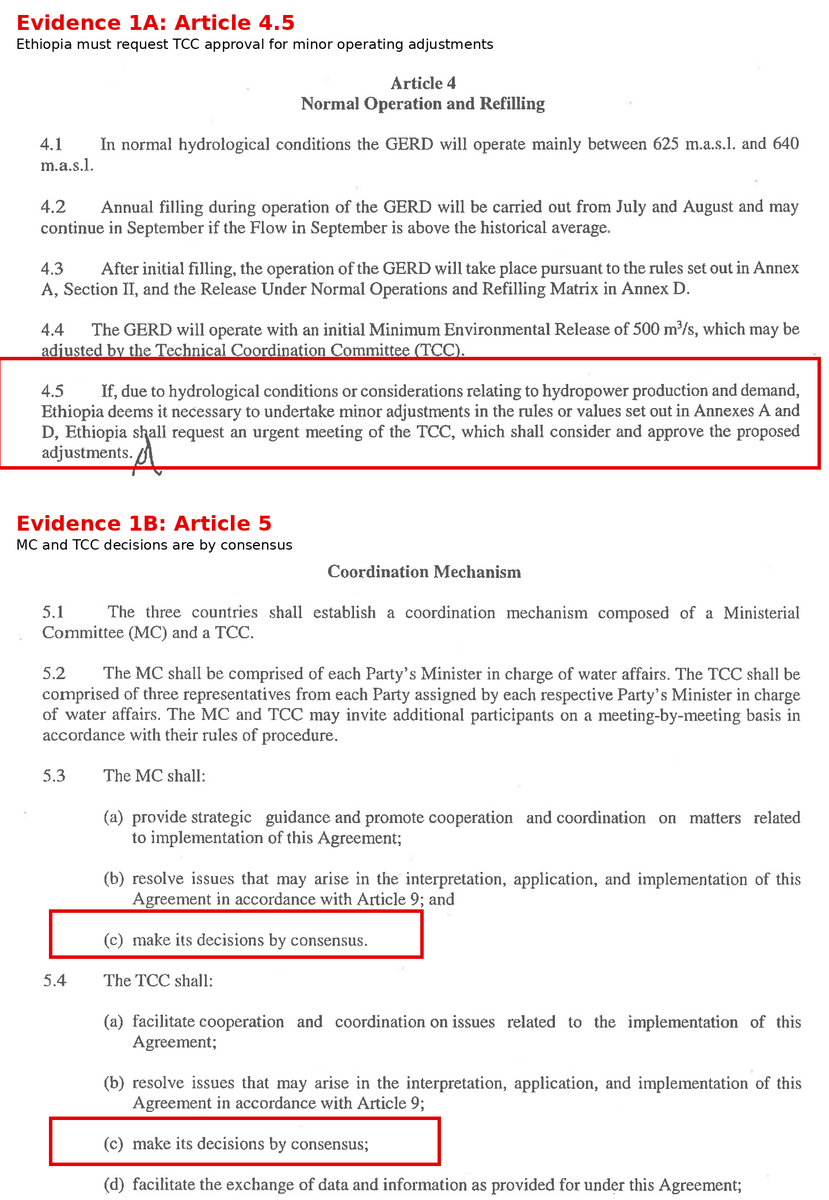
“If, due to hydrological conditions or considerations relating to hydropower production and demand, Ethiopia deems it necessary to undertake minor adjustments in the rules or values set out in Annexes A and D, Ethiopia shall request an urgent meeting of the TCC, which shall consider and approve the proposed adjustments.”
Read those words slowly, because they are quietly outrageous. Minor adjustments. For your own hydropower. For your own demand. For your own people who need electricity tonight. And what would Ethiopia have to do? Not decide. Not act. Ethiopia “shall request.” If Ethiopia had signed this as written, it would have had to go, hat in hand, and ask a committee for approval before making even minor adjustments to the agreed operating rules for its own dam.
And who sits on that committee? Egypt. And how does that committee decide? By consensus, under Article 5. Now, consensus is a beautiful word at a wedding. At this table, consensus means something uglier: it means one “no” can end the conversation. It means Egypt could fold its arms, refuse, and the answer would be no. It means the country downstream, the country that has at times spoken openly of military action against this very dam, would get to sit in judgment over whether Ethiopia may turn a dial on Ethiopian soil.
Think about what this does to the word ownership. They let Ethiopia keep the deed. They let Ethiopia keep the concrete, the turbines, the photographs, the ribbon-cutting, the national pride. And then they took the one thing that actually matters: the right to decide. A dam is not the concrete. A dam is the decisions. Who fills it, when, how fast, how much it holds, when it releases, and for whose benefit. Article 4.5 reaches past the concrete and takes the decisions.
So when someone tells you, “but Article 10.1 says it is not an allocation, Ethiopia keeps its sovereignty,” show them Article 4.5 and ask the only question that matters: what is sovereignty over a dam you would not be allowed to adjust without your rival’s approval?
The deed is yours. The key is in Cairo’s pocket. Put more carefully, so no one can wave it away: the deed would still be yours, but the key to ordinary, everyday adjustment would no longer be fully in your own hand.
And here, in one breath, is the whole Ethiopian position, so no one can twist it. Technical cooperation, yes; downstream command, no. Data exchange, yes; operational veto, no. Drought consultation, yes; water debt, no. Binding procedure, yes; binding surrender of our water, no. That line is not extremism. It is the most ordinary thing a sovereign country can say about its own river.
Bolt two. Article 9: this is where the trap grows teeth.
Here is something I want burned into your memory, because it is the single most important legal fact in the entire draft, and almost nobody talks about it.
Article 10.1, the beautiful sentence, has interpretive value, but it has no supremacy teeth. It does not say “notwithstanding Annex A.” It does not override Exhibit A. It does not cancel Article 4.5. It does not limit Article 9. There is no specific punishment written for violating 10.1, no supremacy clause that makes it override Annex A or Exhibit A, and no remedy that turns it into a master shield. It can be read in argument, but it was not written to overpower the operational machinery. If, years from now, Egypt behaved as though the agreement were an allocation, Ethiopia could not easily lean on 10.1 alone to undo the specific obligations in the annexes, because 10.1 was written to be read aloud, not to overrule the machinery beneath it.
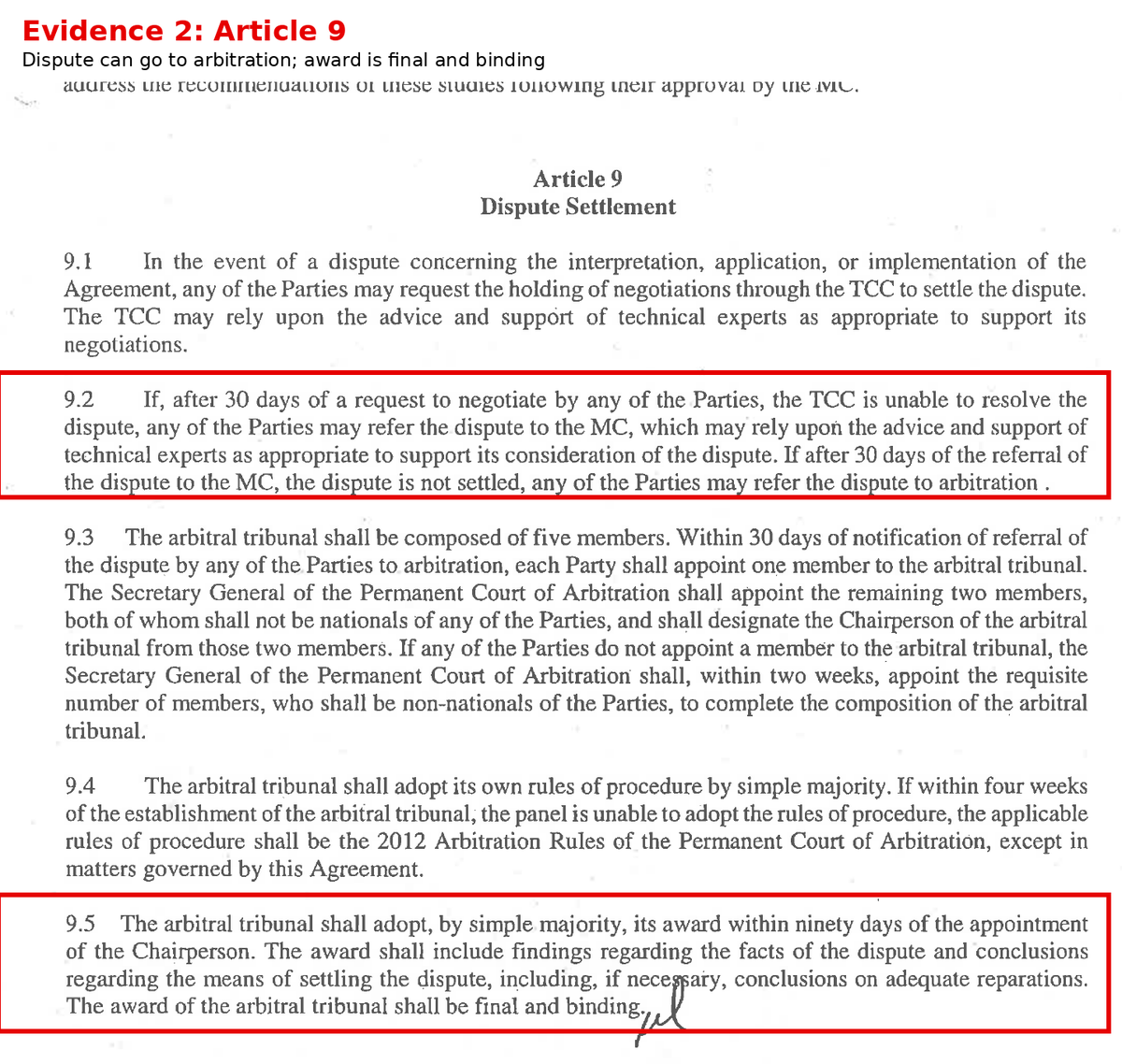
But the release machinery? Exhibit A, Annex A, the drought matrix, the 100 percent drawdown? Those would have teeth, and the teeth are called Article 9. Here is the line that matters:
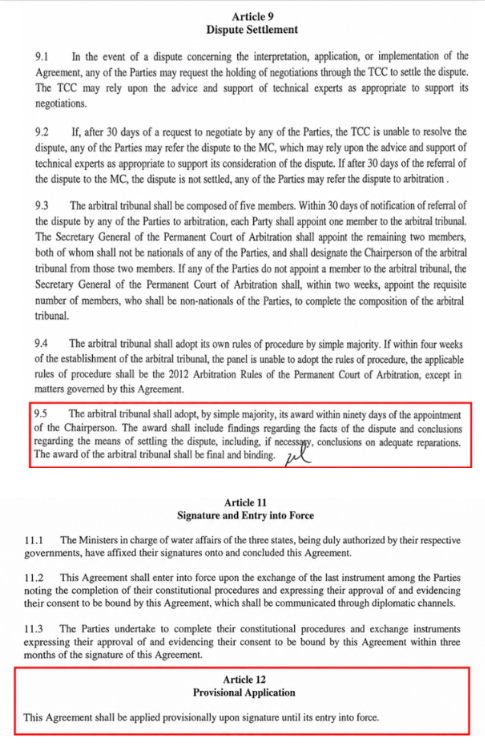
“The award of the arbitral tribunal shall be final and binding.”
Final. Binding. Sit with those two words.
Now let me paint you the fight this clause would make possible, the one that could come ten or twenty years after a signature. A drought arrives. Ethiopia, to keep its own people alive and its own grid breathing, holds back some of the water the matrix demands. Egypt does not send a protest letter. Egypt does not complain in a newspaper. Egypt walks calmly to the arbitral tribunal. And here is the key: Egypt would not need to win the big philosophical argument about whether the Nile is “allocated.” Egypt would only need to ask the tribunal to enforce the specific operational obligations, the exact ones, the number in the box: you agreed to release this, and you did not.
What would Ethiopia bring to that room to defend itself? Article 10.1. A general disclaimer. And a tribunal could treat the specific operational obligations as controlling unless Article 10.1 clearly overrides them. And Article 10.1 does not clearly override them. So Ethiopia would walk into that tribunal holding a poem, and Egypt would walk in holding a contract.
That is the asymmetry I need you to see, and to be angry about. The clause that would help Ethiopia cannot really be enforced. The clauses that would bind Ethiopia could be enforced, finally and permanently, by outsiders. They put the teeth on the trap, never on the promise. That is not an accident. That is design.
Bolt three. Article 12: the trap closes the moment the pen touches paper.
You might think: surely there would be a safety gap. Surely Ethiopia would sign, then go home, let Parliament study it, let the people weigh in, and only then would the dangerous machinery come alive. Surely there would be time to wake up.
There would not. Read Article 12, the whole of it:
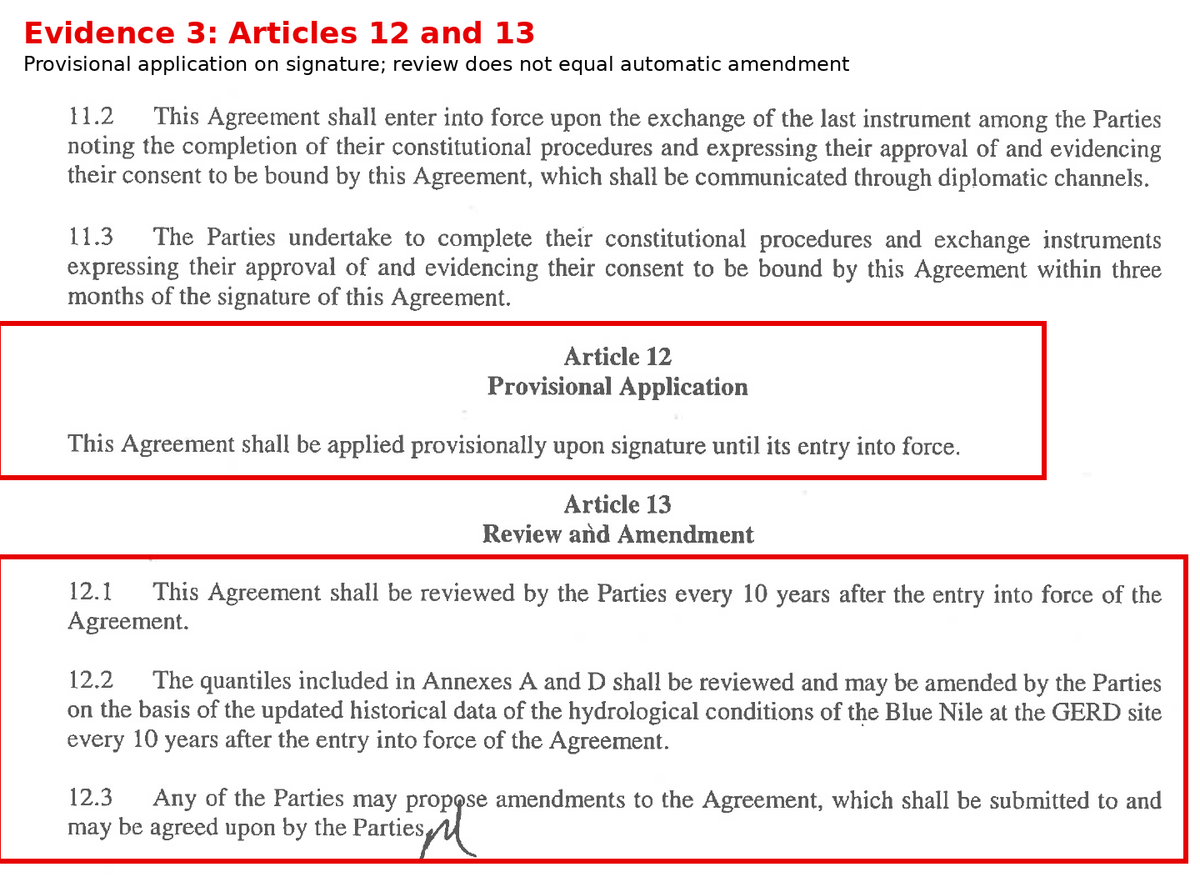
“This Agreement shall be applied provisionally upon signature until its entry into force.”
Provisionally. Upon signature. That means that if Ethiopia had signed this as written, the machine would have started running the instant the pen lifted off the page, before ratification, before Parliament, before the people, before any of the normal protections a sovereign country builds around a decision this enormous. The drought matrix, the drawdown, the approval requirement, all of it could have bound Ethiopia in practice from day one, while the ink was still wet, while the country was still arguing about whether it agreed.
This is the clause that would have removed the morning after. It is the clause that says: no second thoughts, no cooling off, no waking up. You would be living inside the cage before you had finished reading the lease.
Bolt four. Article 14: you cannot keep the candy and refuse the chain.
By now a clever person is thinking the obvious thought: fine, then Ethiopia signs the good sentence, Article 10.1, and simply refuses the dangerous annexes. Take the candy, leave the poison. Sign 10.1, reserve against Annex A.
The draft saw that thought coming and killed it in advance. Article 14:
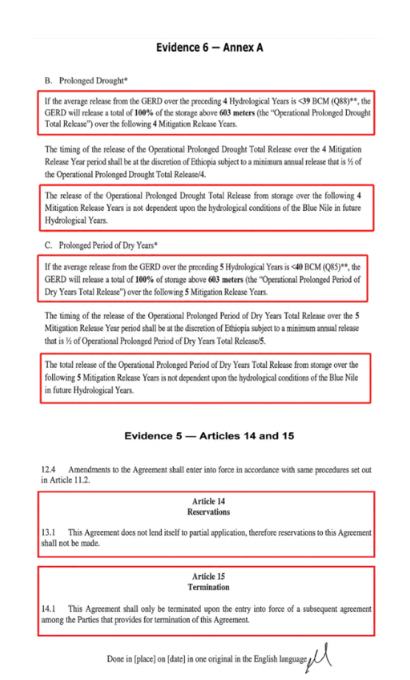
“This Agreement does not lend itself to partial application, therefore reservations to this Agreement shall not be made.”
No reservations. None. It is all or nothing. You cannot accept the beautiful sentence and decline the matrix. You cannot keep the deed and refuse the leash. The shield and the sword come welded into one object, and you must swallow the whole thing or walk away.
And this is the quiet proof of the entire trick. If Article 10.1 had truly overridden the machinery, it would have been far more costly for Egypt to accept. But because Article 14 welds the friendly sentence to the unfriendly machinery, the wording cost Egypt nothing. They could let Ethiopia have the candy, precisely because Article 14 makes sure the candy can never be unwrapped from the chain.
Bolt five. Article 15: the door that locks from the outside.
And now the last bolt, the heaviest one, the one that turns a bad deal into a life sentence. Suppose Ethiopia signs. Suppose five years pass, ten years, and the country sees clearly what it has done, sees the reservoir being drained for someone else’s fields, sees its turbines starving in a drought. Surely a sovereign nation can walk away from a deal that is strangling it?
Read Article 15 and weep:
“This Agreement shall only be terminated upon the entry into force of a subsequent agreement among the Parties that provides for termination of this Agreement.”
Read it again. Ethiopia could only leave if everyone agreed to let Ethiopia leave. Which means Egypt would have to agree. And ask yourself, with a clear and honest mind: why would Egypt ever agree to release Ethiopia from a structure this favorable to downstream control? It would have little reason to. So the arrangement, for all practical purposes, could become indefinite.
Not a treaty for ten years. Not a treaty you could exit when it began to choke you. A door with the handle on the other side. A cage you would have walked into yourself, carrying a piece of candy, and the lock would have clicked shut behind you, and the only party with a real reason to hold the key would be the one who built the cage.
That is the lock on the box. Five bolts. Approval pressure, binding arbitration, provisional application, no reservations, no exit. Each one alone is dangerous. Together they form a machine designed for one purpose: to make sure that once Ethiopia stepped inside, Ethiopia could never step out.
Someone will say, “but Article 13 allows a review every ten years.” Yes, and I want you to see why that is a comfort made of paper. A review is not freedom. A review date does not amend a single word by itself; any amendment still requires the agreement of all parties, which means Egypt’s agreement, which means no. Article 13 gives Ethiopia a calendar, not a key. Ten years later you are standing in the same room, asking the same neighbor for the same permission, and getting the same answer.
What a real Article 10.1 would have looked like.
Now let me show you, in one stroke, the proof that Article 10.1 was decoration and not protection. Just compare it to what a clause written to actually defend Ethiopia would have said.
A real shield does not whisper “this is not an allocation” and then go silent while the annexes do the opposite. A real shield is a master clause, what lawyers call a supremacy clause, and it overrides everything beneath it. It would have read something like this:
“Notwithstanding any article, annex, exhibit, table, matrix, committee procedure, or dispute mechanism in this Agreement, nothing herein shall create a fixed downstream volumetric entitlement, a water debt, a release obligation independent of future hydrological conditions, an obligation to deplete GERD storage for downstream benefit, a pass-through delivery duty, a committee power to approve or veto ordinary GERD operation, an arbitration-imposed release obligation, or any restriction on Ethiopia’s future development of its own waters.”
Read that, then read the real Article 10.1 again, and feel the difference in your chest. The real one says “not allocation” and stops. It never says no water debt. It never says no storage mining. It never says no forced release above the year’s inflow. It never says no veto over how I run my own dam. It never says Ethiopia may walk away if this regime begins to strangle her.
A sentence that names none of the real dangers is not a shield. It is a souvenir. The draft handed Ethiopia the souvenir and kept every danger. They gave us the word “sovereignty” to frame and hang on the wall, and they wrote the machinery that empties the reservoir into the small print underneath.
Why I am angry, and why the anger points at the right people.
Let me say the hard part plainly, because you have read this far and you deserve directness.
This was not an accident. A document does not arrive this elegant by mistake. Someone designed it so the one Ethiopian-friendly sentence would be loud and the Egypt-friendly machinery would be quiet. Someone understood that a tired delegation needs something to carry home, and that a nation’s pride can be satisfied with a name while its water is quietly taken. That is not the work of fools. That is the work of people who have studied this river for generations and studied us for just as long.
And the setting helped them. The United States Treasury facilitated the process, and the World Bank provided technical input. That institutional weight matters. But institutional weight does not make a dangerous clause safe. A clause does not become balanced because it walks into the room wearing a World Bank suit. And remember what the Treasury said when the talks broke down: it stated publicly that final testing and filling of the dam should not take place without an agreement, while Egypt had already initialed the text and Ethiopia was still consulting its own people at home. A finance ministry, helping broker a river it does not share, signaling that the upstream nation should not move on its own water until a deal was done. From an Ethiopian seat, that did not look like neutral refereeing. It looked like pressure, and the pressure leaned downstream.
So when people say Ethiopia “refused to cooperate” by walking away in February 2020, remember what was actually on that table. Ethiopia did not walk away from cooperation. Ethiopia walked away from a cage with a candy in it. And refusing to sign your own imprisonment is not stubbornness. It is the most basic act of a free people.
And let me be clear about what cooperation is, so no one can twist my words. Ethiopia should share its data. Ethiopia should coordinate with Sudan on Roseires and on dam safety. Ethiopia should give honest drought notice and sit at every serious table, with an open hand. Cooperation is a bridge, and Ethiopia should build it. But a bridge is crossed from both sides. What was offered in Washington was a one-way road: our water flowing down it, and a single piece of candy flowing back up. That is not a bridge. That is a drain with good manners.
The whole story, in one breath.
If you remember nothing else from these two parts, remember the chain, because this is the entire trap in a single line:
Article 2 defines the triggers. Annex A creates the water debt. Exhibit A gives the number. Exhibit B makes the debt follow you. Article 4.5 forbids you to adjust it freely. Article 9 makes it final and binding. Article 12 starts it on signature. Article 14 blocks you from keeping only the good part. Article 15 blocks easy unilateral exit.
And Article 10.1, the beautiful sentence, the headline gift, the thing they wanted you to carry home and wave at your people? It stands off to the side, smiling, with no power to stop a single link in that chain.
So now you have seen the whole thing. Part One showed you the empty box, the beautiful ribbon and the air inside. Part Two showed you the lock, the five bolts that could have made the trap, for all practical purposes, indefinite, with no unilateral exit.
And here is where I leave you, with the same question that started all of this, because after everything we have read together, it lands differently now:
We built that dam with our own hands. With our own birr. With the savings of teachers and farmers and taxi drivers who bought bonds they could barely afford, because the dam was ours, a national lifeline, a promise to our grandchildren that the Nile would finally light Ethiopian homes. And we were asked to hand over the operating manual in exchange for one beautiful sentence.
A dam is meant to be a lamp, not a leash. A reservoir is meant to be a shield, not a ransom note.
So if you must build the house with your own hands, carry every stone yourself, go hungry to pay for it, and then sign a paper that says you may not lock your own door, may not adjust your own lights, may not ever move out, then tell me, my friends: whose house is it, really?
I think you already know the answer. I think Egypt knew it too. That is exactly why they could afford to give us Article 10.1.
It cost them nothing. It was an empty box all along.
The end.
#Egypt #Sudan #SouthSudan #Ethiopia #Uganda #Kenya #Tanzania #Rwanda #Burundi #DRC @AbiyAhmedAli #NileRiver #BlueNile #NileDam #AfricanWaters #NoToColonialism @MFAEthiopia #Sovereignty #GERD #WaterRights #Sovereignty #ReadTheDraft #AfricanWaters #NoToColonialism #Abbay #NileNegotiations
How Egypt Tried to Fool Ethiopia: Article 10.1, the Beautiful Sentence in the 2020 Draft That Was Just an Empty Box (Part One)
A close reading of Article 10.1 of the 2020 Washington draft, and why the only “gift” Ethiopia received was wrapped in ribbon and filled with air.
Let me start with a confession.
The last time I sat down and read the 2020 draft, the one Egypt initialed in Washington on February 28, 2020, the one Ethiopia walked away from, I missed something. Not a small thing. A big thing. I was so busy hunting for the poison in the document that I walked right past the one place where the document smiles at you.
There is one sentence in that whole draft that looks like the clear, headline gift for Ethiopia, the one that can make an Ethiopian reader breathe for a moment. Out of fifteen articles, four annexes, and a stack of exhibits, this is the sentence everyone points to first.
It is Article 10.1. And here is what it says, word for word: “This Agreement is not intended to be and shall not be interpreted or applied as an allocation of the waters of the Blue Nile among the Parties.”
Read that again slowly. Not an allocation of the waters of the Blue Nile. For a country that has spent a century being told by colonial-era papers it never signed that its own rain already belongs to someone downstream(Egypt), that sentence is oxygen. It says, in plain legal language, that this document does not divide the Nile. It does not hand Egypt a written quota. It does not bless the old “historical rights.” On its face, it protects the one principle Ethiopia has bled to defend: the Blue Nile is not already spoken for.
But here is the first problem, and you need to see it before you let your shoulders drop. The draft does not leave Article 10.1 standing alone. The opening of the agreement says it consists of the articles, annexes, and associated exhibits, and that these constitute an integral part of it. In plain language: Exhibit A is not decoration. Annex A is not a footnote. They are bolts in the same machine as Article 10.1. So that beautiful sentence must be read together with the very annexes that quietly do the opposite of what it promises.
So I want to be honest with you, my friends, before I get angry, because I am going to get angry. That sentence is real, and it is good. If I tell you it is worth nothing at all, I am lying to you, and a man who lies to his own people to win an argument is no better than the people he is arguing against.
But here is the question that has been burning in me since I reread it:
What is the use of one good sentence in a house built entirely to trap you?
That is what this whole article is about. So pour your coffee, settle in. Let me take you somewhere first.
Let us drive back to February 2020, into a room I was never in.
I want to be completely clear with you. I was not in that negotiation room in Washington. I have no idea what was actually said. What I am about to tell you is my imagination, a story, a picture in my head, and I am telling you it is imagination so that no one can later say Asrat made up facts. I made up nothing. I am painting a scene. Bear with me.
Picture it. February 2020. A cold Washington conference room. A long polished table. On one side, Egypt’s delegation, calm, prepared, lawyers who have studied this river for generations. Beside them, helpfully, the United States Treasury, facilitating. And in the corner, the World Bank, lending its “technical input” like a respectable witness at a wedding nobody asked for.
And the draft on the table? In my imagination, it already leaned heavily toward egypt control. I am not going to hand you a precise percentage and pretend I measured it. I didn’t, and neither did anyone who tells you a number. I am describing the shape of the text: Annex A, Exhibit A, Article 4.5, Article 9, Article 12, Article 14, and Article 15 all lean the same way, like trees bent by one strong wind. They never need to say the word “allocation” to take the water.
Now imagine, in that room, one tired Ethiopian negotiator looks up from the pages, feels his stomach drop, and says, almost begs:
“Wait. Wait. There has to be at least ONE article in here that is good for Ethiopia. One. Give us something we can carry home.”
And imagine Egypt, patient, unbothered, the way a chess player is unbothered when you finally move a pawn, leaning back, thinking for one second, and saying:
“Of course. Here. Write this down: ‘This is not an allocation of the Blue Nile.’ There. Now you have your good article. Article 10.1. Happy?”
And the pen moves, and the sentence goes in, and somewhere a shoulder relaxes.
Again, Don’t take my word for any of that. It is theater in my head. But ask yourself why the theater feels so true. Why does it fit the document so perfectly? Because when you finally read what the rest of the draft actually does, you realize that Egypt could afford to give away that sentence. It cost them nothing. They were never going to need the word “allocation.” They had already written the allocation into the machinery. They just left the name off.
The candy and the toys
Let me use an analogy, so let me give you the one every Ethiopian parent already understands.
A clever uncle visits a child. He crouches down, smiling, and holds out one bright piece of candy. “This is for you,” he says. “It’s all yours. Nobody can ever take this candy from you. I promise.”
The child’s eyes light up. Mine. He said it’s mine.
And while the child is busy unwrapping that one candy, happy, distracted, grateful, the uncle quietly gathers up every toy in the room. The blocks. The ball. The little wooden truck the child’s father carved with his own hands. All of it. Into his bag.
Then the uncle stands up, pats the child on the head, and says, “See? I kept my promise. The candy is still yours.”
That is Article 10.1.
The candy is the word. The toys are the water.
But let me give you a second picture, because the candy story is too gentle, and what was attempted in Washington was not gentle.
Imagine a man builds a house with his own hands. He carries every stone himself. He goes hungry to pay for the cement. His children carry water up the hill for the mortar. For years. And when the house is finally standing, strong, his, earned, a neighbor arrives with a contract. The contract has a beautiful first line: “This document does not say we own your house.” The neighbor smiles. “You see? We respect that it’s your house.”
And then, in the small print, the contract says: you may not lock your own door without our permission. You must leave the windows open on the nights we choose. When the well runs dry, you must give us your stored water first, even if your own children are thirsty. And you may never tear up this contract unless we agree to let you.
Whose house is that, really?
The deed says it’s yours. The operation of it belongs to the neighbor. And a house you cannot lock, cannot run, and cannot leave is not your house. It is your prison that you happen to have built yourself.
That is the genius and the cruelty of what was put on that table. Egypt did not try to take the deed to GERD. Taking the deed would have been too obvious; it would have caused an open fight. Egypt did something quieter and far more dangerous. It reached for the operating manual while letting Ethiopia keep the deed, and then it offered Article 10.1 as proof of its good manners.
Now let us leave my imagination and walk into the real document.
Here is where I stop telling stories and start showing receipts. Everything from here is in the text. I will quote it. You decide.
The whole trick of Article 10.1 rests on a distinction that sounds boring but decides everything: the difference between what a clause says it is and what a clause makes you do.
In law, this is not a small point. It is the whole point. Lawyers have a saying about it that goes back centuries: substance over form. It does not matter what you call the animal. If it has four legs, a mane, and hooves, and it carries a rider, it is a horse. You can write “this is not a horse” on a sign and hang it around its neck. It is still a horse.
Article 10.1 is the sign that says “this is not a horse.”
The annexes are the horse.
So let me walk you through the animal, piece by piece, strongest evidence first, because you asked me to start from the top of the mountain and come down, and the view from the top is brutal.
Exhibit A: the receipt that ends the argument
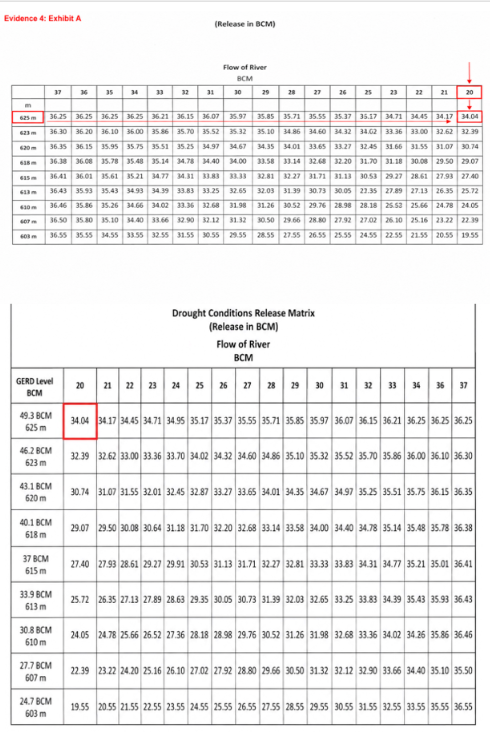
If I could show an Ethiopian only one page of this draft, it would be Exhibit A, the Drought Conditions Release Matrix. It is a grid of numbers, dry and bureaucratic, and inside that grid sits the single most damning fact in the entire document.
Find the row where the GERD reservoir is at its highest listed level: 625 meters above sea level, holding 49.3 billion cubic meters. Now follow it across to the column where the river’s flow for the year is only 20 BCM. A drought year. A hungry year. A year when the rain failed.
The number in that box is 34.04.
Stop and feel what that means. The river brought you 20. If signed as written, the document would require you to release 34.04 BCM. That is about 170 percent of everything nature gave you that year. Where do the missing 14.04 billion cubic meters come from? Not from the sky; the river brought only 20, not 34.04. The missing 14.04 must come from your storage, from the water you saved, from the water your country went into debt to hold back. In the dry year, when your own people most need that reserve, the rule would reach into your reservoir, pull out roughly 14 billion cubic meters of stored Ethiopian water, and send it downstream.
Now turn back to Article 10.1 and read it one more time: “not… an allocation of the waters of the Blue Nile.”
My friends, what do you call a rule that tells you exactly how much water to deliver downstream under specified drought conditions, enforceable through the agreement, and drawn from your own stored water? There is only one honest description for it: functional allocation. Allocation without the name. Egypt did not need the word, because Egypt had the number: 34.04.
That single box cancels most of the comfort of 10.1 by itself. I would put it roughly ninety percent of the way toward making 10.1 meaningless. The sign says “not a horse.” The horse just kicked you.
Annex A: the water debt that follows you into the dark
It gets worse, and I need you to follow me carefully here, because this is the part a downstream legal strategy would love and the Ethiopian public never understood.
Look at the long-term operation rules in Annex A. They say that if the average GERD release over the preceding four hydrological years falls below 39 BCM, GERD must release 100% of the storage above 603 meters over the following four mitigation years. And if the average over the preceding five years falls below 40 BCM, GERD must release 100% of the storage above 603 meters over five mitigation years.
One hundred percent. Not a share. Not a portion. All of the storage above 603 meters.
And then comes the sentence that should make every Ethiopian’s blood run cold. The draft says these releases are: “not dependent upon the hydrological conditions of the Blue Nile in future Hydrological Years.”
Read that slowly, because it is the cruelest line in the document. Not dependent on the future. It means this: suppose a drought hits, and the rule triggers a multi-year obligation to drain your storage. Now suppose the next years are also dry, God forbid, a real drought, the kind the Horn of Africa knows too well. Under any sane, humane rule, your obligation would shrink, because there is no water and your own people are suffering.
But this draft says no. The debt was calculated from the past. You must pay it regardless of the present. Even if your children are thirsty. Even if your turbines are starving. The water debt does not care about the future, because it was never designed to protect you. It was designed to guarantee Egypt’s supply no matter what the sky does to Ethiopia.
This is not cooperation. Cooperation shares the pain of a drought. This exports the pain of drought out of Egypt and pushes it upstream onto us. It turns GERD, the dam we built to protect ourselves from drought, into an insurance policy for someone else’s drought. We pay the premiums. They collect the claim.
And here is the engineering knife hidden inside the legal one. Draining your reservoir down to 603 meters does not only cost you water. It costs you power. A hydropower dam generates electricity from the pressure of the water stacked above the turbines, the “head.” Drop the level, and you drop the pressure, and you drop the megawatts. So in the very years when drought makes electricity most precious, this clause would put GERD under forced drawdown: less stored water, less hydraulic head, exactly when reliability matters most, so that Egypt’s fields stay green. We built the largest dam in Africa, and the draft would have us run it under drawdown to water someone else’s harvest.
What does Article 10.1 do about any of this? Nothing. It cannot. It is a sentence about a name. Annex A is a machine about water. When a name fights a machine, the machine wins every time.
Exhibit B: how one dry year becomes a chain that drags you for years
Now, someone might say: “Fine, one bad drought, one big release. We survive it and move on.” I wish that were true. Read Exhibit B, and you find out it is not a single bad year. It is a system.
Exhibit B does one small kindness. It says overlapping drought and dry-year measures should not be double-counted, and the higher value applies. Good. But it does not make this a single-year problem. It builds a stacking-risk architecture. It shows that a release obligation created in a drought period reduces the water GERD is allowed to keep in later years. And it shows that ordinary drought-matrix releases can operate during the very periods when prolonged-drought or dry-year mechanisms are already in effect.
So watch the chain form. A dry year triggers the matrix. A prolonged dry stretch creates a multi-year release duty. That duty then eats into your retention in the following years, years that may be perfectly normal. And on top of that, the drought matrix can still be firing at the same time. One bad season does not simply pass. It can attach itself to your dam and walk beside you for years, draining a little more along the way.
Article 10.1 has nothing to say to this system. It cannot, because it was never written as a master switch. It does not say “no annex may create water debt.” It does not say “no rule may force release above the year’s inflow.” It is a polite sentence sitting in the corner while the machine runs.
The definitions: how they made your success the reason you must pay
You would never look twice at Article 2. It is the “Definitions” section, the part everyone skips. That is exactly why it is dangerous. The most important traps are always set in the boring rooms.
The draft defines “Flow” like this: “‘Flow’ means the total volume of water entering the GERD reservoir in any given Hydrological Year.”
And it defines “GERD Level” as the level of your reservoir at the start of the year.
Why does this matter? Because these two boring definitions are the trigger for the whole release machine. The matrix doesn’t look at the water crossing into Sudan. It looks at the water inside your dam and at how full your reservoir is. And the fuller your reservoir, the more the matrix demands that you release.
Think about the madness of that. You worked hard. You saved water. You filled your dam, the dam you built to secure your own future. And the document treats your full reservoir not as your achievement but as the evidence that you can afford to give more away. Your savings account becomes the proof that you owe. Your success becomes the trigger of your obligation.
And there is a second blade here, aimed straight at the future, and this is the part I beg you not to skip. Because “Flow” is measured at the dam, any future Ethiopian project upstream of GERD could be argued to reduce GERD inflow and trip the same drought machinery, unless the agreement clearly protects future development from being converted into a release obligation. An irrigation scheme to feed Ethiopian children. A small dam for a thirsty highland town. A watershed to hold back the rains. Each one could lower the flow arriving at GERD, and a lower flow at GERD could be read as a drought under these very definitions. So Ethiopia developing its own land could, on paper, be made to look like the sky failing. Someone downstream could point at your new canal and argue that a drought was triggered, and the matrix would obey. The trap is not only set for today. It is set for your grandchildren, and it risks punishing them for the crime of building.
So when Article 10.1 says “not an allocation,” ask it: then why does my own water level decide how much I must surrender, and why might feeding my own people count against me? The article has no answer.
Article 10.2: the second beautiful sentence, also not enough
To be fair, there is a second sentence that looks friendly to Ethiopia, and an honest writer must deal with it. Article 10.2 says future developments upstream of GERD may be undertaken, but “without prejudice to this Agreement,” and in line with international-law principles like equitable use, no significant harm, and cooperation. That sounds good. Ethiopia should want that sentence.
But look carefully at four words: without prejudice to this Agreement. And what does this Agreement already do? It defines “Flow” at GERD. It ties release rules to GERD flow and GERD level. It pulls Annex A and Exhibit A into operation. So if future Ethiopian development reduces the inflow into GERD, the downstream argument writes itself: you have affected the trigger system inside the draft.
That is why Article 10.2 is not enough either. Future development should not merely be “allowed” in a sentence. It needs a real safe harbor, a line that says lawful Ethiopian development shall never automatically become drought, breach, shortage, compensation, water debt, or a release obligation. Without that protection, the future is allowed on paper but still forced to walk through the cage the rest of the draft has already built.
My Conclusion for part One
So let me close Part One with the simplest truth.
Article 10.1 looks good. If you read it alone, it looks like the most beautiful sentence Ethiopia received in the 2020 Washington draft. It says the agreement is not an allocation of the waters of the Blue Nile. It sounds like sovereignty. It sounds like protection. It sounds like Ethiopia finally got one sentence in its favor.
But once you read the rest of the draft, that beautiful sentence begins to collapse.
Because a sentence does not protect a dam if the annexes control the releases. A sentence does not protect sovereignty if the tables control the storage. A sentence does not protect Ethiopia if the operating machinery turns GERD into a downstream drought buffer.
That is why I call Article 10.1 an empty box.
The ribbon is beautiful. The words are beautiful. The promise sounds beautiful. But when you open the box, the real power is not inside Article 10.1. The real power is buried in Annex A, Exhibit A, Exhibit B, Article 2, and the legal machinery that comes after them.
In Part One, I showed the empty box. I showed the candy. I showed Exhibit A, Annex A, Exhibit B, Article 2, and Article 10.2.
In Part Two, I will show the lock on the box: Article 4.5, Article 9, Article 12, Article 14, and Article 15. That is where the draft moves from dangerous operation into legal trap: approval pressure, arbitration, provisional application, no reservations, and no easy exit.
Part One showed why the beautiful sentence is weak.
Part Two will show why the trap could have become enforceable.
To be continued..
#Egypt #Sudan #SouthSudan #Ethiopia #Eritrea #Uganda #Kenya #Tanzania #Rwanda #Burundi #DRC #UAE @AbiyAhmedAli #NileRiver #WaterRights #Sovereignty #BlueNile #NileDam #AfricanWaters #NoToColonialism #GERD #NileRiver #Kechene @MFAEthiopia #Sovereignty
How is Ethiopia even sitting at the same table with people who say our share is zero?
Egypt’s irrigation minister previously said Ethiopia’s share of the Blue Nile is zero.
He said it with arrogance.
A country that contributes 0% to the Blue Nile, and sits almost 2,000 km away from the source, wants to bully the country that contributes about 85% of the Nile waters.
A country with 0% contribution wants to dictate terms to the source country.
A country with 0% contribution wants to claim control over nearly 70% of Ethiopia’s surface water.
How can Ethiopia’s negotiation team and the Ethiopian government even sat at the same table with this level of arrogance?
#Ethiopia #GERD #Abbay #BlueNile #Nile #CFA #WaterJustice #Africa #Sudan #Egypt #SouthSudan #Uganda #Kenya #Tanzania #Rwanda #Burundi #DRC #Eritrea
There is a reason my GERD research paper was ranked #3 on SSRN for months.
EEP revision: “18 ሺህ 477 ነጥብ 6 ጊጋ ዋት ሰዓት”
My research paper: 19,717.2 GWh/year.
My paper was published in 2024, but the core draft and calculation were developed 4 years earlier. At that time, the commonly repeated GERD annual generation figure was still around 15,250 GWh/year.
Most experts, reports, and public discussions were still circling around that old number.
My draft estimated GERD’s average annual generation at: 19,717.2 GWh/year
Now look at what EEP is saying today.
EEP reports that GERD generated 13,778.37 GWh in the first 9 months of the fiscal year, with 95.7% achievement against the plan. EEP also says the annual target is: “18 ሺህ 477 ነጥብ 6 ጊጋ ዋት ሰዓት”
That is 18,477.6 GWh/year.
Compare the numbers: Old repeated figure: 15,250 GWh/year
EEP current annual target: 18,477.6 GWh/year My draft estimate: 19,717.2 GWh/year
My estimate was not randomly high. It was pointing toward the real operating behavior of the dam.
The difference between my estimate and EEP’s current annual target is 1,239.6 GWh, about 6.7%.
But the bigger point is this: the official operating reality is moving away from the old 15.25 TWh/year line and toward the level my research identified years ago.
That is why I am proud of that paper.
I did not look at GERD as a recycled talking point. I looked at it as a real operating plant. Real head( lower and upper turbine). Real turbine configuration. Real seasonal operation. Real Blue Nile hydrology. Real power generation behavior.
That is the difference.
#GERD #Ethiopia #BlueNile #Hydropower #DamEngineering #Energy #Abbay
Congratulations to @Webuild_Group for receiving the SaMoTer Innovation Award 2026 for the Grand Ethiopian Renaissance Dam, GERD. 🇪🇹🏆
This recognition is not only a celebration of engineering excellence. It is also recognition of one of Africa’s most ambitious and technologically advanced infrastructure achievements.
GERD is proud moment for Ethiopia, for African infrastructure, and for everyone who helped turn this vision into reality. 🇪🇹⚡
#GERD #Ethiopia #GrandEthiopianRenaissanceDam #Hydropower #Infrastructure #Engineering #CleanEnergy #Webuild #Samoter202
Title: @abbas_sharaky’s GERD post, checked against the data
When unsupported technical claims go unanswered, they do not stay small. They get repeated, enlarged, and recycled as fact. That is exactly why I am answering Abbas Sharaky today, with the files, the product limits, and the engineering logic his post tries to hide behind rhetoric.
I checked the DAHITI files I downloaded from my DAHITI account, HydroWeb, the SWOT LakeSP observation and prior files I downloaded from my NASA Earthdata account, and other public inland-water records.
The first weakness in @abbas_sharaky’s post appears before the engineering even begins: he does not transparently identify which database he is using, which date he is using, which satellite track he is relying on, or how he converted water level into BCM. That is not a small omission. Once someone publishes exact numbers like 629 m and 47 BCM, vague sourcing is not good enough. It has to be auditable. His is not.
Once the actual record is checked, that vagueness becomes a serious problem. The DAHITI GERD target summary itself shows that the water-level record ends on March 24, 2026, at 629.732 m ± 0.180 m, while the surface-area record ends on June 6, 2025, at 1548.230 km² ± 136.840 km². Just as importantly, the same GERD target summary shows that volume-variation data are not available there. In plain English, the DAHITI GERD record I checked does not directly give the kind of BCM storage series @abbas_sharaky’s wording implies, and it does not directly contain April 2026 water-level and surface-area rows in the way his precise claims would require. So before I even start dismantling his conclusions, the record already shows that his certainty is running far ahead of the evidence.
1.Quote: “The reservoir was about 629 m and about 47 BCM.”
My response: This is the weakest numerical claim in the entire post.
The DAHITI GERD record I checked does not directly provide absolute storage in BCM. It provides water level from satellite altimetry and surface area from optical imagery, and the GERD target summary explicitly says that volume-variation data are not available for this target. So 47 BCM is not a direct DAHITI number from the GERD record I checked.
Then the storage math collapses.
In the records and operating references I checked, 625 m corresponds to about 49.3 to 49.5 BCM, and 640 m corresponds to 74 BCM. That means 625 m is already about two-thirds of full storage, while 47 BCM is only about 63.5 percent of full storage. So Sharaky is asking people to believe something mathematically backwards: a reservoir at 629 m, four meters higher than 625 m, somehow holds less water than the documented 625 m benchmark.
That is not a tiny slip. That is a storage-math failure.
If you compare 47 BCM to the 625 m benchmark, his number is lower by about 2.3 to 2.5 BCM. In percentage terms, he makes a reservoir that is four meters higher hold about 5 percent less water than the lower benchmark. And if you do even a crude interpolation between 625 m and 640 m, 629 m lands around the mid-50s BCM, not 47 BCM.
So no, this is not a rounding issue. It is a serious technical miss.
And one more thing: 625 m is not some vague number. In the Ethiopia-Sudan 2022 technical rules, first filling is completed when the reservoir reaches 625 m or above, and GERD is supposed to operate mainly between 625 m and 640 m. In other words, 625 m is already a documented operating reference point. So claiming 629 m and only 47 BCM is not just weak. It is backwards.
2. Quote: “The reservoir stayed almost unchanged since April 10.”
My response: That may be a visual impression from screenshots. But a visual impression is not the same thing as a reproducible data row.
The DAHITI water-level file I checked stops on March 24, 2026, not in April 2026. The DAHITI surface-area file I checked stops in June 2025, not April 2026.
So the record I checked does not directly contain:
April 10, 2026 water level
April 18, 2026 water level
April 23, 2026 water level
April 28, 2026 water level
any April 2026 surface-area row at all
So my careful statement is this: he may have a visual shoreline impression from browser imagery, but he does not have April 2026 DAHITI row support from the file record I checked. That distinction matters. A visual impression is not the same thing as a reproducible measurement row.
3. Quote: “Satellite images show that the upper turbines stopped during the past two weeks.”
My response: No. Not in the way he wants the reader to believe.
The documentation is clear that this class of evidence comes from optical imagery, mainly Landsat and Sentinel-2. That makes it useful for shoreline comparison, visible plume or turbulence patterns, and broad surface conditions. But it is not unit-by-unit turbine telemetry.
This is where Sharaky stops sounding like an operator and starts sounding like a commentator.
A storage hydropower plant on a highly seasonal river like the Blue Nile is not supposed to run every unit at the same load all year. Unit commitment changes with inflow, head, grid demand, maintenance, outages, and dispatch strategy. In the heavy-flow months, more units may run. Outside them, fewer units may run. That is normal plant operation, not automatic evidence of failure.
Optical screenshots cannot, by themselves, reliably prove: which exact turbines are on or off, whether all upper turbines stopped, whether the lower pair has been out since a particular month, exact unit-by-unit dispatch. So a few visible surface cues do not prove the story Sharaky wants them to prove. They do not prove turbine shutdown. They do not prove malfunction. They do not prove bad engineering.
Screenshots are not control-room data. They are not turbine-status evidence.
4. Quote: “The two lower turbines have been stopped since last June.”
My response: That is even weaker.
The file record contains water-level estimates, surface-area estimates, product documentation, and remote-sensing method papers. It does not contain a month-by-month plant operating record. It does not contain a unit-status log. It does not contain a dispatch sheet.
So this claim is not being demonstrated from the evidence base. It is being asserted.
If @abbas_sharaky wants to claim that specific lower units have been offline since a particular month, the burden is on him to produce plant-status evidence, not screenshots and not DAHITI level-area products.
5. Quote: “Under good operation, the reservoir should have been about 20 BCM, not 47 BCM.”
My response: This is another major overreach.
The DAHITI files do not say that. They cannot say that. They are not operating-rule documents.
And the broader GERD literature cuts against him. Published GERD work places normal or optimal operation in a much higher band, around 625 to 640 m, not near some universal early-May target of 20 BCM. The Ethiopia-Sudan 2022 technical rules also say first filling is completed when the reservoir reaches 625 m or above, GERD operates mainly between 625 m and 640 m, and replenishment usually happens in July, August, September, and October.
So this 20 BCM by early May line does not read like a neutral engineering benchmark. It reads like @abbas_sharaky’s personal operating assumption being presented as if it were settled dam law.
It is not.
6. Quote: “The rainy season in the Blue Nile Basin begins specifically on May 1.”
My response: Here wording matters.
He did not say around May 1.
He did not say roughly early May.
He said it specifically.
That is false precision.
A basin does not switch on like a machine on one date. The Upper Blue Nile has the shorter Belg season and the main Kiremt rainy season, and onset varies. The broad wet-season transition is real. But specifically May 1 is not serious operations language. It is rhetoric dressed up as precision.
So yes, I challenge him directly on the wording.
7.Quote: “Weak operation or shutdown of the 13 turbines is due to technical installation problems and lack of readiness.”
My response: That is not demonstrated by the evidence.
The data products are about water level, surface area, optical water masks, and remote-sensing methodology. They are not commissioning records, not contractor defect logs, and not plant-readiness reports. So moving from weak visible surface release to installation problems is not an engineering conclusion here. It is speculation.
And again, he skips the real engineering variables:
head, available flow, unit commitment, maintenance
grid absorption, dispatch strategy, Without those, this is not a diagnosis. It is a guess.
A serious mechanical-readiness diagnosis would require plant records, commissioning updates, or credible engineering reporting. Screenshots do not do that work for him.
8. Quote: “The dam needs wise management and coordination with Egypt and Sudan.”
My response: This is where wording matters again.
@abbas_sharaky does not literally write, “This proves poor dam management.” So I will not misquote him.
But he clearly uses the imagery, the 20 BCM assumption, the technical-problems story, and the release narrative to push the reader toward that conclusion. He is framing the situation as evidence of weak operation and a need for wiser management.
That is the fair way to describe what he is doing.
And the fair rebuttal is this: even if high releases occurred at some point, that alone does not automatically prove turbine trouble, installation failure, or poor management. It proves a release event occurred. The leap from large release to therefore bad management is his argument, not a direct product output from the evidence base.
9. The April SWOT files make his April case weaker, not stronger
This is the new point that sharpens the whole rebuttal.
A satellite track is just one strip of ground the satellite flew over on that day. The GERD DAHITI page lists GERD SWOT tracks as 012, 318, and 499. That means April 23 track 165 is not even a GERD track.
And the only GERD-relevant April track in the NASA files I checked, April 18 track 012, still does not rescue his claim. In the observation files, I did not get a GERD-consistent record. In the prior files, the nearby entries are no_data placeholders, not valid observed water-level or area values.
So my statement is this: I checked both the April SWOT LakeSP observation files and the April SWOT LakeSP prior files downloaded from NASA Earthdata. April 23 track 165 is not even a GERD track, and for the only GERD-relevant April track in the set, April 18 track 012, the files still do not produce a valid GERD observation.
What actually survives after the bluff
Once the exaggeration is stripped away, what survives is much smaller: yes, the Blue Nile is highly seasonal
yes, the basin transitions toward higher inflows as the wet season approaches. yes, Ethiopia’s grid constraints are real. yes, the screenshots may support a visual impression of limited shoreline change over a short interval.
But that is not the same thing as a sound dam-operations diagnosis.
The real story is: Abbas Sharaky takes some plausible hydrology, wraps it in screenshots, and then stretches it into engineering conclusions that the data record does not actually prove.
His strongest-sounding claims are actually his weakest: 629 m = 47 BCM, screenshots prove turbine shutdown, good operation should have been 20 BCM
specifically May 1.
So no, this is not a clean technical reading of GERD operations. It is a political argument leaning hard on data that cannot carry the weight he puts on it.
#GERD #BlueNile #Abbay #NileBasin #Hydrology #DamEngineering #WaterSecurity #TransboundaryWater #DataNotNoise #Ethiopia #Egypt #Sudan #SouthSudan #Uganda #Kenya #Tanzania #Rwanda #Burundi #DRC #Eritrea
Part One
Title: THE DROUGHT TRAP: How Egypt Tried to Turn Weather into a Water Quota In The 2020 Washington Draft. Without Ever Saying “Historic Rights”
Trump(Jan 16, 2026): “Predictable water releases during droughts and prolonged dry years for Egypt and the Sudan.”
Today I’m doing one thing only: unpacking “drought” and “prolonged dry years” in the 2020 Washington draft. I’ll return later to the rest of the text, which is even worse for Ethiopia.
Why this matters: in negotiations, “drought” is not just weather. It becomes a technical trigger. A trigger becomes a forced release. And forced releases become a quota, without ever writing the words “historic rights.”
Here’s the deeper trap: if drought is defined against downstream baselines, then Ethiopian development itself gets framed as “drought.” Ethiopia irrigates to feed its people, or builds upstream power and regulates flows, and the reduced inflow is labeled “drought.” The trigger clauses activate not because nature failed, but because Ethiopia developed.
That’s the strategy: freeze Ethiopian development without openly stating a quota.
Now the receipts. The draft was “Initialed by the Arab Republic of Egypt on February 28, 2020 (Washington, D.C.).” Ethiopia did not sign it. Egypt initialed it. So I will use only Egypt’s own clauses and numbers, line by line.
Read this slowly: the draft turns “drought” into a switch. When that switch flips, GERD stops being Ethiopia’s tool and becomes downstream drought insurance.
FIRST RECEIPT: Egypt defines “Flow” in a way that can punish Ethiopia for development
This draft defines Flow like this:
Article 2(d): “Flow” means the total volume of water entering the GERD reservoir in any given Hydrological Year.
Read that again.
It does NOT say “Flow of the Blue Nile at the border.”
It says what enters GERD.
This is Egypt’s first move: control the definition, control the outcome.
So if Ethiopia builds upstream projects in the future that reduce what enters GERD (irrigation, storage, regulation), that reduction shows up in the treaty’s math as low Flow at GERD.
And low Flow is the trigger that activates the drought handcuffs you’ll see below.
Think about what that means:
Any future dams use that reduces inflow into GERD (even for Ethiopia’s own farms and people) pushes the dam closer to the <37 BCM trigger and Egypt’s drought matrix.
The draft doesn’t need to write “Ethiopia may not develop.” It writes: “If your inflow drops, you must release according to our table.”
This is how Egypt tried to freeze Ethiopian development without ever saying “you cannot develop.” or " You can not build dam." This is how “development” becomes “drought” on paper. This is how a treaty becomes a cage disguised as cooperation.
In My Assessment Ethiopia Future Development Risk (under this draft): 70–85% (high). Under this design, every time Ethiopia tries to use more of its own water upstream, the treaty can punish it by shouting “drought” at GERD and forcing extra releases. Development becomes a crime. Drought becomes the punishment.
SECOND RECEIPT: The drought trigger is a hard number, not “cooperation.”
Annex A (Filling Period, Section A, Drought) is blunt:
“If the Flow at the GERD is <37 BCM… the release from the GERD will be according to the Drought Conditions Release Matrix (Exhibit A).”
This applies both during filling and long term operation.
Translation for you:
Not “consult,” not “coordinate.” The draft says the release WILL follow a table. A table controls the dam.
This isn’t “consultation.”
This isn’t “dialogue.”
This is a switch: Flow < 37 BCM to Egypt’s matrix controls Ethiopia’s release.
Egypt doesn’t need to declare drought. Egypt doesn’t need to ask permission. The number does it automatically. And the matrix is where the ugliness lives.
THIRD RECEIPT: The drought matrix can force Ethiopia to release MORE than the river brings in
Open Exhibit A, Drought Conditions Release Matrix.
It literally gives releases (in BCM) based on the Flow and the GERD level.
Here is a clean example straight from the table:
• If the GERD level is 49.3 BCM (625 m)
• and the Flow of River is 20 BCM
• the required release is 34.04 BCM
Stop and feel the meaning:
Inflow = 20 BCM.
Release = 34.04 BCM.
That means Ethiopia must drain about 14 BCM from storage in one year just to satisfy the matrix.
That is 170% of inflow (34.04 ÷ 20).
That means Egypt gets more water during Ethiopia’s drought than nature itself provided.
That is not “shared pain.” That is Egypt using Ethiopian storage as Egypt’s insurance policy.
That is Ethiopia’s dam forced to bleed for Egypt benefit.
This isn’t “cooperation.” This is a drought tax on Ethiopia paid out of Ethiopia’s storage.
And that is the heart of the trap:
A dam built to lift Ethiopia out of poverty gets converted, on paper, into a tank that protects Egypt from drought.
Egypt’s security. Ethiopia’s sacrifice.
Ethiopia Harm Meter (from this clause): Drought matrix trap severity: 95% harm.
Every kilowatt GERD fails to generate in drought is a school without light, a clinic without power, a factory that never opens. This draft makes sure that when the river suffers, Ethiopian development suffers first so Egypt can feel it last.
FOURTH RECEIPT: “Prolonged drought” and “dry years” create a multi-year WATER DEBT Ethiopia must pay regardless of future suffering
Now the draft goes from “drought year” to “drought era.”
In the filling period, Annex A says:
• If the average release over the previous 4 years is <37 BCM, the GERD “will release a total of 62.5% of the storage above 603 meters” over the following 4 Mitigation Release Years.
• If the average release over the previous 4 years is <40 BCM, the GERD “will release a total of 50% of storage above 603 meters” over the following 4 Mitigation Release Years.
Then comes the line that should make every Ethiopian feel a chill:
The release… “is not dependent upon the hydrological conditions… in future Hydrological Years.”
Allow me to translate that into plain language:
Once you trigger it, you owe it, even if the future is still dry.
Even if Ethiopian children need that water.
Even if Ethiopian hospitals lose power.
Even if Ethiopian factories shut down.
Egypt gets paid. Ethiopia pays. The future doesn’t matter.
This is not drought “management.”
This is Egypt turning drought into a debt contract, and Ethiopia into the debtor.
This is how Egypt tried to make Ethiopia’s stored water Egypt’s legal entitlement.
This is drought turned into debt.
The 603 m line: why it matters (and why Egypt chose it)
Exhibit A includes a reference point showing 24.7 BCM at 603 m and 49.3 BCM at 625 m, meaning the storage “above 603 m” at 625 m is about 24.6 BCM.
That’s roughly half of GERD’s total storage.
So if Ethiopia fills to around 625 m (the draft’s own completion benchmark), “storage above 603 m” is about 24.6 BCM.
Now apply the draft’s own percentages:
• 62.5% of that ≈ 15.4 BCM
• 50% of that ≈ 12.3 BCM
And the draft requires a minimum annual release (no “pause” button). It forces that debt to be paid across the mitigation years.multi-year
Egypt didn’t pick 603 m randomly. Egypt picked it to maximize what Egypt can force out.
603 m isn’t simply a technical level in this draft. It becomes a legal harvesting point, a place where Ethiopia’s stored water gets treated like a pile of money Egypt can claim when Egypt says “drought.”
Ethiopia Harm Meter (from the multi year debt clauses): Filling period prolonged drought/dry years debt: 90% harm.
Because it turns Ethiopia’s stored water into something Ethiopia can be forced to “pay out” later, regardless of future conditions, regardless of Ethiopian need, regardless of Ethiopian sovereignty.
Ethiopia’s children will grow up in a hotter, more unpredictable climate. They will need more electricity, more food, and more resilience than we did. This draft does the opposite: it trades away their flexibility in crisis so that another country can lock in comfort.
Part 1 showed you the mechanism. Now I’m going to show you the blade Egypt tried to hold over Ethiopia’s throat.
FIFTH RECEIPT: In long term operation, Egypt demands 100% of storage above 603 m
Annex A, Long Term Operation, says:
• If the average release over the preceding 4 years is <39 BCM, the GERD “will release a total of 100% of the storage above 603 meters” over the following 4 Mitigation Release Years.
• And if the average release over the preceding 5 years is <40 BCM, the GERD “will release a total of 100% of storage above 603 meters” over the following 5 Mitigation Release Years.
Then again, it repeats the debt logic:
The release… “is not dependent upon the hydrological conditions… in future Hydrological Years.”
Let that sink in.
100%.
Not 50%. Not 62.5%. One hundred percent.
Egypt wrote a clause that would force Ethiopia to drain all storage above 603 m, spread over 4 to 5 years, regardless of what happens to Ethiopia during those years.
This is not subtle.
This is not “coordination.”
This is Egypt writing a rule that strips Ethiopia’s dam of its essential buffer, on paper, by force, on a schedule, for Egypt’s benefit.
If we use the draft’s own reference numbers (about 24.6 BCM above 603 m when GERD is around 625 m), then “100%” means all of it becomes exposed to mandatory release across 4 to 5 years.
That’s half of GERD’s total capacity, forced out, to protect Egypt.
This is the draft openly telling Ethiopia: “Store it… and when drought hits, you will empty it for us.”
Ethiopia Harm Meter: Long term 100% clause: 98% harm.
Because it converts Ethiopia’s stored water into Egypt’s insurance policy, not an Ethiopian asset.
Because it treats Ethiopian sovereignty like Egyptian property.
SIXTH RECEIPT: Egypt wrote the draft so obligations can stack. Yes, stack.
Exhibit B removes all doubt:
“Releases from the Drought Conditions Release Matrix… shall be in addition to these other releases.”
So picture what that means:
• You can be in a mult year “prolonged drought / dry years” mitigation obligation AND
• still be forced into the annual drought matrix on top of it.
“In addition.”
That is not poetry. That is a trapdoor.
Egypt built a system where Ethiopia can be hit twice, in the same year, for the same drought.
That is how Egypt tried to turn Ethiopia’s dam into a treadmill: you run, but the belt drags you backward, and Egypt controls the speed.
Ethiopia Harm Meter: Stacking (“in addition”) risk: 90–95% harm.
Because it opens the door to compounding release pressure when Ethiopia needs flexibility the most, and Egypt knows it.
SEVENTH RECEIPT: Egypt’s own draft admits the truth that these obligations reduce Ethiopia’s retention
Exhibit B, Section II, says plainly:
“A release obligation… reduces the amount of water retained by the GERD…”
And it even gives an example:
• Retention value: 10 BCM
• Mitigation obligation: 2 BCM
• Net retention: 8 BCM (10 – 2)
So Egypt’s own draft confesses the logic:
Your retention is not yours. It is subtractable. It belongs to the matrix. It belongs to Egypt’s security.
That is the draft confessing the design: The “mitigation” mechanism eats Ethiopia’s storage.
Egypt wrote that line. Egypt knew what it meant.
EIGHTH RECEIPT: Egypt built a brake into Ethiopia’s filling timeline
The Stage I table sets:
• Definition of drought (annual flow at GERD): 31 BCM
• Release rule: Lower of 31 BCM or Flow
• Postponement rule: “If Flow < 31 BCM, Stage I is postponed.”
That is a direct brake on Ethiopia’s timeline, exactly when Ethiopia needs momentum.
Egypt designed this so a dry year doesn’t just slow Ethiopia down. It stops Ethiopia completely.
While Egypt’s Aswan continues operating. While Egypt’s farms continue irrigating.
Ethiopia waits. Egypt flows.
Ethiopia Harm Score: 85% (severe).
Because the first years are when Ethiopia needs power and economic return most.
NINTH RECEIPT: Egypt built an enforcement machine to make the drought clauses legally binding and punishable
A bad clause is one thing.
A bad clause backed by monitoring, data pipelines, and binding arbitration is a cage with a lock.
This draft builds enforcement around the drought triggers:
• Monitoring & verification: the TCC shall “monitor and verify the implementation of the rules” governing filling/operation. (Article 5.4(f))
Egypt gets to watch Ethiopia’s every move, in real time.
• Daily data pipeline: the Parties exchange daily data including “water level and water release from GERD.” (Article 6.1(b))
Egypt gets the numbers. Every single day. To check if Ethiopia is “complying.”
• Binding arbitration: the arbitral award “shall be final and binding.” (Article 9.5)
If Ethiopia resists, Egypt drags Ethiopia to court. And the court’s decision is final.
• No reservations: you cannot sign “with exceptions.”
“reservations… shall not be made.” (Article 14)
Egypt made sure Ethiopia couldn’t sign and exclude the ugly parts.
• Hard to terminate:
“only terminated upon a subsequent agreement…” (Article 15)
Once Ethiopia signs, Egypt holds the exit door shut.
• Immediate bite:
“applied provisionally upon signature…” (Article 12)
Egypt wanted the chains on Ethiopia before the ink dried.
Once you sign, you cannot say “I accept cooperation but reject Annex A.” You cannot cross out the 100% clauses. You cannot walk away alone. The exit door opens only when everyone else agrees to open it. In practice, that means never.
So if Ethiopia signed, this wouldn’t be “words on paper.”
This would be a monitored, measured, enforceable regime with Egypt holding the enforcement tools.
Ethiopia Harm Meter: Enforcement cage severity: 90% harm.
Because it turns drought triggers into a legal weapon Egypt can use against Ethiopia, not a technical guideline.
If this draft had been signed, it would not just have chained Ethiopia. It would have told every African country: if you try to rise using your own rivers, someone else will write the rules, watch your reservoirs, and drag you to court when you protect your own people.
“WHAT IF” SCENARIOS, so you can WITNESS the darkness Egypt tried to create for Ethiopian children
What if #1: A true drought hits when GERD is full
Flow = 20 BCM, GERD level around 625 m.
Egypt’s matrix says release 34.04 BCM, meaning Ethiopia must pull about 14 BCM from stored water.
Imagine what that means in real life:
• Ethiopian turbines lose head
• Ethiopian power drops
• Ethiopian factories shut down
• Ethiopian children sit in darkness
• While Egypt’s lights stay on, powered by water drained from Ethiopian storage
The country pays drought twice: once from nature, once from Egypt’s paper.
What if #2: Ethiopia tries to retain water to protect its own people
This draft punishes “low releases” with multi year obligations.
If the moving average release drops below 39 or 40, the draft demands 100% of storage above 603 m over 4 to 5 years.
So the more Ethiopia tries to save its own people, the more Egypt’s treaty writes a bill.
Ethiopia’s self protection becomes Ethiopia’s legal violation.
What if #3: Future development reduces inflow into GERD
Remember: Flow = what enters GERD.
If Ethiopia uses more water upstream (irrigation for Ethiopian farmers, water for Ethiopian cities), Flow into GERD can fall below 37 BCM, triggering Egypt’s drought matrix.
Consequence: the project’s benefit is partially cancelled by forced releases, creating a chilling effect on Ethiopian development.
That is how Egypt’s treaty becomes a silent veto on Ethiopia’s future:
Ethiopia develops to Flow drops to Egypt’s drought clauses activate to Ethiopia is forced to release anyway.
Egypt grows. Ethiopia is frozen.
What if #4: The obligations overlap (because Egypt designed them to)
Egypt’s draft says drought matrix releases “shall be in addition.”
So Ethiopia can be locked into multi year mitigation and get hit with annual drought releases on top.
That’s not “sharing.” That’s Egypt compounding pressure on Ethiopia until Ethiopia breaks.
What if #5: Ethiopia needs to modify operations for a domestic emergency
Article 4.5 says:
Even “minor adjustments” require TCC approval by consensus.
Consequence: Ethiopia’s domestic emergency planning becomes exposed to Egypt’s veto.
Ethiopian mothers wait for power. Egyptian bureaucrats decide if Ethiopia can adjust.
What if #6: The “paper to court pipeline” Egypt built
What if Ethiopia deviates from Egypt’s matrix because reality doesn’t match the table?
TCC monitors/verifies (Egypt watches). Data is exchanged (Egypt has proof). Disputes go to arbitration with final binding awards (Egypt sues).
Consequence: constant risk of legal escalation becomes Egypt’s political weapon against Ethiopia.
FINAL VERDICT
Egypt’s draft does not need to say “historic rights.”
It doesn’t need to say “quota.”
Egypt did something more sophisticated and more dangerous:
• Egypt turned the word “drought” into a technical trigger that forces extra releases from Ethiopian storage…
• and Egypt made that trigger enforceable with monitoring, data exchange, and binding arbitration…
• and Egypt made the debt payable even when future years are still dry and Ethiopians are suffering.
Ethiopia Harm Index (if signed): 90–95% in drought and prolonged dry years scenarios.
Because Egypt’s own numbers convert Ethiopia’s stored water into Egypt’s entitlement.
This is why I call it what it is:
• A paper leash written by Egypt.
• A technical trap designed by Egypt.
• A slow, sophisticated attempt to turn Ethiopia’s dam into Egypt’s insurance policy.
Now read it yourself.
And ask one question that matters:
Who benefits when Ethiopia’s drought becomes Ethiopia’s legal debt to Egypt?
Egypt.
It’s written in the numbers Egypt chose. In Annex A Egypt drafted. In the 100% clause Egypt inserted.
Most people who argue about this have never read Egypt’s actual clauses.
They argue about “cooperation,” and “win win” and “regional stability.”
But they never open Egypt’s Exhibit A.
They never read Egypt’s line that says “not dependent upon future hydrological conditions.”
They never do Egypt’s math: 34.04 BCM release when inflow is 20 BCM.
They never ask: what happens to Ethiopian children when their dam is legally required to empty its storage to protect Egyptian farms in a multi-year drought?
So I did it for them. I read every clause Egypt wrote. I circled every trap Egypt designed. And now you have the receipts.
To be continued....
#Egypt #Sudan #SouthSudan #Ethiopia #Eritrea #Uganda #Kenya #Tanzania #Rwanda #Burundi #DRC #China #Russia #UAE #GERD #NileRiver #WaterRights #Sovereignty #BlueNile #NileDam #EthiopiaRising #AfricanWaters #NoToColonialism #ReadTheDraft
The Fourth Lie in Cairo’s “Life and Death” Script
Cairo keeps acting as if this dispute is only about a thirsty child and an empty glass.
Its own numbers say otherwise.
Egypt’s 2026 water-demand breakdown says annual demand is 88.55 bcm. Out of that, 68.1 bcm goes to agriculture and only 12.45 bcm goes to drinking water.
Do the arithmetic.
That is about 76.9% for agriculture in arid desert and about 14.1% for drinking water.
So let’s stop the performance.
Cairo wraps the whole Nile issue in survival language, but its own numbers expose an irrigation-heavy state allocation model, not just a household emergency. The slogan is emotional. The numbers are merciless.
That is the lie.
Egypt’s water turning a giant agriculture system into a morality play about one glass of water is political manipulation.
Scarcity does not create ownership. Dependence does not create a veto. And irrigation demand is not a title deed over Ethiopia’s river.
If Cairo wants honesty, let it start with its own water budget.
#GERD #BlueNile #NileBasin #Hydrology #WaterPolicy #WaterSecurity #DataNotNoise #Ethiopia #Egypt #Sudan #SouthSudan #Uganda #Kenya #Tanzania #Rwanda #Burundi #DRC #Eritrea
Another Lie in Cairo’s “Life and Death” Script
The most politically explosive number is the Reuters Jirian figure. Reuters reported that Egypt plans to route about 10 million m3/day of Nile water, roughly 3.65 bcm/year, about 7% of Egypt’s claimed annual Nile quota, to the Jirian desert-city corridor while helping irrigate the adjacent 2.28 million-acre New Delta agricultural project.
Let that sink in.
Cairo tells the world the Nile is “life and death,” then sends about 7% of its annual (self claims) quota into a desert-city and frontier-agriculture corridor built to raise land values, expand development, and serve regime priorities.
That is not emergency drinking water. That is not bare survival.
That is regime-priority water.
So the mask slips again. Cairo’s “life and death” noise is not an honest engineering description. It is a manipulative political script used to demand sympathy abroad while massive Nile-linked water is pushed into desert expansion at home.
Scarcity is real as any country in the world. But this performance is selective. Dependence is not ownership. And victim language is not a veto over Ethiopia’s future.
#GERD #BlueNile #NileBasin #Hydrology #WaterPolicy #WaterSecurity #Jirian #NewDelta #LakeNasser #DataNotNoise #Ethiopia #Egypt #Sudan #SouthSudan #Uganda #Kenya #Tanzania #Rwanda #Burundi #DRC
The Third Lie in Cairo’s “Life and Death” Script
Cairo cries about “lost water” upstream while sitting behind one of the biggest evaporation burdens on the Nile.
Peer-reviewed studies place Lake Nasser evaporation broadly in the 10 to 16 bcm/year range, with some estimates around 12.3 to 12.9 bcm/year. By contrast, the widely cited GERD operations study estimates GERD net evaporation at about 1.7 bcm/year, partly offset by about 1.1 bcm/year of reduced evaporation at High Aswan once the system reaches a new equilibrium.
So let’s strip away the theater.
Egypt stores huge volumes in a hot desert reservoir, loses far more water there, then points at Ethiopia and shouts “waste.”
That is not serious hydrology.
That is not honest accounting.
That is a political script built on selective memory and deliberate misdirection.
If Cairo wants to preach about water loss, it should begin with the water disappearing over Lake Nasser before lecturing the upstream source.
The Nile does not become Egyptian property because Egypt chose a desert-storage system with massive evaporation losses.
Upstream hydropower is not the scandal. The real scandal is turning your own internal losses into somebody else’s crime.
#GERD #BlueNile #NileBasin #Hydrology #LakeNasser #HighAswanDam #DataNotNoise #Ethiopia #Egypt #Sudan #SouthSudan #Uganda #Kenya #Tanzania #Rwanda #Burundi #DRC
Why @sharaky_abbas Has Kept Getting GERD Wrong for the Last 10 Years
His problem is not lack of access. His problem is professional discipline.
The numbers he keeps repeating match the older 2010 GERD design-basis line, not the current operating frame. That older line is clear: 63.35 BCM total storage, 51.604 BCM active storage, 5,250 MW installed capacity, FSL 640 m, and MOL 590 m. That was one design stage, not the whole life of the dam.
But GERD did not stay there.
The project evolved, as real engineering projects do. Public design language moved to 6,000 MW, later public reporting pushed even higher capacity claims, and the current operating frame is 5,150 MW with a different machine layout and a later reservoir line widely described at 74 BCM. So when someone keeps repeating the smaller-storage line as if it still defines the present dam, he is mixing design eras and calling the result analysis.
That is the core technical mistake.
And this should not shock anyone who actually understands engineering. Design change is normal. Projects are refined, corrected, optimized, uprated, downsized, and redesigned as studies improve, execution realities appear, and the system matures. I see the same thing in my own engineering work. The system I am working on has already gone through multiple redesigns and is now on its sixth generation. That is not an anomaly. That is engineering doing its job.
A serious engineer starts with one basic question:
Which design stage am I talking about?
If that question is not answered, the rest of the analysis is already compromised.
This is why Sharaky’s repeated use of 63.35 BCM, or nearby smaller-storage lines, is not a harmless shortcut. It creates a false impression that GERD has one static identity across all phases of its design history. It does not. The older 2010 design-basis line belongs to the older 5,250 MW scheme. The later public and operator-era frames do not sit inside that same box.
So when he uses the old line as if it still governs the current dam, he is not being precise. He is blending incompatible design stages and presenting that blend as if it were engineering truth. That is not technical clarity. That is technical confusion.
And that confusion has consequences. Once the wrong design frame is chosen, everything that comes after it starts drifting: storage interpretation, turbine interpretation, operating logic, release claims, and the public understanding of what GERD is and is not.
That is why Abbas Sharaky keeps getting GERD wrong.
In engineering, numbers only mean something when they are tied to the correct design stage.
#GERD #BlueNile #Hydropower #DamEngineering #NileBasin #Ethiopia #Egypt #Sudan
Note 9: The technical verdict on the 5 to 10 BCM drawdown by April 20/30 claim
I keep seeing this GERD and Nile claim repeated in different forms, so here is my technical verdict from my research archive.
The methodological background
In my manuscript, the operative Blue Nile allocation denominator is the certified annual El Deim border flow, F_y. The canonical engine is border-observable, EFR-first, mass-balanced, and non-stacking. It excludes reservoir storage, dam elevation, internal operating thresholds, and other non-border dam-state variables from the allocation math unless they are explicitly translated into border terms. It also separates border EFR from dam-outlet MER. They are different variables and should not be merged.
Now to the internal hydrology anchors. For observed El Deim annual volumes from 1954 to 2003, the project pack gives:
mean = 48.83223456 BCM/yr
Q92 = 37.834117632 BCM/yr
Q95 = 35.37960768 BCM/yr
For the combined 1954 to 2024 series, the values are:
mean = 48.461151098 BCM/yr
Q92 = 38.60826336 BCM/yr
Q95 = 36.199376 BCM/yr
The annualized border-accounting EFR used in my manuscript is 9.92736 BCM/yr.
The provenance warning is also explicit in my public files. The February 2020 Washington draft and the June 2020 Ethiopia draft define “flow” at or for GERD, not at El Deim. So values such as 500 m3/s, 37 BCM, 603 m, 615 m, and related drought clauses can be cited as GERD-site draft-rule numbers, but they are not automatic El Deim border triggers unless they are explicitly re-derived into border terms.
If the question is reduced to pure water-balance arithmetic, the discharge requirements are straightforward:
5 BCM in 6 days = 9,645 m3/s
10 BCM in 6 days = 19,29 m3/s
5 BCM in 16 days = 3,617 m3/s
10 BCM in 16 days = 7,234 m3/s
These are net drawdown requirements. They are not automatically turbine flows, spillway flows, or border-gauge releases.
The hydraulic context in the archive explains why this distinction matters. My manuscript set preserves multiple GERD numerical and design layers, including an older 16-Francis, 6000 MW layer and an older 5,250 MW, 63.35 BCM, 4,305 m3/s layer. The archive also reports twin 6000 mm bottom outlets with maximum discharge capacity 886 m3/s at FSL 640 m, and four 8 m gated outlets associated with a 14,700 m3/s hydrological design assumption. The practical implication is clear: the archive does not support treating one undocumented number such as 324 m3/s per unit as a stable plant fact across all design or operating frames.
So the engineering conclusion is narrow but strong: turbines alone are too small to move 5 to 10 BCM in about six days. Any drawdown on that timescale would require extraordinary use of major release structures, not normal turbine routing alone.
One more caveat matters because experts will care about it. The HESS 2023 file states that Eldiem discharge exists through 2022, but from 2012 onward, during June to October, Eldiem is affected by Roseires backwater and may be estimated using Roseires water balance rather than only a local rating curve. My manuscript’s proxy-validation appendix also shows that Roseires Dam, GRDC 1663800, is the strongest external cross-check to El Deim, with monthly correlation 0.992506 and annual correlation 0.984161. That strengthens confidence in the denominator record, but it remains a proxy-validation layer, not a replacement treaty denominator.
My technical conclusion is this: the volume-time arithmetic is correct, but this note should be labeled as a feasibility calculation, not a verified current-status report. The core engineering point is clear: turbines alone cannot deliver a 5 to 10 BCM drawdown in roughly a week.
#GERD #BlueNile #ElDeim #Hydrology #WaterBalance #DamEngineering #Hydropower #ReservoirOperations #Sudan #NileBasin #Ethiopia #Egypt #TransboundaryWater