Yeah, the fix is small: one shared limit that both the size check and the hint text read from, so the number can't drift again.
I think the better fix may be refusing big files before the upload even starts, so nothing lands in storage at all. That's next for us.
An 11 MB file uploaded fine and still failed.
Our browser allowed 50 MB, the server only takes 10 MB, and it only checked after the upload was done. So anything in between went into storage, got rejected on save and just sat there
Two limits that never talked to each other.
Yeah, one thing I'd check before deleting: the new path may be missing something the old one handled.
Ours was missing a guard for one edge case, so that fix went in with the same change.
Then remove the flag from code and archive it, so nobody flips it back by accident 💯
A feature flag that's on for everyone isn't really a flag anymore. It's a second copy of the code you still have to maintain.
We just deleted one like that. The old path was unreachable, but every change still had to touch both.
For those who moved up from HDFC Regalia to Infinia, Diners Black or Regalia Gold, did the higher fee actually pay for itself with normal everyday spends?
Trying to work out if the upgrade is worth chasing 💳
If you're salaried, when the salary lands, do you split it into separate accounts right away (bills, investments, spends)?
Or run everything from one account and sort it out at month end?
Yeah, the fix was three small things:
- start the tracker before the app is built
- report the 5xx it still misses (like a provider failure we return as 502)
- send error logs that carry an exception, not warnings
May look noisy at first, I think that's just the old backlog 🙏
Our error tracker was only ever seeing the crashes. Anything we caught, logged and moved on from just vanished 🫣
Turns out the tracker was starting after the app's error handling was already set up, so every 5xx we returned on purpose skipped it completely.
Ever had a screen make 27 API calls just to show one tiny label? 🙃
Ours was asking "is this schedule draft or published" once for every location the person could work at.
One person, 27 locations, 27 calls.
Two things I'd lean towards every time:
- ship the new server endpoint first, then the code that calls it. Other way round and everything shows as draft for a while
- apps already on people's phones won't update on your schedule, so any new flag defaults to the old behaviour
Fix I'd lean towards for now is kinda boring: retry that write in-process after a short backoff. By then the other job is done, so it almost always goes through.
Proper fix may be ordering the writes (inserts first, then updates) so the cycle never forms 🙏
Two jobs running in parallel on the same MySQL table, each writing only its own rows.
Not a single row in common.
How do they still end up deadlocking each other? 🤔
Yeah, hit this one recently.
An upsert checks the unique index for duplicates, and InnoDB locks the row plus the gap before it (next-key lock).
Ids from different accounts sit next to each other in that index, so each job ends up holding a gap the other wants to insert into.
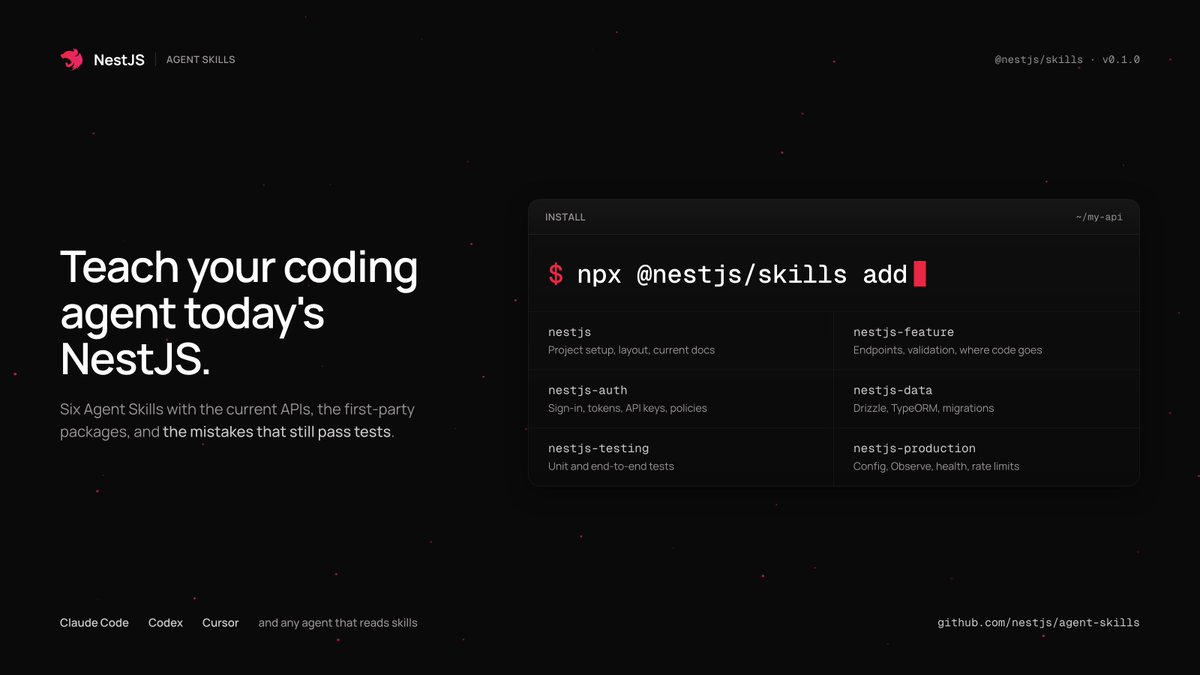
"the mistakes that still pass tests" is the part I like 💯
Yeah, green tests but not how the framework wants it. That's where most of my agent cleanup goes I think. https://t.co/YXE4IjAnUx
🚀 Introducing the official NestJS agent skills!
Today’s APIs, first-party packages and the mistakes that still pass tests, for your coding agent 🧠
⚡ npx @nestjs/skills add
✨ Built into nest new
🤖 Claude Code, Codex, Cursor & more
👉 https://t.co/wr9EugoZCO
Yeah, ours did. One row had a ~500 KB JSON snapshot, and when no index covers the ORDER BY, MySQL packs every selected column into the 256 KB sort buffer, not just the sort key. One row didn't fit, so error 1038 😅
The fix wasn't a bigger buffer. Nothing on that path read the JSON, so we load it later by primary key only when needed.