@musa_kiliya There is no organization that is comparable with the DSS, NIA and the Military.
To me it's not about salary, it's about the selfless service and sacrifice to the country.
@jacksonhinkle And the jackals like you will be all over us now, the common Nigerians are not benefiting from any of these except for the chaos the bring along.
35 MILLION HUNGRY IN NIGERIA’S FOOD BASKET
How Northern Nigeria Went from Feeding Africa to Depending on Aid Agencies
By Bello Saleh
I. A Number That Should Shame a Nation
Thirty-five million.
35,000,000 human beings.
Not a statistic. Not another Senate talking point forgotten before lawmakers finish lunch.
According to the United Nations, between June and August 2026, thirty-five million Nigerians will face acute hunger.
The kind of hunger that stunts children’s brains, drives desperate crime, destroys families, and tears apart the social fabric that holds civilisation together.
Among them are 6.4 million children suffering acute malnutrition.
The Global Report on Food Crises 2026 now places Nigeria alongside Afghanistan, Sudan, and South Sudan.
Nigeria.
Africa’s most populous country.
Africa’s largest economy.
A nation whose northern region once fed much of sub-Saharan Africa.
A region whose famous groundnut pyramids in Kano were so vast they could be photographed from aircraft. A region that exported cotton to Europe, livestock across West Africa, and agricultural produce as far as Central Africa.
That same land — the same rivers, the same soil, the same people — is now on a UN emergency hunger watchlist alongside war zones.
How did this happen?
The truth is brutal:
Northern Nigeria spent sixty years making catastrophic choices.
Oil over agriculture.
Politics over education.
Patronage over productivity.
Elite comfort over mass survival.
And now the bill has arrived.
II. The Pyramids We Destroyed Ourselves
In the 1990s, while working in Port-Gentil, Gabon, I saw something unforgettable.
Across the street from supermarkets well-stocked with imported European foodstuff that would not look out place on any Carrefour or Auchan supermarket on any Paris street, are local African markets for the local Gabonese citizens. These are beside open drainages and dusty roadside stalls, where traders sold onions, tomatoes, kuli-kuli, smoked fish, and grains transported all the way from northern Nigeria.
By the 90s, despite the decimation of our agricultural base due to the oil boom, Northern Nigeria was still feeding parts of Africa through the sheer labour of its farmers, herders, and traders.
This was not mythology.
The groundnut pyramids of Kano were real. Hundreds of thousands of tonnes stacked into giant pyramids and moved through a railway system that actually worked.
Farmers planned around predictable rail schedules. Markets functioned with certainty. And certainty creates investment.
Cotton from Sokoto, Katsina, and Zamfara fed textile mills in Kaduna — once among the largest industrial employers in sub-Saharan Africa.
Then came oil.
Oil did not destroy northern agriculture overnight. It destroyed it slowly.
Government abandoned productivity for rent-sharing. Agriculture became less profitable. Political connections became more valuable than enterprise.
By 1977, the groundnut pyramids were gone.
Not because the land failed.
Because the political economy changed.
By the 1980s, Nigeria had become an importer of groundnut oil.
That fact alone should haunt every government office in Abuja.
Within one generation, a country that once led global groundnut production became dependent on imports for the same product it once exported to the world.
III. The Education Debt: How We Compounded the Catastrophe
In 2002, responding to Alhaji Wada Nas's speech at the Zumunta Convention in Houston, USA, I wrote something that was uncomfortable then and remains brutally vindicated now: "The number one issue in the north today is education, or lack of it. Every shortcoming we have today can be traced to ignorance and illiteracy."
Twenty-four years later, 35 million people face hunger. The diagnosis was correct. The treatment was never administered.
The connection between education and hunger is not abstract. Education, in this case, goes beyond a farmer with basic scientific education understanding soil chemistry and, with it, farming not only by tradition and guesswork.
An educated farming community with literate members can draft and read contracts, understand market prices, form cooperatives, negotiate fair prices. A community without this capacity is prey for every manipulative middleman and every corrupt official who leeches off them. Such a community will not be empowered to make demands of their political leadership.
The north's historical resistance to Western education, rooted in distrust of colonial missionary schooling, legitimate Islamic scholarly tradition, and elite manipulation that found uneducated masses more manageable, created a structural deficit that has compounded across generations.
Federal programmes designed to close the gap, UPE, UBEC, etc, consistently underperformed in #Arewa, were underfunded, corrupted in implementation, or overtaken by population growth.
The result, by 2026: farmers using implement technologies that predate the industrial revolution. Post-harvest losses of 30 to 40 percent, because basic storage and processing knowledge is absent. And, most catastrophically, an entire generation of young men finding no productive vocation in a stagnant rural agricultural economy, available instead for recruitment into the bandit gangs and insurgent groups that have become the modern, lethal variable in the hunger equation.
IV. The Security Catastrophe: The Death Spiral
Hunger and violence in the north have ceased to be parallel problems. They are a self-reinforcing loop.
Between October and December 2025 alone, approximately 1,350 people were abducted during the harvest season — during harvest, the single most critical period in a farming community's economic calendar. In Borno, Yobe, and Adamawa, emergency food conditions persist. Across Zamfara, Katsina, Sokoto, and Kebbi, banditry has driven displacement at a scale that has fundamentally broken agricultural production.
Consider what abduction during harvest means in practice. A family that has planted, watered, tended, and waited through an entire growing season arrives at harvest to be attacked, abducted, taxed of their labour or driven from their fields. Their crops rot or are stolen. They arrive at a displacement camp with nothing. Their land, unplanted the following season, begins its slow return to bush. Multiply this by tens of thousands of families, across hundreds of local government areas, for over a decade.
But the relationship between insecurity and hunger runs deeper than direct disruption. Markets collapse. Traders stop travelling to conflict zones. Input prices spike. Extension workers stop going to communities that cannot be protected. Even communities not directly attacked suffer the agricultural consequences of nearby insecurity.
And here is what those who study only economics miss: food insecurity itself feeds insecurity. Young men with no food, no land, no education, and no visible future are the recruitment pool from which bandit gangs and insurgents draw their numbers.
Nigeria's northwest bandits are not primarily ideologically motivated. They are economically desperate young men from communities that the Nigerian state comprehensively failed for many generations. The nomadic fulani animal husbandry/livestock economy existed side by side with the agrarian economy of the rest of the #Arewa population for centuries. The bandits now terrorising north-western Nigeria find easy recruits in uneducated and economically disenfranchised members of their communities.
The death spiral: educational neglect produces agricultural stagnation, which produces rural poverty, which produces desperate young men, who join bandit gangs, who attack farming communities, which produces displacement and hunger, which produces more desperate young men. The snake eats its tail. And in the middle, 35 million people in northern Nigeria wait. Hungry.
VI. The Federal Allocation Trap: How Political Power Became Developmental Failure
This is what northern political elites prefer not to discuss.
Of Nigeria's 65 years of independence, northerners have held the presidency or head of state position for approximately 39 years. The north has controlled the military, shaped federal security policy, influenced the distribution of federal revenues.
And yet the north remains the poorest region by virtually every metric. Lowest school enrolment. Highest infant and maternal mortality. Greatest proportion of citizens below the poverty line. Worst infrastructure. And, as of 2026, the most severe food crisis in all our history.
How? How does a region that controlled federal power for nearly four decades end up in a humanitarian emergency?
The answer requires confronting a truth northern political rhetoric has consistently evaded: the northern political elite did not use political power to develop the north. They used it to enrich themselves, maintain patronage networks, and retain social control through keeping ordinary northerners poor, uneducated, and dependent on elite largesse. Federal allocations flowed to northern state governments and disappeared. Education budgets were allocated and diverted. The Almajiri reform programme was initiated by a southern president, funded, photographed, and quietly defunded - sadly by northern politicians.
The Katsina State government received billions of dollars in federal allocations between 2000 and 2020. Its out-of-school children numbers increased. Zamfara State deteriorated from a functioning, if poor society, into the epicentre of a banditry crisis that has displaced hundreds of thousands and made agricultural land inaccessible. Same story with Sokoto, Benue, Yobe - choose your pick.
Having a northerner at the top is not the same as having northerners develop. A kleptocratic northerner in Aso Rock does nothing for the farmer in Gusau or the schoolgirl in Daura. The rhetoric of northern solidarity — the insistence that the north's problems are caused by the south, that what the north needs is political power — has functioned as a magnificent distraction. It gives northern citizens someone to be angry at, something to celebrate, and a reason to ignore the actual culprits of their poverty: their own political class, feeding at a trough while their constituents starve.
Nigeria's structural inequalities are real. The systematic decimation of life and livelihood in the north by the current government is not imaginary. It exists and must be challenged. But at the arrowhead of this societal destruction is not only in the federal establishment in Abuja where every decision about the north is taken by those who are mostly not from the region and perceived not to care much about it, but also in the various government houses in the 19 northern state capitals.
Unequal federal treatment and self-inflicted localised elite failure are not mutually exclusive. Both are true.
Blame the president for choosing political expediency and looking the other way as the northern elites cannibalise their own - something he wouldn’t for a moment tolerate in his beloved Lagos State or the South West, but beyond that, blame the corruption, failures and lack of both vision and capacity on our own state chief executives. Some of whom still parrot the idea of federal neglect for ills they could remedy if only they recognise they exist and are ready to work to remedy them.
The danger of the elite narrative — emphasising federal neglect — is that it relieves the northern political class of all responsibility. It gives northern governors a permanent grievance to perform, and a permanent excuse to avoid accountability for schools that do not teach, hospitals that do not heal, and farms that do not produce.
The north needs federal justice. It also needs to hold its own leaders to account with the same ferocity it applies to Abuja. Both things, simultaneously.
VII. The Climate Crisis: The Injustice Nobody Talks About
The climate crises is another major reason why according to the UN thirty-five million of us will face starvation this year.
Lake Chad once covered 25,000 square kilometres and supported 30 million livelihoods across Nigeria, Cameroon, Chad, and Niger. It has shrunk by approximately 90 percent since the 1960s. The fisheries are gone. The Fadama systems that produced dry-season vegetables and cash crops are severely diminished. Communities that built their entire economic life around the lake are now environmental refugees.
In the northwest, changing rainfall patterns have compressed the farming calendar and increased the risk of total crop failure. The Sahel is advancing. Pastoralists whose grazing lands have shrunk are being pushed southward into agricultural communities, reigniting farmer-herder conflicts that kill thousands every year.
Nigeria contributes approximately 0.6 percent of global greenhouse gas emissions. The Sahelian region contributes a fraction of that. Yet Nigerian Sahel communities are experiencing climate impacts that rival those of the most vulnerable places on earth. They are the least responsible for the warming that is destroying their agricultural systems, and the least politically empowered to demand compensation or adaptation resources.
A farmer in Kebbi State or Yobe State in 2026 is being squeezed from three directions simultaneously: agricultural productivity declining because of climate, market access destroyed by insecurity, and government providing neither the education to allow adaptation nor the investment to compensate for what nature and violence have taken.
Add to that a government that has still not said a word about any measures to mitigate the coming hunger or plans for support and succour to its 35 million citizens vulnerable. The statement from the UN was nit a suggestion - it was a warning.
VIII. The Children Who Will Pay
Of the thirty-five million, six-point-four million children facing acute malnutrition. in 2026. Again, this from the UN.
Not hunger. Malnutrition, the kind that permanently affects a child's brain during the most critical developmental window of human life. The first 1,000 days, from conception to a child's second birthday, are when the human brain develops most rapidly and is most vulnerable to nutritional deficiency. A child who suffers acute malnutrition during this window will, statistically, have lower cognitive capacity, poorer educational outcomes, reduced adult productivity, and shorter life expectancy. Not from any failure of character or intelligence, but because the brain did not receive what it needed at the moment it needed it most.
These children, if they survive, will enter a school system already cognitively behind children who were adequately fed. They will be less able to learn, less able to compete, less able to take advantage of whatever opportunities the north manages to create in the years ahead.
Every bag of rice not delivered to a hungry child in Borno today is an educational failure, an agricultural failure, and an economic failure that will manifest in 2036, 2046, and 2056 — long after the UN emergency declarations have been forgotten.
Feeding the north's children is not charity. It is the most strategic developmental investment the region can make.
Ask yourself - how many northern governor is losing his sleep over this as agains how many losttheir sleep over the recent party primary elections, sorry, concessus affirmations.
IX. What National Unity Demands
This is not merely a northern problem. Framing it as one is itself part of the problem, it allows the federal government to treat northern hunger as a regional affair for regional leaders and international aid agencies, rather than a national emergency. Basically, treat it the same way it does the killings and kidnappings in the northwest.
Nigeria cannot be a functioning nation while 35 million of its citizens face hunger in a single season, concentrated in one region. A country where one half eats and one half starves is not a country. It is a time bomb.
Kidnapping gangs already operate in Abuja's satellite towns. Displaced northerners swell the informal settlements of Lagos and Port Harcourt. The security costs of northern instability are borne by the entire federal apparatus, funded by all Nigerians. The lost agricultural productivity of a region that should be feeding half the continent means higher food prices in Apapa and in Maiduguri alike.
Northern food security is Nigerian food security. This is not a plea for sympathy. It is a statement of structural fact.
X. What Must Change
The north is not monolithic. Kano is not Maiduguri. There are pockets of agricultural dynamism, educational innovation, and entrepreneurial energy that deserve recognition. But 35 million hungry people is not a problem to be solved by acknowledging bright spots.
Agricultural investment must become the north's genuine political priority — not as rhetoric, but as budgetary reality, measured in rural roads built, functional storage facilities commissioned, and trained extension workers deployed. Every northern state government that diverts its agriculture allocation to recurrent expenditure and political patronage deserves the accountability that northern civil society has historically been too co-opted to provide. In other words, #Arewa desperately needs an alternative model of bringing these politicians to account on their misapplication of priorities.
Rural security requires a development response, not just a military one. The bandits of Zamfara and the insurgents of Borno are developmental failures wearing military clothing. Suppression is necessary. It is not sufficient. The communities from which armed groups recruit must be given tangible, material, immediate reasons to choose peace: schools, clinics, roads, the means for a young man in Katsina to look at his options and find something better than joining a gang.
Girls' education must be treated as the emergency it is. Educating girls produces more economic return per dollar invested than almost any other development intervention. Educated women invest more in each child's health and education, maintains the family unit optimally, are better SME entrepreneurs and, in the field, produce more agricultural output per unit of land. A northern Nigeria in which girls consistently complete secondary school would look, within a single generation, fundamentally different from today.
This sad situation did not start with the UN telling us throty five million of us will face hunger in the next few months. The truth is that northern Nigeria is in an emergency that was not inevitable, that was built decision by bad decision over sixty years, and that can only be unmade by the same ingredient that built it: decision. Deliberate, courageous, honest decision-making by leaders who have finally understood that the north's children cannot eat political rhetoric, cannot be educated only by half-hearted efforts, and cannot be protected by speeches at knee-jerk #Arewa summits.
XI. Epilogue: The Pyramids Are Still Possible
There is a photograph that every northern Nigerian of a certain generation knows. Taken in the 1950s in Kano, it shows groundnut pyramids, vast conical mountains of sacked produce, stretching toward the horizon. In the foreground, small figures of workers give the pyramids their scale. Behind them, the sky is vast and blue and full of possibility.
That photograph is not fantasy. It is a record of what this land produced when its people were given half an opportunity.
The same land is still there. The rivers still flow. The rains still come, changed and diminished, but not gone. The people, more of them than ever, hungrier than they should be, more talented than they are given credit for, are still there.
The north does not need oil. Neither does does it need another presidency or political capture at centre. It needs the commitment to invest in its people: their education, their security, their agricultural productivity, their health, their capacity to imagine and build a future that does not depend on handouts from Abuja or food parcels from the World Food Programme.
The groundnut pyramids were dismantled in 1977 because Nigeria chose oil over agriculture. They were not destroyed by nature. They were dismantled by choice.
They can be rebuilt. By choice.
#Arewa na bukatar shugabanchi nagari.
#Arewa na bukatar shugabanni nagari.
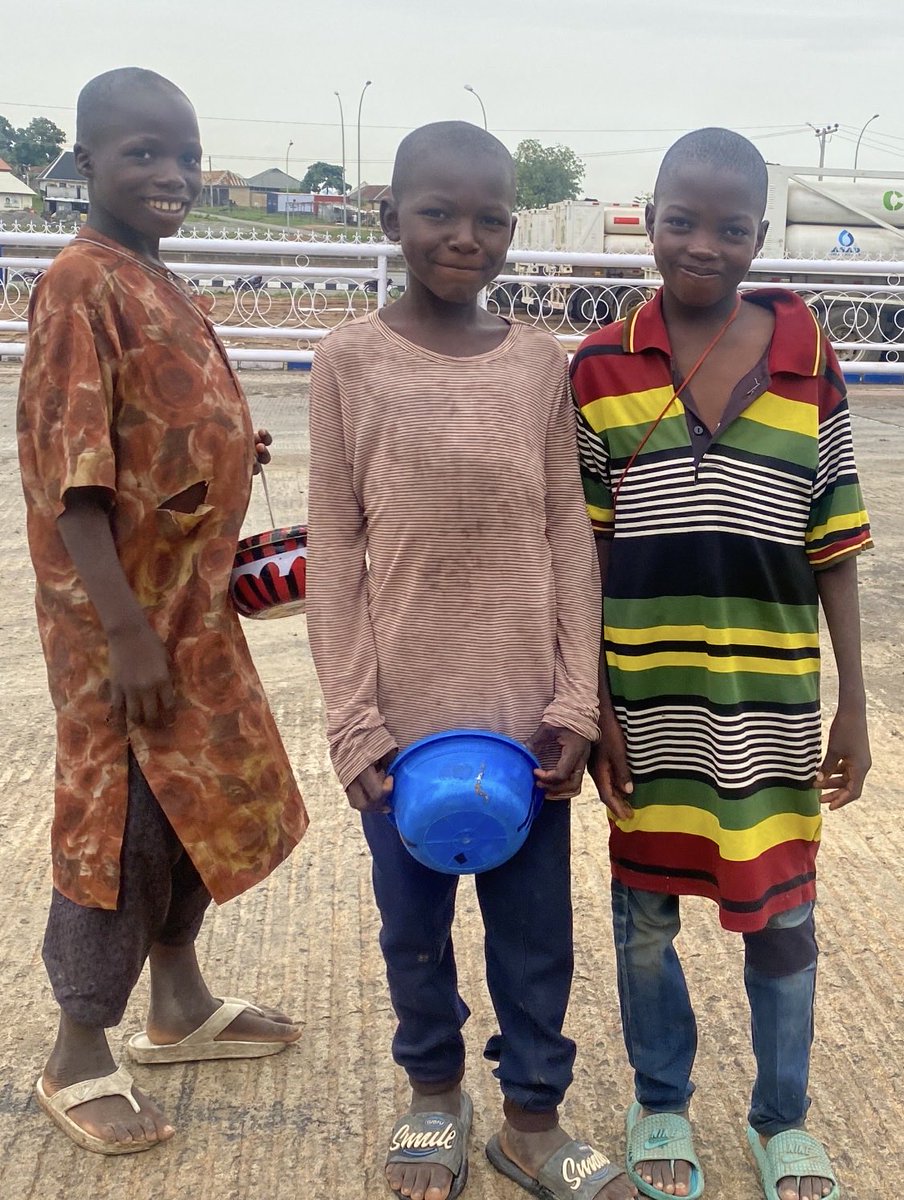
Meet Yusufa, Hafizu and Audu — and their innocent, cheeky smiles.
These pre-teen boys are street beggars I encountered a few days ago in Abuja.
Away from home.
Away from school.
Away from safety, dignity and childhood itself.
They are from Mashi, Katsina State.
Their Local Government Chairman is Salisu Kallah Mashi.
Their representative in the Katsina State House of Assembly is Hon. Sani Bello Mustapha.
Their representative in the House of Representatives is Hon. Majigiri Salisu Yusuf.
Their Senator is Distinguished Senator Nasiru Sani Zangon Daura.
Their Governor is His Excellency Dikko Umaru Radda.
The President of their country is His Excellency Bola Ahmed Tinubu.
Every one of these elected officials swore an oath to protect children like Yusufa, Hafizu and Audu.
To protect their dignity.
To secure their future.
To ensure they have access to education, safety and opportunity.
But because #AlmajiranchiIsChildAbuse, these children have been failed.
Failed by leaders who refuse to enforce Nigeria’s Child Rights Act (2003), which clearly states:
“No child shall be used for the purpose of begging for alms…”
And we, as a society, have also failed them — by normalising this exploitation, looking away, and refusing to hold our leaders accountable.
Child begging is not culture.
It is not tradition.
IT IS CHILD ABUSE.
We must advocate to #BanAlmajiranchiNow.
@officialABAT@dikko_radda@UNICEFNigeria@UNICEFAfrica@UNICEF@NigeriaGov @MinOfInfoNG @FMYDNG @FedMinOfJustice @nassnigeria@PoliceNG @ICPC_PE @officialEFCC
10 Muslims were killed yesterday by terrorists in the village of Damri, located in the Bakura Local Government Area of Zamfara State.
May Allah grant their family the fortitude to bear this loss and grant the deceased Al-Jannat ul-Firdaus. May the perpetrators and their sponsors never know peace for the rest of their days😭🤲
Alex Barbir, despite being expelled from Nigeria for allegedly making inciting comments that fueled division among the Christian and Muslim communities in Nigeria, especially in Benue and Plateau States, has not relented in his propaganda against Nigeria. In a video he posted on his social media handle, the American self-acclaimed missionary and humanitarian is clearly weaponizing the insecurity ravaging Nigeria and the weak state response to amplify his sinister motive.
He showed some Nigerian Christians, whom he described as ordinary citizens and not paid actors or CIA agents, who are tired of the failure of the Nigerian government to protect them and are thereby calling on President Trump to intervene. This is not an unfamiliar pattern; we saw a similar propaganda played out in Iran before the war, where the economic situation of the country, caused by the imposition of sanctions on the country by Western powers, was weaponized by foreign agents who infiltrated protests in the country, which led to unrest with thousands of lives lost.
For us in Nigeria, our insecurity and religious divide are the biggest weapons being used as a destabilization tool. We must resist any attempt that will plunge us into a religious crisis that could engulf our country. They promised Iranian women liberation from their oppressed government and ended up striking a girls' school, killing over 160 school girls on the first day of their intervention. This should serve as an eye-opener for us all.
The same country that once deprived our country of sales of ammunition to confront Boko Haram over human rights concerns, without considering the damage the terrorists are inflicting on helpless citizens, suddenly cares about our citizens and, even more worrisome, made their concern solely about Christians without talking about the sufferings of Muslims, make everything questionable. I hope we, as a people, realize that America or any other foreign country promising our people liberation are only after their interest. We have seen their interventions elsewhere and how countries were destroyed after their interventions. Nigerians, for the sake of our own peace, we must rally round our government and armed forces to defeat the monsters threatening our collective existence. We must not allow our country to be used as a battleground by foreign interests.
THE CAPTURE OF YORUBA KIDNAPPERS IN ONDO
By: MM Gembu
For a long time, the dominant narrative has been that Fulani people are responsible for kidnappings in Ondo State. This narrative has fueled unnecessary harassment, profiling, and exploitation of Fulani pastoralists moving with their cattle across the region, often at the hands of local security outfits like Amotekun.
However, recent developments continue to show a more complex reality.
What Led to the Arrest:
A farmer, while returning home from his farm, was kidnapped by a group of criminals. Fortunately, he managed to escape from captivity the same night.
The following day, upon stepping out again, he recognized some of his abductors moving freely within his community. He quickly raised an alarm and alerted security operatives, which led to their capture.
The Reality:
The suspects apprehended were not Fulani, as is often assumed in similar cases. This incident reportedly occurred in Ifira Akoko, Ondo State.
If these individuals had not been identified and apprehended, the blame would likely have been placed—once again—on the Fulani community.
This raises an important question about the dangers of generalization and the need for fairness, accuracy, and responsibility in both public discourse and media reporting.
Criminality should be treated as criminality, not as a tool for ethnic or religious profiling.
Even international news organizations are now exposing Alex Barbir as a fake peacekeeper. It is clear he was only hiding behind humanitarian work while actually fueling the fire between Muslims and Christians in Nigeria.
This fraud has been exposed