2026 is the year AI realizes it needs a new layer in the infrastructure stack.
To prove it, we're posting one story per day for the next 10 days.
Follow @MainLabs_AI to see why every AI company will need what we're building.
We trained AI on what humans wrote years ago. The next step is learning from what humans do right now.
Training data captures text. Intent data captures behavior. But human behavior is dynamic, evolving, never static.
If AI is ever going to be aligned with humans, it needs to actually understand us. Text alone simply cannot provide that.
2026 prediction:
The winners in AI won't be who has the biggest model. They'll be who captures the best human signals.
Models are commoditizing. Data is not.
Intent is the moat. That's the Human Intent Network thesis.
You're building an AI agent platform.
Users expect continuity. But persistence is expensive.
The tradeoff is UX vs unit economics.
How are you solving AI memory/persistence?
We're building for agents that actually know and understand you and save you money.
Nice one @joshclemm. We enjoyed reading this. The bundle approach, super tools, sub-agents with narrow tool sets. All the right instincts.
We're building in an adjacent space: human intent infrastructure that captures why users need context, not just what context exists.
Think of it as the understanding layer on top of memory and retrieval. Would love to chat if you're open to it.
Curious how you think about the intent layer on top of this.
Memory architecture solves "what does the agent know?" But understanding requires "what does the user actually want?" There seems to be a disconnect here.
Feels like combining persistent memory with real-time human intent signals is where agents go from useful to genuinely intelligent.
Memory architecture matters, but it's worth noting: all four types still answer "what does the agent know?"
The harder question is "what does the user actually want?"
Memory is the storage layer. Intent is the understanding layer. One retrieves context, the other knows what to do with it.
Until we solve both, we're working with an incomplete picture. We are drawing that picture. MVP soon.
𝗔𝗜 𝗔𝗴𝗲𝗻𝘁’𝘀 𝗠𝗲𝗺𝗼𝗿𝘆 is the most important piece of 𝗖𝗼𝗻𝘁𝗲𝘅𝘁 𝗘𝗻𝗴𝗶𝗻𝗲𝗲𝗿𝗶𝗻𝗴, this is how we define it 👇
In general, the memory for an agent is something that we provide via context in the prompt passed to LLM that helps the agent to better plan and react given past interactions or data not immediately available.
It is useful to group the memory into four types:
𝟭. 𝗘𝗽𝗶𝘀𝗼𝗱𝗶𝗰 - This type of memory contains past interactions and actions performed by the agent. After an action is taken, the application controlling the agent would store the action in some kind of persistent storage so that it can be retrieved later if needed. A good example would be using a vector Database to store semantic meaning of the interactions.
𝟮. 𝗦𝗲𝗺𝗮𝗻𝘁𝗶𝗰 - Any external information that is available to the agent and any knowledge the agent should have about itself. You can think of this as a context similar to one used in RAG applications. It can be internal knowledge only available to the agent or a grounding context to isolate part of the internet scale data for more accurate answers.
𝟯. 𝗣𝗿𝗼𝗰𝗲𝗱𝘂𝗿𝗮𝗹 - This is systemic information like the structure of the System Prompt, available tools, guardrails etc. It will usually be stored in Git, Prompt and Tool Registries.
𝟰. Occasionally, the agent application would pull information from long-term memory and store it locally if it is needed for the task at hand.
𝟱. All of the information pulled together from the long-term or stored in local memory is called short-term or working memory. Compiling all of it into a prompt will produce the prompt to be passed to the LLM and it will provide further actions to be taken by the system.
We usually label 1. - 3. as Long-Term memory and 5. as Short-Term memory.
And that is it! The rest is all about how you architect the topology of your Agentic Systems.
Learn how to deal with memory hands-on in my End-to-end AI Engineering Bootcamp: https://t.co/gWBu8OLTzn
Any war stories you have while managing Agent’s memory? Let me know in the comments 👇
Alignment at the prompt level is security theater. A mirage.
A well-crafted jailbreak bypasses any system prompt.
Post-hoc filtering catches problems after they occur. Real alignment requires infrastructure.
Continuous human signals, not one-time constraints.
Andrew's right. AGI became a marketing term more than a technical benchmark.
So many labs are missing the point here. You can't replicate human intelligence without first understanding human intent.
Current models are trained on what humans wrote, not how humans think, decide, or feel. That's a fundamental gap. It's the gap we're closing.
Before we debate timelines to AGI, we need infrastructure that captures real human signals continuously. Intent, emotion, behavioral patterns. The biological data that actually defines intelligence.
This is exactly why we need to evolve past RAG entirely and focus on true human intent.
We're still treating memory as retrieval when it should be understanding.
Agent memory shouldn't just organize what was said. It should capture why humans said it, what they meant, and how their intent evolves over time.
Structured hierarchies help. But the ceiling is still "better search over past conversations." The breakthrough comes when memory becomes a living semantic profile that anticipates needs before the next query even happens.
Aside from that, this type of structure often leads to completely irrelevant memories being injected into context, confusing the model and utterly ignoring what the person *actually* desired in the first place.
Human intent data is fundamentally different from dialogue logs. It's biological, continuous, and contains information no retrieval system can surface because it was never explicitly stated.
The next evolution isn't smarter RAG. It's new infrastructure that captures intent at the source. Infra that we are building.
Context graphs capture 'the why.' Physical observability captures 'the what.'
But we can take it further: capturing 'the who' through continuous behavioral signals.
The semantic graph of human intent that explains why the "why" even matters to this specific user in this specific moment.
That's where personalization becomes real understanding. We're building that layer.
Context graphs capture why. Physical observability captures what actually happened. Agents need both to work in the real world.
Happy to see @perceptroninc included in @FoundationCap latest ecosystem map for Context Graphs.
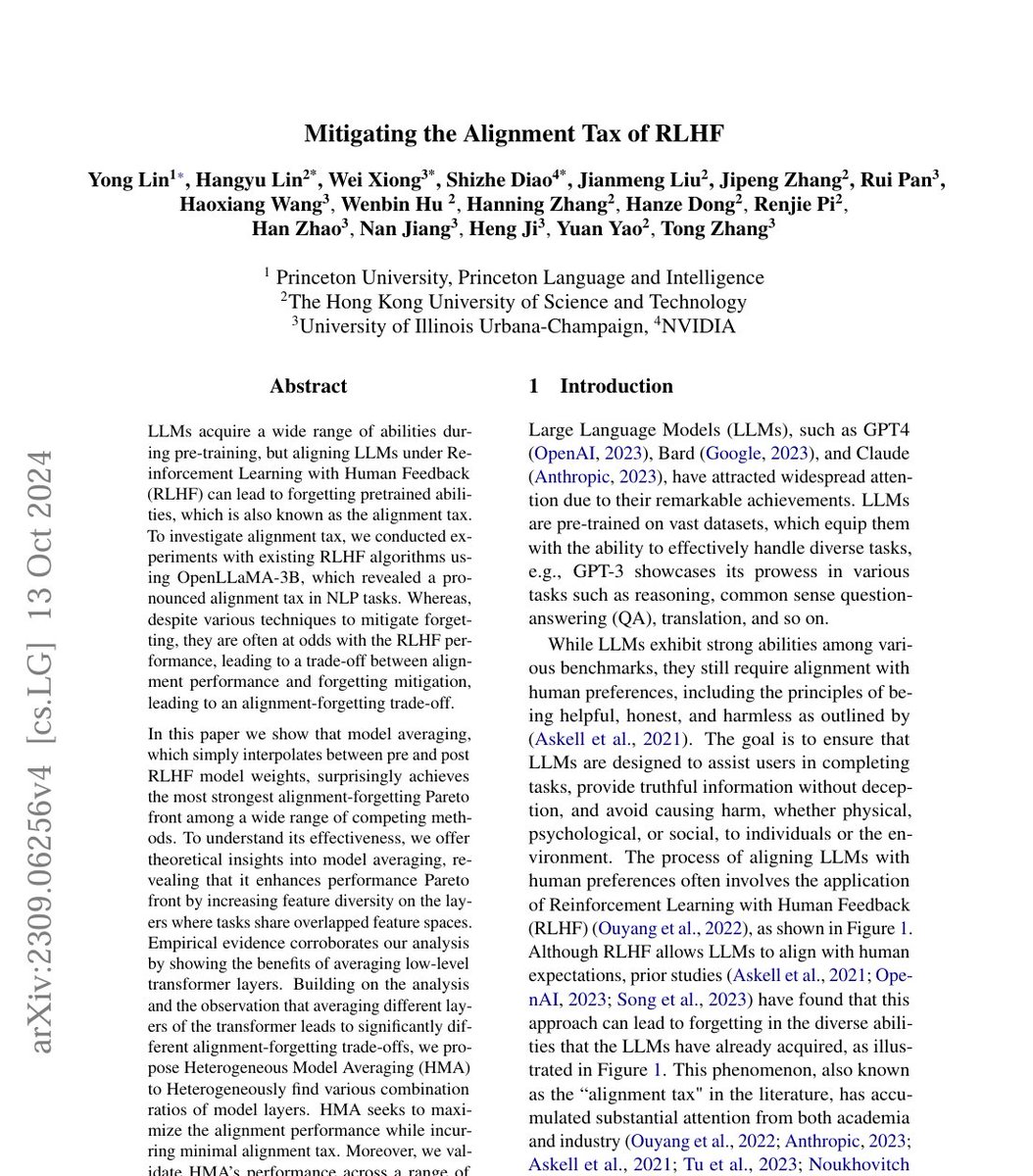
RLHF is incredibly powerful, but costly, and static.
Research shows alignment degrades as models scale.
The key issue is that training-time alignment can't adapt to evolving human values.
To solve this, it requires continuous intent signals at the infrastructure level.
Retrieval without relevance modeling.
These systems know what you said but not why it matters or when to use it.
Truly personalized AI should understand your decision patterns, context and intent well enough to know that your Toyota Corolla is irrelevant to 99% of your convos.
Memory is a feature. Understanding is infrastructure.
If you're calling your AI product "memory-enabled," you've already lost.
Memory is table stakes, not differentiation. The question isn't "does your AI remember?"
The real question you should be asking is, "does your AI understand?"
@AlexFinn Just wait until you see what true personalization does to your agents.
We're unlocking a new layer in the infrastructure stack that makes your AI agents understand you on a level that just reading your prompts could never replicate.
Demo coming soon.
Amazing video by the way.
Agree that creating the conditions for breakthroughs is the hard part.
One underexplored angle: most research focuses on what happens inside the model. But what about the connective layer between models and real human behavior?
It seems to use that not enough focus is being put in this area of research. It's something we're focused on near exclusively. Would love to hear your thoughts.
What's the hardest part of building AI products right now?
• Context management across sessions
• Personalization that actually works
• GPU costs crushing margins
• Getting agents to coordinate
Drop your answer.
We'll share what we're seeing across 50+ AI companies.
Introducing MAIN: The Human Intent Network for AI.
The missing data exchange layer in the AI infrastructure stack.
Enabling collective learning, cross-domain intelligence, and alignment with human intent.
Read our https://t.co/fx95GyurZi.
2026 is the year AI realizes it needs a new layer in the infrastructure stack.
To prove it, we're posting one story per day for the next 10 days.
Follow @MainLabs_AI to see why every AI company will need what we're building.
10/ We're building the Human Intent Network.
The first behavioral data exchange designed for the AI era.
This isn't an app feature. It's not a memory wrapper. It's the missing layer between isolated AI systems.
The infrastructure that makes personalization actually work. That lets AI agents understand what you want before you say it.
Not to replace foundation models. To make them exponentially more useful.
Not to compete with AI companies. To give them the behavioral intelligence layer they need to build what's next.
2026 is the year AI agents go mainstream. They'll need this layer to maximize their capabilities.
If you're building AI agents, shopping tools, or consumer AI: DM us. Let us build together.
Everyone's building multi-agent agentic AI systems.
Most of them will fall short or fail.
Not because the agents aren't capable. Because they have no shared ground truth.
The problem with isolated agents:
Each agent has its own context. Its own memory. Its own understanding of the user.
When Agent A learns something, Agent B doesn't benefit. When Agent C makes a decision, it can't reference what Agent D already knows.
They're not collaborating. They're competing.
What shared intelligence looks like:
Imagine agents operating on a common semantic graph. A unified understanding of:
- User preferences (across all interactions)
- Decision patterns (why users choose what they choose)
- Behavioral context (what the user is trying to accomplish)
Now agents can actually coordinate. Now learning compounds. Now multi-agent becomes multiplier, not just multiple.
We built agent frameworks without building agent infrastructure.
That's like building web applications before TCP/IP.
Main Labs is building that infrastructure layer. The shared intelligence that makes multi-agent systems actually work.